Written by: Rita
Trends Guide Introduction
Goldman Sachs released the management meeting minutes of Circle Internet Group (CRCL.US) on July 5. Circle is the issuer of USDC, and the key message from the meeting is that stablecoins are transitioning from a peripheral tool in the crypto world to the infrastructure of traditional finance and the AI economy. The use cases for USDC are rapidly expanding, extending from crypto trading to cross-border payments, consumer e-commerce, capital market settlement, and even AI agent payments. Goldman Sachs rates Circle as neutral, with a target price of $96, while the current stock price is $64.62, representing an upside potential of approximately 48.6%.
The growth of stablecoins has detached from the crypto market cycle
Circle’s management repeatedly emphasized a judgment during the meeting: the growth of stablecoins is now decoupled from the ups and downs of the crypto market. Over the past few quarters, trading volume and prices in the crypto market have been on the decline, but the market capitalization and trading volume of stablecoins continue to rise.
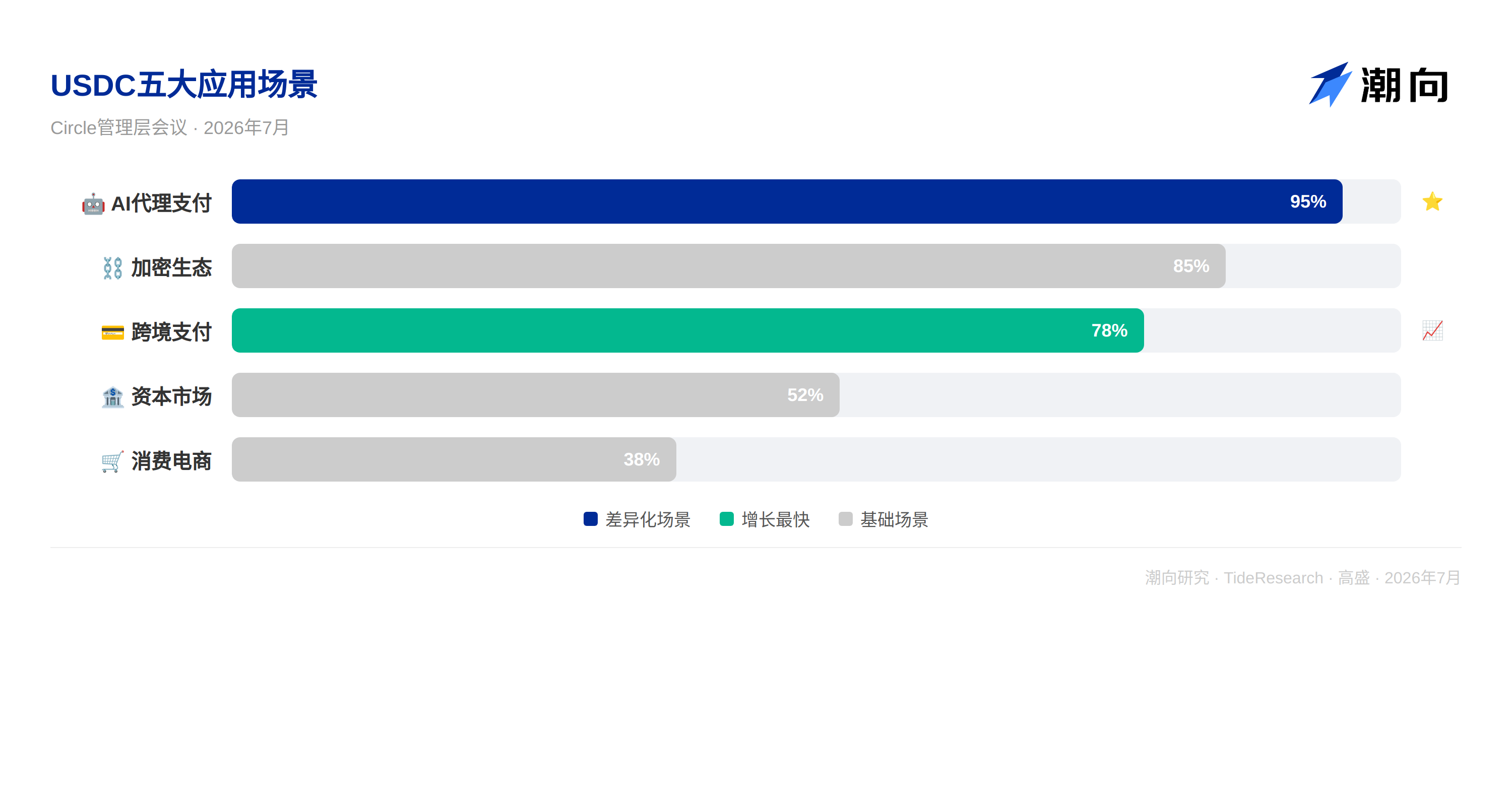
The reason lies in the diversification of use cases. Circle categorizes the applications of USDC into five levels, covering the entire spectrum from the crypto ecosystem to AI agent payments.
The crypto ecosystem is the foundation of USDC, collaborating with rapidly growing platforms like Hyperliquid to continually expand liquidity.
Cross-border payments and treasury management are currently the fastest-growing sectors. USDC’s instant settlement and extremely low transaction costs are changing the traditional bilateral cross-border payment process. Circle noted that there is particularly strong demand for USD stablecoins in emerging markets, which reflects a trend of "digital dollarization," with people using USDC as a substitute for local currencies or unreliable banking systems.
Use cases in consumer e-commerce are also starting to take shape. Mainstream e-commerce platforms like Stripe and Shopify have begun accepting USDC payments, allowing users to select USDC at checkout. Credit cards associated with stablecoins are also on the rise, enabling users to hold and spend stablecoins.
Breakthroughs in capital markets are even more critical. Circle sees the potential of USDC as collateral for derivatives and as a settlement currency. Recently, the CFTC approved futures commission merchants to consider certain stablecoins as collateral that can be liquidated at any time, which is an important institutional catalyst. The tokenization of real-world assets is also expanding the application scenarios for USDC, with stablecoins serving as a natural cash settlement tool for on-chain transactions.
Circle emphasizes the differentiated scenario of AI agent payments. AI agents are autonomously performing economic activities, and x402 is currently the leading agent payment protocol, with USDC accounting for approximately 99% of all transactions on the protocol. AI agents require atomic settlement and extremely low transaction costs, making stablecoins the most suitable payment tool.
The competitive barrier of USDC is the network effect
Management believes that stablecoins are a typical network effect business. The USDC network is a public internet financial infrastructure that anyone can access, usable by individuals, enterprises, and developers.
Circle lists three major competitive advantages of USDC.
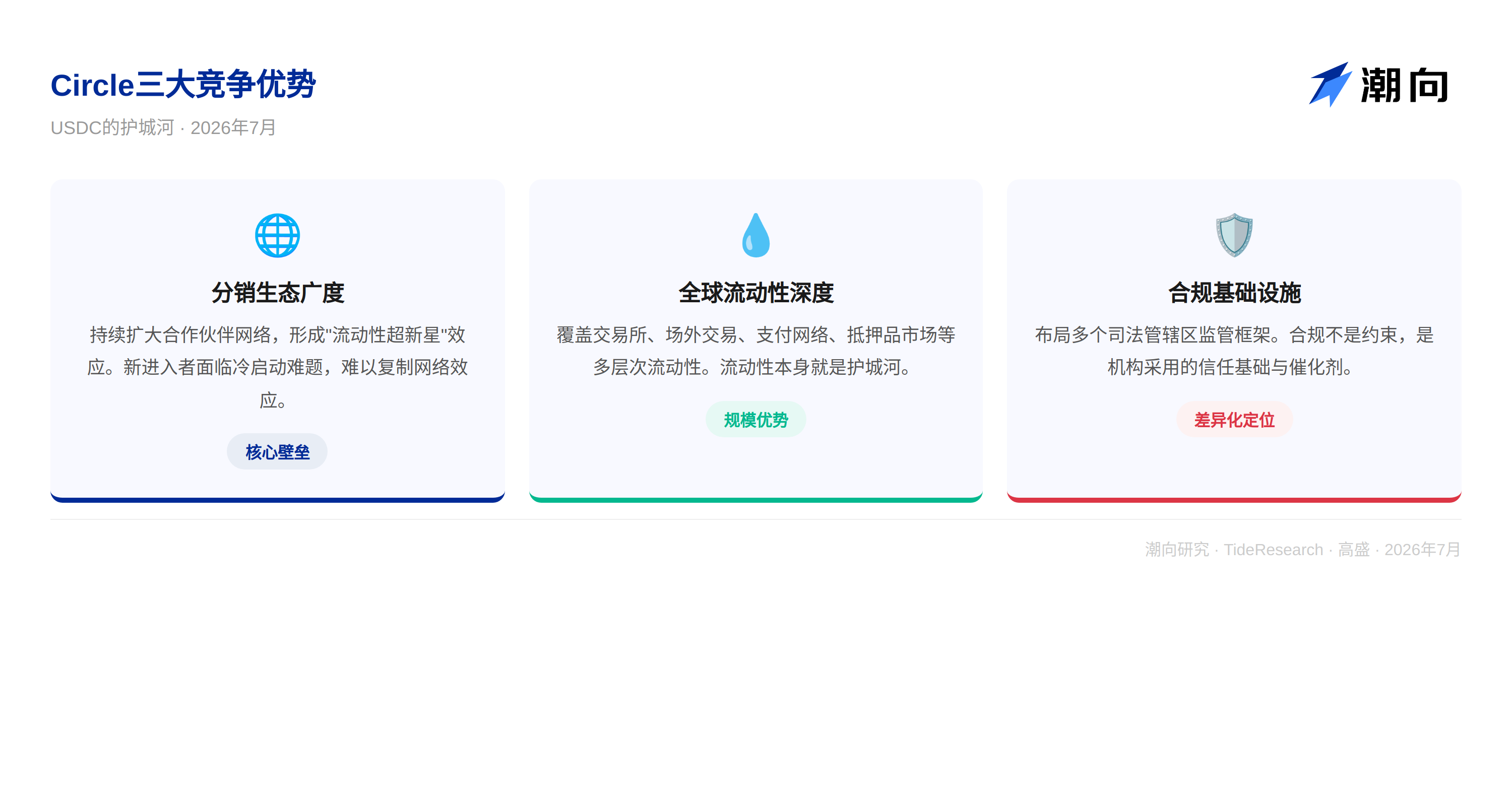
The first is the breadth of distribution and platform ecosystem. USDC strengthens liquidity by continuously increasing partners, creating a "liquidity supernova" effect. New entrants in stablecoins find it difficult to replicate this network effect due to the cold start problem; without liquidity, there are no users, and without users, there is no liquidity.
The second is the depth of global liquidity. USDC has deep liquidity across exchanges, over-the-counter markets, payment networks, and collateral markets, and this depth itself is a moat.
The third is the compliance infrastructure. USDC has regulatory layouts in multiple jurisdictions, and management believes this is a key driver for institutional adoption, rather than a constraint.
Regarding competition, Circle distinguishes between two types of rivals. One is tokenized deposits, digital deposit certificates issued by banks. Circle believes that stablecoins have an advantage over tokenized deposits because stablecoins are open, interoperable, have no bank credit risk, and are fully reserved. The other is new stablecoin competitors; Circle expects more new stablecoins to emerge, but they lack the network effect accumulated by Circle over more than a decade.
The difference between tokenized deposits and stablecoins is structural
Circle believes the difference between stablecoins and tokenized deposits is structural, not merely a question of who came first.
Stablecoins are a public, open internet financial system that anyone can access, allowing liquidity to flow freely across platforms. In contrast, tokenized deposits are more like an extension of the banking system, still trapped within a single bank or alliance ecosystem. This represents two completely different architectures: stablecoins are internet-native, while tokenized deposits are a digital upgrade of the banking system.
Another key difference is credit risk. Stablecoins are fully reserved, risk-free digital cash. Tokenized deposits are essentially liabilities of banks, carrying bank credit risk. In Circle's view, this difference is fundamental.
Circle's three strategic products aim to turn stablecoins into an operating system
Circle is not just a stablecoin issuer; they are working to position themselves as an internet financial platform. Management emphasized three strategic products during the meeting.
Arc is Circle's self-developed Layer 1 public blockchain, positioned as a comprehensive financial operating system, aiming to enhance liquidity and interoperability, particularly attracting traditional financial institutions.
Circle Payments Network (CPN) is a cross-border payment product that enables faster, more efficient cross-border payments through blockchain settlement, and institutional adoption rates are increasing.
Agentic Stack is a product line aimed at AI agents, designed to maintain USDC's dominant share in AI-related economic activities. Considering that USDC already accounts for about 99% of transaction volume on the x402 protocol, the first-mover advantage in this field is evident.
Regulation is a catalyst, not a constraint
The market has long been concerned that stablecoin regulation would limit Circle's business model, but Circle's management provided a completely opposite interpretation. If the CLARITY Act market structure bill is passed, Circle believes it will be a catalyst for the growth of USDC, rather than becoming a business constraint. There are three reasons: the bill allows issuers to continue incentivizing distribution through revenue sharing, enabling Circle to keep expanding partnerships; the bill could unlock institutional-level crypto adoption, leading to greater stablecoin usage; the bill encourages usage-based reward mechanisms rather than passive holding, which will promote the active use of USDC and reduce idle accumulation.
Trends Perspective
Goldman Sachs rates Circle as neutral, but this meeting minutes have already clarified many issues. Circle is transitioning USDC from a crypto trading tool to the infrastructure of internet finance, and this direction is correct.
It is worth questioning how deep Circle's moat really is. The network effect does exist, but USDC's biggest competitor, USDT, still leads in stablecoin market capitalization. The compliance advantage that Circle relies on is seen as a weakness by crypto purists; transparency means it can be regulated, and being regulated means it can be frozen. The institutional positioning of USDC is a double-edged sword.
Another point worth noting is Goldman Sachs' valuation framework. The target price of $96 corresponds to a 35x price-to-earnings ratio, but Circle's current profitability highly depends on interest income from reserve assets. If interest rates decline, Circle's profits will be directly pressured; this risk is lightly touched upon in the minutes, but its actual impact on valuation is greater than that of regulation.
Disclaimer
This article is a整理 and interpretation of third-party brokerage research reports by Trends Research. The ratings, target prices, earnings forecasts and related judgments quoted in the text reflect the views of the analysts of that brokerage and represent the position of their institution, not the views of Trends Research, and do not constitute any investment advice.
The market has risks; decisions should be made independently. This article should not be used as the basis for buying or selling any securities.
免责声明:本文章仅代表作者个人观点,不代表本平台的立场和观点。本文章仅供信息分享,不构成对任何人的任何投资建议。用户与作者之间的任何争议,与本平台无关。如网页中刊载的文章或图片涉及侵权,请提供相关的权利证明和身份证明发送邮件到support@aicoin.com,本平台相关工作人员将会进行核查。


