Organized & Compiled: Deep Tide TechFlow
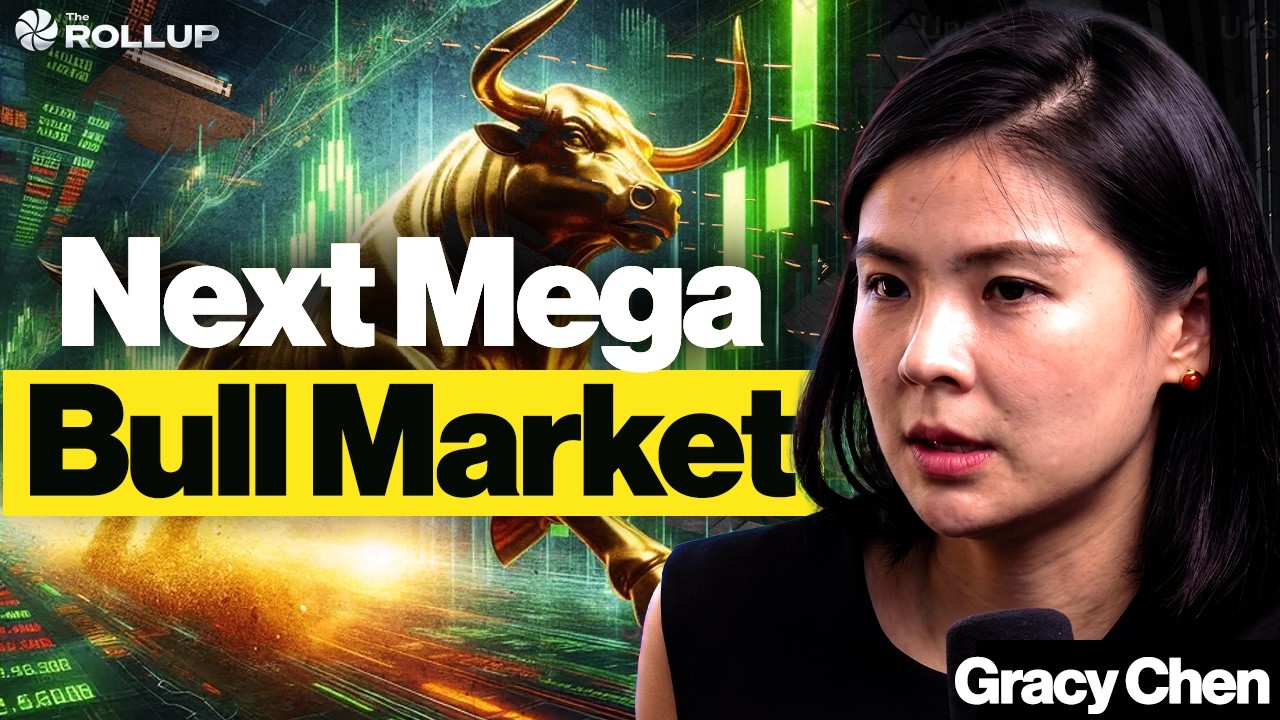
Guest: Gracy Chen, Bitget CEO
Host: The Rollup
Podcast Source: The Rollup
Original Title: Bitget CEO: Tokenization Is The Most Important Mega Trend in Finance (Full Thesis)
Broadcast Date: July 1, 2026
Key Takeaways
Bitget CEO Gracy Chen shared her core judgments on industry transformation at the Tokenization Tower in New York: cryptocurrency is no longer an alternative asset, but rather a penetration of underlying technology into traditional finance. She proposed a "10% blueprint" — in a private discussion with BlackRock COO Rob Goldstein, she predicted that by 2030, the penetration rate of tokenized assets among various traditional financial assets will rise from the current 0.01%-0.5% to 10%. This session revolved around three core conflicts: clarifying the relationship between tokens and equity, the divergence of DEX and CEX paths, and whether perpetual contracts and spot tokenization are complementary rather than substitutive. Chen explicitly stated that Bitget is shifting from a cryptocurrency exchange to a "Universal Exchange" (UEX), considering an IPO route instead of continuing to rely on platform token narratives.
Highlights of Opinions
10% Blueprint for Tokenization
- "When I was having coffee in his Manhattan office with BlackRock COO Rob Goldstein, he asked me what I think RWA will look like in 2030. I said I have a 10% blueprint — the current penetration rate of tokenized assets in traditional finance is extremely low, with tokenized stocks at only 0.01% and private credit at about 0.5%, but by 2030, these should reach 10%."
- "Cryptocurrency is finally no longer just a small group of people who listen to your podcast and follow your Twitter — now we need to include Wall Street, traditional finance, big banks, lawyers, regulators, and even politicians."
Token ≠ Altcoin
- "Token is not just altcoins like meme coins; it also includes tokenized assets. RWA has been a very important topic since 2025."
- "I don't want every project to resemble a meme coin. Meme coins are inherently speculative assets — not to say they are worthless, but they are essentially speculative."
- "If more bad players only tell stories and narratives, this industry will die very quickly."
Divergence of Exchange Paths
- "Among the top ten exchanges, at least four or five are seriously pursuing compliance routes, obtaining licenses, and conducting Big Four audits. At the same time, some exchanges have chosen a different path — a completely DeFi, purely on-chain, no KYC altcoin market."
- "I don't want to fight big lawsuits with the SEC and CFTC. I want to do compliant things."
Collision of Tokens and Equity
- "Many projects, especially those that can generate good revenue and profits, may not want to issue tokens at all, but rather pursue a formal IPO path to be listed in a larger market, gaining better liquidity and investor exposure."
- "We used to have the platform token BGB, but it has been transferred to Morph for management as a Layer 2 public chain. Bitget itself is considering the IPO path."
Who Wins the Tokenization Wave
- "Exchanges definitely have a voice, but not every exchange — only those who truly see this vision and invest resources and manpower to build."
- "Stablecoin issuers will be the second group to benefit — whether it is USDT, USDC, or USD Gold, stablecoins are becoming an important means of payment and trading for all asset classes in exchanges."
- "I am more optimistic about Solana's development in RWA — it has closer collaborations with regulators and big banks; Ethereum is also involved."
Opening: The Dilemma of Tokens and Industry Transformation
Host: Welcome back to the Tokenization Tower. Today we are discussing the debate between tokens and equity, with guest Gracy Chen, CEO of Bitget. Gracy, welcome.
Gracy Chen:
I am glad to be here.
Host: Bitget is one of the longest-serving exchanges for global clients, covering cryptocurrency assets, commodities, stocks, etc., and is expanding towards a "Universal Exchange". Today, I want to focus on the current state of digital assets — we have probably been in a bear market for eight or nine months now, and every bear market has seen tokens being considered bad, with no one wanting to hold tokens. But this time is a bit different; we have experienced various types of tokens and seen a large number of retail investors suffer losses due to unreasonable token structures, insiders, market makers, etc. Now token holders are beginning to demand investor rights like equity holders. From your perspective, how is the token market reconstructing itself compared to previous bear markets?
Gracy Chen:
From 2025 to now, I believe the biggest transformation is — when you talk about cryptocurrency, it is no longer just an alternative asset class. It is about blockchain, about underlying technology that has the potential to disrupt a trillion-dollar traditional finance market.
Similarly, when you talk about tokens, as you mentioned, many altcoins are indeed losing momentum, with prices either plummeting or behaving like a roller coaster — which is likely due to market manipulation. But tokens are not just altcoins; they also include tokenized assets. RWA has been a very important topic since 2025, and Bitget is very forward-looking in this area — we launched tokenized stocks and commodities last year.
Now we offer not only cryptocurrency, but also forex, stocks, ETFs, and even bonds and money market funds, as well as pre-IPO stocks. We partnered with Republic Crypto to launch pre-IPO stocks of SpaceX — that was in April, allowing retail users to capture returns before the stocks go public.
This is the real revolution I see in this industry — cryptocurrency is finally no longer just a small group of people who listen to your podcast and follow your Twitter, but we need to involve Wall Street, traditional finance, big banks, lawyers, regulators, and even politicians. They are all very important stakeholders in this industry.
What Token Investors Are Demanding
Host: I think this transformation is fundamental — we have shifted from thinking about the existing two or three trillion-dollar cryptocurrency market and $150 billion TVL in DeFi, to facing the major transition of hundreds of trillions of assets getting on-chain. This transformation also changes the type of investors. New investors have completely different demands for tokens — in the past, I might buy a token because of a narrative that a certain bank might put it on its balance sheet. But now token investors are demanding income, requiring value to flow back to tokens, and demanding a clear and transparent framework between tokens and equity. They are examining assets from the perspective of "what exactly do I hold" — as a token holder, am I a first-class citizen? What do you think about this shift in token economic structure and how the new institutional RWA investors, along with a friendlier regulatory environment, will prompt investors to reevaluate tokens?
Gracy Chen:
You asked a lot; I'll try to cover it.
When you talk about tokenized assets, it is not just the token in the sense of altcoins — it also includes tokenized stocks. We do see many projects, especially those that can generate good revenue and profits, they may not want to issue tokens at all, but pursue a formal IPO path to be listed in a larger market, gaining better liquidity and investor exposure. Or like us — we used to have the platform token BGB, but it has been transferred to Morph for management as a Layer 2 public chain. Bitget itself is considering the IPO path. This shift is crucial in the current industry.
Even for token launches at the altcoin level, we as an exchange are also very cautious. In the past week or so, the only token we launched was an RWA token. A shift is happening among exchanges, retail buyers, and project founders — we need to focus more on high-quality projects.
I began actively promoting this about two years ago. People weren't very attentive back then; I publicly warned on Twitter to be cautious of many altcoins that could just be market manipulation. Meme coins are inherently speculative assets — not to say they are worthless, but they are essentially speculative. I don't want every project to be like a meme coin. It shouldn't be that way. Now is a very interesting time for investor protection and token economics — indeed, some projects are striving to be transparent, sharing a lot of on-chain and off-chain data with the community, building something truly meaningful. But there are also more bad players who only tell stories and narratives without truly creating value — if such players increase, this industry will die very quickly.
Two Paths of Exchanges
Host: You mentioned the collision of tokens and equity — many projects with equity structures and token structures are thinking about how to merge the two. You mentioned that Bitget has BGB and is also considering an IPO. I have a prediction: some tokens may ultimately be gradually phased out and replaced with tokenized equity; or find a way to merge company/foundation equity with existing tokens. As a company that has both tokens and is considering an IPO, how do you see the fusion of these two worlds?
Gracy Chen:
This is indeed a dilemma. All exchanges that issued platform tokens four or five years ago are facing the same issue.
The current market approach is — to hand over tokens to a Layer 2 public chain or public chain for management, just like OKX's platform token is handed over to X Layer, our BGB is handed over to the Morph Foundation. Then the exchange itself goes on the compliance path — finding the Big Four for audits, obtaining licenses in various jurisdictions: Europe's MiCA, Dubai's VARA, and the U.S.'s MTL and broker-dealer, etc.
We indeed see that the top ten exchanges are beginning to diverge along these two paths — at least four or five are seriously pursuing compliance routes, obtaining licenses, conducting audits, and being transparent with regulators and the public. I firmly believe in cooperating with governments and regulators, doing compliant KYC/AML, ensuring more user protection, and being transparent — especially if we go public in three years.
As for the role of BGB, it now belongs to Morph Foundation — Morph is the company we invested in and incubated. These issues are complex and require careful navigation.
But there is another interesting trend — after the interview, I will go to Nasdaq. Nasdaq and the New York Stock Exchange, these largest stock listing platforms, are also seeking tokenized stocks or even more native methods of issuance. These conversations are still in early stages; they need substantial support from regulators like the SEC, but that future looks very exciting.
"10% Blueprint" and the Ultimate Direction of Tokenization
Host: What does that future look like?
Gracy Chen:
I have a "10% blueprint" that I shared with BlackRock's COO Rob Goldstein. The last time I was in New York, we were having coffee in his Manhattan office, and he asked me, "Gracy, what do you think RWA will look like in 2030?"
I said: Currently, the tokenized versions of all traditional financial asset classes — money market funds, real estate, stocks, private credit, etc. — have extremely low penetration rates in traditional finance. Private credit is about 0.5%, and tokenized stocks are only 0.01%. But by 2030, my judgment is that these should reach 10%. So all discussions around tokenizing traditional financial assets are still very early — we need to continue building on the current foundation to advance adoption and realize my 10% blueprint.
Host: We have long had a similar judgment — hundreds of trillions of traditional assets will have 10 to 20 trillion going on-chain in the next 5 to 10 years. But who wins? If the argument for tokenization is correct, which companies, which protocols, which platforms, which infrastructures capture the most value? You just spoke with BlackRock, and they clearly believe in this direction. So, who wins?
Gracy Chen:
This is the first time I've been asked the specific question of "who will be the winner in three or four years."
Different ecological participants will play roles in this wave of trends. As an exchange, I would certainly say exchanges have a voice — they are the market connecting users, assets, liquidity providers, and institutions. But not every exchange will win — only those like us who see this vision and genuinely invest resources and manpower to build good products. Those exchanges that choose to just do crypto and serve small communities unwilling to do KYC may not be suitable partners for RWA in the future.
The second beneficiary group will be stablecoin issuers and providers. Just two days ago, Visa and others launched the Open USD network, which directly depressed Circle's stock price — but in any case, these stablecoin participants will be very important. We now allow users to use stablecoins like USDT, USDC, and USD Gold to trade all asset classes, and stablecoins occupy a significant share in payments and trading.
The third group is projects building protocols and public chains — I am more optimistic about Solana's development in RWA, as it has closer collaborations with regulators and big banks. Ethereum is also involved.
There is also one crucial group: the community and retail users. When these users gain access to all valuable assets through universal exchanges like ours, they can perform the best portfolio management — for example, we now allow users to use RNVDA (the tokenized Nvidia stock of Reality) as margin to trade perpetual contracts or other stocks and Bitcoin. This enhances capital efficiency, gives users more choices, and allows access to markets 24/7 or at least 24/5 with more freedom across jurisdictions. We allow users from dozens of countries to access tokenized U.S. stocks — assets they might be unable to reach in their own traditional financial markets.
DEX vs CEX and Perpetual Contracts
Host: On the exchange side, perpetual contract platforms are indeed rapidly launching real-world assets — whether it is the DEX side like Hyperliquid, Lighter, etc., or on the CEX side with your and other platforms' pre-IPO perpetuals, traditional commodities, stocks, indexes, etc. CZ was recently asked about Hyperliquid when talking with someone from Galaxy; he said their advantage is no KYC, and then he expressed hope that they have good lawyers, saying that he himself went to jail and doesn't want to go again. Gracy, what do you think of Hyperliquid?
Gracy Chen:
Whenever Hyperliquid is mentioned, whether positively or negatively, I tend to receive a lot of backlash. So I’ve decided not to comment specifically on Hyperliquid.
But generally speaking, DEX and CEX — or what we call UEX — will continue to exist in a bipolar pattern in their narrative and roles. Some people really like DEX and prefer not to do KYC. We as CEX do not serve U.S. clients — at least not for now. That will change once we launch a U.S. site and a dedicated app by the end of this year. That’s also one of the reasons I've been frequently coming to New York this year — to expand into the U.S. market.
But we want to take a compliance path, do legitimate KYC/AML, and avoid getting into those big lawsuits with the SEC, CFTC. I do not want to deal with that.
Host: Overall, perpetual contracts are indeed returning to the U.S. — the CFTC and Michael Saylor have talked about this on CNBC, and the competition for onshore perpetuals is happening. Some have asked: Are perpetual contracts complementary to or in conflict with spot tokenization? Spot tokenization is about one-to-one ownership, while perpetuals only need one oracle — do you think these two are complementary or substitutive?
Gracy Chen:
I think they are complementary. Perpetual and spot have coexisted in cryptocurrency exchanges for a decade, with people trading both in different scenarios.
For example, myself — I don't have time for day trading, but I'm very bullish on certain tokens or stocks and want to hold them long-term, so I would only trade spot rather than futures. Futures have funding rates, risks of liquidation, and leverage that can offer higher returns but also carry more risks.
As an exchange, we have always offered both spot and perpetual. Perpetual contracts are synthetic oracle-driven data that support the entire market's operation. We have seen the same pattern in stock listings — at least in the offshore exchange setup.
In the long run, perpetual contracts will not replace the one-to-one ownership relationship of spot tokenization. However, in the U.S. market, this is an important topic that is continuously evolving — CME only started launching single-stock futures in the past few weeks, and trading perpetual stock futures in the U.S. is still a very new thing, though we've been doing it in the offshore market for a decade.
Host: To be honest, U.S. users are just using a VPN to trade these.
Gracy Chen:
But they cannot trade here because we still have to do KYC.
Industry Identity Crisis and Future Landscape
Host: We're nearing the end — you are about to go to Nasdaq. When you joined Bitget in 2022 (Bitget was founded in 2018), the cryptocurrency industry was still small, very libertarian, anti-Wall Street. Now the industry has somewhat of an identity crisis — on one hand, we have ceded much of our identity to traditional finance, while on the other hand, the dynamics between tokens and equity have made us realize that there are actually not many high-quality assets in crypto, necessitating a redefinition of what constitutes high-quality assets and making them investable, while also bringing traditional assets on-chain. In the eight-month bear market, there is a huge emotional gap between institutional considerations of the technology and regular investors. In this context, what has changed in your judgments about digital assets in the past year or two? What is your updated understanding of the direction of this industry?
Gracy Chen:
How the industry will evolve in the coming years — I’ll answer that last question first, as we just discussed 2030.
My 10% blueprint is a good representative — RWA, stablecoins, payments, real product-market fit, the integration of crypto with traditional finance, and AI, these will be the trends moving forward.
Regarding the identity crisis, that's an interesting term, and you are certainly not the first person to talk to me about this this year. There have been dozens of similar conversations.
But my feeling is — this is how things are supposed to be. Whether you like it or not, it will develop this way. Just like during the AI era, there are also people undergoing identity crises — I am a carbon-based human, not silicon-based, when AI can do things faster and better than I can, what is my value? There’s a common principle behind these dialogues: when an industry or the world is rapidly evolving, you cannot stop these trends.
You cannot stop the trend of RWA, nor can you stop the trend of AI. You can only choose to follow the trend, ride the wave, become an important player, and do something remarkable. That is how I handle the identity crisis.
As Bitget, we are also closely watching these trends, thinking about our positioning, how to serve users, and how to run this marathon together — this is not a sprint. Running an exchange is not a sprint; running a project is not a sprint. You must have a long-term mindset to build great things.
And if you have that mindset, I believe now is the best time, New York is the best place — you can really do something remarkable. Sometimes I feel we are in a time similar to the early 20th century when J.P. Morgan pioneered a revolution in finance — and the core of this revolution is tokenization. We have a great position and opportunity to ride this wave — let’s do something together.
免责声明:本文章仅代表作者个人观点,不代表本平台的立场和观点。本文章仅供信息分享,不构成对任何人的任何投资建议。用户与作者之间的任何争议,与本平台无关。如网页中刊载的文章或图片涉及侵权,请提供相关的权利证明和身份证明发送邮件到support@aicoin.com,本平台相关工作人员将会进行核查。


