Author: Gino Matos
Translation: Deep Tide TechFlow
Original link: https://cryptoslate.com/wall-street-is-selling-bitcoin-the-old-holders-are-buying-it-back/
Deep Tide Summary: ETF funds are retreating, but long-term holders are absorbing the selling, and BTC ownership is being redistributed. Glassnode data shows that 10.83 million BTC are currently at a loss, but under this pressure, experienced buyers are starting to re-establish positions. For investors, the real question is not when the price will rebound, but whether this turnover can complete under the ongoing pressure of institutional outflows.
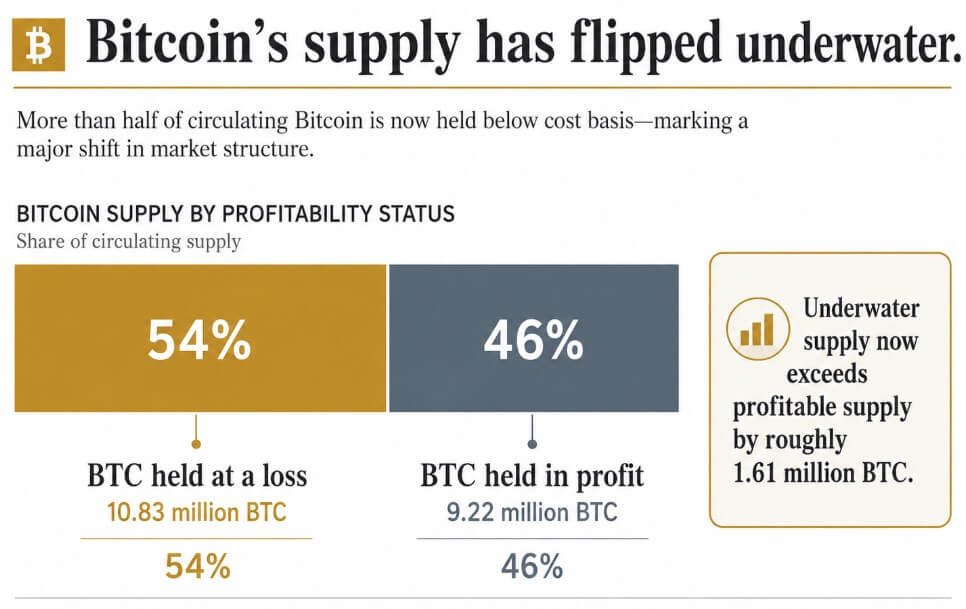
Glassnode's latest Week Onchain report shows that about 10.83 million BTC are at a loss, while only 9.22 million are still profitable.
The amount in loss now accounts for about 54% of the total measured supply, while the profitable supply constitutes 46%, meaning there are approximately 1.61 million more BTC underwater than in profit.
Glassnode describes this as one of the sharpest declines in investor profitability since the beginning of this bull market, a threshold with real psychological weight.
Crossing this threshold has often been accompanied by a true capitulation of new buyers, whose pressure creates structural pullbacks.
Underwater holders are most likely to panic sell or exit near the breakeven point when prices rise, forming a layer of resistance above the market.
However, if patient capital is willing to absorb these coins, they may transfer to more conviction-driven buyers, and Glassnode's data is showing that such buyers have already begun to appear.
Under this pressure, the seller profile has started to change, with Glassnode stating that long-term holders have begun to rebuild positions, reversing from the ongoing distribution phase, with net holdings changing back to positive territory.
This pace remains mild, far from the buying frenzy seen in previous accumulation cycles, but the direction has changed. The first signs of a bottom often appear here—experienced holders see the pullback as a buying opportunity long before the price itself confirms any signals.
Glassnode's accumulation trend score has risen in multiple groups this week, with wallets holding less than 1 BTC and entities holding 100 to 1000 BTC showing the strongest readings.
Wallets in the range of 1000 to 10000 BTC have also turned into net buyers. The latent buying pressure for Bitcoin is spreading across the entire ownership ladder, from the smallest wallets to mid-sized entities.
Spot Bitcoin ETFs traded in the U.S. remain in a state of continuous net outflow, even as on-chain faith builds in the opposite direction; this selling pressure continues. The ETF narrative explains why prices remain soft, while the on-chain narrative explains who is picking up the pieces.
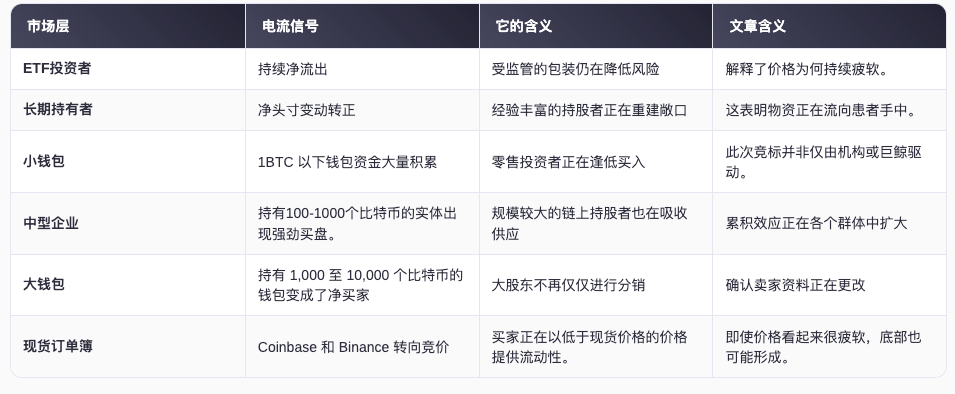
Order books from Coinbase and Binance both show a shift towards the buy side, with buyers adding liquidity below the spot price. This buying appears to be patient, which is why even as a bottom begins to form below, prices may still seem weak.
Hyperliquid traders hold the highest levels of bullish preference tracked by Glassnode, betting on a rebound with leveraged exposure before spot confidence is fully confirmed. The cash market is trying to establish a bottom, while the derivatives market is attempting to get ahead.
Options traders have begun to pay for protection: the 14-day put-call volume ratio has climbed above 1.0, marking the highest reading in a year. Implied volatility is also rising, although recovering from low levels, but Glassnode does not classify it as a panic reading.
The market holds enough fear to begin bottoming, although the fear necessary to confirm capitulation may still be accumulating.
Overall, this pattern appears unusual for the bottoming process; Bitcoin may be finding a bottom through an unusual mechanism: ETF investors are selling, while stronger, more patient hands are absorbing the exits in real-time.
Glassnode defines it as an early and still developing bottoming process, noting that the final capitulation could still drive volatility to spike.
The scale of purchases from long-term holders also lags far behind the magnitude of previous accumulation waves, keeping the recovery of accumulation weak.
Bitcoin may find a bottom before ETF capital inflows return, as long as outflows slow enough to stop overwhelming on-chain accumulation, while crowded bullish positions on Hyperliquid gradually unwind through price increases.
How This Will Develop
In a bullish scenario, ETF outflows continue but slow down, while long-term holders and a broader group of wallets continue accumulating throughout the summer.
The buy-side dominated order book continues to absorb supply from new underwater holders, while Hyperliquid's aggressive bullish positions get resolved through a genuine rebound.
The adjustment in Bitcoin becomes a controlled migration, shifting from ETF sellers and short-term holders to patient on-chain capital, with the transition phase becoming the bottom.
In a bearish scenario, Hyperliquid's crowded bullish positions are washed out, ETF outflows persist, and underwater holders capitulate at lower prices.
Implied volatility spikes to real panic levels, while the pullback deepens, causing long-term holders' accumulation to slow. Bitcoin still eventually transfers to stronger hands, but through a final capitulation event.
The next bottom for Bitcoin may begin with an unusual sequence: institutions exiting, weaker holders capitulating, while stronger hands quietly absorb the sell-off. The bottom starts with a rotation of supply ownership, far before the price is revealed.
免责声明:本文章仅代表作者个人观点,不代表本平台的立场和观点。本文章仅供信息分享,不构成对任何人的任何投资建议。用户与作者之间的任何争议,与本平台无关。如网页中刊载的文章或图片涉及侵权,请提供相关的权利证明和身份证明发送邮件到support@aicoin.com,本平台相关工作人员将会进行核查。


