Author: Li Jia, Wall Street Journal
On July 1, at the annual central bank forum held by the European Central Bank in Sintra, Portugal, Walsh reiterated that the Federal Reserve will not provide forward guidance on future interest rate paths and hopes that decision-makers can engage in thorough discussions based on the latest data at each meeting, rather than giving a heads-up to the market about policy direction.
He stated that the risks of inflation in the United States have eased over the past four weeks, and the supply expansion brought about by AI could profoundly change the way the economy operates. The United States is at the center of this transformation, but whether AI ultimately leads to inflation or deflation should be judged by the central bank based on data.
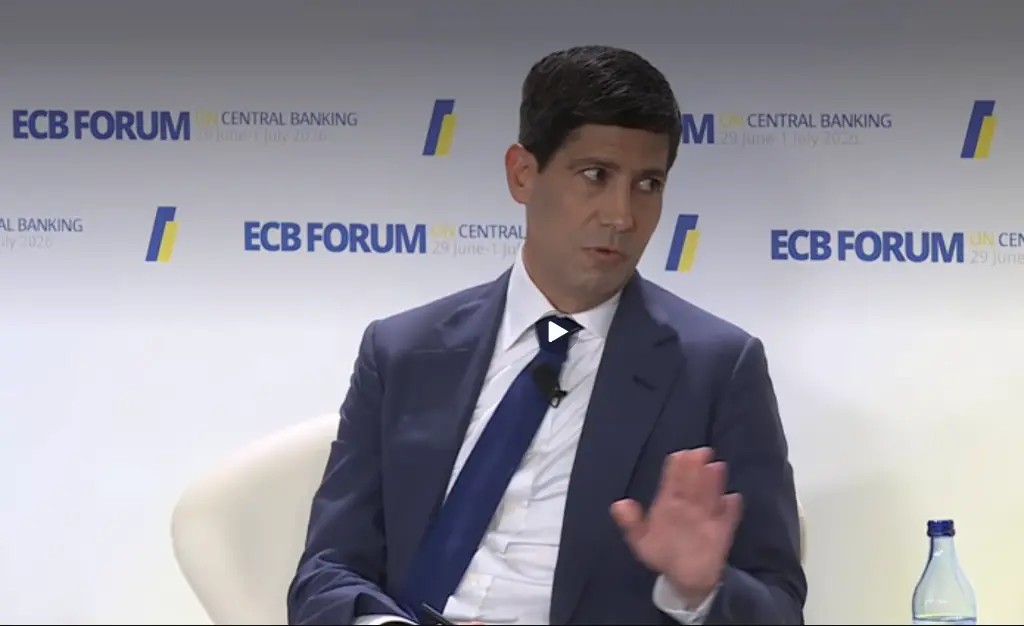
No Forward Guidance on Interest Rates
Walsh stated that the Federal Reserve is “walking a new path” and will not significantly hint at future interest rate directions as it did in the past. He said:
“We will hold our next meeting in four weeks, and I hope that a real family-style debate can unfold then.”
He reiterated that forward guidance is not the correct policy under the current economic situation, and in the future, the Federal Reserve will continue to make decisions based on the latest economic data rather than committing in advance to a policy path.
This means the Federal Reserve will rely more on real-time economic data, rather than signaling policy to the market in advance.
At the June meeting, the Federal Reserve unanimously decided to maintain the federal funds rate in the range of 3.5%-3.75%. However, the latest dot plot shows that out of 18 officials, 9 expect at least one more rate hike this year, and the market has mostly priced in the possibility of at least one 25 basis point rate hike before the end of the year.
However, Walsh himself declined to reveal his policy preferences, only emphasizing that future policy decisions will depend on data performance.
AI is Changing the Economy at an Unprecedented Speed
Walsh discussed the impact of artificial intelligence on the macroeconomy at the forum. He stated that the improvement in AI model capabilities is showing a distinct exponential growth.
He pointed out that the supply capacity expansion driven by AI will become a new variable that future monetary policy must pay close attention to, as productivity improvements mean that the economy can achieve faster growth under lower inflationary pressures.
However, he also acknowledged that there remains significant uncertainty about how AI will currently affect the job market.
“There are serious questions about when AI will truly begin to impact employment.”
He emphasized that the Federal Reserve must continue to achieve both full employment and price stability, and any policy adjustments must balance both.
Inflation Risks Decrease, but Whether AI Has Inflationary Effects Remains to be Observed
Walsh stated that the risks of inflation in the United States have decreased over the past four weeks, indicating a certain degree of easing of recent price pressures.
However, regarding the widely discussed question of whether AI serves as a deflationary force or a new source of inflation, Walsh did not provide a clear answer. He stated:
“Whether AI has inflationary effects should be determined by the central bank.”
In his view, while AI can enhance production efficiency and expand supply, it may also stimulate new investments and demand, so the final effects need to rely on data judgment rather than preset conclusions.
In addition, Walsh noted that the Federal Reserve's policies not only affect the United States but also have significant spillover effects through global financial markets.
Reaffirming the Independence of the Federal Reserve: Policies Will Not Be Influenced by External Pressure
In response to ongoing external attention on the independence of the Federal Reserve, Walsh provided a clear response once again. He stated:
“The Federal Reserve has long maintained its independence, and will continue to maintain its independence; you will not see any changes.”
This statement is also seen by the market as a response to President Trump’s recent calls for the Federal Reserve to cut interest rates. Walsh emphasized that the Federal Reserve will autonomously decide on the appropriate policy path and will not change its decision due to external political pressure.
The United States is Facing a Great Opportunity for Productivity Increase
In addition to monetary policy, Walsh also focused on the long-term growth prospects of the U.S. economy that day.
He said that over the past four weeks he has been focused on monetary policy work, and that the current time is full of great opportunities for the United States. Walsh believes that the supply side of the U.S. economy remains strong, and the potential growth rate appears to be on an upward trend, therefore there is ample reason to remain optimistic about future productivity.
He stated that if the economic performance of the past four quarters can serve as a reference for the future, then the outlook for the U.S. economy is indeed worth staying optimistic about. He expressed:
“The United States is not afraid of productivity-driven economic growth.”
However, he also acknowledged that it is still unclear whether improvements in productivity will have a direct impact on short-term monetary policy, but the continued expansion of supply capacity will undoubtedly profoundly influence future policymaking.
The Stance on Balance Sheet Reduction Remains Unchanged
Besides interest rate policy, Walsh also discussed the Federal Reserve's balance sheet.
He said, his view on the balance sheet has not changed over the past four weeks. “It’s no secret that I hope to see the size of the Federal Reserve’s balance sheet shrink.”
However, he also stated that the Federal Reserve remains open to discussions on the appropriate size of the balance sheet. Walsh pointed out that balance sheet policy mainly operates through asset prices, thus any significant decisions regarding the balance sheet will go through public discussions and be decided collectively by the FOMC.
He also stated that the current balance sheet size of approximately $6.7 trillion is still far above pre-pandemic levels, and even if the balance sheet continues to shrink in the future, it cannot be completed in a short time, “18 weeks is far from enough.”
Five Reform Working Groups Will Welcome New Progress
In fact, abandoning forward guidance is only part of Walsh's effort to push for reform at the Federal Reserve.
Last month, Walsh announced the establishment of five internal special working groups, each responsible for researching topics such as communication mechanisms, balance sheets, data usage, productivity and employment, and inflation frameworks. He recently revealed that the member list of the special working groups will be announced as soon as next week.
Walsh stated that these working groups will not only include Federal Reserve officials but will also invite external experts to participate, including some from outside the United States. He hopes these reforms will revisit the Federal Reserve's policy framework and communication mechanisms, making monetary policy more adaptable to the rapidly changing economic environment.
免责声明:本文章仅代表作者个人观点,不代表本平台的立场和观点。本文章仅供信息分享,不构成对任何人的任何投资建议。用户与作者之间的任何争议,与本平台无关。如网页中刊载的文章或图片涉及侵权,请提供相关的权利证明和身份证明发送邮件到support@aicoin.com,本平台相关工作人员将会进行核查。


