
Author: Xiaojing, Tencent Technology
Editor|Xu Qingyang
On July 1, Beijing time, foreign media reported that Meta is building a cloud computing business and will sell AI computing power to external customers.
This was not without warning. Five weeks ago, Zuckerberg was asked at the Meta annual shareholder meeting if they would compete with Amazon and Microsoft in the cloud computing space, to which he gave a clear response: “It's definitely on the table.”
He also revealed a detail: “Almost every week, external companies come to us, either asking if they can open an API or asking if they can pay a premium for Meta's computing power.”
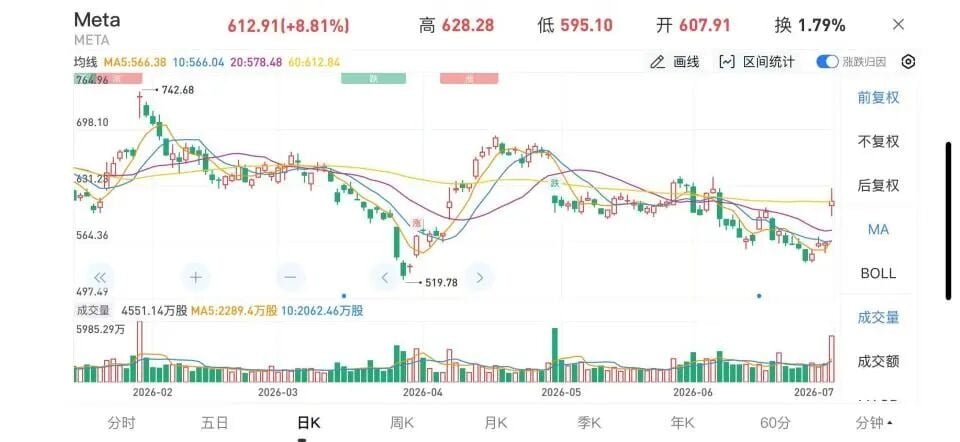
It took only five weeks to move from “under consideration” to “under construction.” After the news broke, Meta's stock surged, while it “crashed” the AI infrastructure stocks in the U.S. market.
At the U.S. market close on July 2, Meta rose by 8.81%, while the Philadelphia Semiconductor Index plummeted over 6%, with Micron Technology down 8.37%, SanDisk dropping over 11%, Intel falling more than 7%, ASML, AMD down over 5%, TSMC down, and ARM down over 5%. Independent cloud computing companies faced even harsher sell-offs, with Nebius plummeting over 14.5% and CoreWeave dropping over 13%.
01. How much has Meta invested in AI?
By 2026, the combined capital expenditure of the four major tech giants (Meta, Microsoft, Alphabet, Amazon) is expected to reach approximately $725 billion, a 77% increase from approximately $410 billion in 2025. Meta's individual CapEx guidance is set at $125 billion to $145 billion. This figure was adjusted upward by $10 billion from the previous $115 billion to $135 billion when the Q1 earnings report was released at the end of April.
Besides its own data center construction, Meta has signed several huge external contracts this year: a five-year strategic agreement with AMD to procure $60 billion worth of 6 gigawatt custom Instinct GPUs; a $21 billion AI computing power infrastructure contract with CoreWeave; and a computing power procurement agreement with Nebius worth up to $27 billion. The total of just these three external contracts exceeds $100 billion.
However, Meta's investment situation fundamentally differs from the other three: Microsoft has Azure, Google has GCP, and Amazon has AWS, allowing them to directly offset their massive CapEx investments with cloud service revenues. Meta does not have that. Every penny spent on infrastructure previously was purely a cost item, entirely used for its own advertising recommendation system and AI applications, with none designated for external sales products.
Sherwood News pointed out directly in their analysis in May: compared to other tech giants also making large investments, Meta lacks the highly profitable cloud business and enterprise-level revenue to cushion the impact.
This also explains a paradox: Meta exceeded Wall Street’s profit expectations for two consecutive quarters in 2026, but its stock price has still fallen by about 4% since the beginning of the year. The market's core question is about investing $135 billion to build data centers; where is the return?
02. Zuckerberg's calculation: buying insurance
Zuckerberg's original statement at the shareholder meeting was: “We haven’t done this yet because we believe there is still use for this computing power. But obviously, if one day we feel we overbuilt, then this is also an option; this to some extent boosts our confidence in continuing to invest in construction.”
Two keywords. “If we have overbuilt,” he himself is leaving a way out for the possibility of over-construction. “Partially what gives us confidence,” the very existence of this option of doing cloud is what gives him the guts to continue spending. In other words, Meta isn’t building data centers because it wants to do cloud; instead, it is because it has built too many data centers, so it needs to do cloud to cushion the situation.
Tech content platform Datafloq, which has long focused on big data, AI, and cloud computing, pointed out in early June’s analysis: this makes it easy for investors to interpret Meta's capital spending bets as an either-or judgment—either internal AI investment succeeds, or it fails.
But in reality, doing cloud is an option. If internal monetization of AI is successful, all computing power can be used internally, and the cloud business can be omitted; if internal consumption is below expectations, any surplus computing power won’t just depreciate on the books but can generate income. It turns “losing the bet means losing everything” into “losing the bet still earns rent.”
However, reading the same line in reverse also reveals anxiety. Foreign media commentary is sharp: “If it can’t use all the power itself, it shifts the costs to others. This isn’t something someone confident in the future of AI would say. If Zuckerberg genuinely believed that internal demand could consume all the computing power, he would have no reason to share valuable GPU resources with external competitors.”
03. What else does Meta lack to do cloud? Having GPUs doesn't mean it can sell
Having a GPU cluster does not equal being able to do cloud business.
The things Meta lacks can be listed: enterprise-level multi-tenant isolation architecture, security compliance certifications (SOC 2, HIPAA, ISO 27001, etc.), fine-grained billing and SLA support systems, global multi-region deployment and networking access points, and most importantly, an enterprise sales team and customer success system.
Since its inception, Meta has been a purely B2C company; it has never sold anything to enterprise customers and lacks B2B sales muscle memory.
Analysis by Datafloq made a judgement about Meta's possible path: “Attempting to build a full-stack cloud platform is a strategic error; the correct approach is to narrow the focus.”
The article listed four potential product forms: first, bare computing power rental with hourly pricing and no long-term contracts, scheduled via API to deploy GPU clusters; second, hosting Llama model inference, enabling enterprises to run Llama without having to build their own GPU infrastructure; third, enterprise model fine-tuning services, using proprietary data to fine-tune open-source models on Meta's hardware; fourth, Agent infrastructure, providing dedicated tool invocation, credential management, and audit logs for AI Agent workloads.
This suggests that the short-term form of Meta's cloud is likely to be a "wholesale" power sale targeting a small number of large clients, signing long-term contracts in a model similar to CoreWeave, rather than providing a self-service registered, on-demand platform with hundreds of services like AWS. The organizational capabilities and customer ecosystems required for the latter cannot be fulfilled in just two or three years.
Meanwhile, on the same day, May 28, Meta also did two other things: announced the introduction of paid subscription tiers for Instagram, WhatsApp, and Facebook, and according to The Information, established a brand-new “Enterprise Solutions” department, sending engineers and product managers directly into large enterprise customer environments to assist with deploying AI tools.
These three actions form a complete narrative: Meta is systematically looking for revenue sources outside of advertising to support its CapEx bills. Doing cloud is just the boldest step among them.
04. Industry chain earthquake: Meta up 6%, CoreWeave and Nebius down 9%
After this news broke, Meta rose over 6%, while both AI computing power rental companies CoreWeave and Nebius dropped over 9%.
The sharp decline of CoreWeave and Nebius indicates that the market sees this as a repricing of the entire neocloud business model moat.
The hit is threefold.
The first layer is the direct competitive threat. CoreWeave and Nebius's business model essentially involves “bulk purchasing GPUs → building clusters → selling at a markup to AI companies.” The high profit margin relies on a tight market for GPU computing power, where customers have few alternatives.
Once the most aggressive player in computing power, Meta enters the arena, adding a huge player to the supply side, and Meta's GPU procurement costs are lower than those of neocloud companies because it signs multi-billion dollar strategic deals directly with Nvidia and AMD and secures optimal prices. Its selling price can be lower than CoreWeave’s while still making a profit.
The second layer is more lethal: identity conflict. One of CoreWeave's largest clients is Meta. In April 2026, CoreWeave announced an expansion of its AI infrastructure agreement with Meta, amounting to $21 billion, with a service period lasting until 2032.
Now, if Meta aims to do the same thing, it means the client is turning into a competitor. The market's natural reaction is to question whether this $21 billion contract will be renewed after expiration. Is Meta spending money to buy time, waiting until its cloud business is built before it no longer needs CoreWeave?
The third layer is the collapse of the valuation narrative. The story CoreWeave told during its IPO in March 2025 was “explosive growth in AI computing power demand, extreme scarcity in supply, we are a scarce supplier.” This narrative supported its rocket-like growth from zero to a market cap of hundreds of billions.
However, Meta's entry into the computing power market directly undermines the core premise of “supply scarcity.” If even the world’s biggest spenders on AI computing power believe they may have surplus capacity to sell externally, is the supply-demand relationship really as tight as previously stated?
This doesn’t mean CoreWeave's business will collapse immediately; it reported revenues of about $2.1 billion in Q1 2026, with substantial backlog contracts, ensuring short-term income. But the capital market prices expectations, not reality. When the largest client is also a potential competitor, the long-term growth narrative needs to be rewritten.
05. Is this good news or a warning?
Regarding Meta's cloud initiative, is it good news?
Optimists believe this is an upgrade of Meta's investment logic. Previously, Meta's CapEx was a purely one-way bet, wagering that AI could significantly enhance advertising revenue and user engagement; if it wins, the return is huge, but if it loses, it's a costly sunk cost. Now, with the cloud business as an option, investment has transformed into “offensive and defensive capabilities.”
The global cloud infrastructure services market's Q1 2026 revenue reached $128.6 billion (Synergy Research Group data), annualized over $455 billion, with AI computing being the fastest-growing sub-segment. Meta only needs to slice a small piece for considerable income. From the perspective of portfolio theory, this changes Meta's CapEx from “high-risk single bet” to “a dual-option with hedging.”
Pessimists argue that this is precisely the “early warning signal” of the AI CapEx bubble, with simple logic: if Meta truly believes internal AI demands can absorb all computing power and generate corresponding returns, why would it share valuable GPU resources with external competitors? The move into cloud is itself hedging against the possibility that internal AI monetization velocity falls short of expectations.
The four giants are projected to have a combined CapEx of about $725 billion in 2026, but the incremental income directly brought by AI may only be in the range of tens of billions, resulting in a serious mismatch in the investment-output ratio. Meta's move into cloud could be the most aggressive player preparing for the possibility of computing power surplus.
There is also a technical concern. AI inference efficiency has quickly improved over the past year, cutting unit inference costs every few months. If the rate of efficiency increase continues to exceed the growth rate of demand, the data centers built today may not be “insufficient” but “too many.” Meta's cloud initiative is essentially buying insurance against this possibility.
On the same day, the U.S. stock market's storage sector plummeted. Companies like Micron and SanDisk fell by around 10%. The core logic for these companies' massive gains over the past year was “the AI data center construction boom driving explosive demand for HBM and enterprise-grade SSDs,” with Micron reporting a year-on-year revenue increase of 196% last quarter, claiming “unlimited demand, supply can’t keep up.”
However, Meta's news directly undermines the underlying assumption of “build first, then supply”; if tech giants slow the pace of future data center construction, it means adjusting down expectations for procurement growth of HBM and enterprise-grade storage.
This is also a story about the AI arms race entering its second half. Over the past two years, everyone has been competing on who dares to spend, who can snag GPUs, and who has the largest data center scale.
But even the boldest spender, Zuckerberg, is now “afraid.” “Having built so much infrastructure, we need to ensure that whether AI monetizes quickly or slowly, we won’t lose everything.”
When the biggest buyer begins preparing to become a seller, who will still be a true buyer?
免责声明:本文章仅代表作者个人观点,不代表本平台的立场和观点。本文章仅供信息分享,不构成对任何人的任何投资建议。用户与作者之间的任何争议,与本平台无关。如网页中刊载的文章或图片涉及侵权,请提供相关的权利证明和身份证明发送邮件到support@aicoin.com,本平台相关工作人员将会进行核查。


