
Author: Flora, CryptoPulse Labs
On July 1, according to data from DeFiLlama, the total value locked (TVL) across the DeFi sector has dropped below $70 billion. It currently stands at approximately $69.358 billion, marking a new low since February 2024, quickly attracting market attention.
As an important indicator measuring the activity of the decentralized finance ecosystem, changes in TVL not only reflect the flow of funds on-chain but also, to some extent, mirror market sentiment and cyclical trends in the industry.
Compared to the peak of over $180 billion in 2021, it is evident that the current DeFi market has entered a new adjustment phase. Does the drop below this key threshold indicate that DeFi is entering a recessionary cycle, or is the industry undergoing a new round of reshuffling and restructuring?
1. TVL drops below $70 billion, why is DeFi liquidity continually shrinking?
TVL, or total value locked, has long been regarded as the core indicator for assessing the health of the DeFi ecosystem. It represents the total value of assets locked in lending, DEX, derivatives, yield aggregation, and other protocols.
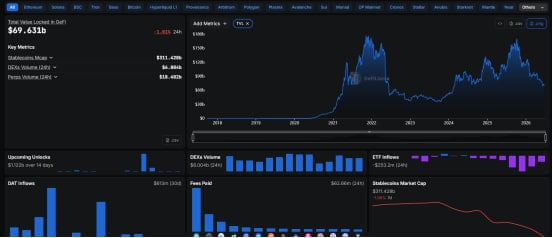
Therefore, an increase in TVL usually indicates fund inflows and market activity, while a decrease signifies capital withdrawal and liquidity contraction. The recent drop in total TVL below $70 billion fundamentally reflects the ongoing shrinkage of overall DeFi liquidity.
The primary reason for this phenomenon is the overall decrease in risk appetite within the cryptocurrency market. When key assets like Bitcoin and Ethereum enter a period of fluctuation or even correction, risk capital in the market often withdraws first from high-volatility sectors.
As a field highly reliant on market sentiment, DeFi naturally bears the brunt. Users are no longer frequently engaging in leverage, borrowing, and liquidity mining operations, resulting in decreased on-chain fund activity.
At the same time, the liquidity incentive models that DeFi heavily relied on over the past few years are becoming ineffective. During the DeFi Summer of 2020-2021, many protocols attracted capital through high token subsidies. With APYs reaching dozens, or even hundreds, capital was able to accumulate rapidly.
However, this growth model is essentially subsidy-driven rather than demand-driven. Once incentives weaken, funds quickly exit. The market is now increasingly aware that many protocols' high TVL does not represent real value, but is more often the result of short-term arbitrage capital accumulation.
Additionally, capital is migrating to other popular narratives. Over the past two years, market attention has gradually shifted from DeFi to new sectors such as AI, RWA, stablecoin payments, and modular infrastructure.
Capital naturally chases higher growth expectations; as new narratives continuously attract attention, the capital appeal of traditional DeFi sectors is diminished. In other words, a drop in TVL does not merely indicate that funds are leaving the blockchain; it also signifies that the market is reallocating capital.
2. Behind the cooling of DeFi: the industry is facing growth bottlenecks
If we review the development history of DeFi, we find it was once one of the most revolutionary innovations in the entire cryptocurrency industry. Protocols like Uniswap, Aave, and MakerDAO successfully reconstructed transaction, lending, and stablecoin issuance mechanisms in traditional finance, allowing users to perform complex financial operations without banks or brokers.

This concept of permissionless finance was once thought to be the most core application of blockchain.
However, after several bull and bear cycles, the growth bottlenecks of DeFi are becoming increasingly apparent. First, the speed of innovation has notably slowed. In the early DeFi ecosystem, there were significant differentiations among protocols. Some focused on trading, some on lending, and others explored synthetic assets. But today, many new projects are merely reproducing and fine-tuning old models.
New AMMs, new lending protocols, and new yield farms emerge endlessly, yet they seldom bring genuine structural innovation. Intensifying homogenous competition has led to a decrease in user migration willingness.
Secondly, the significant drop in yields has weakened the appeal of DeFi. Many of the high yields commonly seen in 2021 were driven by token inflation and market bubbles. As the market matures, real yields are gradually returning to rational levels.
Currently, the return rates for stablecoin lending, market making, and basic yield products have generally fallen to single digits. For ordinary users, when DeFi yields begin to approach those of traditional financial products, the complexity of operations and risks from smart contracts rather become a disadvantage.
At a deeper level, the issue lies in stagnant user growth. Although the industry has developed for several years, DeFi still struggles to break through the native user circle of cryptocurrency. For ordinary users, concepts like wallet management, Gas fees, cross-chain bridges, private key security, and liquidation risks remain high barriers.
Compared to using traditional payment systems such as PayPal or Visa, the user experience of DeFi still appears complex. Technical advancement does not equate to ease of use in products. This user experience bottleneck has made it persistently difficult for DeFi to achieve true mass adoption.
3. A sliding TVL does not indicate an endgame; DeFi may be entering a new phase
Although TVL has dropped to a low point, this does not mean DeFi is approaching its end. In fact, viewing TVL as the sole indicator itself has limitations.
Since TVL is usually denominated in dollars, the price fluctuations of cryptocurrency assets directly affect the value changes. Even if the amount of assets locked by users remains unchanged, as long as the prices of assets like Ethereum drop, TVL will also significantly shrink. Thus, a decline in TVL does not completely equate to an actual outflow of funds.
More importantly, the industry is transitioning from a focus on capital accumulation to efficiency competition. As Layer 2, modular architectures, intent-driven transactions, and cross-chain liquidity solutions continue to mature, future DeFi protocols may no longer require large amounts of TVL to sustain business scale.
The improvement in capital efficiency means that smaller amounts of locked funds can generate higher transaction volumes and better user experiences. This will change the market's past singular reliance on TVL.
Meanwhile, DeFi is also extending towards more realistic financial scenarios. One of the most notable directions is RWA, or Real World Assets on-chain. Through tokenization, traditional assets like U.S. Treasuries, funds, real estate, and private credit are gradually entering the on-chain financial system.
This means that the revenue source for DeFi is beginning to shift from "token subsidies" to real cash flows, and the value support is becoming more solidified.
On the other hand, the rapid expansion of the stablecoin ecosystem is also pushing DeFi into a new phase. The USD Coin issued by Circle and the Tether issued by Tether have gradually become the core liquidity foundation of on-chain finance.
From a longer-term perspective, the core competition of DeFi in the future may no longer be about "whose APY is higher," but rather "who can provide more stable, secure, and efficient financial services." Protocols that can genuinely traverse cycles often possess four key characteristics: real income, strong user stickiness, high capital efficiency, and robust security.
A $70 billion TVL may seem low, but it resembles a watershed after the cleanup of industry bubbles. DeFi is bidding farewell to an old era reliant on subsidies and speculation, moving towards a new stage that is more rational and mature. The next round of industry explosion may no longer depend on financial speculation, but on who is closer to the financial demands of the real world.
Conclusion
The drop of the total value locked in DeFi below $70 billion superficially appears to be a sign of market cooling, but behind it reflects that the industry is undergoing a deep valuation reassessment. From the barbaric growth driven by liquidity mining to the current rational return of capital and accelerated market clearance, DeFi is saying goodbye to the old narrative built on high-yield myths.
In the short term, liquidity contraction, slowing user growth, and intensified sector competition will still put considerable pressure on the industry. However, in the long term, the sustained evolution of RWA, stablecoin payments, and on-chain financial infrastructure is also opening new growth spaces for DeFi.
免责声明:本文章仅代表作者个人观点,不代表本平台的立场和观点。本文章仅供信息分享,不构成对任何人的任何投资建议。用户与作者之间的任何争议,与本平台无关。如网页中刊载的文章或图片涉及侵权,请提供相关的权利证明和身份证明发送邮件到support@aicoin.com,本平台相关工作人员将会进行核查。


