Author: Kirsten Korosec
Translation: Shenchao TechFlow
Shenchao Introduction: Micron's stock price surged 236% in a month, briefly surpassing Meta and Tesla, approaching a market value of $1.27 trillion. The crazy demand for storage chips from AI data centers has created a "RAMageddon"-level supply crisis, with Micron's Q3 revenue quadrupling year-on-year to $41.45 billion. Wall Street bets that it will be the next Nvidia, but has the cyclical curse of the storage chip industry really been broken?
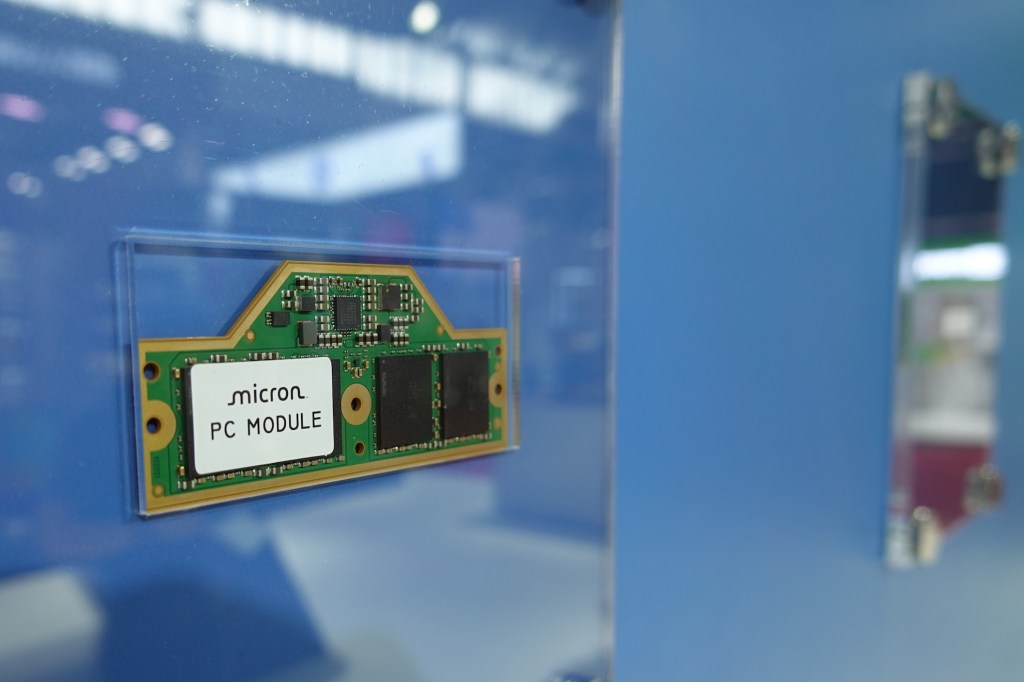
Caption: Source CFOTO/Future Publishing via Getty Images
Micron, a storage chip manufacturer based in Boise, Idaho, has become the new darling of Wall Street. How long this romantic relationship can last largely depends on how long the AI-driven storage chip supply shortage can be sustained.
Micron claims to be prepared for long-term stability, able to withstand sudden drops in demand or oversupply. Wall Street has bought into this narrative. Last Thursday, Micron's market value briefly surpassed Meta and Tesla, and although it fell back on Friday, it still remained close to those two giants.
Specifically, Micron's market value closed at about $1.27 trillion on Friday, while Meta stood at $1.39 trillion and Tesla at $1.42 trillion. Micron's stock price soared more than 236% in the past month, closing at $113.2 per share on Friday. In comparison, this stock had been lingering below $100 for years before mid-2025.
For a company whose consumer image is still seen as "little cards for expanding memory in computers and phones," this surge is staggering.
AI Devouring Storage Chips
Wall Street is not focused on consumer-grade product lines. Micron benefits from a system-level storage chip shortage triggered by the wave of AI data center construction, including DRAM, NAND, and high-bandwidth memory (HBM). An AI server requires tens to hundreds of times more memory than a regular laptop.
AI system vendors like Nvidia, as well as large-scale cloud providers like Microsoft, Amazon AWS, Google, Meta, and Oracle, are all purchasing storage chips in large quantities. This has forced all companies needing storage to stockpile as well, from PC manufacturers like Dell and HP to various end device manufacturers.
This supply shortage has even been given a specific name: RAMageddon. It is predicted that the shortage will last until 2027. Moreover, it has already been pushing up the prices of consumer electronics, including Apple products and Xbox gaming consoles.
Q3 Performance Explosion: Revenue Quadruples, Profit Soars 14 Times
The entire tech industry is scrambling for storage chips, and Micron's Q3 financial report released last week was explosive. Revenue quadrupled year-on-year to $41.45 billion. Profit skyrocketed from $1.88 billion in the same period last year to $28.2 billion. The company also provided an optimistic forecast for the next quarter, expecting revenue to be between $49 billion and $51 billion.
Wall Street has been looking for more publicly traded companies that can replicate Nvidia's trajectory, and this report card has only heightened excitement.
The Old Problem of Storage Chips: After Prosperity Comes a Crash
Storage chip manufacturers face a historic dilemma: building factories and expanding production is both slow and expensive. By the time production capacity finally comes online, demand often turns downward, leading to oversupply and price crashes. Both Micron and Samsung have suffered from this.
This time, Micron has preemptively addressed market concerns about an AI bubble burst. The company emphasizes that it has signed a series of long-term supply agreements with partners including Nvidia and AI lab Anthropic. In its earnings call presentation, Micron stated that it has signed 16 strategic customer agreements covering data centers, consumer electronics, and the automotive market, believing that these agreements will fundamentally change its business model.
This has convinced many analysts. William Blair technology analyst Sebastien Naji pointed out in a report that the pace of demand growth continues to exceed that of new capacity coming online. He maintained a "outperform" rating for Micron, citing that the average price of storage chips is likely to rise in the coming quarters, along with increasing revenue visibility from the continuous expansion of long-term agreements, suggesting that Micron's profit growth may be more sustainable than in the past.
Whether Micron can truly break the cyclical curse of the storage chip industry will require time for verification. But at least at that moment last Thursday, the market value of this American company did indeed surpass that of some tech giants.
免责声明:本文章仅代表作者个人观点,不代表本平台的立场和观点。本文章仅供信息分享,不构成对任何人的任何投资建议。用户与作者之间的任何争议,与本平台无关。如网页中刊载的文章或图片涉及侵权,请提供相关的权利证明和身份证明发送邮件到support@aicoin.com,本平台相关工作人员将会进行核查。


