Author: Rita
Trend Guide
HSBC has just released a research report on SK Hynix, raising the target price from 2.9 million won to 4 million won, an increase of 56.6%, maintaining a buy rating. The core logic is unexpectedly simple: DRAM and NAND prices are surging, and HBM prices are following suit, which is enough to support strong growth for SK Hynix in the second half of 2026 and in 2027. With the upcoming listing of the US stock ADR at the end of June, this leading South Korean memory company is entering a golden period of both volume and price growth.
Two Unexpected Driving Forces in the Second Quarter
The recent earnings season data has demonstrated what "unexpected" truly means.
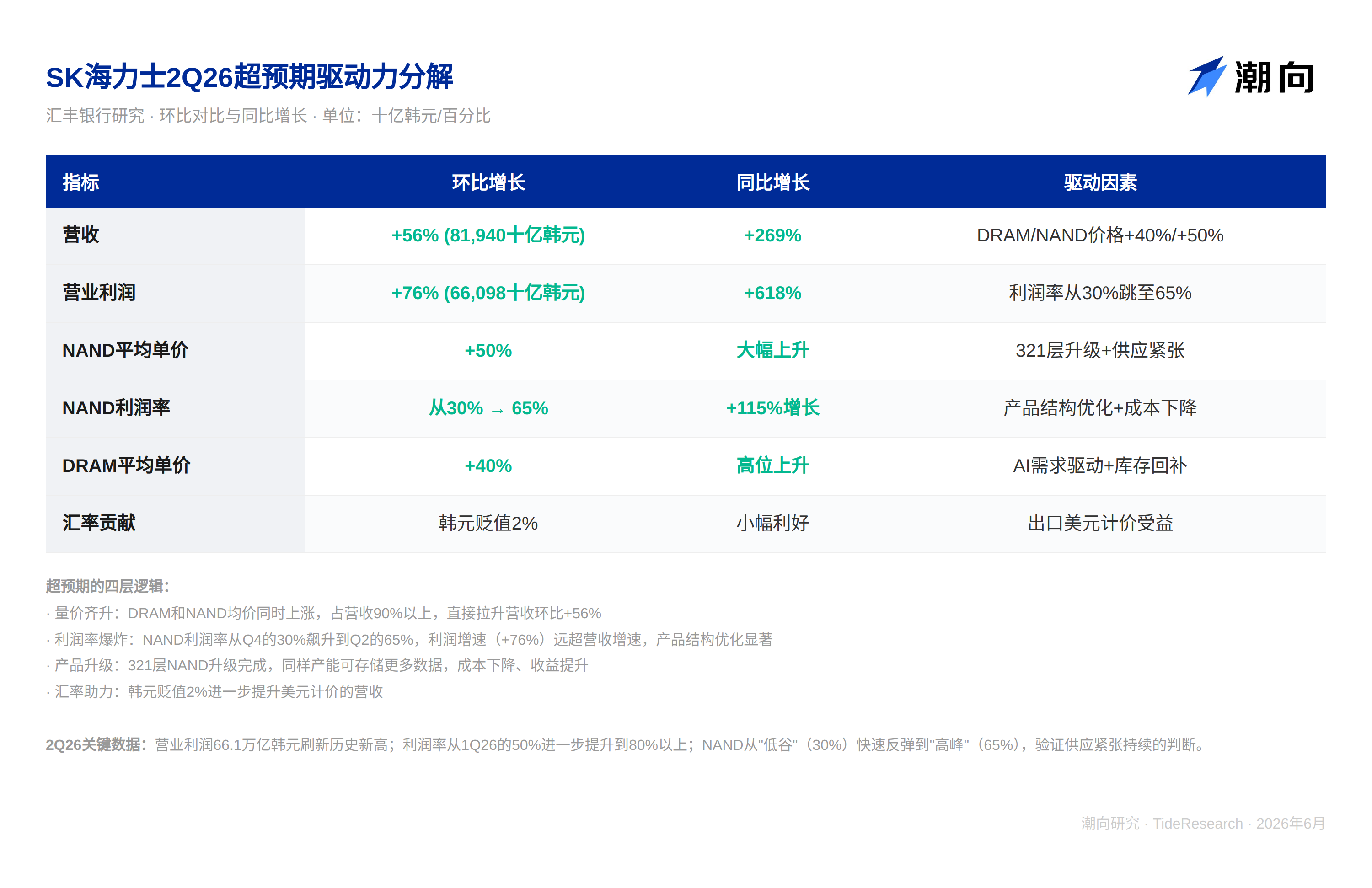
SK Hynix's revenue in the second quarter is expected to reach 81.94 trillion won, an increase of 56% quarter-on-quarter and 269% year-on-year. Even more surprising is the operating profit, expected to reach 66.1 trillion won, a quarter-on-quarter increase of 76% and a year-on-year increase of 618%, marking explosive growth.
The reason behind this is the simultaneous rise in DRAM and NAND prices. The average price of DRAM has increased by 40% quarter-on-quarter, while the average price of NAND has increased by 50% quarter-on-quarter. These two products account for over 90% of SK Hynix's revenue; when prices move, profits follow suit. From a cost perspective, the cost of memory chips is relatively fixed, so price increases directly translate into profit expansion.
Moreover, the product structure is also improving. SK Hynix has just completed an upgrade to 321-layer NAND, which allows the same production capacity to store more data. Additionally, the 2% depreciation of the won provides an exchange rate advantage, causing NAND's profit margin to soar from 30% in the fourth quarter of 2025 to 65% in this year's second quarter. The leap from 30% to 65% is a qualitative jump. This indicates that not only are prices rising, but the unit cost of the products is also decreasing.
The story for DRAM is similar. Although the specific numbers are not as dramatic as NAND, a 40% price increase quarter-on-quarter means that even without an increase in production, profits are experiencing significant expansion.
Where Is the Confidence for Continued Price Increases in the Second Half?
The short-term price increases are a result of demand shock and supply tightness, but HSBC believes there will be more growth momentum in the second half.
HBM is key. HBM is a memory product tailored for AI chips, with costs and technological difficulties far exceeding those of ordinary DRAM. In the past few months, HBM has lost its price advantage over ordinary DRAM due to some chip defect issues. However, HSBC expects that memory manufacturers will adjust their strategies in the second half and raise the prices of HBM3E 12-layer products to re-establish premium pricing. This round of price adjustment is in the context of continued supply tightness, with customer demand for high-performance memory still far from saturated.
Looking towards 2027, HBM4 will become a new growth point. HSBC estimates that HBM4 will have a 40% to 50% premium over standard products. This means that SK Hynix's average selling price in 2027 is expected to grow by 35% year-on-year. A 35% increase in average selling price means that even if chip shipment volumes remain the same, profits will increase significantly. This type of profit growth driven by product upgrades rather than production expansion is the highest quality growth model in the memory industry.
The Certainty of the AI Cycle
HSBC likens the current memory cycle to the supercycle from 1990 to 1995. This comparison is interesting, as the explosive growth of personal computers during that era drove chip demand, and now AI is the driving force.
Growth comes from two aspects. First is the advancement of Agentic AI. This new AI application model demands unprecedented computing power from servers, with general server shipments expected to grow by 20% and 21% in 2026 and 2027, respectively. More servers mean greater memory demand.
Second is the surge in capital expenditures from large cloud service providers. HSBC has calculated that the capital expenditures of the four major cloud service providers are expected to reach $643 billion in 2026, a year-on-year increase of 71%. These cloud service providers are the largest customers of SK Hynix, and their capital expenditures represent sales opportunities for SK Hynix. As these giants increase their investments by hundreds of billions of dollars annually to deploy AI chips and related infrastructure, memory demand simply continues to flow.
Moreover, AI's demand for memory is diversifying. Initially, everyone was scrambling for high-end HBM, but as deployment deepens, the demand for lower-cost alternatives is also increasing. This expands the overall market and provides memory manufacturers with more growth space.
Why There Is Still 56% Upside Potential
HSBC has raised the target price from 2.9 million won to 4 million won, corresponding to a 56.6% upside potential. There are three logics behind this adjustment.
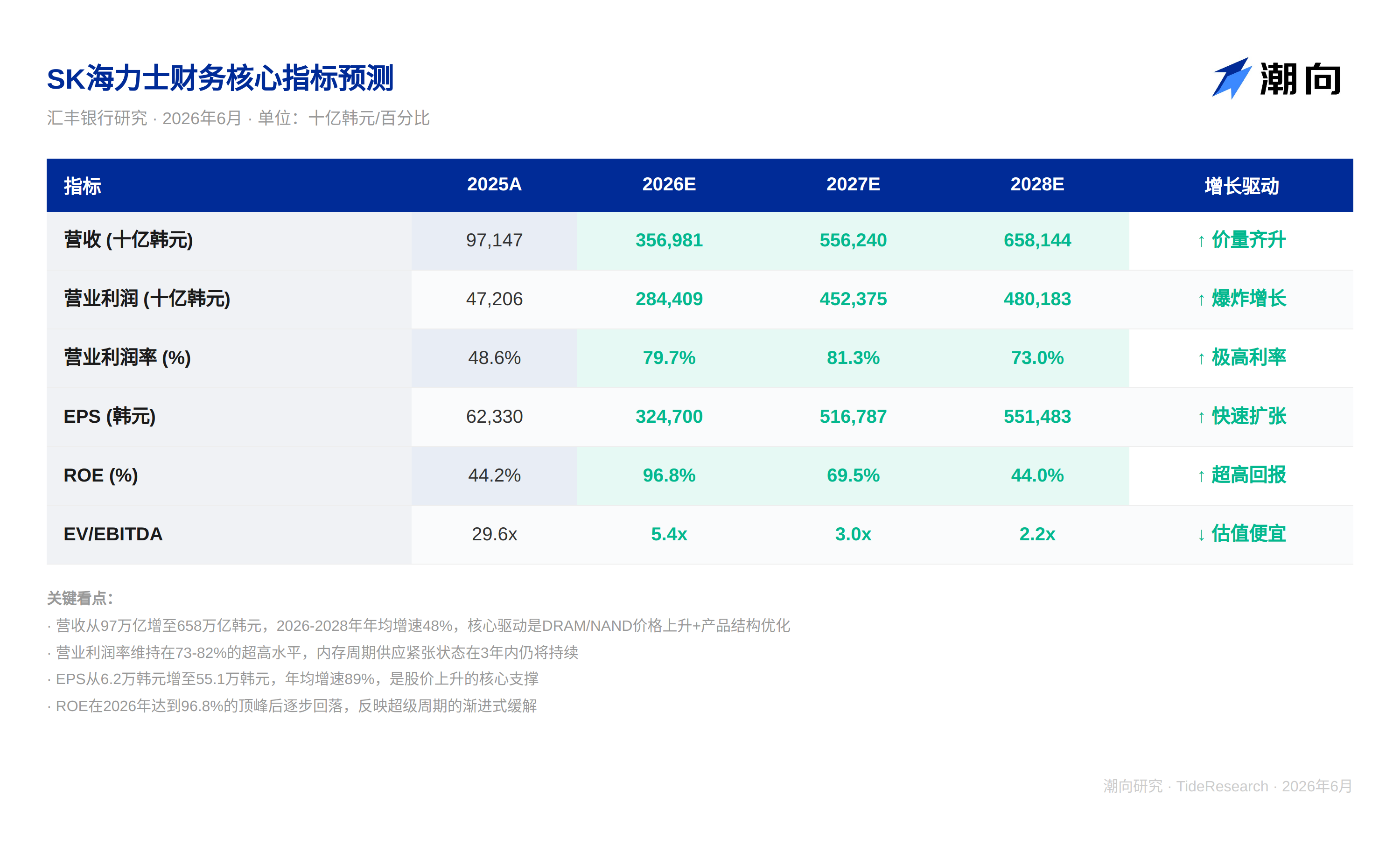
The first is the growth of performance itself. SK Hynix's operating profit is expected to grow fivefold to 284 trillion won in 2026. It will continue to grow in 2027, reaching 452 trillion won. Earnings per share will increase from 62,300 won in 2025 to 324,700 won in 2026, and then to 516,800 won in 2027. Such rapid growth is sufficient to support a high multiple valuation.
The second is the expansion of valuation multiples. SK Hynix's current price-to-book ratio is 5.4 times, which is not outrageous in the memory industry. However, HSBC believes there is still room for growth. Referring to Micron, this American memory manufacturer has enjoyed an average valuation premium of 35% over SK Hynix over the past 13 years. Therefore, HSBC has raised SK Hynix's target price-to-book ratio from 2.8 times by 20% to 3.4 times. This adjustment may sound conservative, but the key point is that the upcoming ADR listing will bring this premium.
The third is the catalyst of the ADR listing. SK Hynix officially submitted the plan to list its ADR on NASDAQ on June 24. The listing itself does not change the company's fundamentals, but it will allow more international investors to directly invest in this company. Historical experience indicates that once US stock investors can buy in more conveniently, valuation premiums often arise.
HSBC's Judgment
HSBC's research report bets on a simple story: memory has completely moved from an oversupply era to an undersupply era.
The fundamental reason for this shift is AI. Before AI, memory manufacturers could stabilize prices by expanding production, which resulted in thin profits. But AI has changed this. AI servers demand far more memory than in any previous cycle. Cloud service providers are frantically expanding the production of AI servers, and the supply of memory cannot keep up with the demand. In this situation, SK Hynix and its peers have no motivation to significantly lower prices, thus maintaining high prices or even causing them to rise.
How long can this logic hold? HSBC believes it can last at least until 2027. The launch of HBM4 in 2027 will provide new premium space. What about 2028? HSBC's forecast shows that profit margins will decrease from 81.3% in 2027 to 73% in 2028. This means that by 2028, competitive pressures may begin to show, with prices likely to start declining, but that is a matter for another time.
Risks and Bottom Line
HSBC also listed downside risks. US interest rate hikes may lead cloud providers to tighten capital expenditures, excessive capacity expansion among memory manufacturers could crush prices, and the spread of geopolitical conflicts in the Middle East could disrupt supply chains. However, these risks are not the primary concern at this time.
SK Hynix's story is a typical case of a memory manufacturer being driven by demand during a supercycle. The certainty of the AI cycle is high, the pricing logic is solid, and combined with the catalyst of the ADR listing, the triple benefits resonate, making a target price of 4 million won justifiable.
Disclaimer
This article is a summary and interpretation of third-party brokerage reports by Tide Research. The ratings, target prices, profit forecasts, and related judgments quoted in this article reflect the views of HSBC analysts and represent the positions of their institution, not those of Tide Research, and do not constitute any investment advice.
Please pay attention to three points when reading: First, the target price is the analyst's expectation for the next approximately 12 months and is a forecast rather than a commitment, and will be repeatedly adjusted based on performance and market conditions. Second, sell-side research reports are inherently biased toward the positive, and some covered companies have investment banking relationships with the brokerage. Third, the value of a research report lies in the main line of logic and its underlying assumptions, rather than any specific target price. Focus on the logic, not just the price.
The market carries risks, and decisions should be made independently. This article should not serve as a basis for buying or selling any securities.
Data Source: HSBC Research Ricky Seo & Han Kil Chang, June 25, 2026 · SEC Financial Report
Tide Research · June 2026
免责声明:本文章仅代表作者个人观点,不代表本平台的立场和观点。本文章仅供信息分享,不构成对任何人的任何投资建议。用户与作者之间的任何争议,与本平台无关。如网页中刊载的文章或图片涉及侵权,请提供相关的权利证明和身份证明发送邮件到support@aicoin.com,本平台相关工作人员将会进行核查。


