Aave's next battle will be ignited in the intertwining of fantasy and reality.
Written by: Jae, PANews
Following UNI, Standard Chartered Bank has made bold claims towards the crypto industry: AAVE is expected to soar 50 times by the end of 2030, reaching $3,500.
Radical rhetoric, exaggerated multiples, combined with a familiar storyline: AAVE's price surged past $80, with a 24-hour increase nearing 20%. The on-chain lending market is buzzing, with some cheering that traditional giants are bullish on AAVE, while others mock Standard Chartered Bank as just another seller swept away in excitement.
Aave's next battle will be ignited in the intertwining of fantasy and reality.
Standard Chartered Forecasts AAVE's 50-Fold Increase with Excel's "K-Line"
If Standard Chartered's AAVE research report can be summed up in one sentence, it would be: the scale of deposits determines the capacity for loans, loan capacity drives fee income, and fee income ultimately translates into token market value. In the past 12 months, approximately 90% of Aave's fee income has come from the net interest margin between deposits and loans.
The traditional valuation framework based on linear mapping logic has also been directly applied by Standard Chartered to lending protocols, and according to their pricing model, AAVE will follow a stair-step increase curve.
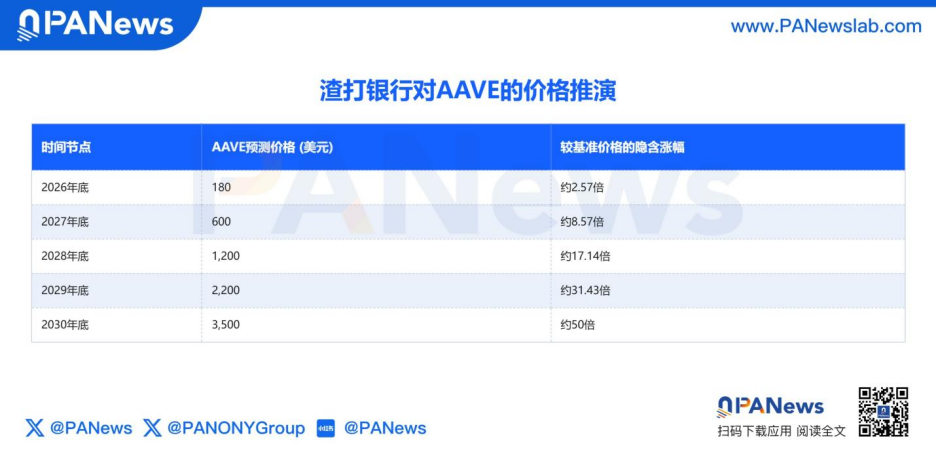
Standard Chartered's assumptions stem from predictions about two major trends in the DeFi sector:
- DeFi TVL (Total Value Locked) is expected to grow 37 times. Standard Chartered predicts that by 2030, the total active assets in DeFi will grow to approximately $27 trillion from the current level, driven by a $2 trillion increase in stablecoin scales and a wave of on-chainization of RWA (Real World Assets).
- The penetration rate of RWA in DeFi will increase from 3.5% to 30%. This means that trillions of dollars worth of traditional assets will flow into on-chain lending protocols.
Looking back at the peak period in October last year, Aave managed up to $75 billion in deposits. If regarded as a traditional bank, this volume would place it among the top 35 banks in the United States.
Standard Chartered believes Aave's business efficiency far exceeds that of traditional banks, which rely on physical locations and redundant manpower. Once the tokenization wave comes, Aave will capture the benefits of RWA on-chain through its Horizon licensed lending market and the rates of its stablecoin GHO, transforming them into real protocol income.
Regarding the capital flight triggered by the KelpDAO rsETH bridge security incident in April this year, Standard Chartered labeled it as a brief fluctuation in a bottom-forming phase rather than a collapse of the long-term fundamentals of the protocol.
Even setting aside long-term narratives and returning to a medium-term perspective, Aave's fundamentals are still stable enough.
On June 18, Grayscale released a deep report on Aave, applying the traditional financial DCF (Discounted Cash Flow) model and P/E (Price/Earnings Ratio) method to the valuation of DeFi protocols for the first time.
The conclusion drawn by Grayscale is that AAVE is a typical cash flow-driven asset, currently priced in the undervalued range.
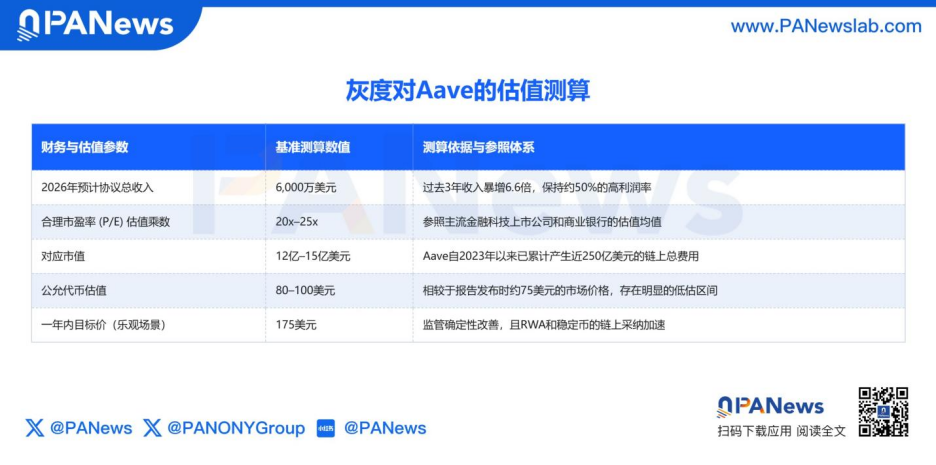
Grayscale emphasized that Aave's total protocol income for 2025 will reach $142 million, boasting a healthy cash flow. More importantly, the token buyback and burn program initiated by Aave DAO last April, along with the "Aave Will Win" proposal for transferring product earnings to token holders, has established a mechanistic pathway for "protocol revenue generation → token appreciation."
Monopolizing 80% of profits with half the TVL of the same sector, some idle funds become Achilles' heel
Beyond the macro picture painted by institutional capital, Aave has also established a deep moat at the micro level.
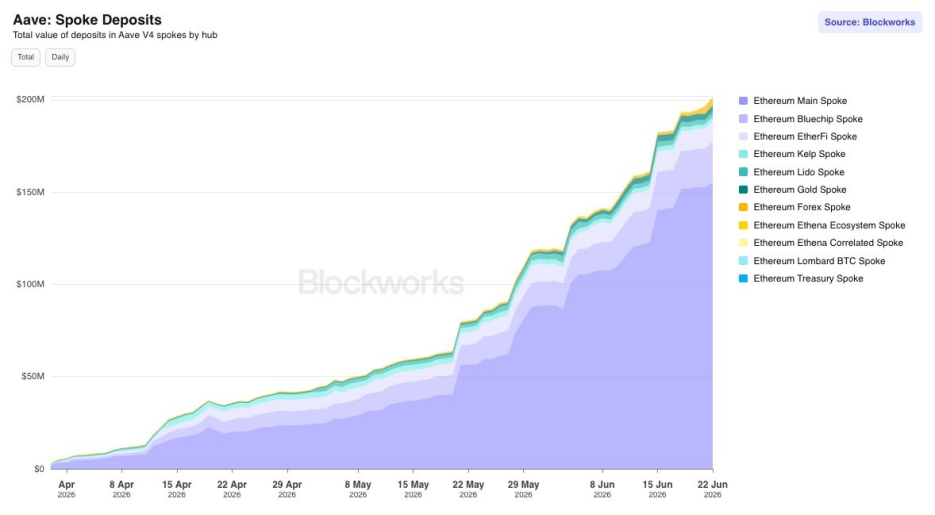
Firstly, the unexpectedly successful breakthrough of the new generation technology architecture, Aave V4. As the largest underlying architecture rewrite for the protocol since 2020, V4 has utilized the "liquidity hub + spokes" design to break the past island effect of single-chain liquidity. To date, V4's total deposits have exceeded $200 million, with loan volumes nearing $60 million.
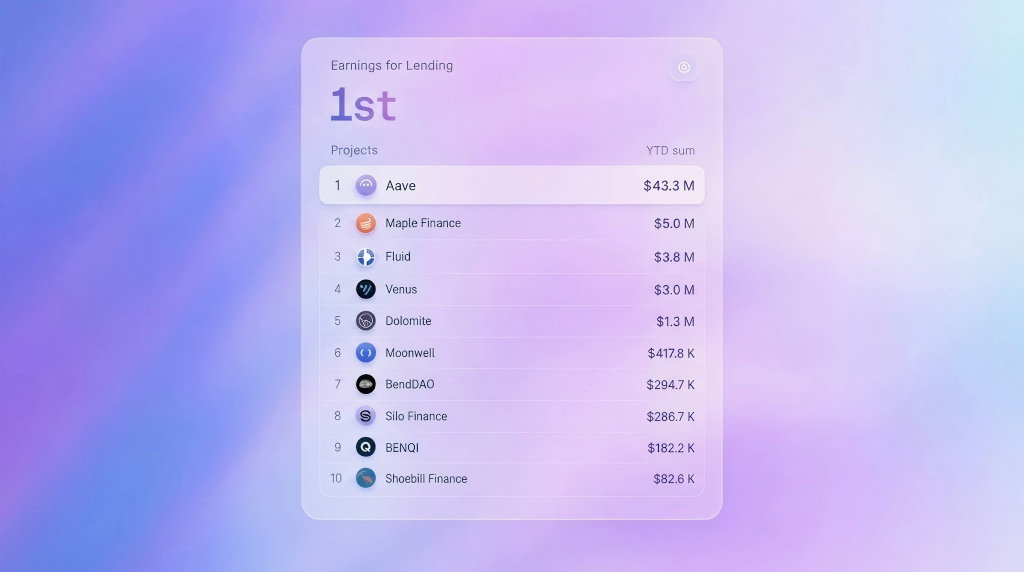
Even more striking is its profitability. The on-chain data analysis firm MSB Intel pointed out that from the beginning of the year to now, Aave has generated approximately $43.3 million in "protocol retained earnings" in the lending sector, accounting for 80.7% of the entire sector's profits. Protocols like Maple Finance, Fluid, and Venus are far behind, with individual profits not exceeding $5 million, making them not even on the same scale.
In the traditional business world, a company's quality often depends on net profit rather than total assets. Retained earnings are an indicator that truly reflects the net revenue-generating capacity of the protocol chain, after deducting related operating costs and token inflation incentives.
In other words, Aave has captured over 80% of the system's net profit with about half of the TVL of the entire sector. This nearly monopolistic profit structure is one of the firmest cornerstones of Standard Chartered's 50-fold prediction.
On the flip side of the coin, structural issues proposed by crypto research firm Delphi Digital still remain unresolved. The root of the problem lies in Aave's Peer-to-Pool lending model.
According to Delphi Digital's calculations, in the three main markets of WETH, USDT, and USDC, Aave incurs an annual implicit loss (Deadweight Loss) of up to $52 million due to idle funds, an amount almost equivalent to half of its annualized net income for Q1 2026.
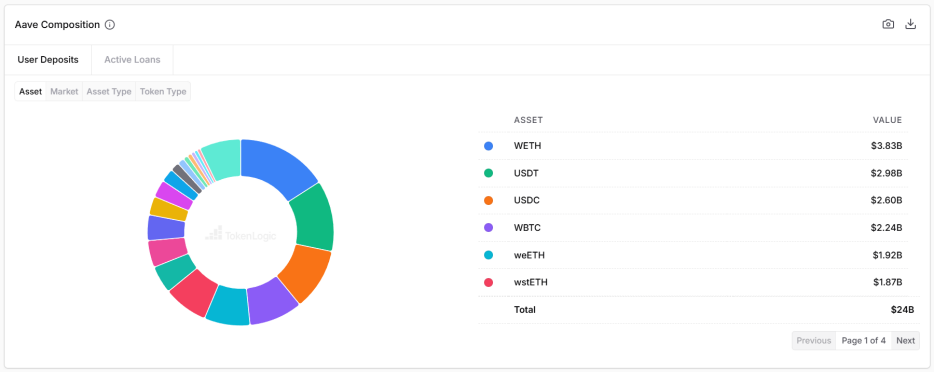
The systemic disconnect between deposit rates and borrowing rates is an inherent flaw of the Peer-to-Pool model. To ensure that depositors can redeem at any time without loss, Aave must maintain a large idle liquidity buffer within the fund pool. This results in depositors receiving rates that are typically 25% to 35% lower than what borrowers pay. The difference represents the opportunity cost of idle funds. Even if the DAO governance layer sets the reserve ratio to 0, the implicit loss from idle funds would still reach $36 million.
The KelpDAO incident in April further revealed the fragility of this model. After hackers siphoned nearly $200 million in WETH, the utilization rate of the WETH fund pool was locked at 100% for five days, leaving ordinary deposit users unable to withdraw or participate in liquidation, leaving Aave with a scar that has yet to heal.
This structural flaw makes Aave susceptible to "upstream risks," and combined with its inherent low capital efficiency, gives latecomers an opportunity to break through. Emerging lending protocols represented by Morpho, featuring modular isolation, peer-to-peer matching, and minimalist underlying design, are eating away at Aave's market share from the efficiency side, becoming its strongest challenger beneath the throne.
Looking back at the midpoint of 2026, Aave stands at the corner of fantasy and reality.
The "3500 dollars" pie chart drawn by Standard Chartered reflects traditional finance's ambition for asset on-chainization. Compared to the growth in TVL figures, Aave's future focus will be on identifying a feasible path to support a trillion-dollar asset scale.
The throne of DeFi lending still stands, but the foundation beneath it requires a reconstruction or reinforcement.
免责声明:本文章仅代表作者个人观点,不代表本平台的立场和观点。本文章仅供信息分享,不构成对任何人的任何投资建议。用户与作者之间的任何争议,与本平台无关。如网页中刊载的文章或图片涉及侵权,请提供相关的权利证明和身份证明发送邮件到support@aicoin.com,本平台相关工作人员将会进行核查。


