Author: Mike Kalil
Translated by: Felix, PANews
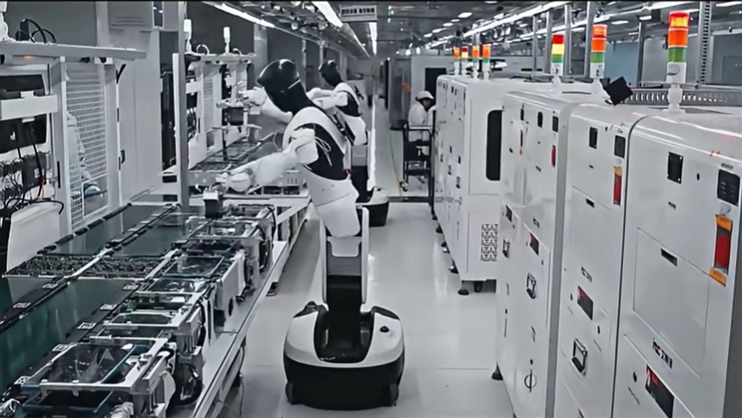
In China, a batch of AI-driven humanoid robots is autonomously working on a tablet assembly line, a live-streaming event considered a first in the industry.
During this historically significant multi-day live stream, these humanoid robots conducted quality inspection tasks alongside human colleagues. They were developed by a startup founded only three years ago, whose rise is putting significant competitive pressure on top global robotics firms.
As investors pour tens of billions of dollars into redefining the future of work, this may signal the direction of future factories. In the gold rush of AI in the physical field, robotics companies are taking bold steps to prove that their machines are ready for real-world application.
Businesses are beginning to assign robots to tasks long considered too difficult, too intricate, and too variable to automate. Within increasingly complex workflows, various types of robots are becoming more adept at collaborating. As they become smarter, they are learning in ways that increasingly mimic human behavior, but at a scale no individual or workforce can match.
AgiBot's Six-Day Live Show
In Shanghai, emerging robotics startup AgiBot launched what is considered a first in the industry with a live stream showcasing a series of autonomous humanoid robots operating on a real tablet production line.
Founded in February 2023 by former Huawei "genius youth" Peng Zhihui, the company claims it plans to produce over 10,000 robots in the first half of 2026. Reports indicate that AgiBot is actively expanding its global business and plans to go public in Hong Kong along with competitors like EngineAI and Pudu Robotics from Shenzhen as well as Galbot from Beijing.
The rise of AgiBot poses a challenge to Unitree Robotics, headquartered in Hangzhou, as well as Western companies like Figure AI. Unitree Robotics was once the global leader in humanoid and quadrupedal robots by 2025.
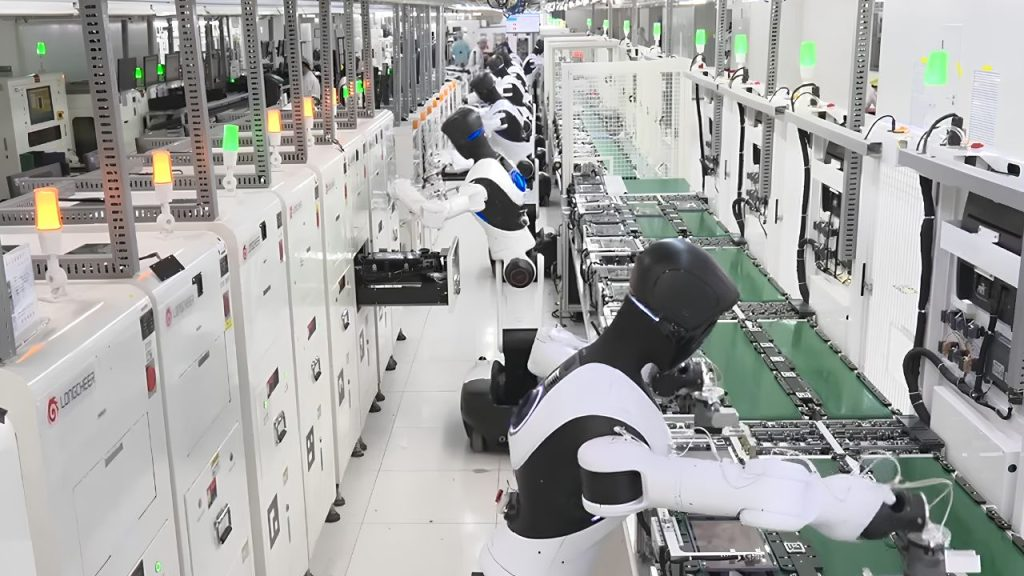
Source: AgiBot
Weeks after the Silicon Valley company Figure gained fame from its multi-day live stream, AgiBot initiated its own six-day broadcast. Figure's live stream showcased a small batch of bipedal humanoid robots Figure 03 taking turns sorting packages in a simulated logistics scenario. They worked continuously 24/7 for eight days in a controlled environment. When one robot's battery ran low after about four hours of work, it would automatically walk to the charging station, while another robot took over its task.
In contrast, AgiBot's live stream featured a larger scale of wheeled dual-arm mobile robotic systems. They collaborated with humans in a tablet manufacturing factory of Nanchang Longqi Technology. They worked standard factory shifts from 8:00 am to 6:00 pm (including lunch breaks), primarily conducting quality inspections.
The robots on the tablet assembly line are AgiBot's G2 model, designed for industrial applications. Standing 1.7 meters tall and weighing up to 100 kilograms, the G2 reportedly has 26 degrees of freedom and can integrate an optional dexterous robotic hand.
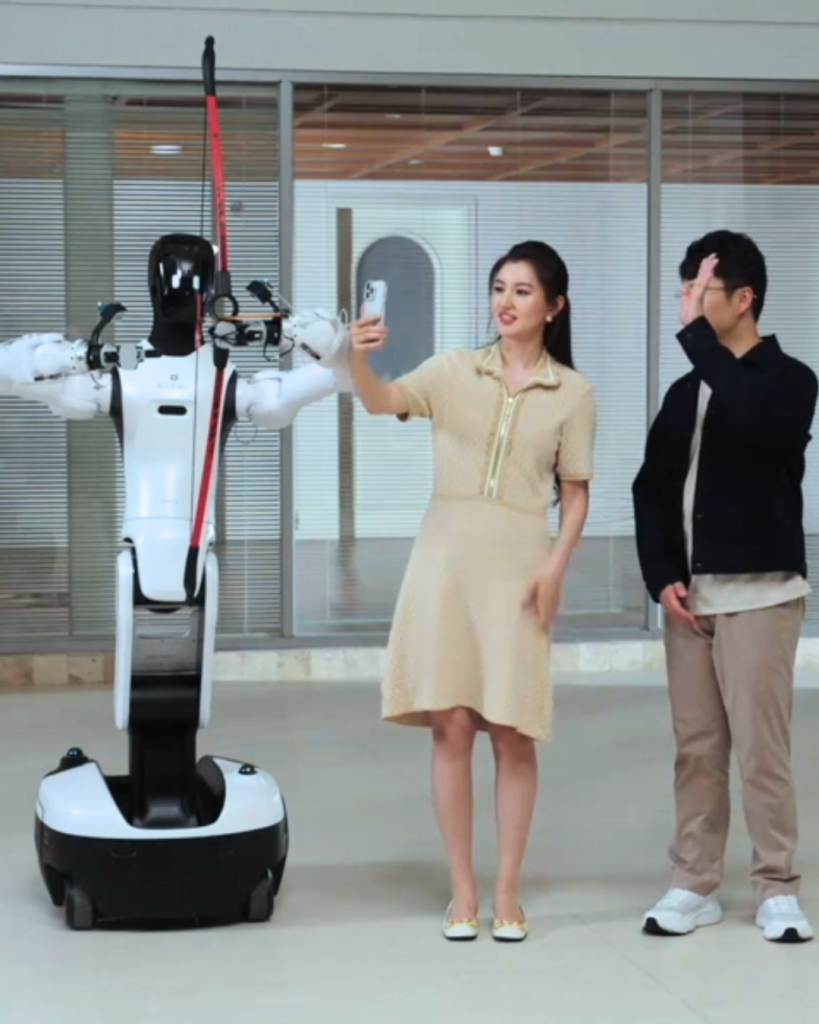
During the live stream announcement, the AgiBot G2 was preparing to shoot an arrow at a pink balloon (Source: AgiBot)
This humanoid robot is equipped with AgiBot's self-developed AI system, which integrates motion, interaction, and operational intelligence into a unified architecture. Reportedly, the G2 can continuously improve its performance through reinforcement learning in the real world and a large dataset from its world model Agibot World.
The robot is designed to operate around the clock, with its wheeled base featuring a hot-swappable battery. Each charge supports 4 to 8 hours of continuous operation, depending on payload and movement intensity. The battery can be replaced within minutes without shutting down the robot. However, currently, it cannot autonomously replace itself like UBTECH's Walker S2, Hexagon's AEON, and Boston Dynamics' Atlas.
Working in the Longqi assembly line, the robots use dedicated robotic arms to fetch tablets, perform inspections using sensors, and then place them into trays. This manufacturer produces electronic products for tech giants like Xiaomi, Samsung, and Lenovo.
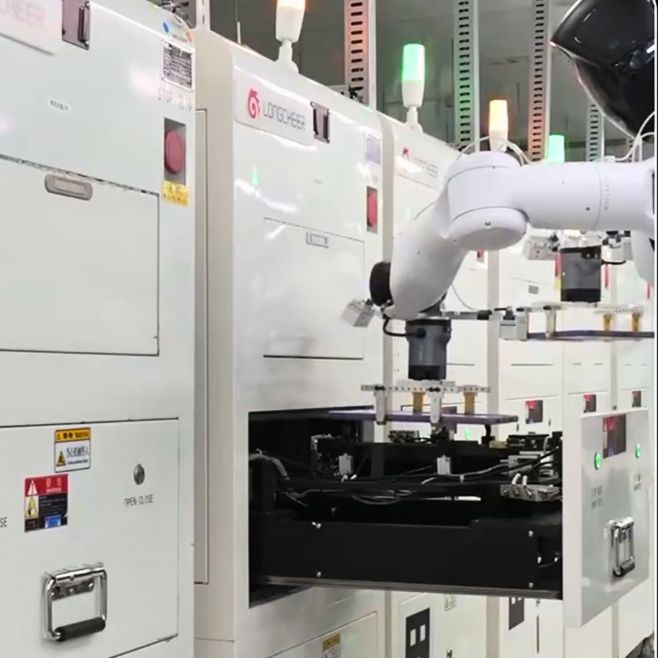
AgiBot G2 humanoid robot's gripper (Source: AgiBot)
Reports indicate the starting price for AgiBot's G2 is around $138,000, making it one of the more affordable options currently for factory deployment.
The most attention-grabbing product from this startup is the Lingxi X2 robot, which has a starting price of about $13,000 (with high-end models nearing $50,000). The X2 stands 1.3 meters tall and weighs 34 kilograms, designed for light operations and entertainment applications. However, AgiBot recently shared a video of its high-end model moving a mini refrigerator in a controlled environment.
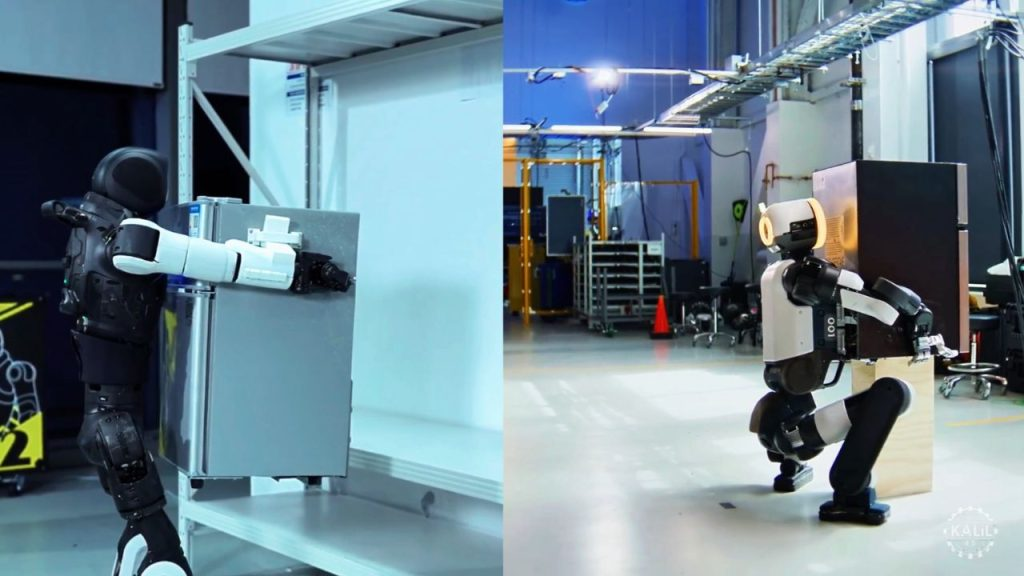
AgiBot's X2 (left) and Boston Dynamics' Atlas lifted mini refrigerators in different demonstrations (Source: AgiBot/Boston Dynamics)
This is clearly a direct "shout-out" to Boston Dynamics. Just the week before, the Massachusetts robotics company showcased a similar task performed by Atlas, its humanoid robot.
Both demonstrations have the same overall concept but feature some key differences. In Boston Dynamics' demo, Atlas grabbed a mini refrigerator with its dexterous robotic arm, causing noticeable damage in the process; whereas AgiBot's X2 used a customized handle on the refrigerator to lift it with its robotic arm. Additionally, the refrigerator handled by Atlas appeared larger than the one in AgiBot's lab.
However, Atlas also weighs more than twice the X2 at 90 kilograms. Its height is also significantly greater than the X2, nearly 2 meters. Both robots leverage their built-in AI, using extensive simulated training and real-time sensor feedback to perform tasks, but Atlas has the advantage of its extraordinary rotational joints.
Currently, as AgiBot plans to achieve a production target of 20,000 robots by 2026, you are more likely to see AgiBot's humanoid robots in public. Boston Dynamics is also actively promoting its Atlas, along with its other well-known robots Spot and the logistics solution Stretch, to the labor market. Reports indicate that its parent company Hyundai is seeking to acquire Boston Dynamics outright to achieve a production capacity of 30,000 robots.
Sanctuary AI Claims Breakthrough in Wiring Technology
Canadian startup Sanctuary AI claims they have trained a Universal Robots dual-arm collaborative robot system to successfully complete one of the most difficult automation tasks in automotive manufacturing.
Sanctuary AI is best known for the universal humanoid robot Phoenix, but the company is now expanding its business into all fields of industrial robotics. They are developing a physical AI model called Carbon, suitable for robots of various shapes and sizes.
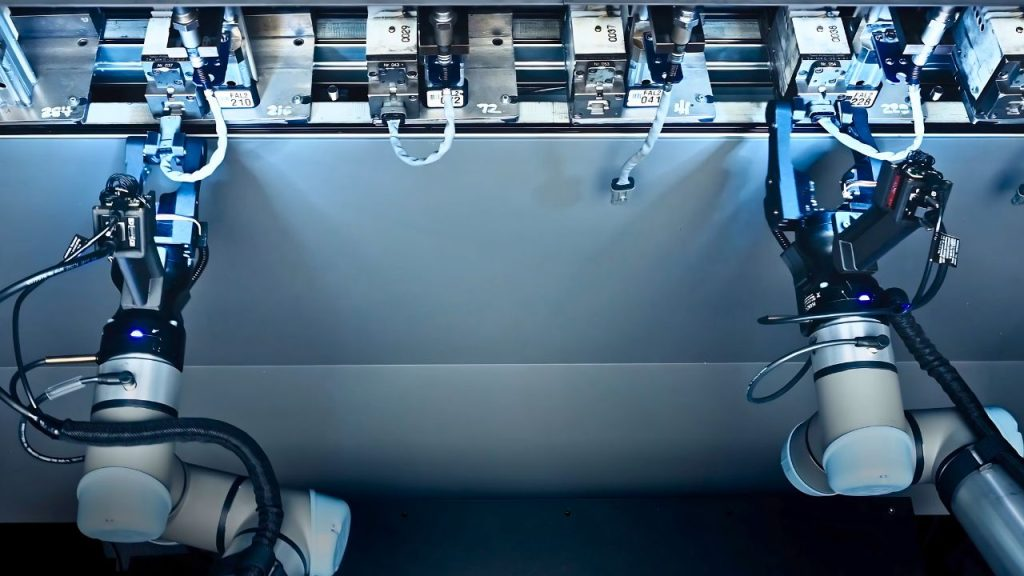
Sanctuary AI claims its Carbon AI model empowers this dual-arm collaborative robot system to perform wiring and connector insertion tasks in automotive manufacturing (Source: Sanctuary AI)
This Vancouver-based robotics company shared a video of UR robots performing wiring and connector insertion tasks for a Tier 1 automotive supplier. While it's easy for humans to repeatedly insert connectors, it poses a significant challenge for robots due to their limited flexibility.
Sanctuary stated that the system achieved a success rate of over 99.5%, completing the task in an average of 2.5 seconds. This means its performance is quick and reliable enough to meet the production line needs of the unnamed customer.
MindOn Tech's Universal AI Robotic Brain
Another startup focusing on developing a universal AI robotic brain is "MindOn Tech," which recently released a demonstration video showing a group of humanoid robots and collaborative robots completing logistics workflows.
Founded in 2025 by former Tencent researchers, the Shenzhen-based company claims these robots can operate completely autonomously. In the video, a Unitree G1 humanoid robot retrieves items from a cargo box and places them on a conveyor belt, where two dual-arm collaborative robots package them for shipping. After the packaging is completed, another Unitree bipedal robot takes the items ready for shipment. The packaging bears the Amazon Prime branding, but there is currently no evidence to suggest an official partnership between the two parties.
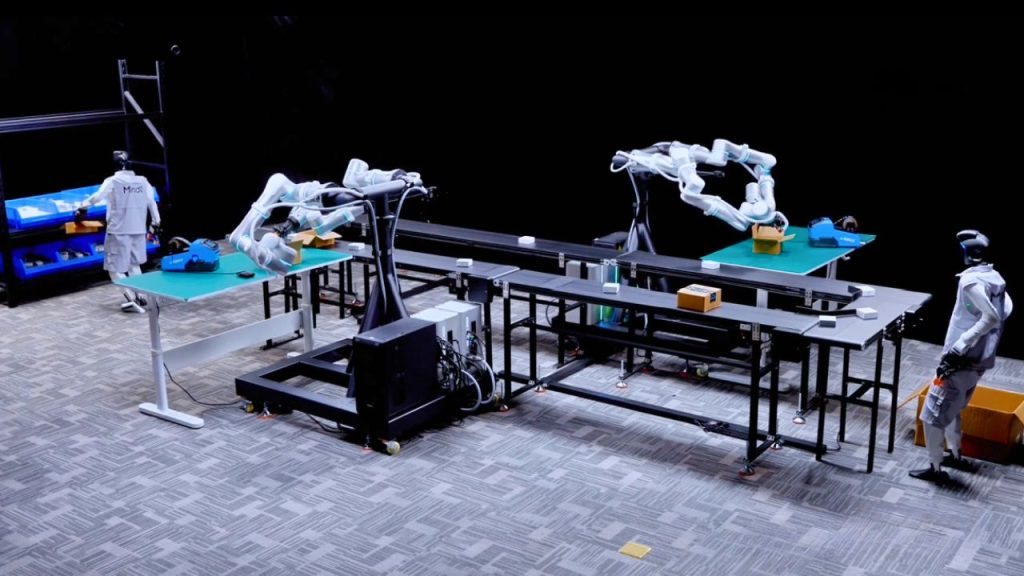
MindOn Tech's demonstration video shows humanoid robots and collaborative robots working together using the same AI brain (Source: MindOn Tech)
MindOn Tech stated its Mind0 model is trained on human-centered data. This data includes human-centered video recorded by head-mounted cameras, operational data captured by handheld gripping devices, and full-body motions tracked by motion capture suits. Additionally, the model incorporates a small amount of physical robot testing data to narrow the gap between simulated behaviors and behaviors in the real world.
This startup claims that Mind0 is an early version of the system. They plan to further enhance the scale, intelligence, and versatility of the AI robotic brain, enabling robot teams to undertake longer and more complex tasks in factories, warehouses, and even in households.
EgoEngine Makes Videos More Useful for Robots
Currently, various laboratories are exploring how to utilize the vast array of video material available on the internet. For example, researchers at Georgia Tech have just launched an AI system named EgoEngine, which can train robots' operational skills using existing first-person perspective video clips.
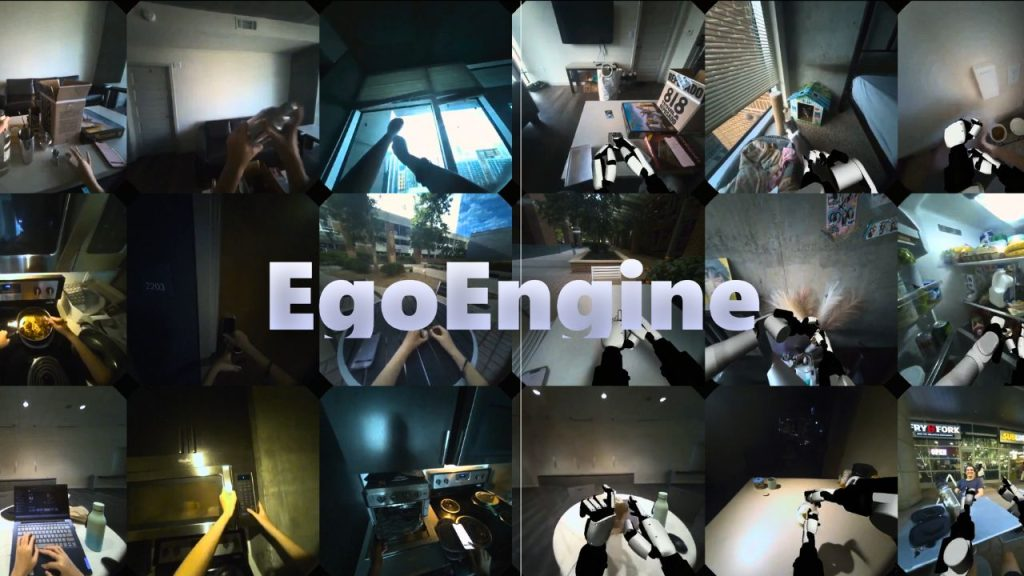
EgoEngine GitHub homepage
The potential scale could be massive, with YouTube alone seeing over 20 million video uploads daily. Even if only a tiny fraction are self-centered videos, this represents tens of millions of videos available to teach robots various skills, from cooking to electronic product assembly.
EgoEngine first identifies and removes human arms and hands from each video frame. It then reconstructs the scene in a digital twin model, generating new videos of robots performing the same tasks. Human actions are converted into robotic motion data and optimized to ensure that the robot can safely execute those actions.
Researchers tested the system using Rainbow Robotics' dual-arm robotic arm, equipped with two five-fingered robotic hands. They stated that the system's performance is nearly as excellent as that of robots trained through remote operation.
UC Berkeley and NVIDIA's Jointly Developed T-Rex System
Researchers at UC Berkeley and NVIDIA have developed a new AI system that utilizes self-centered recordings to bring a robot's eye-hand coordination closer to human levels.
They tested this system, named T-Rex, on the Dexmate Vega-1 robot, which integrates Sharpa's Wave robotic hand. The Wave robotic hand is among the most advanced end effectors on the market, reportedly boasting 22 degrees of freedom for each actuator.
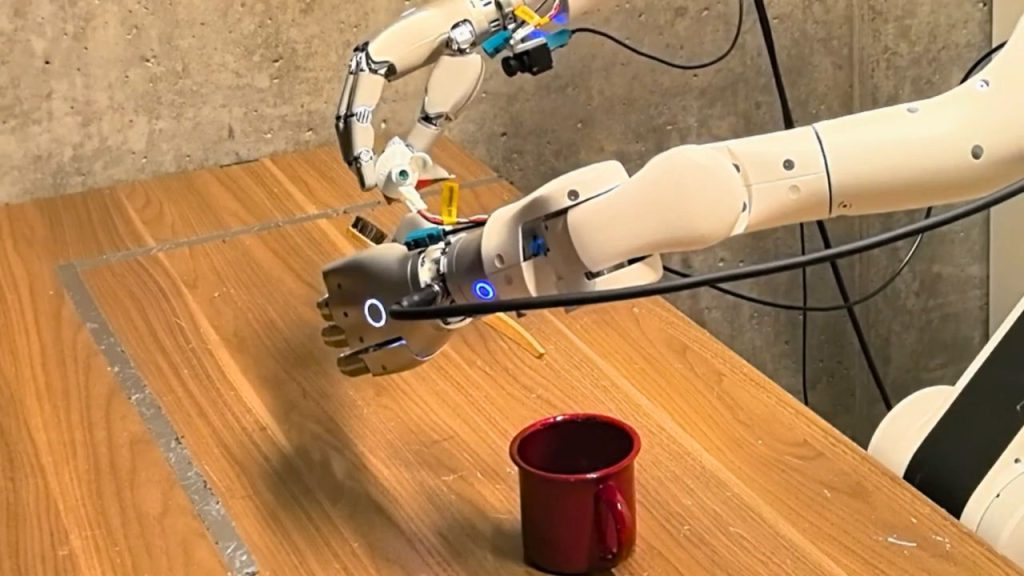
T-Rex system training Sharpa Wave robotic hand
According to the researchers, T-Rex successfully completed 12 tasks that required a high level of tactile manipulation, such as squeezing toothpaste onto a toothbrush and screwing in light bulbs. It operated autonomously using an AI brain trained on over 22,000 hours of first-person video and 100 hours of tactile data.
The robot follows natural language instructions, using its head-mounted camera to comprehend scenes and its wrist-mounted camera to monitor each hand's movements. Simultaneously, tactile sensors in its hands continuously measure changing forces.
T-Rex tracks these signals' instantaneous changes, and its so-called "Transformer mixed architecture" functions like a team working together, composed of multiple specialized AI agents. One agent is responsible for planning the humanoid robot's actions, while another agent utilizes touch to make quick corrections.
T-Rex achieved an average success rate of 65%, about 30% higher than the current most advanced systems. However, the team indicated that this technology still requires more advanced sensors and more precise controls for fully autonomous operation.
Researchers from Stanford University, Panasonic, the University of Rome, and ItalAI also participated in this research.
Related Reading: Not just doing backflips, Boston Dynamics' humanoid robot Atlas has started to "work."
免责声明:本文章仅代表作者个人观点,不代表本平台的立场和观点。本文章仅供信息分享,不构成对任何人的任何投资建议。用户与作者之间的任何争议,与本平台无关。如网页中刊载的文章或图片涉及侵权,请提供相关的权利证明和身份证明发送邮件到support@aicoin.com,本平台相关工作人员将会进行核查。


