Author: Jae, PANews
Since its listing seven trading days ago, the daily stock performance of SpaceX has consistently tugged at the nerves of the capital market. On June 23, SPCX closed with a slight increase of 0.98%, ending a three-day downward trend, but it still remained below the initial price, with its market value having evaporated by nearly $400 billion compared to the peak after listing.
However, the significant shake-up did not deter many investors. "Wall Street's goddess of stocks," Cathie Wood’s ARK Invest increased its holdings of SPCX by about $32.5 million against the trend. Additionally, SpaceX will be included in the Bloomberg global stock index's large-cap segment by the close on June 24.
The strong interest from leading institutions and mainstream indices indicates that SpaceX remains a "favorite" among capital. Although SPCX has fallen back since its high after listing, its average daily trading volume still maintains around $40 billion, and this historically largest IPO company has also catalyzed the development of the tokenized stock track.
Today, the tokenized stock track has evolved into a diverse symbiotic pattern. The decentralized exchange (DEX) on the Solana network has nearly swallowed all market share, with SPCX consistently ranking among the top three in trading volume on Solana.
In centralized exchanges (CEX), mainstream trading platforms such as Binance, Bybit, Gate, and Backpack are rapidly entering the market through partnerships with third-party issuers and brokers or operating their own platforms.
Standing at the crossroads of traditional finance and crypto innovation, SpaceX is undoubtedly a classic case for crypto players to observe and deconstruct the evolution route of the tokenized stock track.
Solana dominates the tokenized stock on-chain market, Ondo establishes a multi-chain liquidity network
Although SpaceX is listed on Nasdaq, it has brought a practical exercise of integrating traditional stocks into the on-chain ecosystem.
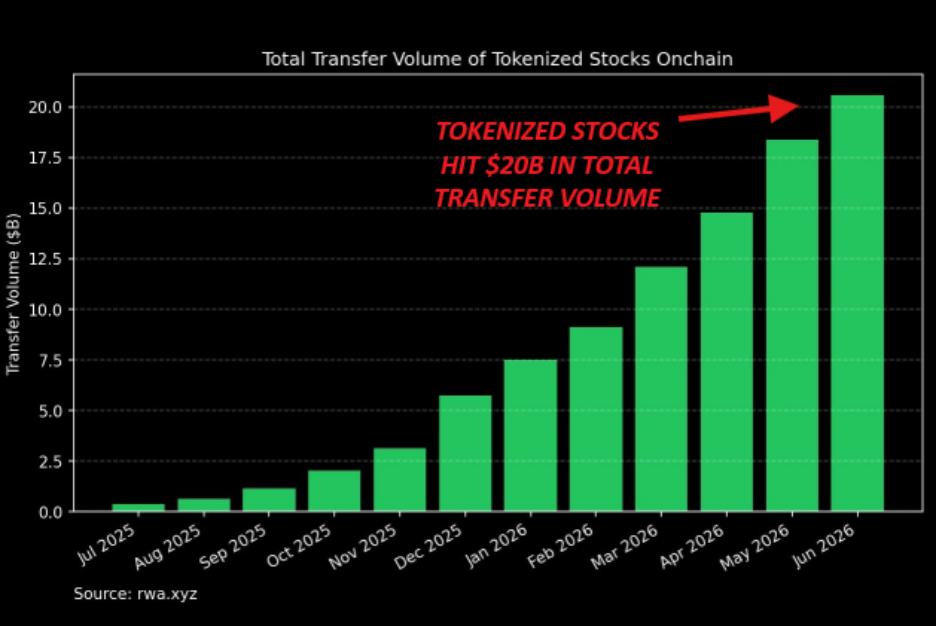
After its IPO, the DeFi market quickly absorbed vast trading demands. According to The Kobeissi Letter, the total trading volume of on-chain tokenized stocks first exceeded $20 billion on June 17. Over the past 30 days, the trading volume in this sector reached $4.3 billion, setting a monthly historical high with a year-on-year growth of over 140%.
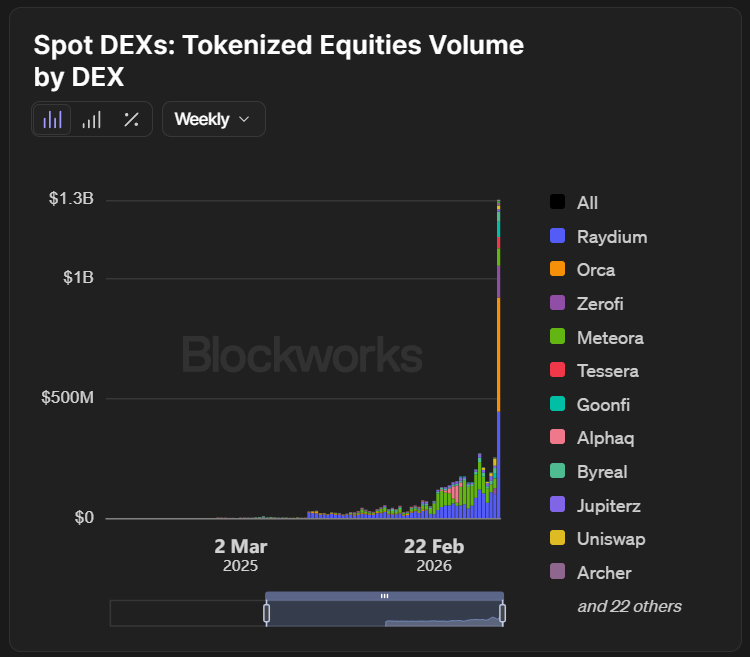
The SpaceX IPO effectively drove explosive growth in on-chain tokenized stock trading volume, with Solana becoming the leader in this relay race. In the past week, the trading volume of tokenized stocks on the Solana chain skyrocketed sixfold to over $1.3 billion, capturing about 98% of the market share. Notably, mainstream DEXs like Orca, Raydium, Zerofi, and Meteora accounted for a total of 78% of the total trading volume, showcasing a significant Matthew effect.
On the other hand, the leading RWA (real-world asset) tokenization protocol Ondo Finance has also demonstrated sensitivity as an established player. When SPCX first began trading, its tokenized asset SPCXon was simultaneously launched on Ondo Global Markets, supporting the three major public chains: Solana, Ethereum, and BNB Chain. Each SPCXon token is anchored 1:1 to SpaceX common stock, providing non-U.S. investors with a channel to configure assets on-chain.
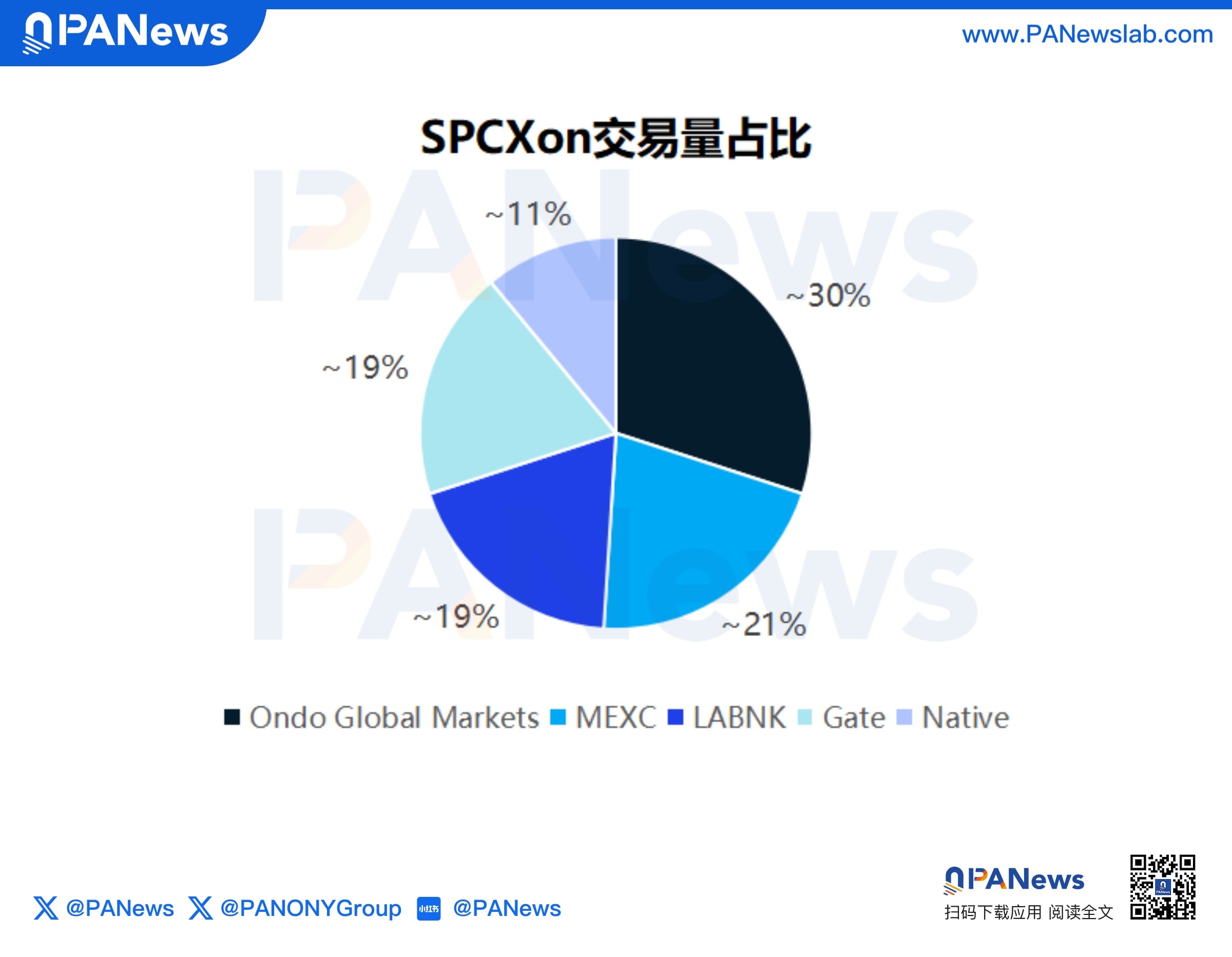
To further develop the liquidity network, Ondo also integrated the DEX aggregator 1inch. According to CoinGecko data, the 24-hour trading volume of SPCXon tokens remains stable at around $3 million, making it one of the most mainstream on-chain SpaceX mapped assets. According to PANews estimates, Ondo Global Markets ranks first with about 30% market share of SPCXon; MEXC, LBANK, and Gate form the second tier, collectively accounting for nearly 60%; DEX Native holds about 10% of the market.
Essentially, the on-chain ecosystem addresses two inherent pain points of the traditional U.S. stock market: first, geographical and threshold limitations, enabling non-U.S. users to participate in trading top assets using stablecoins; second, time limitations, with uninterrupted trading available 24/7, filling the pricing gaps around pre-market and after-hours trading.
The response speed on-chain is unmatched by traditional finance. Simply put, before Nasdaq opens, the tokens can already be traded; after Nasdaq closes, on-chain price discovery continues.
Mainstream CEX focuses on spot trading, Backpack runs a "proprietary trading"
CEX is also an important scene for SpaceX's tokenized trading. Currently, CEX factions' stock spots belong to different types, issuers, and clearing systems.
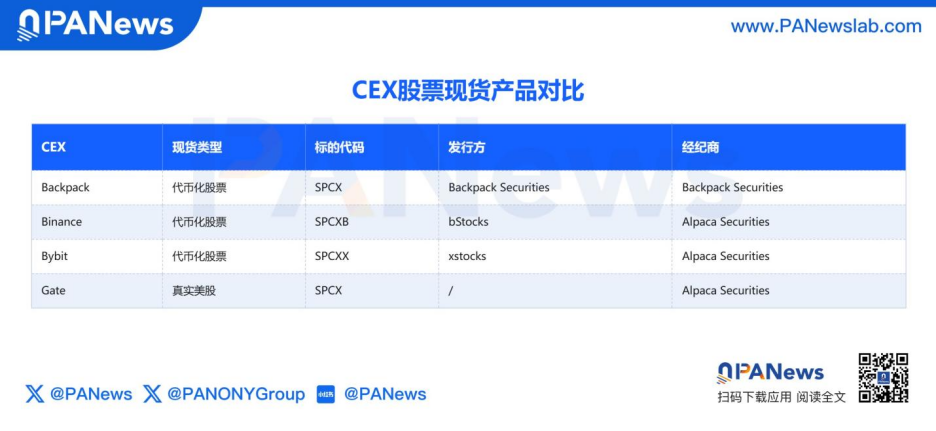
Depending on the cooperative channel, CEX's tokenized stocks are mainly divided into two types of play styles.
The first is relatively conventional, integrating licensed clearing brokers of U.S. stocks, focusing on the main business of spot trading.
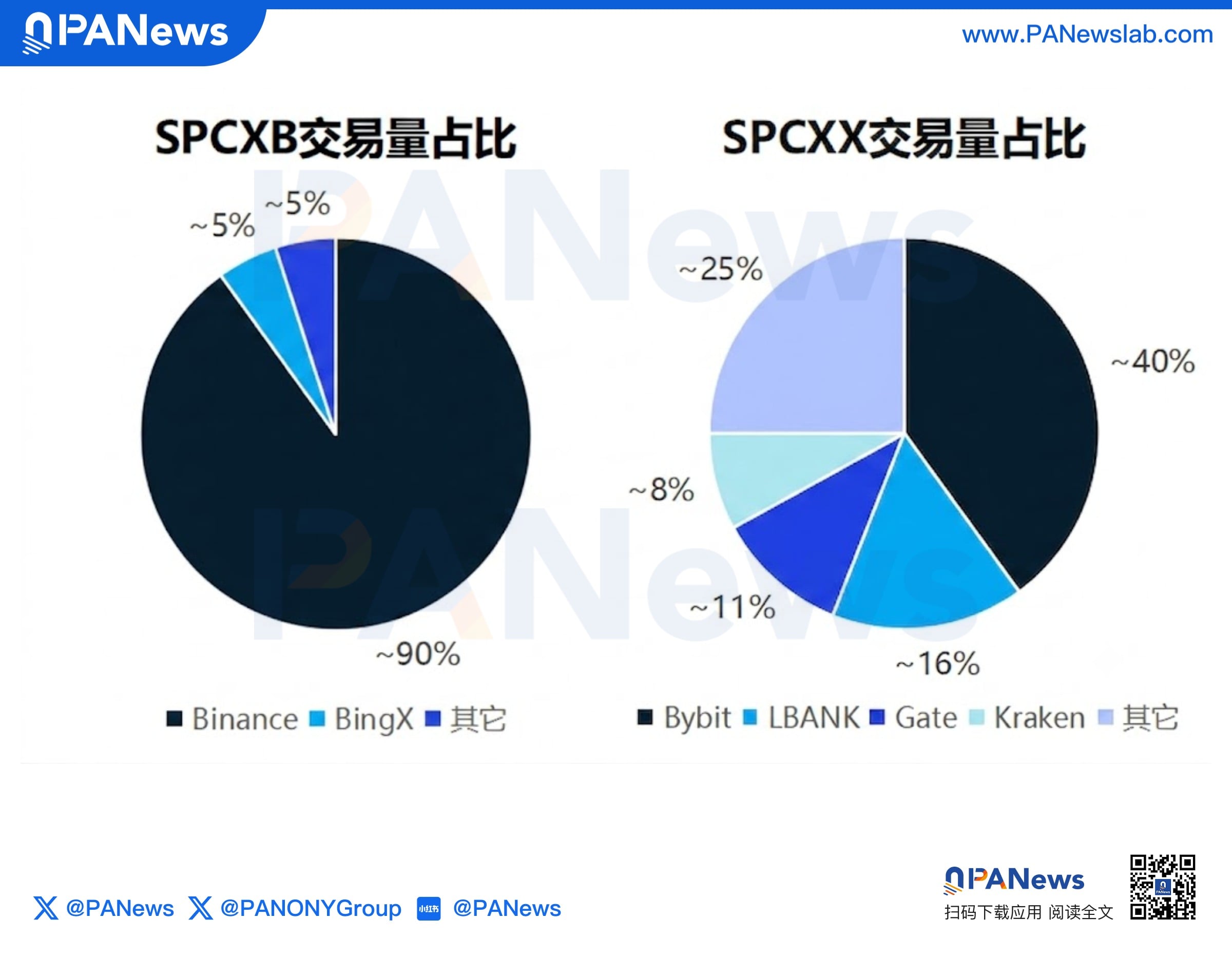
The SPCX performance on Nasdaq also continues into the CEX arena. According to PANews observations, the competition in the CEX market is mainly concentrated on SPCXB (issued by bStocks) and SPCXX (issued by xStocks). CoinGecko data shows that SPCXB's trading volume in the past 24 hours exceeded $56 million, while SPCXX was close to $17 million, only about one-third of the former.
Among them, SPCXB exhibits typical "monopolistic" characteristics, with Binance holding a dominant position with nearly 90% market share, while BingX and other trading platforms collectively account for only about 10%; the trading volume distribution of SPCXX shows a pattern of "one strong leader and many strong followers," with Bybit holding about 40% market share, showing a clear leading advantage; LBANK, Gate, and Kraken collectively contribute about 35%, forming the backbone of trading activity.
Another is the "proprietary trading" type, with the typical case being Backpack's own compliant brokerage, Backpack Securities, which acts as a "bilateral bridge" for SPCX between on-chain and off-chain markets.
Backpack Securities is a licensed entity regulated by U.S. financial authorities; it launched fully collateralized tokenized stocks SPCX (Backpack) on Solana in collaboration with the liquidity gateway protocol Sunrise, with each token corresponding to one share of SpaceX physical stock held at a compliant institution.
The most groundbreaking aspect of this mechanism lies in the de-intermediation and cross-platform bidirectional redeemability. Generally speaking, CEX needs to access self-clearing brokers like Alpaca to redeem tokenized stocks back into underlying U.S. stocks before transferring them to other securities trading platforms.
In contrast, holders of SPCX (Backpack) can directly redeem the tokenized stocks and transfer them into traditional brokerage accounts such as Interactive Brokers or Charles Schwab through traditional securities markets' ACATS (Automated Customer Account Transfer Service) and DTCC (Depository Trust & Clearing Corporation) clearing systems. This also means that SPCX (Backpack) is the on-chain certificate of the real stock SPCX, allowing asset ownership to flow freely between on-chain and off-chain.
According to Backpack, during the week of the SpaceX IPO, SPCX (Backpack) traded up to $439 million on Solana, accounting for 91.7% of the total trading volume of SpaceX tokenized stocks.
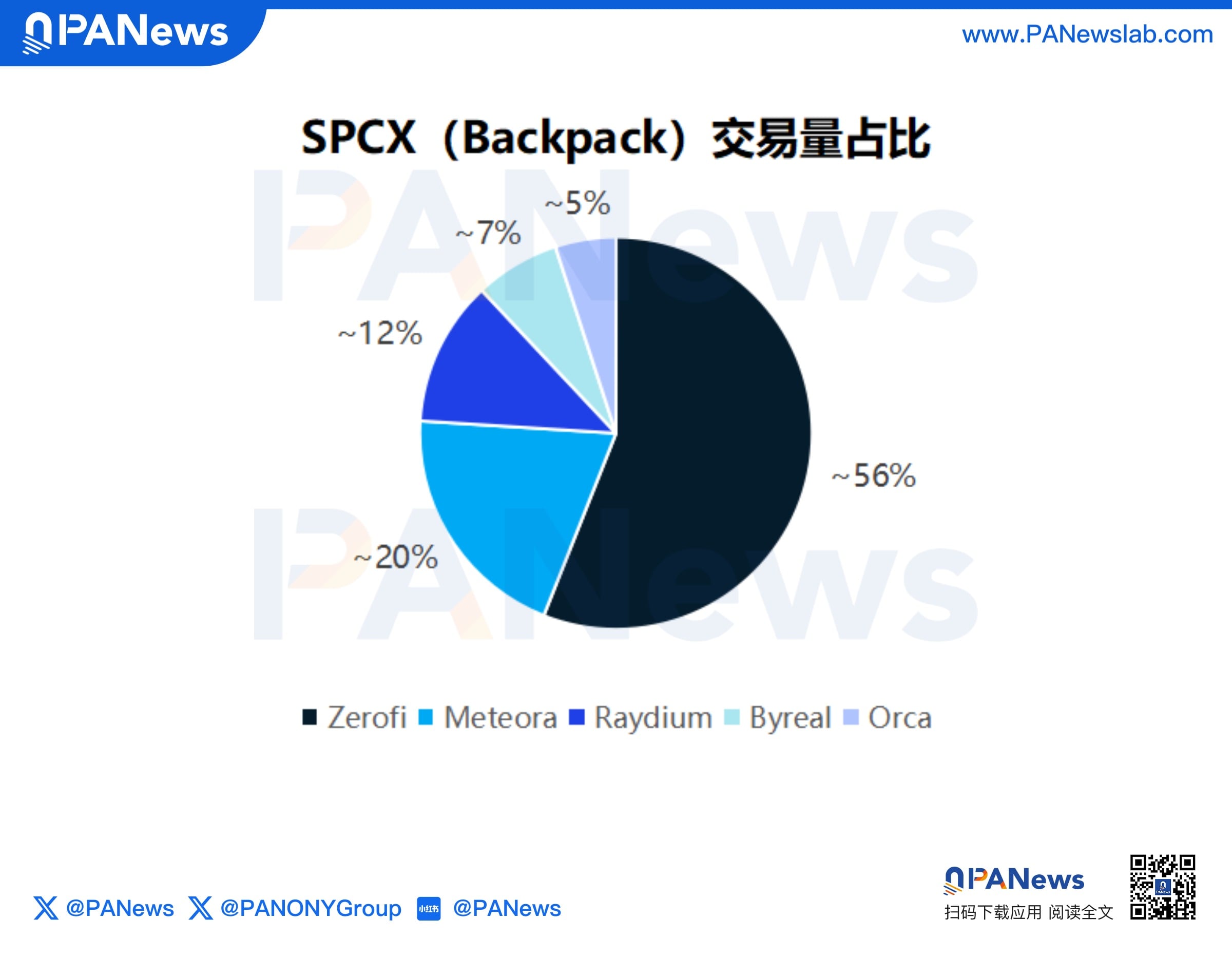
Additionally, according to PANews observations, all spot trading of SPCX (Backpack) occurred on the five major DEXes on the Solana chain. Among them, Zerofi leads with over half of the market share, forming significant monopolistic advantage; Meteora and Raydium collectively account for 32%, lower than Zerofi alone; shares in Byreal and Orca are only in single digits.
Now, the same underlying asset SPCX is being priced in multiple parallel markets: arbitrage space, price differential game, and clearing efficiency may all become the focal points of competition in the next stage.
Different mechanisms and paths are competing for the funds of the same group of users.
Nasdaq remains the pricing center, tokenized stocks realize value filling
However, no matter how hot the trading of U.S. stocks in the crypto market is, all liquidity pricing anchors remain deeply rooted in the real stock traded on Nasdaq.
As of today, SpaceX's market value peak once reached $2.45 trillion, and its average daily trading volume on Nasdaq still hovers around $40 billion, with strong trading demand sparking activity in the on-chain ecosystem, nurturing a large tokenized stock market.
According to estimates by PANews, the total trading volume in the crypto market currently accounts for only 0.07% of this number. Blockworks data indicates that SpaceX accounts for nearly 30% of all on-chain tokenized stock trading.
The vast divergence in size indicates that the traditional capital market remains the absolute pricing center, while the crypto market is merely a supplement and extension of the mainstream market.
However, an allocation of less than 0.1% also precisely indicates: the growth space for tokenized stocks has just begun to open a crack.
Extreme scarcity triggers liquidity overflow: The actual free float share ratio of SpaceX at the initial stage of its listing was extremely low, accounting for only about 4% of all shares. This extreme supply-demand imbalance led to a massive outflow of funds that could not obtain the IPO allocation, seeking exposure through on-chain and off-chain markets, thus supporting the crypto market's spot trading volume;
All-weather liquidity's "feedback effect" on U.S. stock pricing: During Nasdaq's trading limitations, tokenized stocks continue to trade uninterrupted, with their real-time fluctuations essentially acting as a "preliminary barometer" for Nasdaq's opening trends, reflecting changes in global fund expectations ahead of time, providing investors with a crucial cross-time zone price discovery tool.
The SpaceX IPO is a catalyst for tokenized stocks to move from niche to mainstream. As SpaceX's holdings in the U.S. stock index and active ETFs are further increased in the coming month, the spillover effect of SPCX as a highly volatile technology leader will continue to amplify.
It is foreseeable that once super unicorns such as OpenAI and Anthropic go public one after another, more top-tier assets will flow into the tokenized stock market along this path. The trading time, geographical, and threshold limitations of traditional securities will be continually broken by blockchain.
The bell of Wall Street and the hash of blockchain will also jointly compose a piece of cross-border resonance.
免责声明:本文章仅代表作者个人观点,不代表本平台的立场和观点。本文章仅供信息分享,不构成对任何人的任何投资建议。用户与作者之间的任何争议,与本平台无关。如网页中刊载的文章或图片涉及侵权,请提供相关的权利证明和身份证明发送邮件到support@aicoin.com,本平台相关工作人员将会进行核查。


