Author: Ethereum Foundation
Translation: Deep Tide TechFlow
Deep Tide Introduction: The Ethereum Foundation announced a 20% layoff, with 54 people leaving, and completed a months-long organizational restructuring. This is not merely a cost-cutting measure, but a strategic contraction—focusing resources on "key tasks that only EF can do and must do," restructured into five clusters. For investors, this marks a shift for Ethereum from broad dissemination to focusing on protocol layer and autonomy protection, but it also exposes the financial pressure on non-profit organizations during a bear market.
Today, the Ethereum Foundation (EF) is transforming, concluding a months-long restructuring process as part of implementing its Mandate and treasury management policies.
The restructured EF has the structure, activities, and personnel necessary to execute future key tasks, but also sees 54 colleagues leave, about 20% of the total EF staff. Many of them will continue to contribute to Ethereum in other ways in the coming weeks.
This article briefly introduces the new structure and details how we support departing personnel.
New Structure
EF now has five clusters, each responsible for different areas of work—protocol layer, access layer, user layer, community layer, and institutional layer—and an operations-focused cluster alongside a team composed of management and direct support for management work.
Each work area requires different approaches, is accountable for different types of outcomes, and has different internal structures tailored to the required work. We will share more about this in the coming month, and today we only provide a top-level introduction.
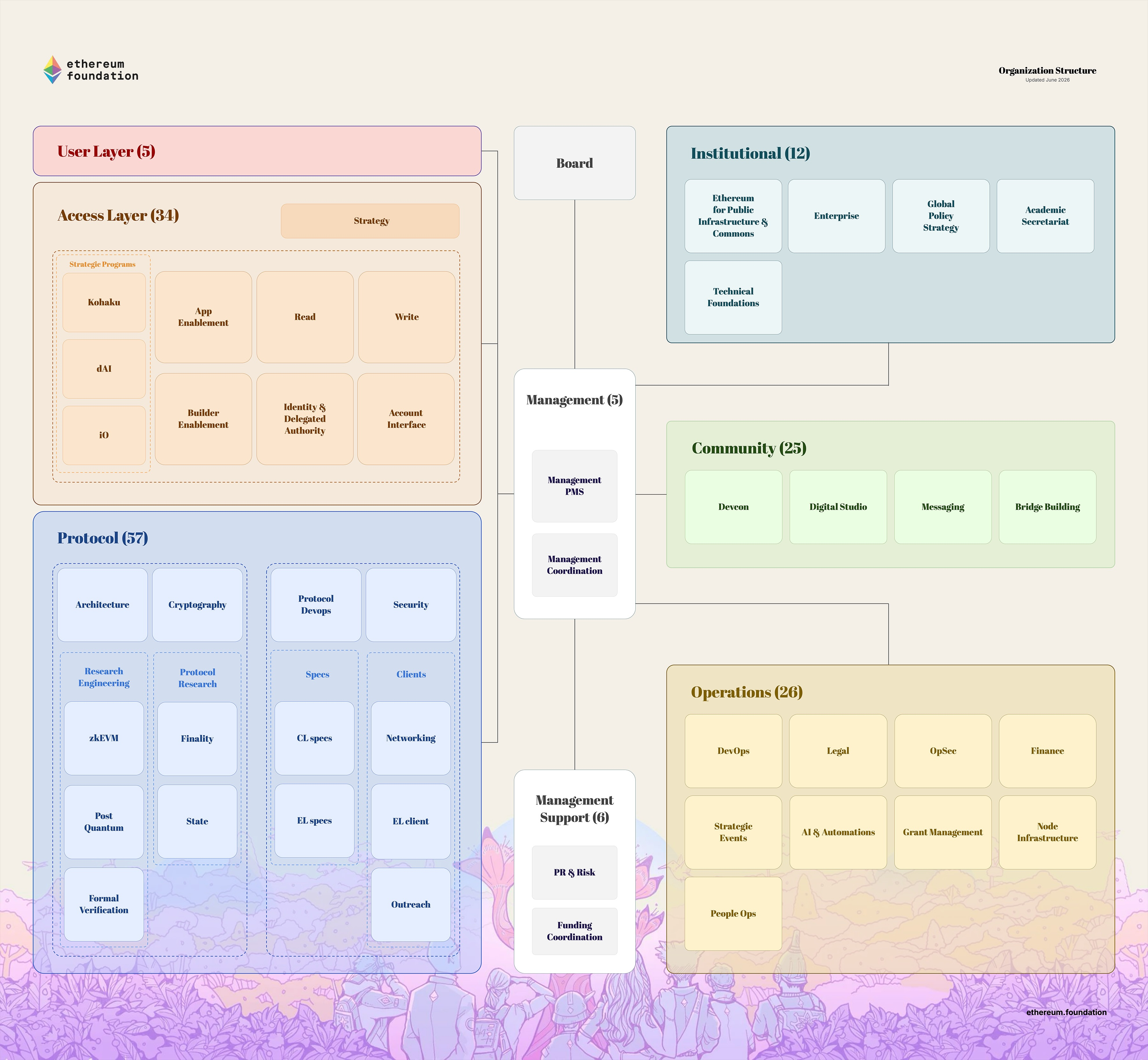
Protocol Layer
The protocol cluster carries EF's tradition and responsibility, ensuring that Ethereum fulfills its fundamental commitment to expanding autonomy. It achieves this by laying the groundwork for strengthening and expanding the Ethereum protocol itself. Its goal is to ensure that the Ethereum protocol continues to execute attributes worth defending: censorship resistance and anti-capture, open source and open, privacy and security as uncompromisable protocol guarantees.
The existence of the protocol cluster is to ensure the core protocol continues to advance without compromising autonomy protections. Its existence is not to make Ethereum more marketable or to focus on short-term gains, nor to make it easier to transform into another financial track controlled by intermediaries. Its work is to make Ethereum harder to corrode or capture and to make it more reliable when counterparty failures, platform censorship, government overreach, and intermediary profit extraction occur. This means safely delivering forks, reducing unnecessary complexity, minimizing trusted dependencies, protecting transaction channels from harmful MEV and privileged order flows, and accelerating and transforming long-term research, such as post-quantum security, zkEVM, and L1 privacy, into protocol changes that maintain and improve autonomy at scale.
Access Layer
The access layer is where Ethereum serves individuals with actual needs for CROPS attributes or fails. The work of this cluster is to make autonomy available, understandable, and sustainable in key operations: reading chains, transacting, proving, delegating, and exiting. These operations must support users and increasingly support agents acting on their behalf, who must be able to read current status, history, and relevant data without relying on unverifiable intermediaries. They should be able to trade privately without the risk of censorship, with transaction outcomes guaranteed or failing for free when conditions are not met. As more work shifts to agents, users must retain control, granting limited permissions and revoking them at will, while keeping custodianship of their own intentions rather than exposing them to intermediaries. From chips to front-end interfaces, they must be verifiable, understandable, and recoverable, regardless of frequency of use or depth of technical knowledge.
The principles applied by this cluster are zero options: for every mediated path, there must be a credible non-mediated path and maintain accessibility. Strategically, this means identifying where stronger CROPS attributes can be applied to the current infrastructure and recognizing that credible alternatives are necessary when economic incentives tend toward aggregation, identification, and control.
The user layer cluster anchors EF's work in users and organizations that have significant interests in autonomous use of Ethereum, broadening tools and standards for such use as widely as possible. It helps EF understand the most important capabilities, the most severe failure modes, and the trade-offs that can be accepted when necessary.
Its work includes user segmentation, roles, educational materials, use case studies, and impact assessments. The goal is not to make EF a product studio, but to ensure that the decision-making of protocol and access layers is shaped by real current and potential users, true constraints, and genuine metrics of autonomy.
Community Layer
The community cluster is responsible for how EF presents itself to the world, both within and outside the Ethereum ecosystem. Its work is to clarify the positions EF represents and how this differs substantively from zero-sum financial cryptocurrencies, cryptocurrencies compromising with corporations, and the mundane nonprofit world where grant management gets entangled with the status quo and incentives distort due to geopolitical interests. EF is committed to maximizing its community value by remaining independent from these and other counterproductive entanglements.
This cluster also builds EF's relationships outside of cryptocurrency. Autonomy has natural allies in fields such as free and open source, security and locally prioritized software and hardware, privacy and cryptography research and advocacy, as well as civil liberties, decentralized networks, and public interest technologies. This cluster is committed to ensuring that the overlap between Ethereum and these fields is productive, non-coercive, and high-quality.
Institutional Layer
This cluster is responsible for EF's collaboration with institutions that shape how end-users interact with Ethereum through institutional intermediaries. This can include financial institutions, whether consumer payments, insurance, or others. It can include non-financial enterprises, such as manufacturing, social, publishing, and many other industries. It may include government applications. It may include universities or other nonprofit organizations.
In all cases, our goal is to prioritize the creation of effective showcase cases that integrate Ethereum and crypto technology, which maximize CROPS attributes and guarantees offered to institutions and users—for example, guarantees of fair and correct execution, ensuring data portability and more general practical exit capabilities, protecting the privacy of all participants, proving the authenticity of data, better detection and even prevention of misconduct, etc. We believe many enterprises, governments, and nonprofit organizations will realize their incentives tend to serve users in a way that enhances autonomy while retaining guarantees necessary for them to create value or fulfill their missions, and that Ethereum and crypto technology could be part of realizing this goal. Beyond direct engagement, the institutional cluster will also pursue these goals by helping establish and thoughtfully communicate best practices, standards, reference architectures, and educational materials for institutional adoption.
The institutional cluster also collaborates upstream with academia and allied organizations around the world to ensure that Ethereum is understood correctly in its current form and potential, as well as to track and respond to policy and regulatory developments that may affect Ethereum's commitment to autonomous use and its core principles of censorship resistance (and anti-capture), open source, privacy, and security.
Departing Personnel
As part of the change in EF's structure, activities, and spending shape, we are parting ways today with 54 colleagues.
These decisions are difficult, but they are necessary. We must allocate resources and organize in a way that enables us to focus on the key work that only EF can do—and must do—over the next few years, without excessive disruption from short-term market fluctuations.
To ensure departing personnel are prepared for the transition, our comprehensive offer includes severance pay and transition support. The severance pay is the higher of one month's salary for each year of working at EF and the local amount specified for individuals in their jurisdiction. This is the same as the severance pay we offered colleagues who left EF in the past few months. Transition support includes assistance in finding new roles within the ecosystem and a small transition stipend specifically for covering personal transition costs (such as career coaching).
We are grateful for each of their talents, dedication, and time contributed to Ethereum at EF, and we look forward to working alongside those who find their next home elsewhere in the ecosystem.
What’s Next
The EF that emerges from this transformation is leaner and more focused. We will share more information in the coming weeks and months about how our work is changing and how the ecosystem can best interact with the new structure.
免责声明:本文章仅代表作者个人观点,不代表本平台的立场和观点。本文章仅供信息分享,不构成对任何人的任何投资建议。用户与作者之间的任何争议,与本平台无关。如网页中刊载的文章或图片涉及侵权,请提供相关的权利证明和身份证明发送邮件到support@aicoin.com,本平台相关工作人员将会进行核查。


