Author: Rita
Tide Guide Reading
Morgan Stanley just raised the target price for Samsung Electro-Mechanics from 920,000 won to 2,560,000 won. Analysts have rewritten the story of MLCC (Multi-Layer Ceramic Capacitors) from a cyclical industry to one of structural prosperity. The core logic is very straightforward: the thirst for MLCCs in AI servers is 10 to 15 times greater than in traditional servers.
AI Ignites "Both Quantity and Price Rising"
An AI server needs 440,000 MLCCs. A traditional server? 30,000. That's more than ten times the difference.
This is not just a matter of quantity. The requirements for MLCCs in AI are also upgrading: higher capacitance, smaller size, and lower ESL and ESR. The focus has shifted from competing on quantity to competing on quality, resulting in an upward movement of ASP (Average Selling Price). Morgan Stanley states that by 2026, Samsung Electro-Mechanics’s MLCC business will contribute 15% of revenues, and by 2030, this proportion will jump directly to over 50%. Behind this is an enhancement of pricing power leading to real profit expansion.
Supply Tightness is Structural, Not Cyclical
This cycle is somewhat similar to the MLCC super cycle from 2017 to 2018, but the underlying logic is completely different. Last time, it was a short-term mismatch caused by insufficient inventory and a surge in orders. This time, the capacity ceiling meets sustained new demand.
The production lines for high-end MLCCs are already fully booked, and new production lines will take two years to come online. The inventory level in the supply chain has now spread from the spot market to contract prices, and distributors have started to stock up, indicating they no longer view this as a temporary shortage.
Morgan Stanley expects MLCC prices to rise by 30% in the second half of 2026 and then by another 30% to 50% in 2027. This is not a prediction from futures traders, but a conclusion drawn from existing contract prices and distributor behavior that can be seen now.
Why Samsung Electro-Mechanics is the Biggest Beneficiary
Samsung Electro-Mechanics has three dimensions of benefits.
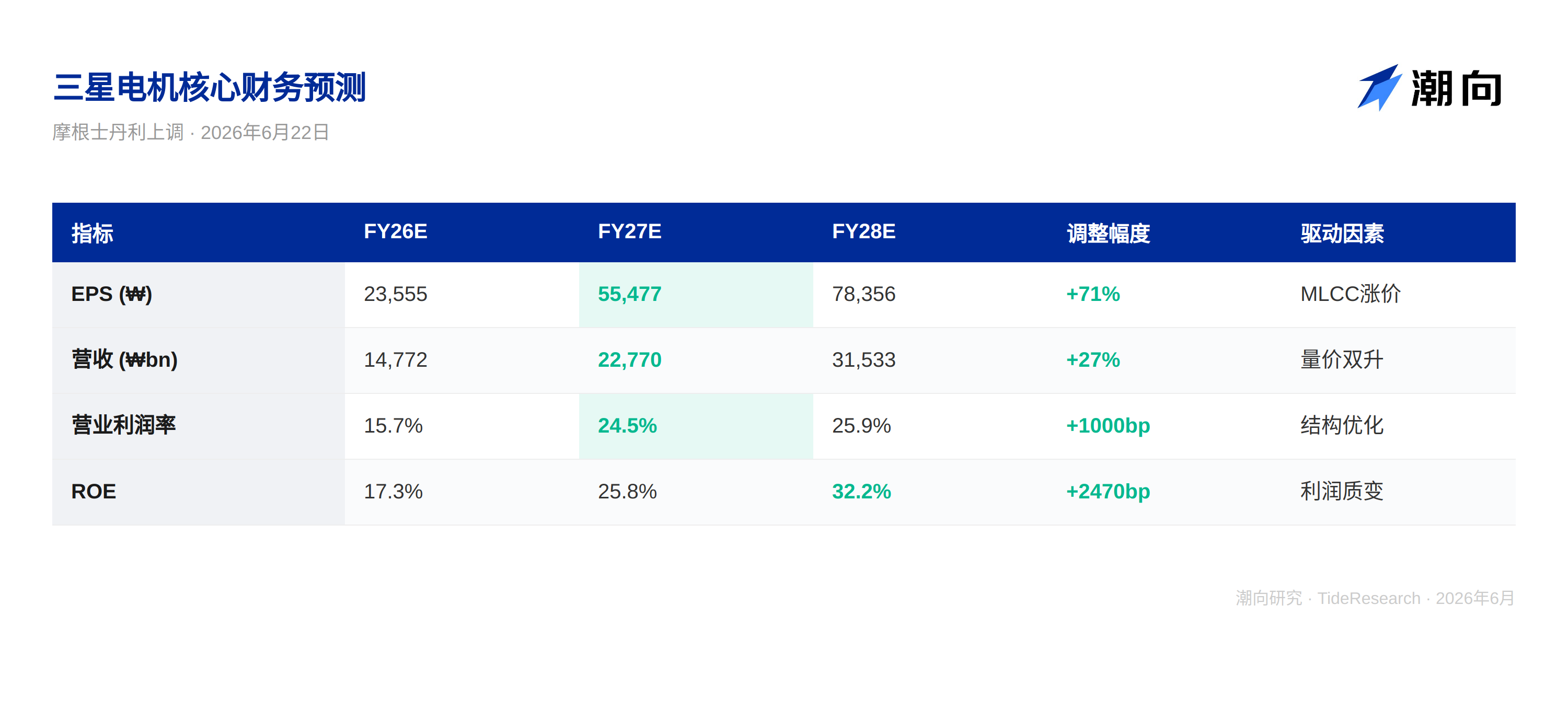
The first is the direct price increase of MLCCs. MLCCs for IT applications are increasing in price, and those for AI are also rising, with AI's profit margins being thicker. The 1Q26 financial report shows revenues exceeding expectations, with 3.2 trillion won compared to an expected 3.1 trillion won. More importantly, Morgan Stanley has raised its EPS forecasts for the next three years, with FY27E being raised to 55,477 won, 71% higher than previously. Operating profit margins will jump from the current 15.7% to 24.5% by 2027, and to 25.9% by 2028. This is not a numbers game, but real profit expansion brought about by enhanced pricing power.
The second line is ABF substrates. The orders for ASIC chips from AI customers have already saturated, and Samsung Electro-Mechanics is seeing rapid growth in shipments and profits in this area.
The third line is new product lines. They have secured $1.3 billion in orders for silicon capacitors, and glass substrates are already in trial production. These will not contribute to revenue in the current year, but they are laying the groundwork for the coming years.
Will ROE Really Jump from 7.5% to 32.2%?
Morgan Stanley assumes that Samsung Electro-Mechanics' ROE (Return on Equity) will rise from 7.5% in FY25 to 17.3% in FY26, and then to 32.2% in FY28. At the same time, the company's dividend payout ratio will increase from the current 5% to 20%.
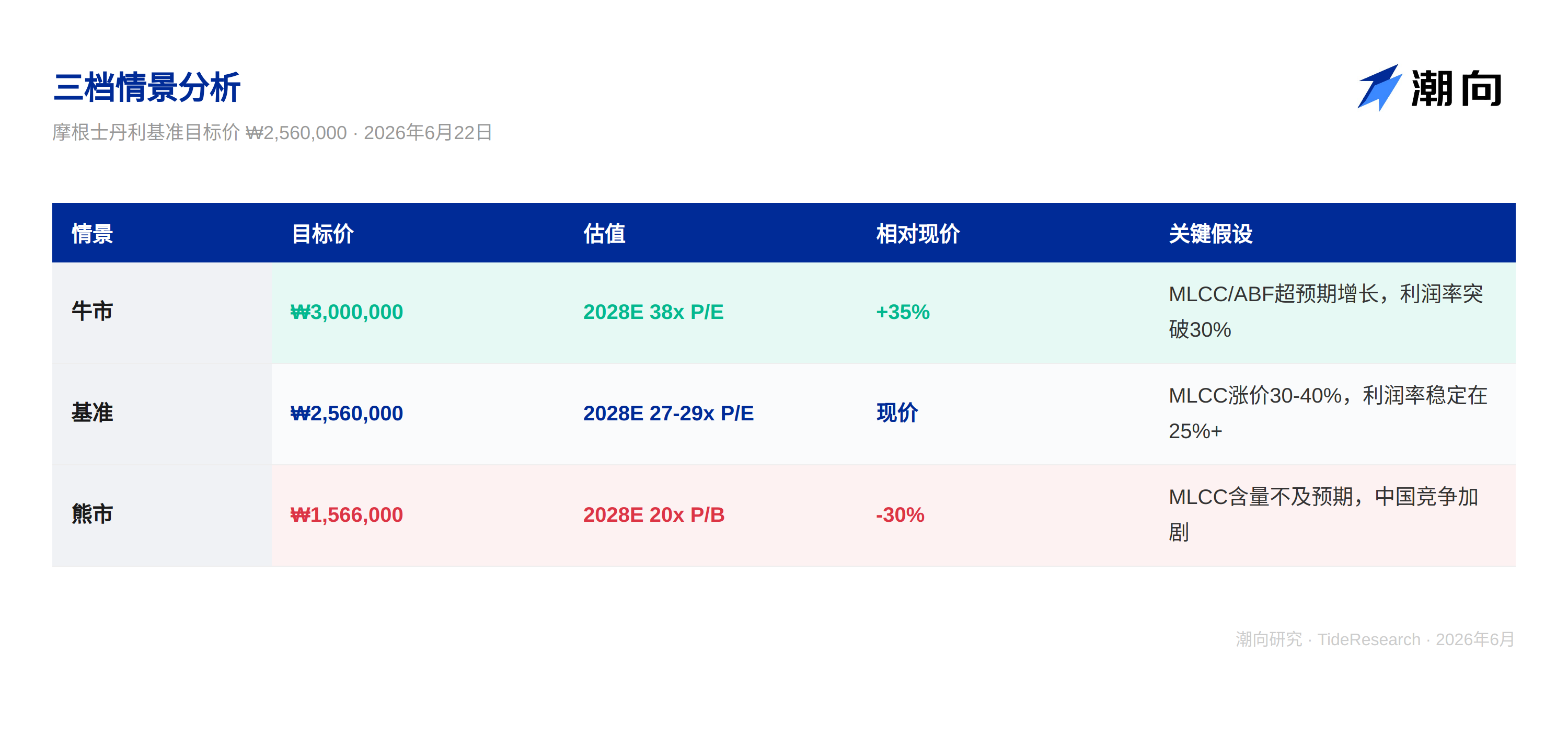
This means that a South Korean electronic components company, which originally had a not-low ROE, is now likely to enter a higher profit cycle due to changes in product structure and pricing power. The current valuation of 1.4 times P/B (Price-to-Book ratio) is still below the historical average of 1.7 times. Raising the target price from 920,000 to 2,560,000, representing an increase of nearly 178%, is not solely due to net profit growth, but also provides room for valuation recovery.
Clarifying Where the Risks Are
Upward risks: MLCCs could be forced to continue significantly increasing prices due to genuine shortages; smartphone demand may rebound beyond expectations; stimulus policies from the Chinese government could create additional demand.
Downward risks: A significant decline in the flagship smartphone cycle at Samsung Electronics (a considerable portion of Samsung Electro-Mechanics’ products are consumer electronics); ineffective execution in expanding Chinese smartphone customers; weak global consumer demand.
What are the catalysts? Further increases in contract prices, a rising Book-to-Bill ratio, capacity utilization nearing full load, and confirmation of increased MLCC content in the next generation AI platform (Rubin, VR200).
The New Aristocrat of AI Infrastructure
From a side dish to the main course, from cyclical to structural, from traditional capacitor supplier to AI infrastructure provider. This is the story Morgan Stanley is telling about Samsung Electro-Mechanics. How long the story can last depends on how the demand for AI chips, capacity construction, and competitive landscape evolve. However, it is currently a supply constraint supporting prices, with price increases supporting profits.
Disclaimer
This article is an organization and interpretation of third-party brokerage research reports by Tide Research. The ratings, target prices, earnings forecasts, and related judgments quoted in this text are solely the views of Morgan Stanley analysts and reflect the positions of their institution, not those of Tide Research, and do not constitute any investment advice.
Please note three points while reading: First, the target price is an analyst's expectation for the next approximately 12 months; it is a forecast, not a commitment, and will be adjusted repeatedly according to performance and market conditions. Second, sell-side research reports tend to be overly optimistic, and some covered companies have investment banking relationships with the brokerage. Third, the value of research reports lies in the mainline logic and its underlying assumptions, rather than a specific target price. Focus on logic, not just price.
The market carries risks, and decisions should be made independently. This article should not be used as the basis for buying or selling any securities.
Data Sources: Samsung Electro-Mechanics 1Q26 Financial Report (SEC and other public data) · Morgan Stanley Research Report (Shawn Kim et al., June 22, 2026)
Tide Research · June 2026
免责声明:本文章仅代表作者个人观点,不代表本平台的立场和观点。本文章仅供信息分享,不构成对任何人的任何投资建议。用户与作者之间的任何争议,与本平台无关。如网页中刊载的文章或图片涉及侵权,请提供相关的权利证明和身份证明发送邮件到support@aicoin.com,本平台相关工作人员将会进行核查。


