Author: Nancy, PANews
After the foundation era, Ethereum is welcoming a new standard bearer.
On June 23, several former EF researchers announced the establishment of a non-profit R&D organization Ethlabs, regarded by the community as an important auxiliary force to EF. The organization has received support from various parties within the Ethereum ecosystem, including two Ethereum DAT companies BitMine and Sharplink, as well as funding endorsements from Ethereum co-founder Joe Lubin.
Former core EF members set out anew, largest ETH treasury BitMine endorses
As the Ethereum Foundation (EF) gradually shifts to a behind-the-scenes role, discussions about "who will take up the banner" have heated up in the community.
This morning, the independent non-profit R&D organization Ethlabs announced its establishment. Unlike EF's gradual retreat from its central role in the ecosystem, Ethlabs focuses more on core protocol R&D, infrastructure building, and product implementation, aiming to drive Ethereum toward the global economic settlement layer and accelerate institutional-scale large-scale on-chain applications.
Ethlabs was co-founded by Ansgar Dietrichs, Barnabé Monnot, Caspar Schwarz-Schilling, Josh Rudolf, and Julian Ma. All five previously worked at the Ethereum Foundation and left one after another in the first half of 2026.
During their time at EF, they deeply participated in research and promotion of key technological directions for Ethereum, covering core topics such as finality mechanisms, scalability, data availability, EVM and zkEVM optimizations, protocol economics, and L1/L2 interoperability, making them important participants in the evolution of the Ethereum protocol.
In addition to the attention drawn by the core team background, Ethlabs' support lineup is also quite substantial. Currently, the organization has received support from over 50 ecosystem contributors, including DeFi developers, Ethereum core developers, L2 network teams, and venture capital institutions.
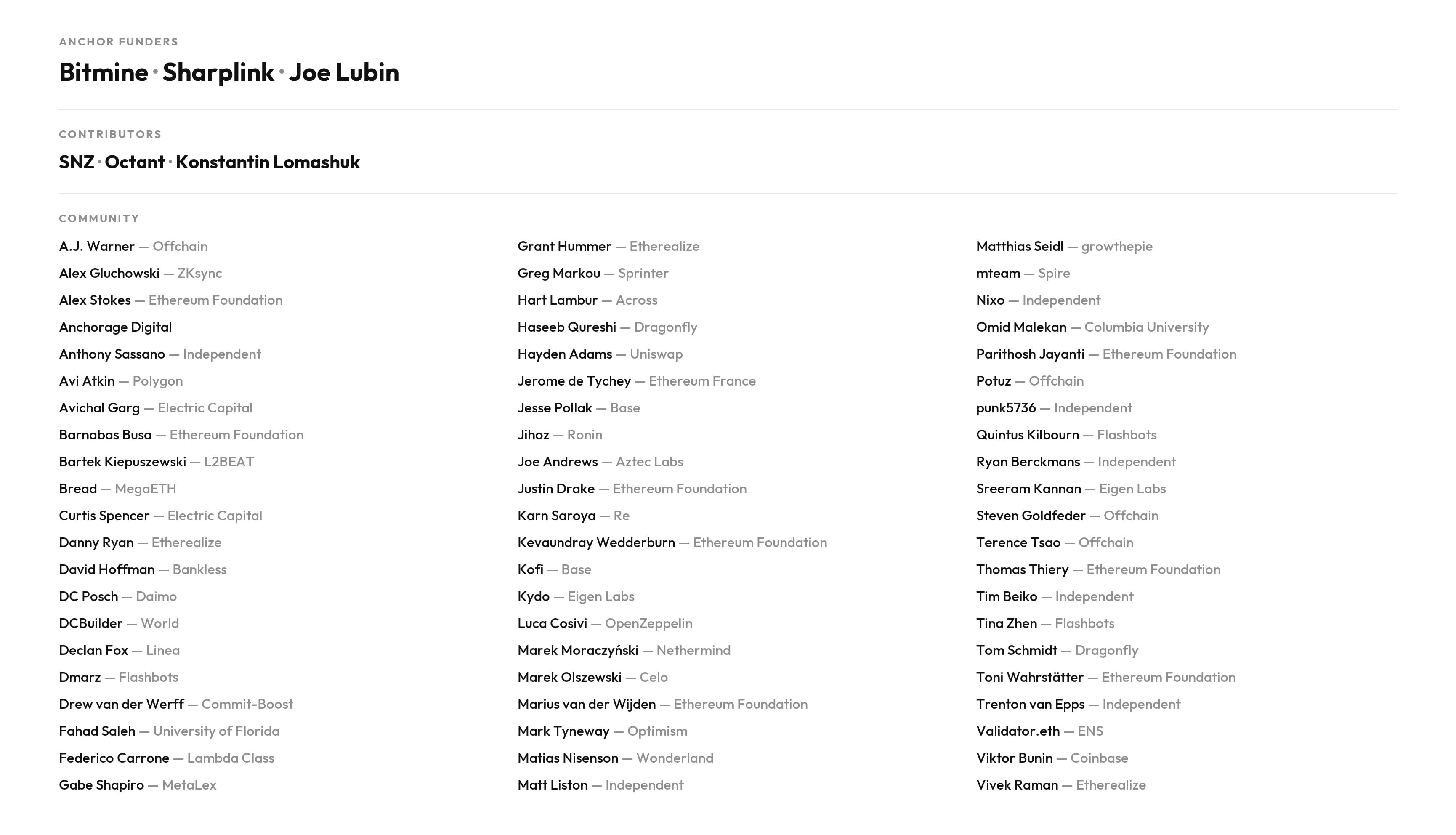
Moreover, Ethlabs has also received financial support from Ethereum co-founder Joe Lubin, as well as the two Ethereum DAT companies BitMine and Sharplink. Among them, BitMine holds about 5.67 million ETH, accounting for about 4.7% of the total supply; Sharplink holds approximately 870,000 ETH. As one of the largest ETH treasuries in the current market, BitMine not only possesses ETH reserves far exceeding EF but has also been regarded by the community as an important influencing force following Ethereum's entry into the institutional era, and at one point was one of the most highly favored candidates for the next leader.
From the perspective of team background, financial strength to ecosystem support strength, Ethlabs is seen by the community as the most promising new force in the post-EF era.
EF retreats behind the scenes, Ethereum enters the ecological alliance era
In addition to Ethlabs, several "civilian" organizations have joined the ecological construction of Ethereum. Over the past two years, a number of institutions focusing on different fields have been established, covering protocol R&D, infrastructure building, and application ecosystem expansion.
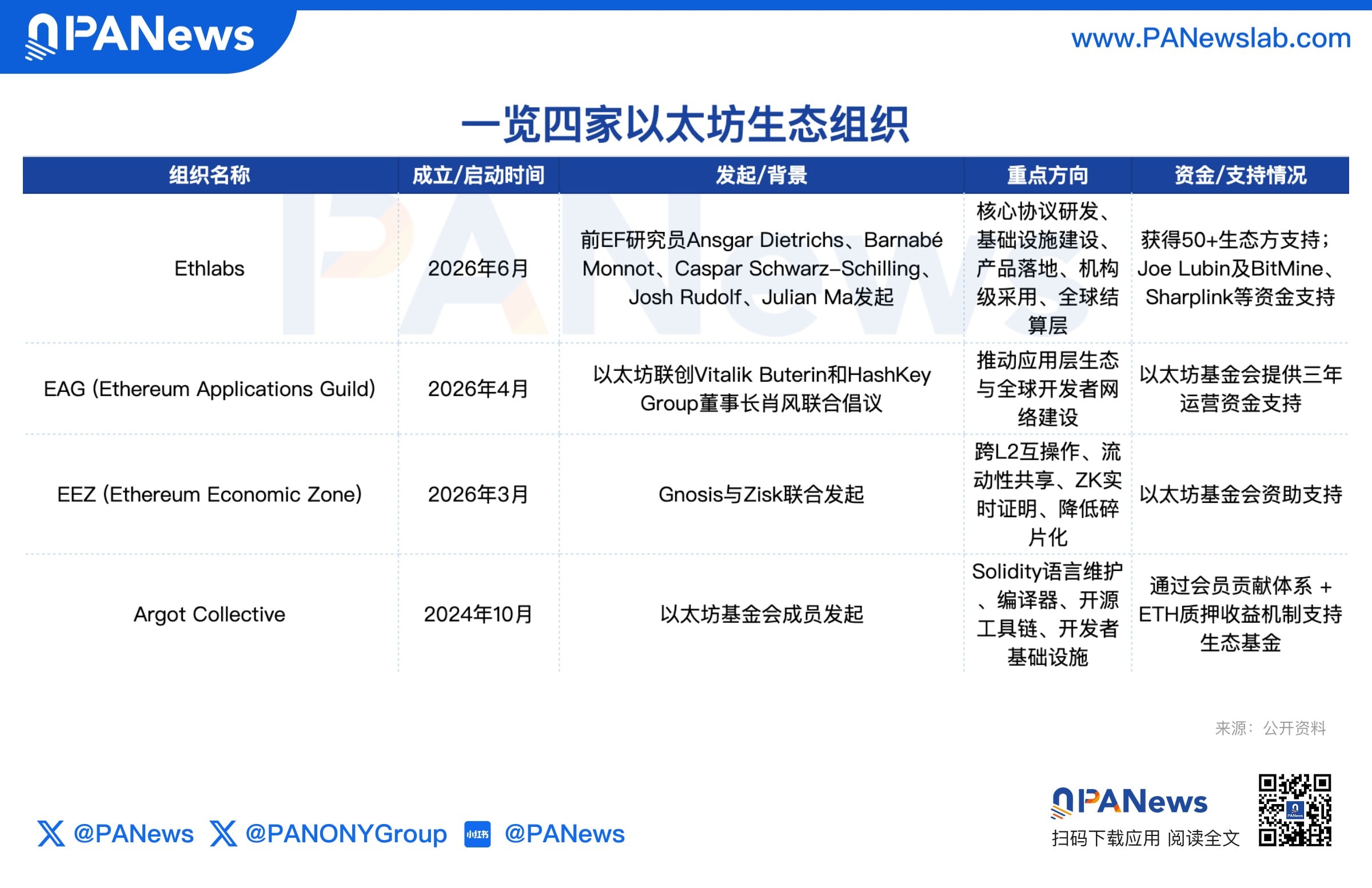
As early as October 2024, members of the Ethereum Foundation initiated the non-profit R&D group Argot Collective, focusing on maintaining free and independent software related to Ethereum. EF subsequently announced in 2025 that it would provide three years of operational funding support to advance the development of the Solidity language and other key open-source infrastructure.
In March of this year, with funding from the Ethereum Foundation, Gnosis and Zisk co-initiated Ethereum Economic Zone (EEZ), aiming to improve the collaboration efficiency of Ethereum’s various L2 networks, reduce the time and cost of cross-network transfers, and enhance the interaction experience of developers and users in a multi-chain ecosystem.
A month later, the Ethereum Applications Guild (EAG) was officially established. This was jointly initiated by Ethereum co-founder Vitalik Buterin and HashKey Group Chairman Xiao Feng, with the goal of promoting the development of the application layer ecosystem and accelerating Ethereum's transition from the infrastructure phase to the application phase. The organization focuses on four directions: promoting the landing of real-world applications, connecting cross-domain ecological networks, establishing unified evaluation and development frameworks, and building sustainable funding mechanisms. EAG will adopt a membership contribution system based on organizational scale (such as valuation, market cap, or AUM), and through a staking revenue donation mechanism, will funnel a portion of ETH staking rewards into an ecological growth fund.
From Argot Collective to EEZ, then to EAG and the newly established Ethlabs, these organizations cover various aspects such as R&D, infrastructure, cross-chain collaboration, and application ecology. They are not replacements for EF but take on responsibilities that were previously highly dependent on the Foundation's promotion in their respective fields.
In the view of azeem, co-founder of the privacy blockchain Miden, those leaving the Foundation are forming genuinely Ethereum-aligned new organizations, rather than stopping at verbal support. These new organizations can obtain better financing and take social capital away from the Foundation, creating a kind of "external coup" effect. In the coming months, we will see more former Ethereum Foundation teams executing according to the Ethereum roadmap after financing, which will benefit the entire ecosystem.
And as more similar organizations join in the future, the development of Ethereum will shift from being driven by the foundation to a multi-party collaborative construction. This means that Ethereum is moving from the "Foundation era" to the "Ecological Alliance era", which will bring it greater resilience and innovative vitality.
Caught in governance and funding controversies again, EF responds by sticking to its mission rather than pleasing the market
The community's attention to Ethereum's new leaders derives in part from dissatisfaction with the long-term management model of the Ethereum Foundation (EF). Recently, EF has once again faced external criticism over issues related to fund management, liquidity reserve utilization, and talent loss.
Aave Chan Initiative (ACI) founder Marc Zeller recently pointed out that EF originally held a "good hand." In his view, the Foundation could simply have basic budget management capabilities, using funds reasonably and leveraging its reserves as collateral to support genuinely valuable ecological projects. Meanwhile, he believes the Ethereum PoS transition has taken too long, and if the upgrade is not completed beyond the expected period, the Foundation could stake a large amount of its held ETH, achieving long-term, sustainable operation through continuous staking rewards.
Former EF member Trent Van Epps openly states that EF's long-term subtraction strategy was intended to reduce the Foundation's direct influence over the ecosystem, but in practice, the Foundation still retains significant institutional influence over brand, credibility, funding, core developer employment relationships, and media resources. As the Ethereum Foundation treasury continues to shrink, the client incentive program is set to expire in April 2026 with no replacement solutions, he warns that the ecosystem may face a slowly fermenting protocol funding crisis in the next 3 to 9 months, which could weaken core development, research, and coordination capabilities, impacting long-term scalability and responses to challenges such as quantum computing.
In his view, the Ethereum Foundation will not become the main guardian of Ethereum for the next decade; the ecosystem needs to quickly explore new social, political, and economic contracts, clarifying governance responsibilities for shared resources such as software, networks, and assets, and establishing scalable, accountable, and neutral funding mechanisms to support Ethereum's subsequent expansion, maintenance, and institutional succession.
To promote the continued development of the Ethereum ecosystem, the community is also seeking alternatives. For example, BitMine Chairman Tom Lee recently proposed that the Ethereum treasury currently holds about 7% of ETH supply, generating about $500 million in staking rewards annually. These earnings could be directly used to fund core development, grants, public goods, and ecological construction, rather than relying on EF. He also emphasized that the likelihood of a funding crisis occurring in Ethereum is zero and stated, "The funds are in place."
In response to market controversies, EF's interim co-CEO Bastian Aue reiterated the Foundation's mission direction in a recent post. He pointed out that the existence of EF is to ensure that Ethereum becomes and remains a truly permissionless sovereign infrastructure, possessing characteristics such as censorship resistance, resistance to capital and state capture, privacy, security, and rather than pursuing its own influence or catering to short-term speculators or endorsing ecological projects.
At the same time, Bastian Aue disclosed that MEV (maximum extractable value) could become the next main battlefield of the cryptopunk wars, and EF will prioritize efforts to reduce order flow monopolies, decrease extractive MEV, enhance trading inclusivity, and explore open order flow solutions to avoid Ethereum maintaining a permissionless state in form but actually being controlled by private order flows, Builder Cartels, or intermediary supply chains. Additionally, Aerugo stated that privacy should become Ethereum’s default capability, not an extra option; EF is also gradually shifting employee compensation and key financial relationships to ETH and compliant Ethereum-native stablecoins, to promote direct use and experience of Ethereum ecosystem products.
Regarding the recent controversies over EF personnel departures, he mentioned that reasons for leaving include strategic differences, job fit, normal organizational changes, or personal choices, and that EF would not discuss individual personnel issues on social media but stated that departing employees should have a dignified exit; if public statements severely mislead the public's understanding of EF's direction or decisions, the Foundation may clarify at the policy and factual level, but will not publicize personal matters. As for the standards for EF funding allocations to external teams, he candidly stated that the criteria are whether the work is mission-critical, whether there are more suitable execution parties, and whether it can be completed without increasing capture risks or dependencies, rather than solely because the team once belonged to EF.
However, EF's strategic restructuring has also garnered considerable support within the community. For instance, Grayscale's research director Zach Pandl believes that in the long run, the current institutional adjustments being made by the Ethereum Foundation are positive for Ethereum, primarily for two reasons: first, more development work will be transferred to commercial organizations, potentially reducing the development responsibilities of the Foundation, allowing more work to be driven by commercial entities, thus improving overall ecosystem efficiency; second, the structural adjustments help maintain Ethereum's core principles as a digital currency infrastructure, as a Foundation with more defined responsibilities and concentrated scope could better ensure that Ethereum continues to adhere to the CROPS principles needed for building a healthy digital currency. He stated that if the Ethereum Foundation reduces direct participation in ecosystem development in the future and focuses on maintaining Ethereum's long-term core goals, it may help enhance ETH's positioning as a decentralized digital asset infrastructure.
The founder of Etherealize suggests that EF's deliberate "step back" is not a governance flaw, but an important design principle of a decentralized system. The underlying infrastructure of future financial systems should not be dominated or controlled by any single institution; the more important responsibility of the Foundation is to uphold the network's core values, including security, censorship resistance, privacy protection, and open standards, while continuously advancing long-term technical directions such as zero-knowledge proofs (ZK) and quantum resistance.
Overall, EF's gradual retreat from the ecosystem's executive center has become a trend, and the next phase of Ethereum's research and evolution will increasingly rely on the dynamic balance and self-organization optimization of various internal forces within the ecosystem.
免责声明:本文章仅代表作者个人观点,不代表本平台的立场和观点。本文章仅供信息分享,不构成对任何人的任何投资建议。用户与作者之间的任何争议,与本平台无关。如网页中刊载的文章或图片涉及侵权,请提供相关的权利证明和身份证明发送邮件到support@aicoin.com,本平台相关工作人员将会进行核查。


