

Preface
At midnight on June 12, 2026, Beijing time, the 23rd FIFA World Cup officially commenced. With 48 teams participating and 104 matches being held across Canada, Mexico, and the USA, this event has become not only a grand celebration for global fans but also a hotspot for illegal gambling and crypto fraud.
The Hong Kong police have clearly stated that with the kickoff of the World Cup, illegal gambling activities are expected to increase significantly. What is more alarming is that in recent years, the promotion, communication, and betting methods for illegal gambling have shown a clear trend of digitization, even using virtual currencies to settle bets in order to evade law enforcement scrutiny. Meanwhile, on-chain security monitoring has detected multiple active cryptocurrency scams targeting World Cup fans, with related scam funds pooling towards specific public chain and exchange addresses.
USDT—this stablecoin with a market capitalization of approximately 190 billion US dollars—is becoming the "preferred chip" for illegal betting payments during the World Cup, due to its price stability, strong anonymity, and fast cross-border transactions. Dissecting this on-chain fund flow is a crucial step in understanding the risk chain behind online gambling.
Part 01 - Why has USDT become the "preferred chip" for online gambling during the World Cup?
During the World Cup, the demand for fund movements by gambling platforms surges explosively, and USDT plays a core role in this.
1. Stablecoins alleviate "betting volatility anxiety"
Traditional cryptocurrencies (BTC/ETH) exhibit extreme price volatility, while USDT is pegged to the US dollar, allowing users to:
• Deposit 1000 USDT ≈ 1000 US dollars
• Remain unaffected by market fluctuations
• Use directly as "betting units"
This enables gambling platforms to establish a unified pricing system.
2. No dependency on banking systems, instant cross-border circulation
USDT (especially TRC20) has:
• Transfers without KYC
• Global wallet interoperability
• Reversible transactions are not possible
For gambling platforms, this means: once funds enter the chain, they are in an "irrecoverable state."
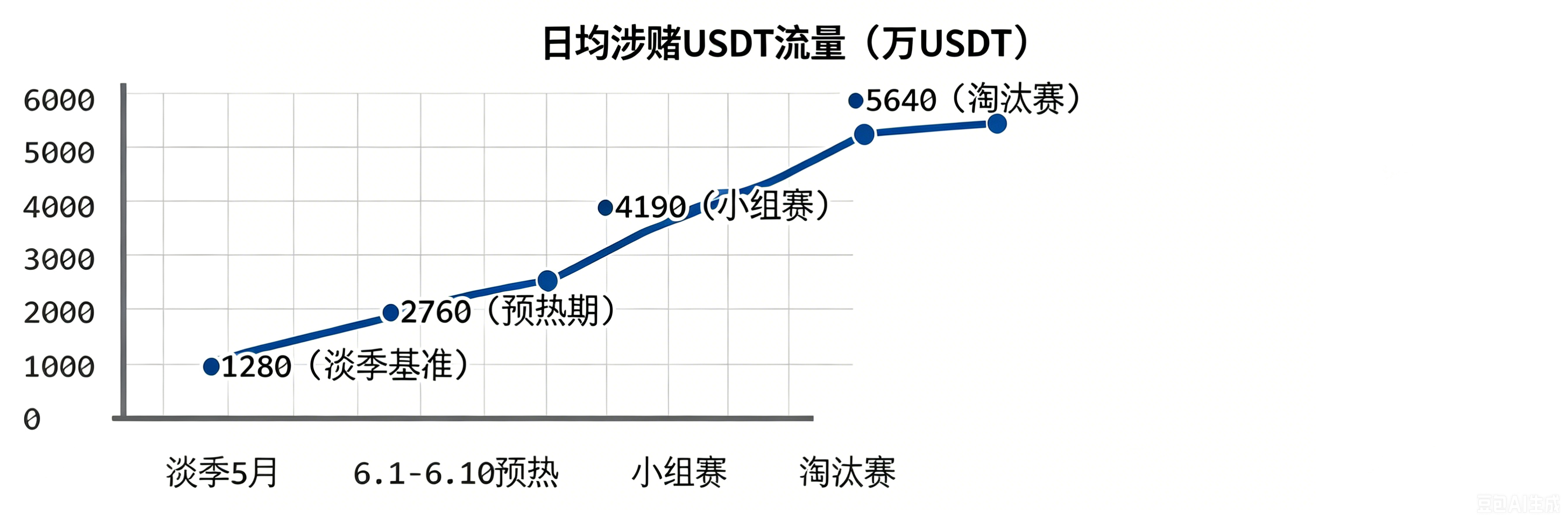
3. Significant anomalies in USDT flow during the World Cup
According to observations from various on-chain security agencies:
• The frequency of USDT transfers significantly increases during the World Cup period
• Increased activity of gambling-related addresses
• Rapid expansion in the number of intermediary addresses
Part 02 - Understanding at a glance: The complete on-chain funding flow for USDT gambling
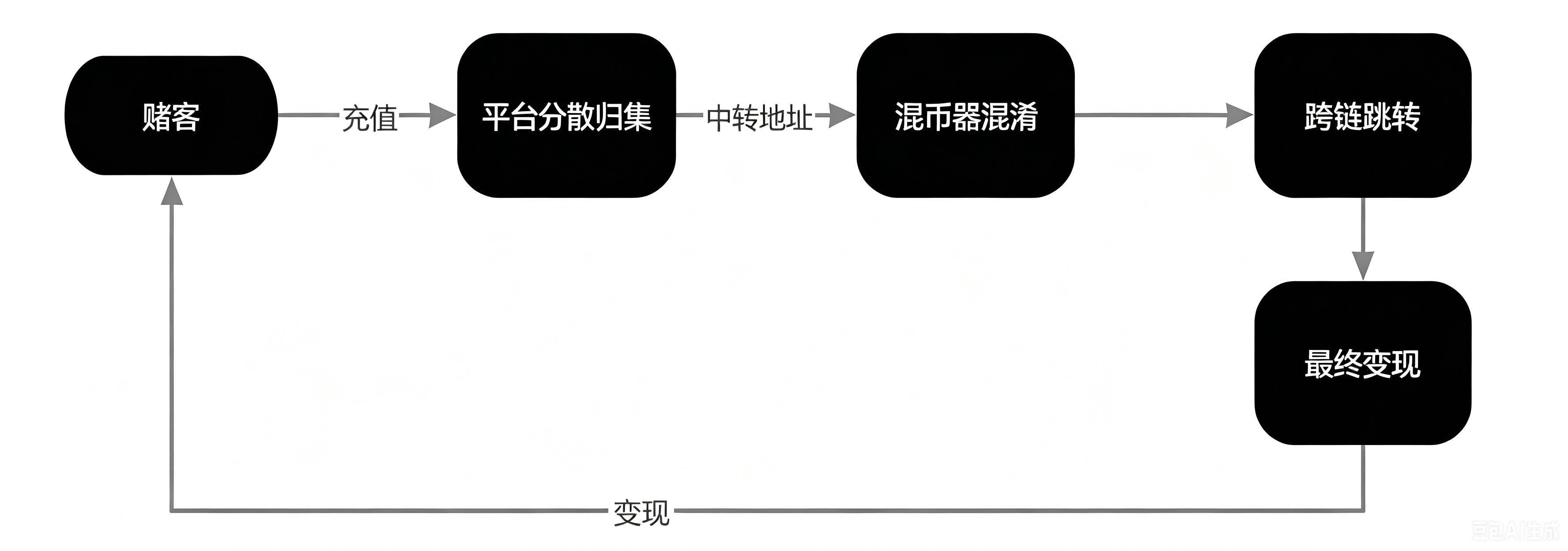
The flow of funds in USDT gambling is not simply "gambler → platform → withdrawal" but a complex money laundering route involving multiple hops and cross-chain dispersal.
1. Gambler deposits
The flow of funds in USDT gambling is not simply "gambler → platform → withdrawal" but a complex money laundering route involving multiple hops and cross-chain dispersal.
2. Platform dispersed collection
Platforms do not concentrate all betting funds in one address but gather them through numerous dispersed addresses. Each address receives small amounts of funds that are dispersed to evade on-chain monitoring and risk control systems.
3. Intermediary address groups
Funds from dispersed addresses aggregate into intermediary address groups. This stage is characterized by rapid in-and-out transactions with large amounts—funds quickly exit after entering, and the gas fee payment patterns of addresses controlled by the same group are highly consistent, becoming vital clues for on-chain identification.
4. Mixing services obfuscation
Some funds enter mixing services (such as Tornado Cash) where multiple funds from different sources are blended before redistributing, disrupting the correlation of fund sources and increasing tracking difficulty.
5. Cross-chain hops
Through cross-chain bridges, funds hop between multiple public chains—e.g., flowing from Polygon to Tron and then to Ethereum. This utilizes information isolation between different blockchains to create the illusion of "broken chains."
6. Final cash-out
Funds merge into exchange deposit addresses and are exchanged for fiat currency to complete the laundering process. Notably, security detection platforms have found that World Cup-related scam funds are flowing from Polygon to Tron and directly into exchange deposit addresses—this indicates that the entire money laundering chain is accelerating its closure.
Part 03 - Three common scams during the World Cup involving USDT gambling
Scams during the World Cup are not a "single model" but are highly industrialized operations.
1. "USDT betting to evade regulation" scam
Upgraded pitch:
• "On-chain betting, no real-name requirement"
• "Unregulated, high odds"
Essence:
👉Fake betting platforms + Backend control of wins and losses
2. Impersonation of sports betting platforms (highly mimicked sites)
Characteristics:
• UI highly imitates legitimate platforms
• Initially allows small withdrawals
• Eventually freezes accounts
Typical routine:
👉"First, win you 100 USDT, then make you lose 1000 USDT"
3. Insider prediction / guaranteed win plan
Pitch:
• "Internal data predictions"
• "AI analysis guarantees win"
• "Game outcome manipulation models"
Essence:
👉Exploiting "information anxiety users"
Case: The "gambling website" behind promotion and traffic gathering
In addition to scams directly targeting gamblers, online gambling groups are also extensively laying out promotion and traffic gathering steps. During the World Cup, if you come across “guaranteed recommendations,” “insider scores,” or “high odds access” on social platforms, many are paid advertisements from gambling websites.
In June 2026, the public security Cybersecurity Department of Yulin, Guangxi broke a case involving the promotion of online gambling related to the World Cup during the "Clean Network - 2026" special operation. The suspects established studios and published large amounts of gambling-related ads in various forms on multiple social platforms, providing traffic and operational services for gambling websites to profit illegally, and have been criminally detained according to the law.
The police action indicates: Gambling promotion and traffic gathering are clearly criminal behaviors that are being cracked down on. As an ordinary user, if you encounter such advertisements—don't click, don't trust, don't forward.
Part 04 - How to identify USDT gambling addresses on-chain?
From a security analysis perspective, abnormal funding can be identified through on-chain behavior:
1. Quick in-and-out pattern
The most typical trading feature of gambling addresses is the quick in-and-out—funds have a very short stay at the address, rarely overnight; dispersed inflows, concentrated outflows—large amounts of small funds flow in from different addresses and then are transferred out in one large amount; daily balances are basically zero—funds do not persist in any address.
2. Address clustering abnormalities
Using clustering algorithms, it can be found that while many addresses interacting with the same gambling platform appear independent, they show high consistency in transaction time, amount distribution, and counterparties, and can be categorized as the same entity.
3. Gas fee consistency
Different addresses controlled by the same group have highly consistent gas fee payment patterns—whether in choosing gas prices, distributing transaction times, or setting gas limits, they all exhibit clear "same operator" characteristics. This is referred to as "behavioral fingerprint" in on-chain analysis.
4. High-frequency cross-chain hops
Gambling funds frequently hop between different public chains—Polygon in, Tron out, then to Ethereum. This cross-chain behavior itself is a significant risk signal, especially when funds ultimately aggregate into exchange deposit addresses, basically locking in the cash-out phase.
Part 05 - How can ordinary users identify and prevent USDT gambling traps?
As an ordinary user, you don’t need to become an on-chain detective, but the following points can help you avoid most traps:
✅ Do not engage with any form of "USDT betting" projects
If you encounter the following keywords:
• Stablecoin betting
• On-chain gambling
• Web3 betting
• No real-name high returns
👉Directly judge as high risk
✅ Be wary of "guaranteed win models"
All promises of:
• Stable wins
• Insider information
• AI prediction guarantees
• High win rate offers
👉Are standard phrases of gambling scams
✅ Do not believe in "withdrawable small earnings"
The core logic of gambling scams:
•First let you win, then make you invest more
Platforms usually allow small withdrawals initially to establish trust. As users gradually increase their investments, they will restrict withdrawals under reasons such as account irregularities, deposit guarantees, or withdrawal audits, ultimately absconding with funds.
👉Withdrawable small amounts do not indicate platform safety.
✅ Keep on-chain evidence (critical)
If you have already transferred funds to a suspicious platform, be sure to immediately save:
• Transaction hash
• Wallet address
• Chat records
• Transfer screenshots
• Platform URL
Although blockchain transactions are difficult to reverse, on-chain data is public and transparent. Complete evidence is helpful for subsequent fund tracking, risk analysis, and reporting to relevant authorities.
👉 When abnormal activity is discovered, do not continue transferring funds; first preserve the evidence.
Conclusion
USDT has made cross-border fund movements extremely efficient, but it has also given the black and gray sectors unprecedented "liquidity." The World Cup is not only a sporting event but is also becoming one of the most active cycles for on-chain fund movements in the black and gray industries.
From an on-chain perspective, the essence of such USDT gambling is not complex:
⚠️Wrapping with stablecoins, using gambling as an entry point, and employing cross-chain as laundering.
For ordinary users, the most effective protective measure can be summed up in one sentence:
⚠️Do not participate in any form of on-chain gambling, it is the best risk isolation.
免责声明:本文章仅代表作者个人观点,不代表本平台的立场和观点。本文章仅供信息分享,不构成对任何人的任何投资建议。用户与作者之间的任何争议,与本平台无关。如网页中刊载的文章或图片涉及侵权,请提供相关的权利证明和身份证明发送邮件到support@aicoin.com,本平台相关工作人员将会进行核查。


