Every Monday, Wednesday, and Friday, we review the market with data and seize opportunities with trends, covering macroeconomics, U.S. stocks, precious metals, crude oil, and crypto assets, providing insights into key global market changes, produced by PANews.
Macroeconomic Market
After 18 hours of marathon negotiations in Switzerland, the U.S. and Iran reached an agreement, while Qatar and Pakistan announced the establishment of a high-level supervisory committee and set a 60-day roadmap for a final agreement. The market quickly began to reprice geopolitical risks, with the short-term supply disruption risk in the Strait of Hormuz significantly decreased, although Trump once again warned Iran that if it allows Hezbollah attacks, military strikes would resume, keeping market sentiment cautious.
Brent crude oil at one point rose more than 2% to $81.67 in early trading, but subsequently fell over 1% to settle around $80 as the negotiation results materialized; WTI crude similarly retreated after reaching a high of $77.79. U.S. Vice President Vance stated that both sides had made "significant progress," with Axios citing U.S. diplomats that positive results had been achieved regarding the opening of the Strait of Hormuz and the ceasefire mechanism in Lebanon.
Spot gold rebounded to around $4220, silver broke through $67, indicating that safe-haven funds had not fully exited. Morgan Stanley commodity strategist Amy Gower believes that the real determinants of gold's direction are not war, but rather oil prices, the Federal Reserve's path, and ETF fund flows; if ETF funds cannot return, the $5200 target will face challenges.
The dollar continues to be the biggest winner, as the newly appointed Federal Reserve Chair Kevin Walsh sent a clear hawkish signal in his first meeting, removing forward guidance and downplaying the dot-plot's role, leading the market to start betting on a 25 basis point rate hike before October. The yield on two-year U.S. Treasury bonds rose to 4.22%, a one-year high. JPMorgan Asset Management CIO Bob Michele warned that declining transparency would increase risk premiums, while Pimco economist Tiffany Wilding predicted a systematic rise in future bond market volatility.
The global foreign exchange market is beginning to be reshuffled, with the U.S. dollar index breaking through the 101 mark last Friday, reaching a new high since May 2025. Over the past month, the Norwegian krone has depreciated over 4%, while the Brazilian real, Australian dollar, and South Korean won have all seen declines exceeding 2% against the dollar. Shaniel Ramjee, co-head of asset management at Pictet, believes that the resilience of the U.S. economy and rising real yields continue to strengthen the dollar's attractiveness.
Things to watch next:
June 25th U.S. May PCE price index: The market expects core PCE to rise by 0.3% month-on-month and increase from 3.3% to 3.4% year-on-year. If it exceeds expectations, it will further strengthen rate hike expectations.
June 25th the U.S. will release the final GDP of Q1 2026: The market expects the final value to maintain a seasonally adjusted annualized rate of 1.6% and rise to 3.4% year-on-year. Analysts believe that thanks to ongoing investments in AI-related infrastructure, Q1 equipment spending is expected to see a significant jump, while consumer spending growth is expected to slow.
U.S. Stock Dynamics
Last week, there were only four trading days, and the three major U.S. stock indices continued to rise. The Dow Jones and S&P 500 rose about 1%, while the Nasdaq index increased by more than 2%. The surge in AI capital expenditure remains the core logic driving the market upward.
However, Wall Street funds have begun to defend early. Goldman Sachs data shows that hedge funds shifted from four consecutive weeks of net buying to net selling between June 12 and 18, with technology ETFs becoming a focus for shorting, and the ratio of macro product shorts to longs reaching 3.8:1.
The expansion of AI infrastructure continues. Mywell Technology and Flex will officially be included in the S&P 500 on Monday, as the market continues to bet on the prosperity of the computing power industry chain.
Cryptocurrency
Bitcoin fell 3.7% last week, maintaining above the 200-week moving average for another week, and has since rebounded to around $64000. Bitfinex believes that the current support price for BTC below is about $54000, while there is a large number of short-term holders trapped around $68000, which will still face strong selling pressure.
Bulls believe that if BTC breaks through $66000, it could quickly rush to $73000, $76000, or even $79000, and reclaiming $83000 would signal the return of a bull market. Notable analyst KillaXBT pointed out that historically every time the range is broken, it will backtest the 0.5 Fibonacci position, corresponding to the area of $70000-$71000 this round, but the premise must be to stabilize above $67000.
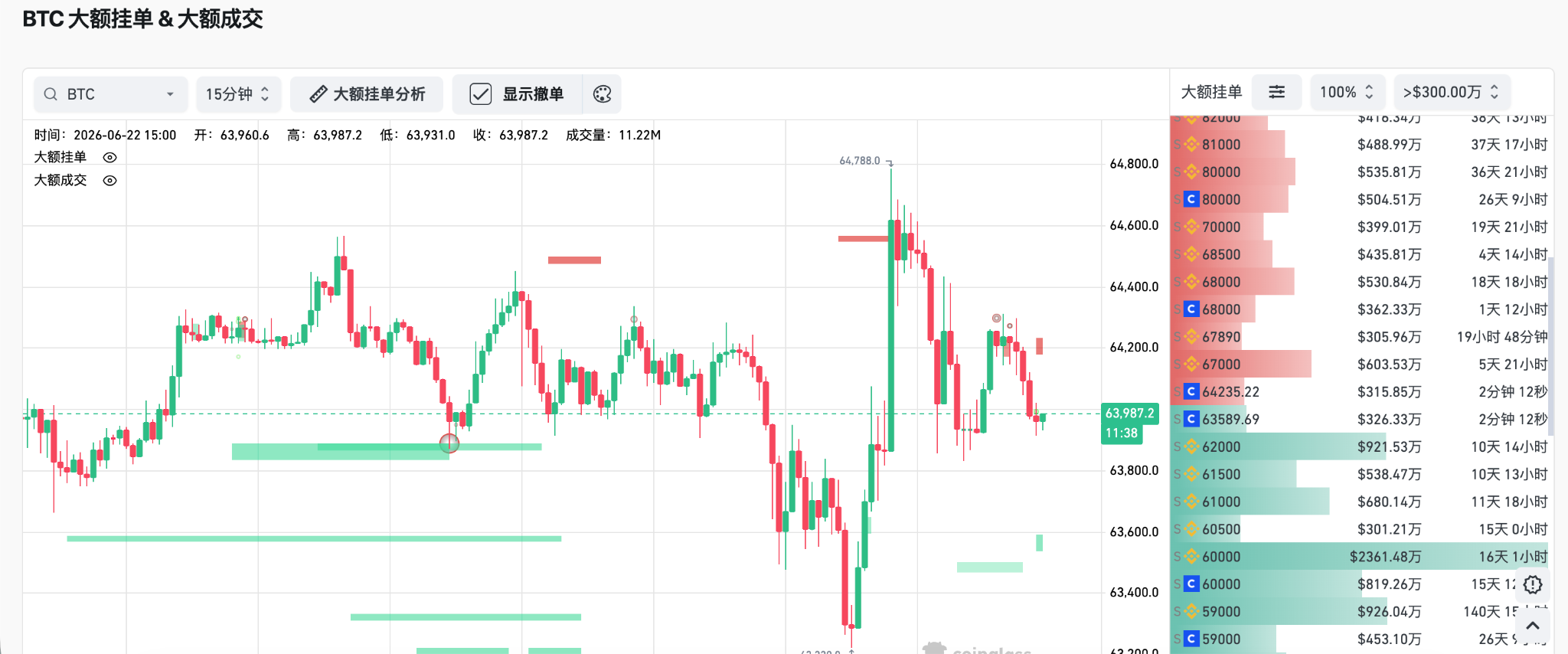
On the other hand, several analysts believe that there is excessive liquidity below $60000-$62000, which market makers find hard to ignore; there may be a retest of $60000 this week.
Today's key points:
Zama, Morpho, and Steakhouse jointly launched an Ethereum privacy DeFi yield vault, which will open for deposits on June 23
MegaETH (MEGA) will unlock about 250 million tokens on June 23, worth about $15.77 million
Upbit's 24-hour trading volume ranking: RE, WLD, XRP, BTC, ID
Bitcoin spot ETF: Last week net outflow of $227 million, marking six consecutive weeks of net outflow
Ethereum spot ETF: Last week net outflow of $10.05 million, marking six consecutive weeks of net outflow
HYPE spot ETF: Last week net inflow of $27.95 million
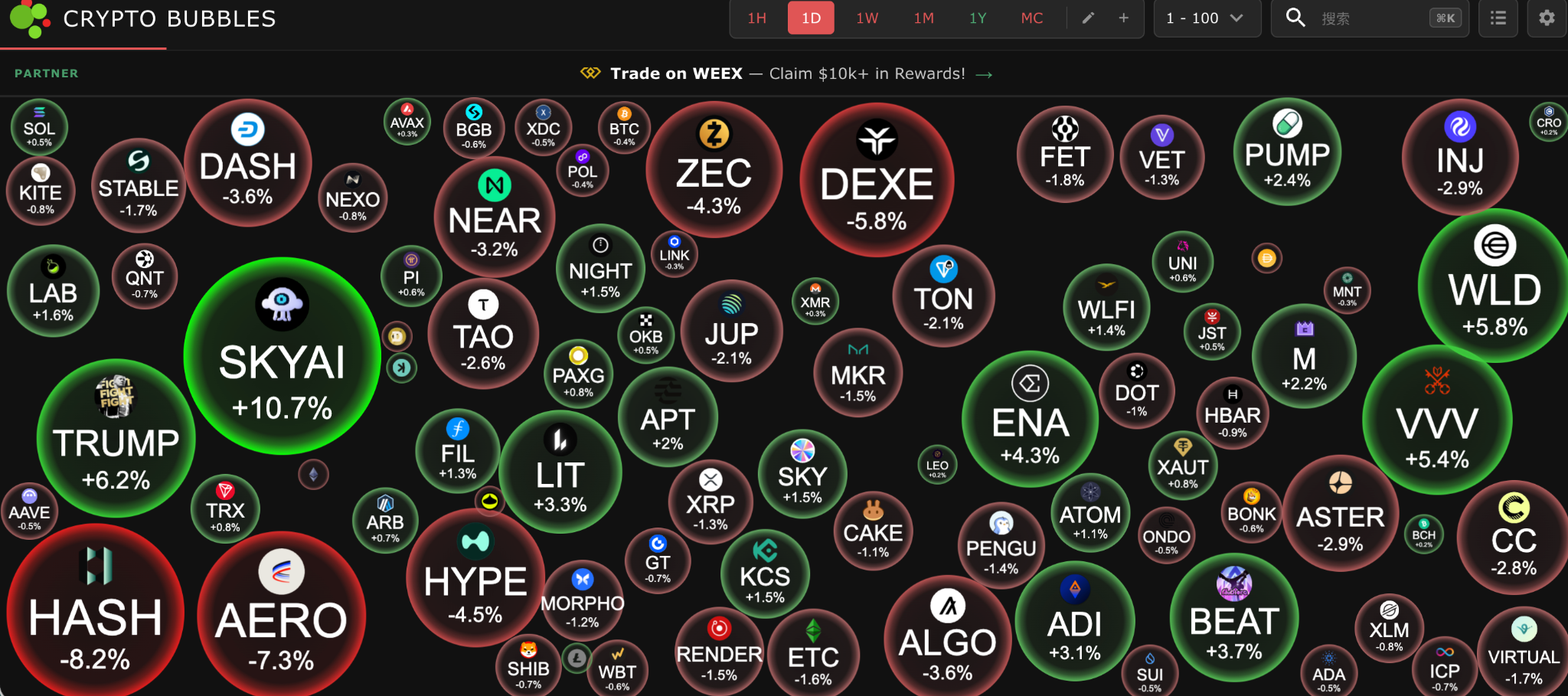
Today, the top gainers among the top 100 coins by market capitalization: SKYAI up 10.7%, Trump up 6.2%, WLD up 5.8%, VVV up 5.4%, ENA up 4.3%.
Asia-Pacific Market
The Nikkei 225 index broke through 72800 points during trading, reaching a new historical high. AI infrastructure-related stocks continue to lead, with the market temporarily ignoring the Bank of Japan's interest rate hike to 1% and risks in the Middle East. Prime Minister Kishi Nobuo expressed support for the Bank of Japan to achieve the 2% inflation target, while Deputy Governor Nakamura warned that delaying policy tightening could lead to uncontrollable inflation.
The market expects the Bank of Japan to raise interest rates again as early as September. Although May's CPI was only 1.4%, rising energy prices may still push inflation higher.
The South Korean market has become one of the strongest performing regions in Asia, with SK Hynix surpassing Samsung Electronics for the first time to become Korea's most valuable company, rising 5.6% to a total market value of about $1.35 trillion. So far this year, SK Hynix has risen approximately 350%, significantly outperforming Samsung Electronics' 194% increase.
In the first 20 days of June, South Korea's exports increased by 60.4% year-on-year, with chip exports surging by 188.4%, and computer product exports soaring by 293.3%. Bank of Korea Governor Lee Chang-yong warned that record bonuses in technology companies could drive broad inflation, with May's CPI already rising to 3.1%, the highest in two years.
LG Group concept stocks collectively surged, with LG Electronics once rising 12%, LG CNS up 14%, as the market bets on its cooperation with Nvidia in robotics and physical AI.
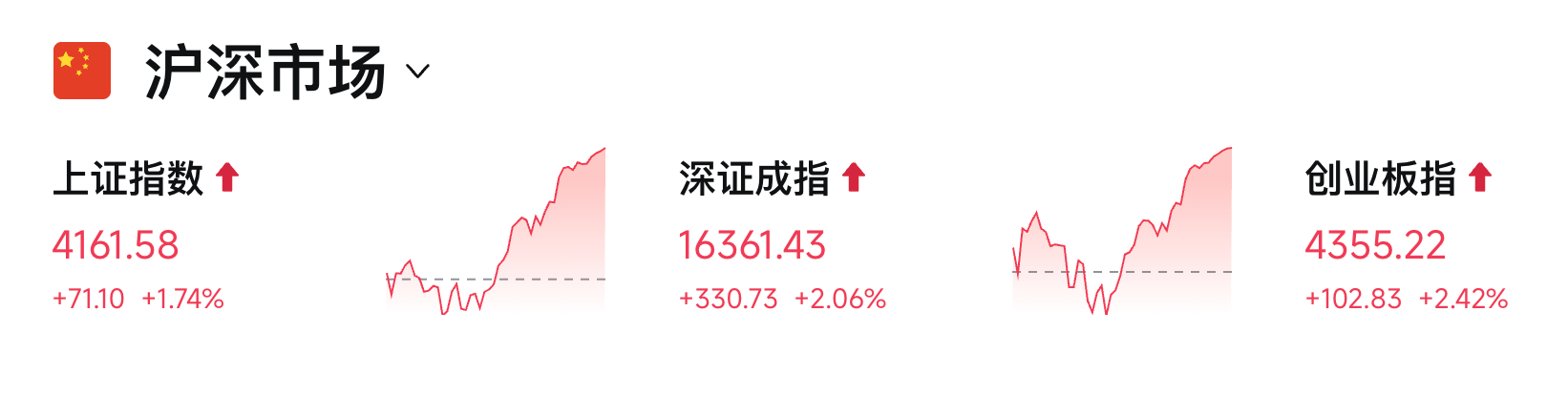
The central bank has maintained the LPR unchanged for the 13th consecutive month, with the one-year LPR at 3.0% and the five-year LPR at 3.5%. Galaxy Securities believes that the tightening period of the funds may be nearing an end, and there may still be room for a downward adjustment of the five-year LPR in the second half of the year.
A-shares rose steadily in early trading, with the ChiNext index once rising over 2.4%. Semiconductors, non-ferrous metals, and large financial companies performed actively, while robotics, innovative pharmaceuticals, and commercial aerospace sectors experienced adjustments.
Hong Kong stocks in the AI sector continued to surge. Zhipu rose as much as 29% during trading, with its stock price reaching 2980 Hong Kong dollars, total market capitalization reaching 1.207 trillion Hong Kong dollars; MINIMAX closely followed with a surge of over 20%, while Chip智控股 rose 12%, Innosek rose 11%, SMIC rose 7%, and Zhaoyi Innovation broke through 1000 Hong Kong dollars.
Things to watch next:
June 22nd week: The U.S. SEC is expected to approve SK Hynix's U.S. listing plan this week (earliest listing expected in August), which may become an absolute catalyst for the global chip asset valuation reconstruction.
June 23rd MSCI will announce the results of the annual market classification review: This will decide whether South Korea can enter the developed market watchlist.
免责声明:本文章仅代表作者个人观点,不代表本平台的立场和观点。本文章仅供信息分享,不构成对任何人的任何投资建议。用户与作者之间的任何争议,与本平台无关。如网页中刊载的文章或图片涉及侵权,请提供相关的权利证明和身份证明发送邮件到support@aicoin.com,本平台相关工作人员将会进行核查。


