Author: June, Shen Chao TechFlow
On June 16, Snap CEO Evan Spiegel officially launched the AR glasses Specs at the Augmented Reality World Expo, priced at $2,195.
On the same day, SNAP's stock price fell nearly 10%, closing at $5.16.
Soon after, a popular post appeared on Reddit's famous retail investor community r/wallstreetbets:
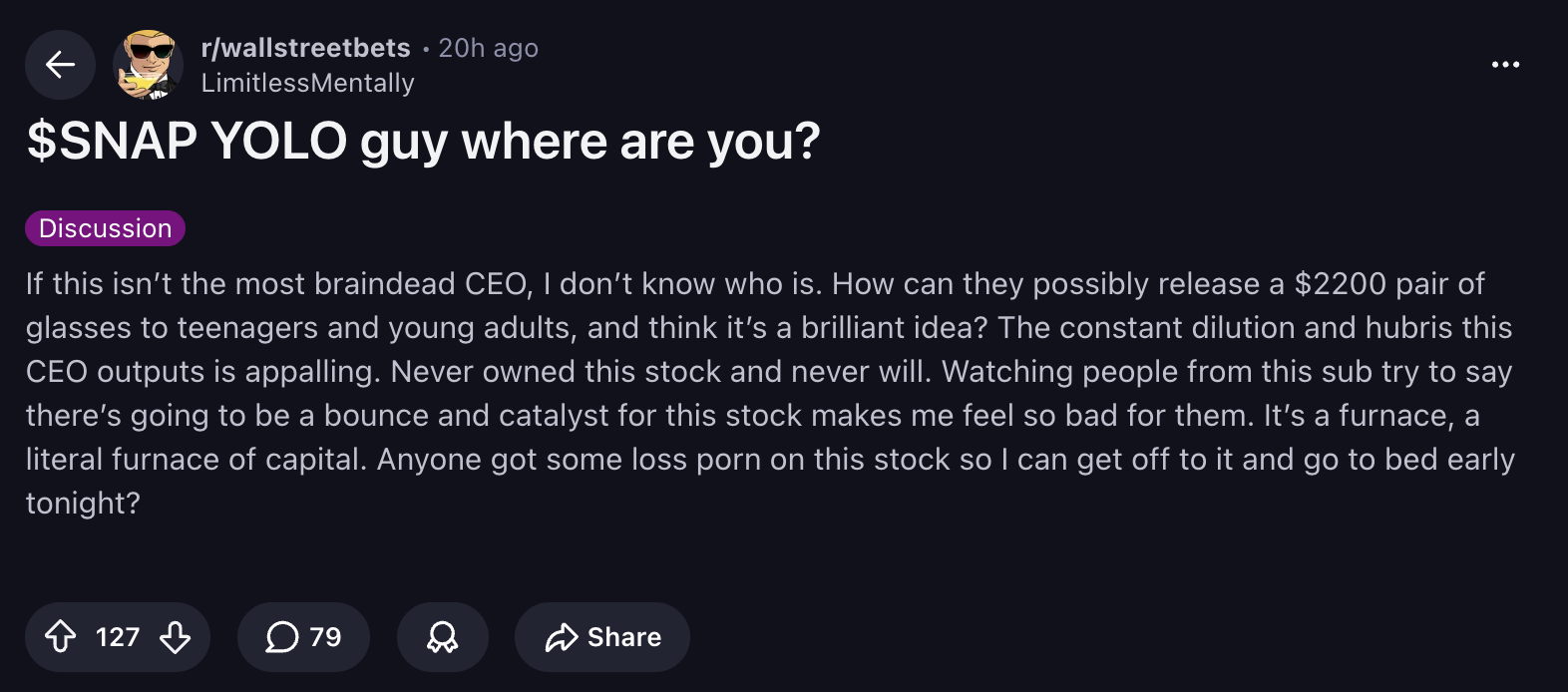
The poster insulted this CEO as a “crazy person,” compared the company to a “capital melting furnace,” and even asked for a “loss situation image” to feel safe and sleep.
He asked the most direct question for the entire market: Why should a company that has been losing money for years place its bets on a pair of glasses that young people can't afford?
A product you may not have used, but have definitely seen
When it comes to Snapchat, friends in China might not be very familiar, but you’ve probably seen the once-popular “dog filter”:

The virtual puppy that sticks out its tongue and moves its ears with the head is one of the most iconic Lenses (AR filters) launched by Snapchat in 2015.
The real-time facial tracking technology behind it comes from Snap’s acquisition of the Ukrainian startup Looksery for about $150 million. This was also the largest acquisition in the history of Ukrainian technology, and it was Snapchat that turned this technology into a global phenomenon, inspiring both celebrities and ordinary users to imitate it.
A pioneer that has been repeatedly copied
To some extent, looking back at Snapchat's history, it resembles a “history of being copied.”
The original fleeting stories (Stories) were almost entirely borrowed by Instagram, and now almost every social app has them; the camera-first interface and left-right swipe navigation have been used throughout the industry for nearly a decade; even its earliest bet on AR glasses has been preemptively made into a blockbuster by Meta's Ray-Ban smart glasses.
Snapchat has repeatedly stood at the forefront of technology, yet has never managed to turn “first-mover advantage” into “commercial success.”
This can also be seen from its stock price.
Since reaching a historical high of $83.34 in September 2021, SNAP has plummeted by as much as 94% in nearly five years, in stark contrast to the continuously rising US stock market during the same period.
2021 happened to be the peak of pandemic benefits but also a turning point. That year, Apple tightened privacy tracking permissions on iOS, directly hurting Snap's ability to target ads, which it depended on to survive. In the following years, TikTok and Instagram rose sharply, while Snap's long-term weak profitability prevented its stock price from returning to its previous levels.
Returning to the hot post mentioned at the beginning.
Why did Snap’s stock drop immediately after launching a new product, and why is this pair of AR glasses almost mocked across X and Reddit?
First, we must mention its core users. The main demographic of Snapchat is Generation Z aged 18 to 24. Selling a pair of glasses priced at $2,195 to a group of young people who can't afford them is obviously unrealistic.
Putting it in the context of its peers makes this dilemma even clearer.
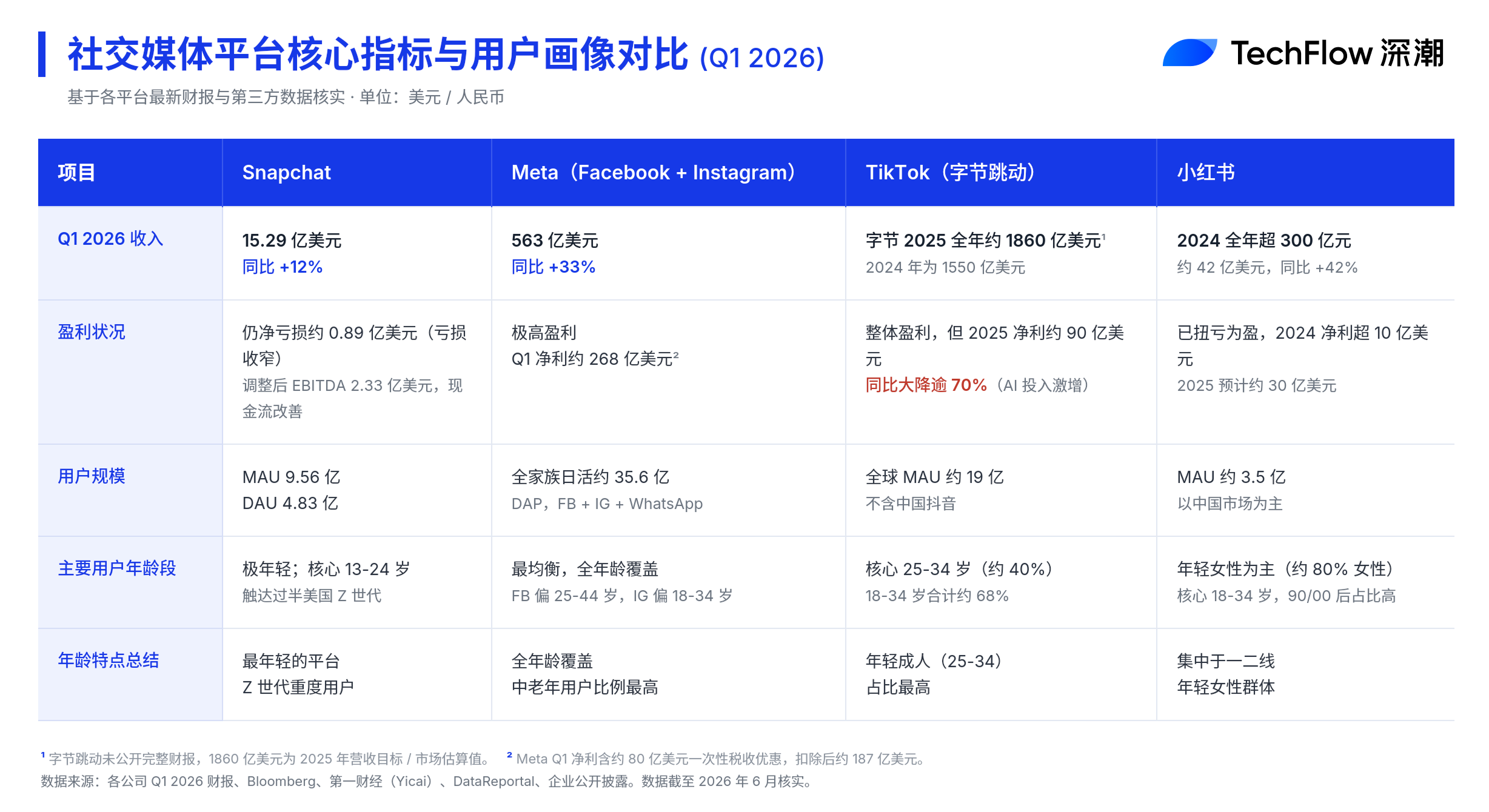
Meta, also engaged in social content, had quarterly revenues of $56.3 billion and net profits of nearly $27 billion; ByteDance and Xiaohongshu have also become profitable.
Only Snapchat has seen user growth and revenue growth, yet registered a net loss of $89 million in Q1 2026. Since its IPO in 2017, it has had a net loss every year. The reason is that young users are not the most favored demographic by advertisers; brands prefer to allocate budgets to the main consumer group aged 25 to 45.
Being young has instead become a burden for Snap's monetization.
A nearly decade-long AR gamble
In such a situation, Spiegel still chose to double down.
He referred to 2026 as the company's “crucible moment.” In April of this year, Snap laid off about 1,000 people, accounting for 16% of the total staff, citing that AI can now handle a lot of repetitive tasks.
Yet, at the same time, the company has invested over $3.5 billion in the Specs AR glasses production line. Starting from the first-generation Spectacles in 2016, this gamble has lasted nearly ten years.
To see how far this decade has come, we must return to that first-generation glasses.
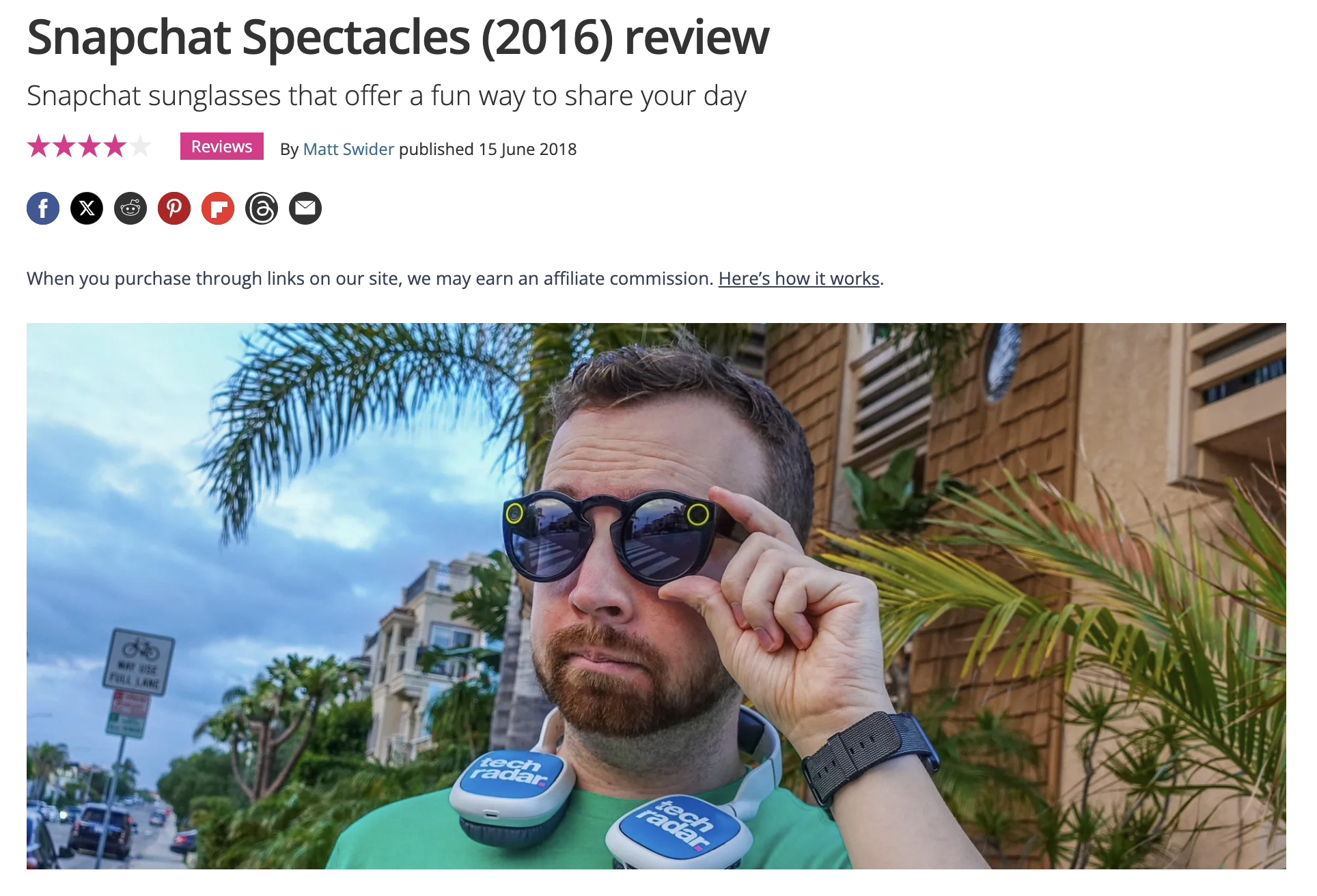
Image: The first-generation glasses from 2016
They were released in September that year and hit the market in November. They were a pair of iconic bright yellow glasses sold through street vending machines, with a camera embedded in the frame. Strictly speaking, they cannot be considered AR; wearing them, you can only take hands-free round short videos to share on Snapchat. In short, they were more like a fun toy worn on the face.
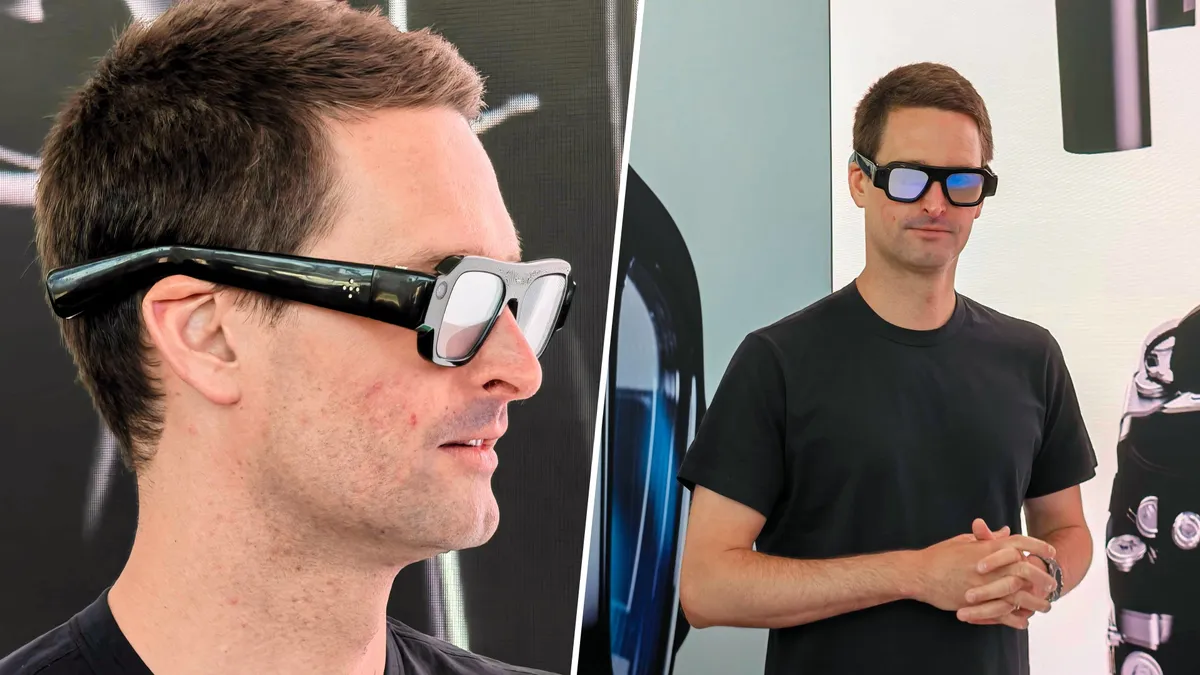
Image: Specs launched in 2026
A decade later, Specs can overlay digital information onto real scenes, run AI functions, recognize gestures, and operate independently from phones. From “video-recording glasses” to “space computers worn on the face,” this is a leap across a decade, representing what Spiegel truly wants to bet on.
What made investors collectively explode during the whole event was the price that is widely considered outrageous.
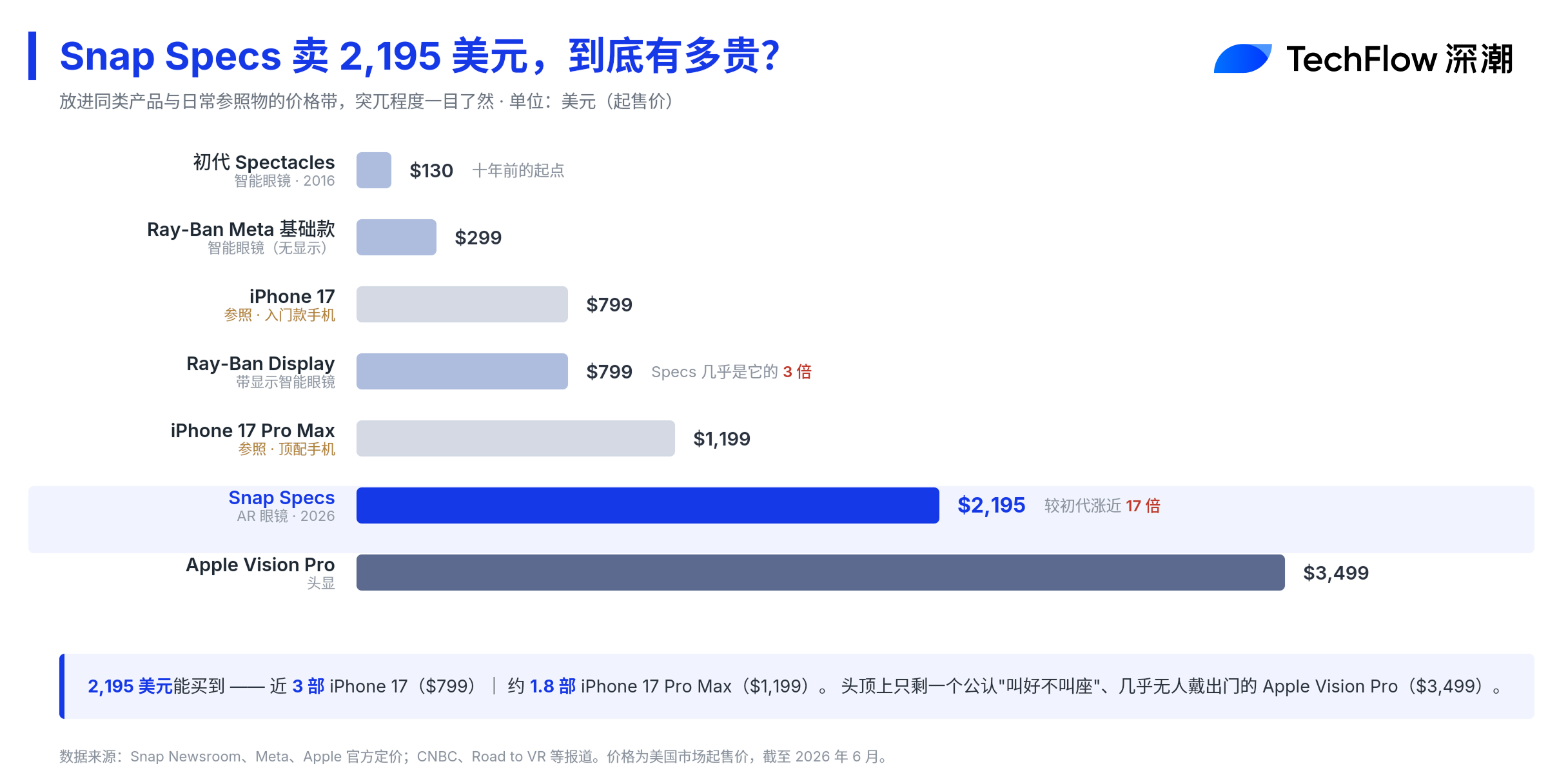
The question is, what do you get for the extra money?
Compared to the $799 Ray-Ban Display, which only has a small HUD in the corner of the lenses, Specs represents true AR, able to overlay digital content into reality, recognize gestures, and operate independently from phones, functionally superior indeed.
However, it weighs about 132 grams (almost twice that of the former), has a battery life of only about 4 hours, while the focused functions of navigation, measurement, and asking AI, smartphones can already do. Paying $2,195 results in a "category leap," but it may not be a mature product that fits into daily life. This might be where investors feel truly unsettled.
When the activist investor Irenic Capital publicly pressured for shutting down or splitting the Specs department to preserve cash flow, Spiegel publicly refused, insisting on seeing it as part of the company's long-term model.
On one hand, cutting jobs to save money, on the other hand, placing heavy bets on a vision that has not returned for a decade.
This is the most accurate portrayal of Snapchat at present.
Conclusion
In 2015, Snapchat became a global sensation with a virtual puppy-like AR effect; eleven years later, the AR glasses it is heavily betting on garner almost no optimism.
However, not everyone sees it as a farce.
Some look at it from the evolution of mobile phones. From the hefty brick-like mobile phones to today's smartphones, this journey has taken over thirty years. The currently expensive and heavy Specs may just be a somewhat awkward step before AR glasses reach maturity.
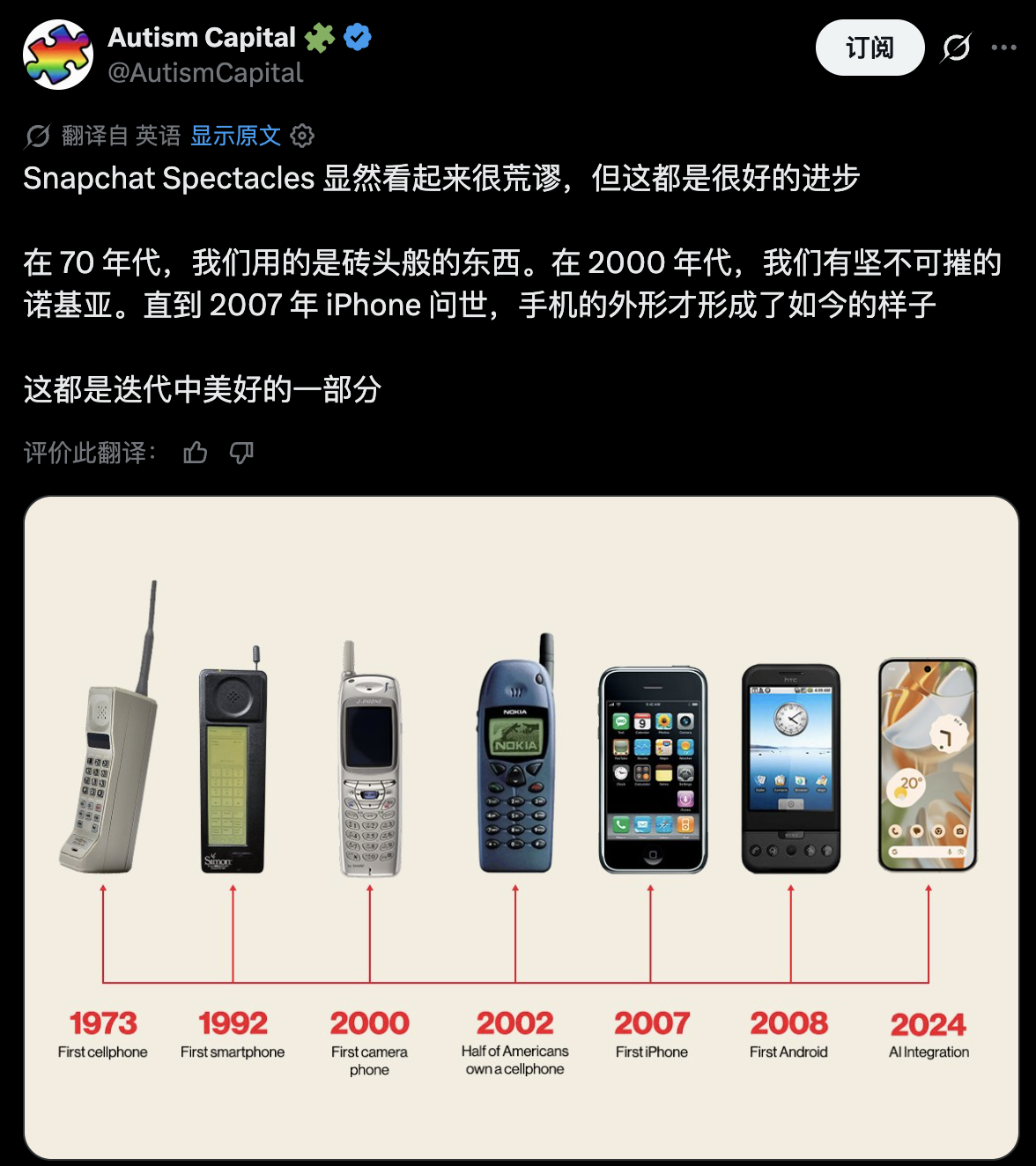
But in an era where there is a common pursuit of short-term returns and herd mentality, entrepreneurs like Spiegel who consistently adhere to their views, are they a rare anomaly in the industry or just gamblers doomed to be eliminated by the market?
This question may be worth each observer answering for themselves.
免责声明:本文章仅代表作者个人观点,不代表本平台的立场和观点。本文章仅供信息分享,不构成对任何人的任何投资建议。用户与作者之间的任何争议,与本平台无关。如网页中刊载的文章或图片涉及侵权,请提供相关的权利证明和身份证明发送邮件到support@aicoin.com,本平台相关工作人员将会进行核查。


