
Author: EDO FARINA XRP
Translator: Peggy
Editor's note: This article attempts to understand the expected IPO of SpaceX, AI Agents, blockchain settlement networks, commodity demand, and digital asset regulation on the same main line: global capital may be shifting from merely chasing speculative growth to betting on the next generation of economic infrastructure.
The author's core judgment is that as traditional growth engines slow down, capital needs new vehicles, and space infrastructure, AI computing power, satellite networks, data centers, and cross-border payment systems may collectively constitute the next round of infrastructure investment cycles. In this framework, commodities are no longer just cyclical products, but are the underlying inputs for AI, communications, orbital manufacturing, and energy systems; blockchain is not merely a transactional asset but may become the financial track for tokenized assets, AI Agent payments, and global real-time settlements.
The article especially emphasizes the potential role of payment-oriented digital assets like XRP and XLM in cross-border settlements, interoperability, and machine-to-machine payments, linking clues from Ripple, Jed McCaleb, Vast, and SpaceX to portray a merged picture of "space commerce + AI + blockchain settlement layer."
It is important to note that this narrative still carries a strong speculative tone, especially when binding specific digital assets to future infrastructure cycles, necessitating a distinction between long-term trends, business realization, and market pricing distances. However, one question it raises is worth noting: If AI is creating new economic entities and space and data centers are generating new capital expenditure cycles, who will undertake the value transfer, identity management, and instant settlements between these systems? This may indeed be the key for digital assets to transition from speculative narratives to infrastructure narratives.
Below is the original text:
The financial world may be entering a new phase. This phase is no longer merely a continuation of traditional market cycles but rather a construction toward a whole new economic infrastructure. The latest developments around SpaceX, artificial intelligence, blockchain technology, and the clarification of digital asset regulation indicate that capital is beginning to flow toward systems that might define the next generation of global commercial systems.
Behind the Expectations of SpaceX's IPO: Capital is Searching for New Infrastructure
The highly anticipated IPO of SpaceX has sparked great attention, not merely because of the company itself but because it represents a broader trend. With the tightening of debt markets and slowing economic growth, governments and financial institutions are looking for new frontiers that can absorb capital and justify ongoing investments.
Space infrastructure, orbital manufacturing, satellite networks, data centers, and advanced communication systems are increasingly being viewed as trillion-dollar opportunities. These areas require massive amounts of physical capital, commodities, financing support, and technological collaboration.
The logic is simple: When traditional growth engines begin to mature, capital will seek new areas that can sustain further expansion. Space may become one of these frontiers, even if this narrative itself is built on lies and deception.
A New Commodity Cycle: AI and Space Cannot Be Separated from Raw Materials
Large-scale infrastructure projects cannot be separated from raw materials.
The expansion of data centers, satellite networks, AI computing facilities, and future space infrastructure will drive enormous demand for key commodities. Metals such as gold, silver, platinum, copper, and rare earths will become indispensable inputs in the next-generation technology system.
The world may be in the early stages of a structural supercycle for commodities. This implies that, driven by infrastructure investment and technological transformation, demand will continue to rise over a prolonged period.
Unlike previous cycles primarily centered around consumer demand, this cycle will be driven by industrial and technological needs.
Blockchain's New Role: Not Just Tokens but a Real-Time Settlement Layer
As new industries emerge, capital must be able to flow efficiently in global markets.
The traditional banking system is designed for a slower world. Future infrastructure will involve tokenized assets, AI-driven transactions, international payments, and even potential space commercial activities, all of which require a settlement system that can operate continuously and process at high speeds.
This is where blockchain technology enters the discussion.
Our podcast yesterday emphasized that as financial infrastructure evolves, digital assets focused on payments and interoperability may become increasingly important. Networks that can quickly and efficiently complete transaction settlements will benefit from the growing demand for real-time value transfers.
Especially digital assets like XRP and XLM, as they focus on payments, interoperability, and cross-border settlements.
It is noteworthy that there is a connection between Ripple co-founder and XRP Ledger architect Jed McCaleb and commercial space projects. His company Vast has a cooperative relationship with SpaceX and Starlink related plans.
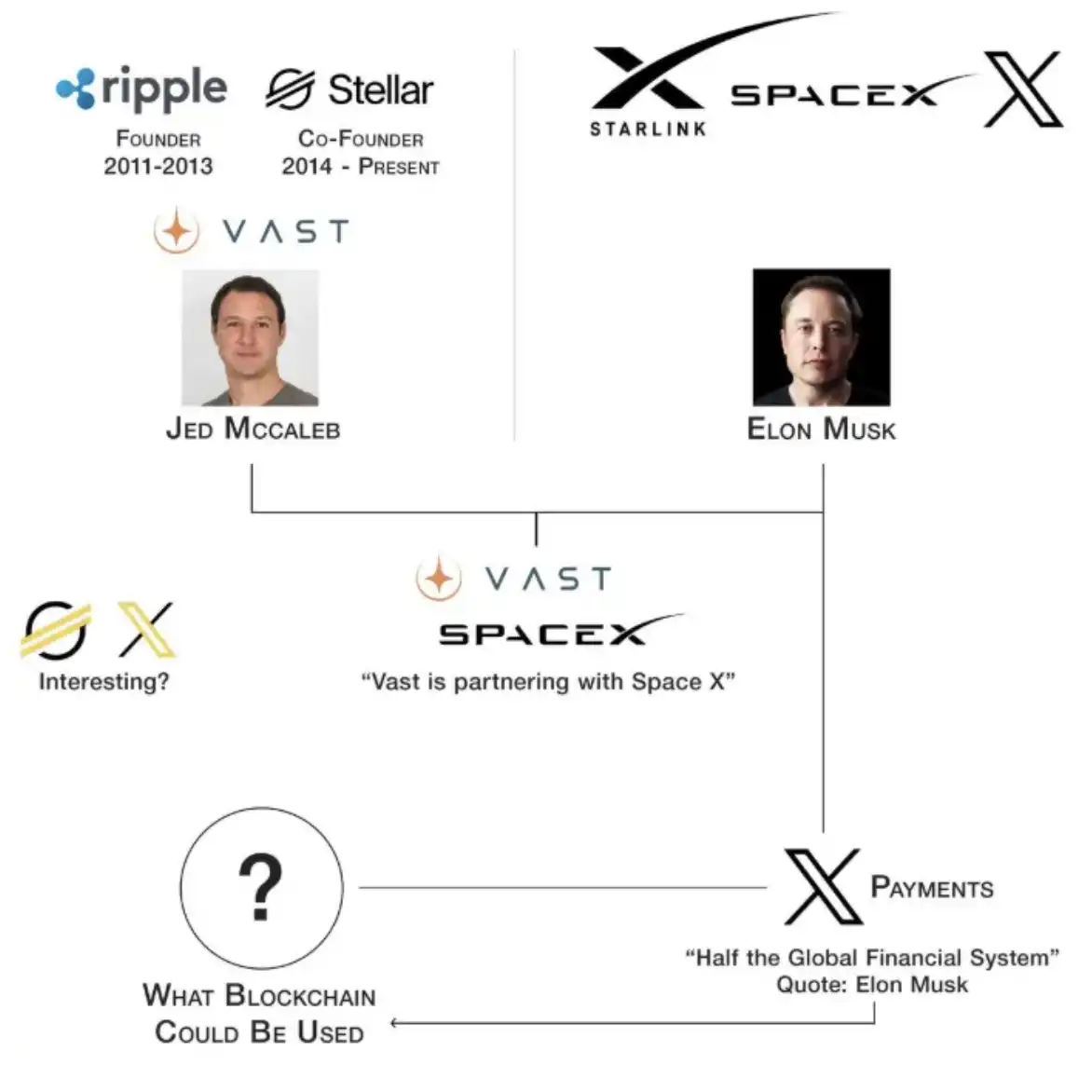
This indicates that blockchain may increasingly intersect with emerging infrastructure industries in the future.
The Integration of AI and Blockchain
One aspect of current technological innovation that is easily overlooked is the integration of artificial intelligence and blockchain technology.
Ripple CEO Brad Garlinghouse recently mentioned that the company is advancing AI-related plans and developing tools that allow AI Agents to interact with the XRP Ledger. This reflects a broader trend forming across the entire tech industry.
AI systems are rapidly evolving from information processing tools to autonomous agents capable of making decisions, executing trades, and interacting with digital services.
To enable these agents to operate effectively at the economic level, they require infrastructure that can support the following functionalities: sending payments; instantly settling transactions; managing digital identities; executing protocols; transferring value across different networks.
Blockchain technology provides many of these capabilities. As AI adoption accelerates, the demand for payment rails that can support large-scale machine-to-machine trading may grow. This will create a potential fusion: AI generates economic activity while blockchain networks provide the settlement layer that supports these activities.
Regulatory Clarity and Institutional Adoption
Another important topic is that digital asset regulation in the United States is gaining increasing momentum. Ripple's management has long believed that regulatory clarity is one of the most significant factors inhibiting broader institutional adoption. Banks, payment service providers, corporate treasury departments, and financial institutions typically require a clear legal framework before committing significant capital to new technologies.
As regulatory certainty improves, institutions may become more willing to integrate blockchain-based systems into existing business processes.
According to Garlinghouse, Ripple anticipates reaching an annualized revenue scale of one billion dollars while continuing to expand globally. This indicates that demand for blockchain solutions among enterprises is still growing.
The importance of regulation is not just on the legal level. It can reduce uncertainty and enable businesses and financial institutions to engage in long-term planning.
From Speculative Narratives to Infrastructure Narratives
One of the strongest conclusions this month is that the market may be shifting from speculative cycles to infrastructure cycles. In the past, the crypto market has largely been driven by retail speculation and narrative-driven investments. The next phase will be different.
If artificial intelligence, tokenization, digital payments, commodity infrastructure, and global settlement systems continue to mature, the value of digital assets may increasingly derive from actual utility rather than speculation alone.
This will represent a significant shift in how investors assess blockchain networks.
The market's focus will no longer be solely on price trends, but will increasingly turn to trading volumes, settlement activities, institutional adoption, tokenization growth, and the integration level with emerging technologies.
Conclusion
The integration of SpaceX, artificial intelligence, blockchain infrastructure, commodities, and regulatory clarity paints a picture of an economy undergoing structural transformation.
Space infrastructure is attracting capital, artificial intelligence is rapidly advancing, and regulators are moving toward a clearer framework for digital assets.
Meanwhile, blockchain networks are increasingly being positioned as the settlement layer that connects these emerging systems.
For investors, the question may no longer be whether these technologies will converge but rather how quickly this convergence will happen and which networks will ultimately become the underpinning backbone of the next phase of the global economy.
Those who truly accumulate wealth have never been late adopters. You must position yourself as an early investor in tomorrow's economic infrastructure before mass adoption arrives.
免责声明:本文章仅代表作者个人观点,不代表本平台的立场和观点。本文章仅供信息分享,不构成对任何人的任何投资建议。用户与作者之间的任何争议,与本平台无关。如网页中刊载的文章或图片涉及侵权,请提供相关的权利证明和身份证明发送邮件到support@aicoin.com,本平台相关工作人员将会进行核查。


