Key Takeaways:
Founder of onchain analytics firm Cryptoquant, Ki Young Ju, told his followers this week that “ Bitcoin analyst consensus currently leans bearish,” a blunt read on the mood inside professional trading desks after months of grinding price action. In a follow-up post, he framed the signal less as a forecast and more as a mirror of the crowd, adding:
“At the aggregate level, it’s probably better viewed as a market sentiment gauge. Even when we try to curate top analysts, the result still tends to look similar to broader market sentiment. To turn this into real alpha, we’d need to filter for top analysts with a strong track record.”
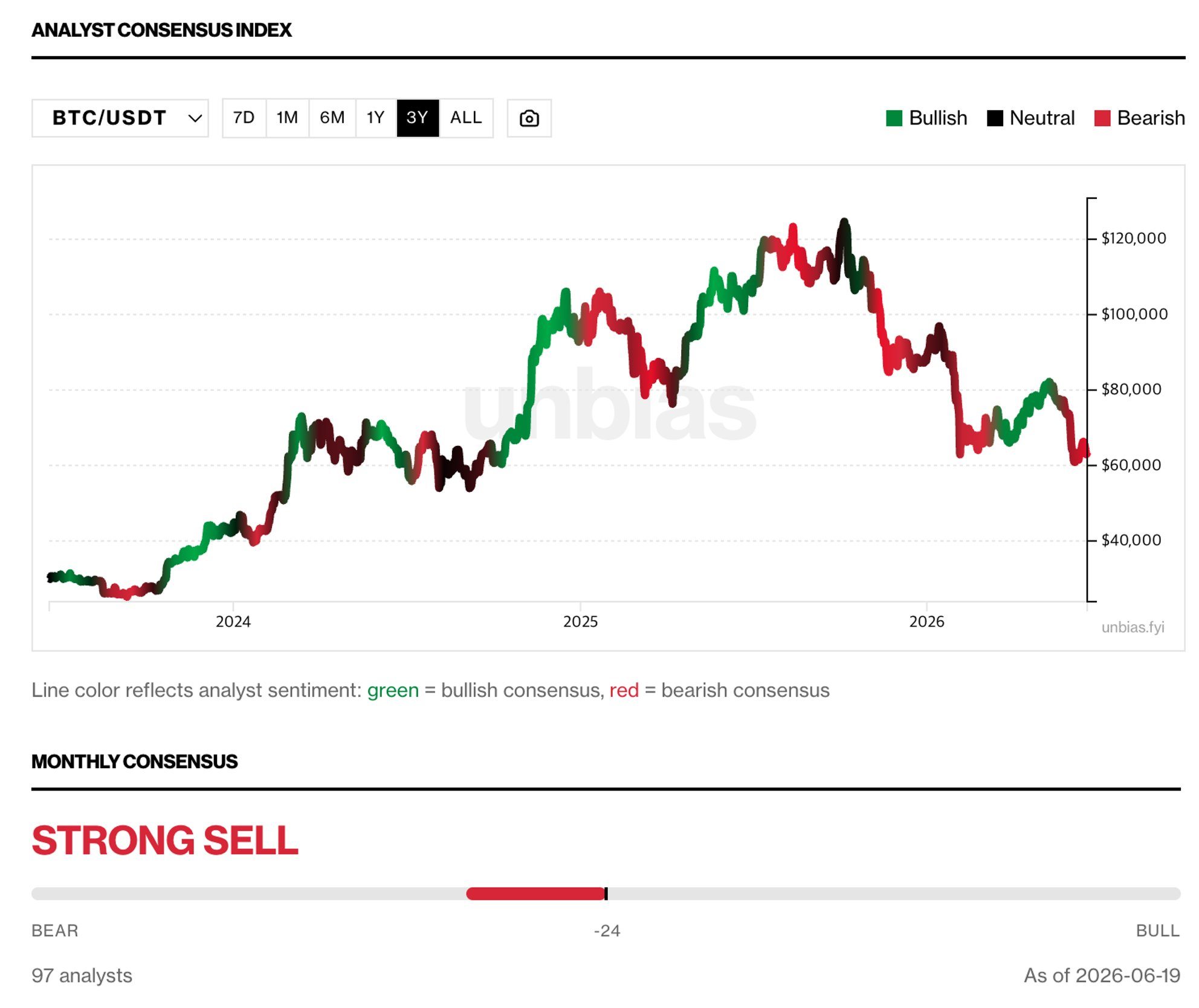
Image source: X
Ki Young Ju did not hide where that left him, casting himself as one of the last holdouts still leaning toward a recovery while professionals all around him seem to be bracing for more downside.
The bearish tilt hasn’t appeared out of nowhere, given bitcoin has shed roughly $25,000 since Jan. 1, sliding under the $70,000 mark and dragging its market dominance down toward 58%. The retreat has erased much of the optimism that defined the prior cycle and left even long-time bulls questioning when the next leg higher arrives.
The Cryptoquant head has spent weeks warning that the discomfort could linger, arguing that bitcoin’s downturn could run into early 2027, citing a profit-taking cascade that historically pulls investor returns lower for about 18 months before a durable floor forms. That call rests on the idea that the market has not yet rebuilt the cushion of unrealized profit it usually needs to fuel a sustained rally.
Until that base is restored, he contends, bounces are more likely to fade than to hold, a dynamic that helps explain why so many analysts have shifted their stance from cautious to outright defensive.
For Ki Young Ju, the real danger is not a violent collapse but a slow slide into irrelevance. In this regard, he has repeatedly flagged “market boredom,” i.e. prolonged stagnation that drains attention and capital, as the condition that could inflict the most lasting damage on bitcoin’s story.
That phrasing sets up two very different kinds of bearish scenarios, one of which is a sharp drawdown that flushes out leverage and quickly resets positioning, often setting the stage for a snapback. The other is a long, flat stretch in which prices neither crash nor recover, and traders simply drift away. The second scenario, in his telling, is the harder one to escape, because it offers no obvious catalyst to force capital back into the market.
That concern has practical stakes for the broader digital-asset economy, where trading volumes, fees, and new project launches all tend to wither when prices go quiet for long stretches.
Ki Young Ju’s willingness to stand apart from his peers is, in some ways, the entire point of watching sentiment. Gauges like the one he describes are most useful at extremes, i.e. when nearly everyone has turned bearish, the consensus itself can become a contrarian signal, because the sellers have largely already sold.
Whether that read pays off depends on factors largely outside any single analyst’s control, including macro liquidity, institutional appetite, and whether bitcoin can claw back the dominance it has ceded in recent months.
免责声明:本文章仅代表作者个人观点,不代表本平台的立场和观点。本文章仅供信息分享,不构成对任何人的任何投资建议。用户与作者之间的任何争议,与本平台无关。如网页中刊载的文章或图片涉及侵权,请提供相关的权利证明和身份证明发送邮件到support@aicoin.com,本平台相关工作人员将会进行核查。


