Author: Shenchao TechFlow
Introduction
"Help me scan for today's contract opportunities."
More and more traders are saying this to AI.
As the boundaries of AI capabilities continue to expand, AI is gradually permeating every aspect of trading analysis, decision-making, and execution, and major trading platforms have simultaneously launched an AI arms race.
But even "AI help me trade" offers very different experiences along different paths.
Take "scan for today’s contract opportunities" as an example:
You can directly open the exchange app, converse with the built-in AI, and obtain a list of opportunities;
Alternatively, you can call tools as needed in Claude Code, generating a complete report featuring OI, funding rates, 70+ technical indicators, smart money flow direction, and news sentiment while also setting it to automatically run every morning at 8 AM.
The experience gap behind this is the choice under different needs and habits, and understanding which range you belong to and what kind of tools you should choose may be the most worthwhile question to consider in this AI arms race.

Two Paths, Two Experience Logics
AI products from various CEX platforms have gradually appeared on the table.
Binance launched Binance AI Pro as a one-stop AI trading assistant, allowing users to use it as soon as they open the app. Meanwhile, Binance also introduced the open-source AI Agent skill market, Binance Skills Hub, as a repository of AI capabilities.
Bitget has Bitget Agent Hub as an ecological AI infrastructure and has launched several Agent products, including GetAgent, GetClaw, and Gracy AI based on it.
This is one path: first, open the door.
In short, by lowering the participation threshold, attract more users to experience it, and then gradually enhance capabilities with built-in agents being the key entrance to open this door.
Beyond Binance and Bitget, whether it’s Bybit’s Aurora or Gate’s GateClaw, the "open the door first" path seems to have become the mainstream choice for most CEXs.
But beyond "opening the door", there is another path: first, build infrastructure.
A typical representative is OKX, which chose not to create a built-in agent but started from the bottom-up approach. On one hand, it developed an open-source AI trading toolkit, OKX Agent Trade Kit, allowing any AI to call upon OKX's trading capabilities. On the other hand, it also created an on-chain operating system, Onchain OS, dedicated to AI, forming a complete AI layout that covers both CEX and DEX.
The logic behind this path is equally clear: create a complete toolchain that covers all AI capabilities users might need, and any AI that users are already accustomed to can be plugged in to access this capability.
Two paths imply two different bets:
Open the door first, betting on user habits; most people lack the patience or ability to configure AI themselves, so built-in agents are the most straightforward choice;
Build infrastructure first, betting on ecological openness; in the future, AI clients will become increasingly diverse, making it more imaginative to create a tool layer that all AI clients can access rather than a single entry point.
One path is "top-down," and the other is "bottom-up." The different paths lead to different applicable boundaries, and the experiences already show distinct differences.
What type of user you are determines which path is more suitable for you.
Capability Boundaries: First Understand What Each Can Do
When selecting AI tools, the first step is to clarify what each platform’s AI can specifically do.
By summarizing the 695 commands from Binance Skills Hub, 172 commands from OKX Agent Trade Kit, and 58 commands and related skills from Bitget Agent Hub, the capability boundaries of different CEX AI can be revealed one by one:
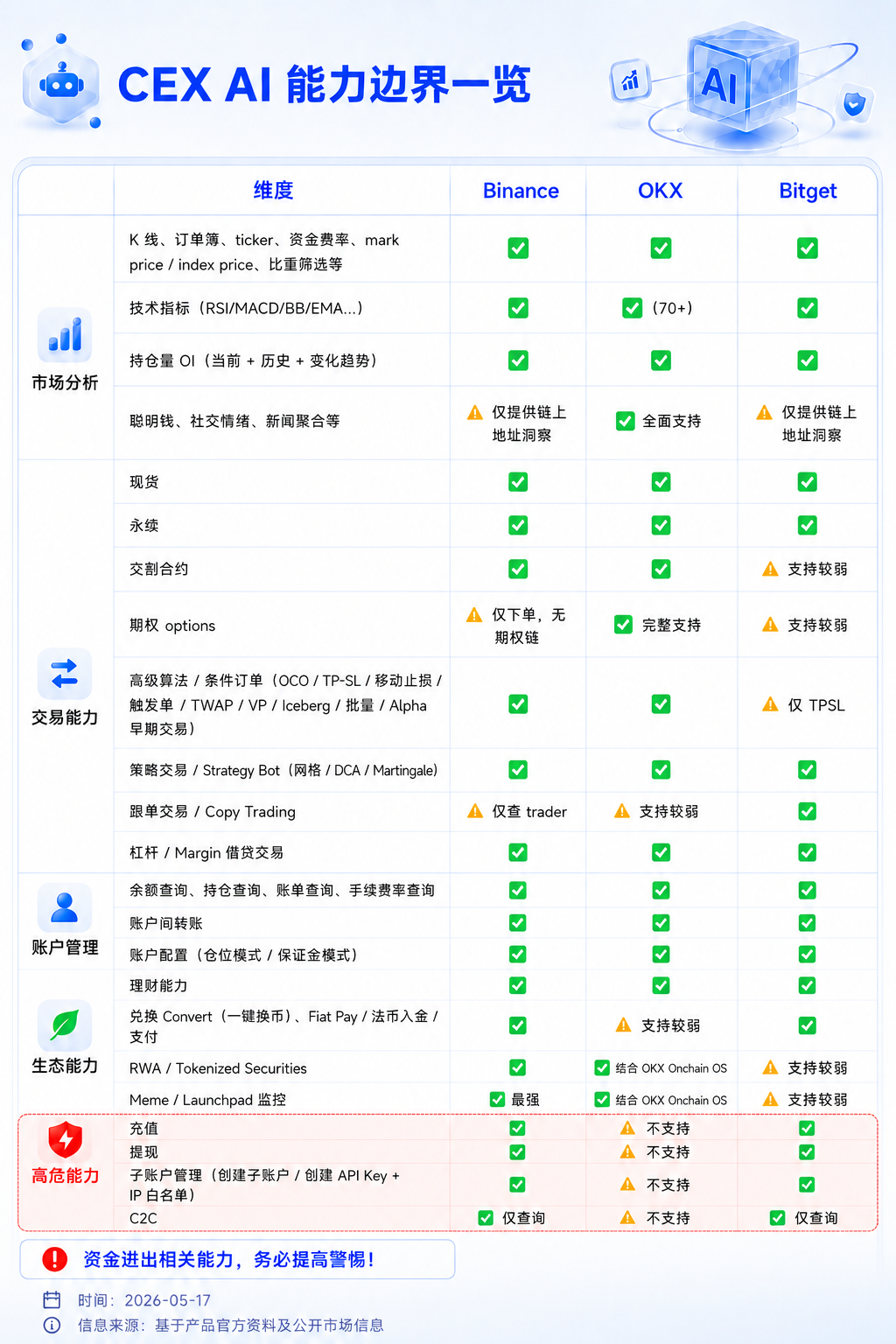
Interestingly, while Binance has the most commands at 695, it is not the most complete in terms of tools.
The high command count stems from Binance's underlying design, where the same function is divided into four repeated endpoints based on spot/futures/coin-m/portfolio-margin.
However, this does not overshadow Binance's core advantage in terms of ecosystem breadth: in scenarios such as Fiat deposits, P2P, RWA, Meme Rush, and early-stage Alpha trades, Binance is nearly a unique entity. This is a strategy of "rapidly expanding its rich ecosystem"; if your needs fall within these exclusive services, Binance is the only option.
Speaking of the most comprehensive tools, we come to OKX, which once again echoes OKX's path choice of "creating a complete toolchain."
172 commands cover spot, perpetual, delivery, and options, spanning the entire cycle of market discovery, analysis, and execution, especially in derivatives and analysis tools.
Moreover, the tool sections are extremely detailed: options include a complete set of Greeks (Delta / Gamma / Theta / Vega / IV), arguably the most comprehensive AI agent options toolset on the market; for market analysis, the Market module uniquely provides 70+ technical indicators, including MA, EMA, RSI, MACD, BB, ATR, and KDJ, paired with market screening tools, historical OI, and sentiment radar, providing agents with more acute market perception. Additionally, OKX offers an array of strategy bots (Grid / DCA).
This meticulous segmentation allows for more precise trading control, thus better meeting the needs of professional traders.
Also following the "open the door first" path, Bitget establishes a differentiated advantage with its exclusive copy trading function.
Five dedicated copy trading tools support automatic selection of elite traders, one-click copy trading, position tracking, etc., making complete and in-depth copy trading capability the most recognizable label in Bitget's AI layout.
As the command lists are presented, the capability boundaries of each platform are further displayed, allowing users to choose according to their own needs.
However, whether these capabilities are usable and efficient can only become clearer through practical tasks.
Run Through a Task: Which Solution Completes Your Task Better?
In the process of executing specific tasks, the experience differences between the "open the door first" and "build infrastructure first" paths become even clearer, providing users with a more distinct reference for choice.
The built-in agent of the exchange representing "open the door first" is Binance AI Pro, while "build infrastructure first" is OKX Agent Trade Kit connected to Claude Code, executing the same task with the same set of prompts. What are the results?
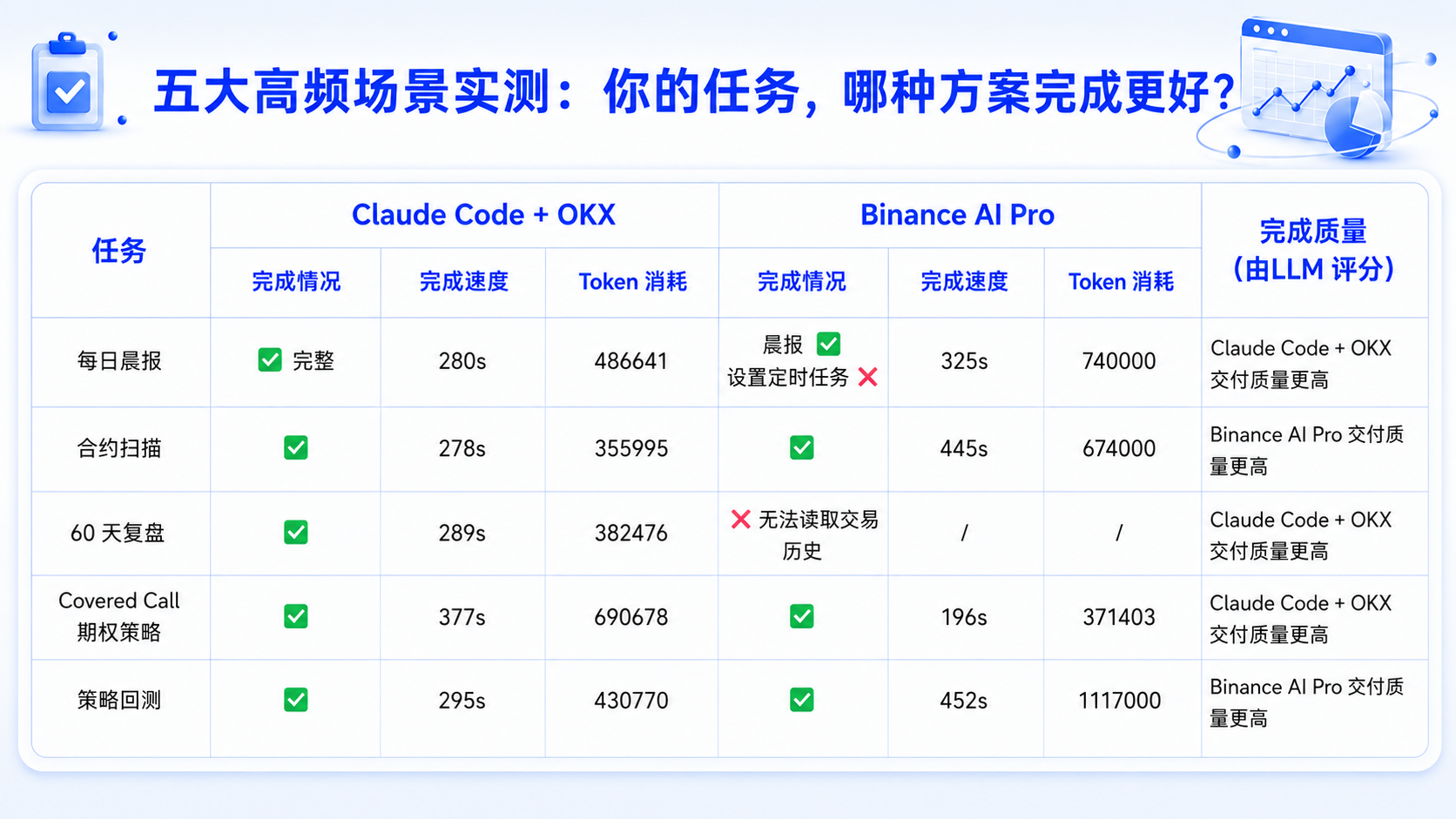
First, let's look at the entry barriers:
Binance AI Pro is ready to use out of the box, requiring no configuration;
Claude Code + OKX requires manual configuration, which poses a challenge for beginners. Clearly, OKX also recognized this and recently launched a "one-click quick connect" feature, allowing users to complete the connection in about 15 seconds. However, the overall operational threshold remains higher than that of the built-in agents.
Next, consider the quality of task completion:
For relatively independent and singular tasks like contract scanning or strategy backtesting, Binance AI Pro handles them more adeptly;
Claude Code + OKX completed all 5 tasks, achieving a higher completion rate in complex tasks involving multiple sectors by leveraging the complete toolchain of OKX ATK.
Of course, it's important that it's also fast and affordable to use.
In terms of task completion speed, Claude Code + OKX completed everything with an average time of 311 seconds, while Binance AI Pro averaged 348 seconds, making the "build infrastructure first" path overall slightly faster than "open the door first."
Specifically, in the contract scanning task, Claude Code + OKX took only 278 seconds, more than two and a half minutes faster than Binance AI Pro's 445 seconds; however, in the options strategy scenario, Binance AI Pro took only 196 seconds, faster than Claude Code + OKX's 377 seconds.
In terms of costs, while Claude Code + OKX has an average token consumption of 444K, lower than Binance AI Pro's 623K, both maintain a "strengths in different areas" dynamic in various scenarios: in the options strategy task, Binance AI Pro’s token consumption is lower than that of Claude Code + OKX; while in the strategy backtesting task, Claude Code + OKX consumes almost 2.5 times fewer tokens than Binance AI Pro.
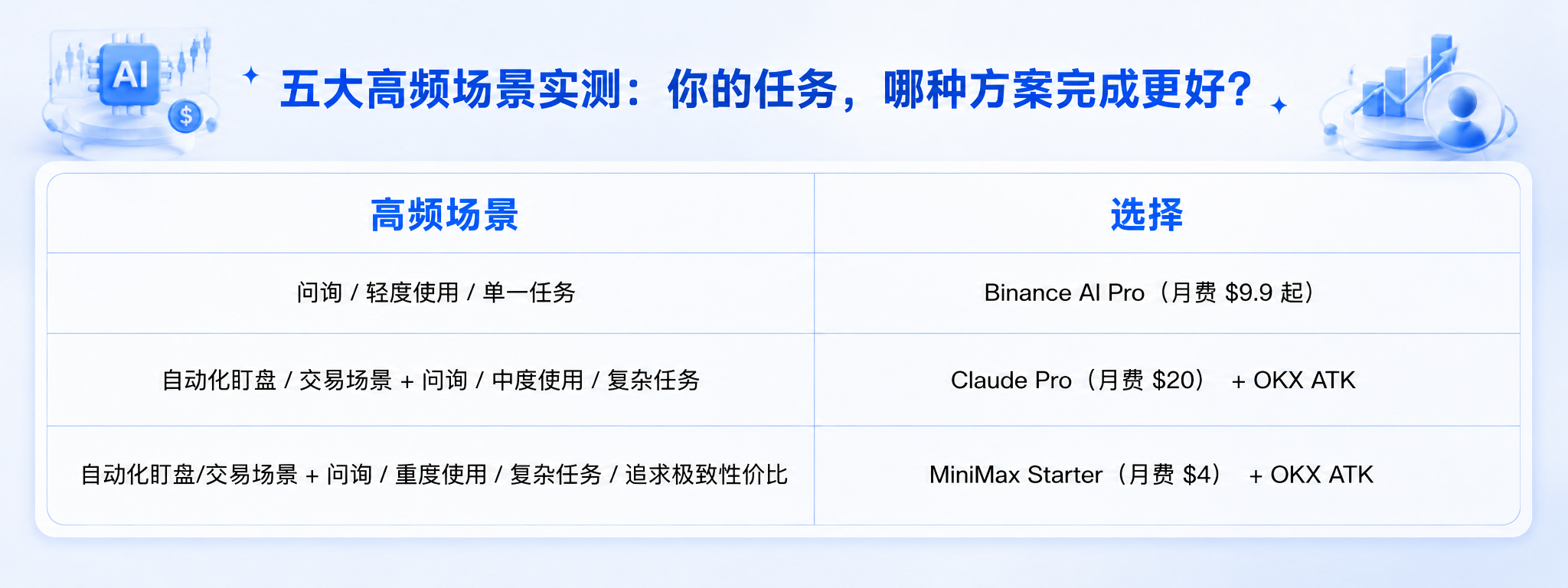
Additionally, Binance AI Pro has a monthly fee starting at $9.9, but with limited monthly token quotas, the consumption per complex task processed is higher;
OKX ATK can integrate multiple agents such as Claude Code / ChatGPT / MiniMax / GLM / DeepSeek, with different agent monthly fees ranging from $4 to $20, maintaining its cost-effectiveness especially under limited monthly token quotas, achieving significant cost compression especially when selecting the $4 MiniMax Starter + OKX ATK option.
In summary, the two paths are not "either/or"; the key lies in where your needs fall:
Choosing according to your usage context makes the answer clear.
Safety and Access: Two Essential Questions Before Making a Final Choice
When selecting AI tools, functionality is often the primary focus.
However, after reviewing capabilities, two questions must also be considered.
First, is it safe for this AI to operate my account?
After all, behind trading capabilities, AI is executing "money."
For this question, each platform's attitude is serious but presents various focuses.
Binance's security logic begins with source control; all listed skills must undergo official Binance security audits to ensure that the skills entering the ecosystem are trustworthy.
At the execution level, Binance controls account permissions through API key authorization and strongly recommends that users create dedicated virtual sub-accounts, strictly limiting all AI operations within the sub-account scope, physically separating them from main account assets.
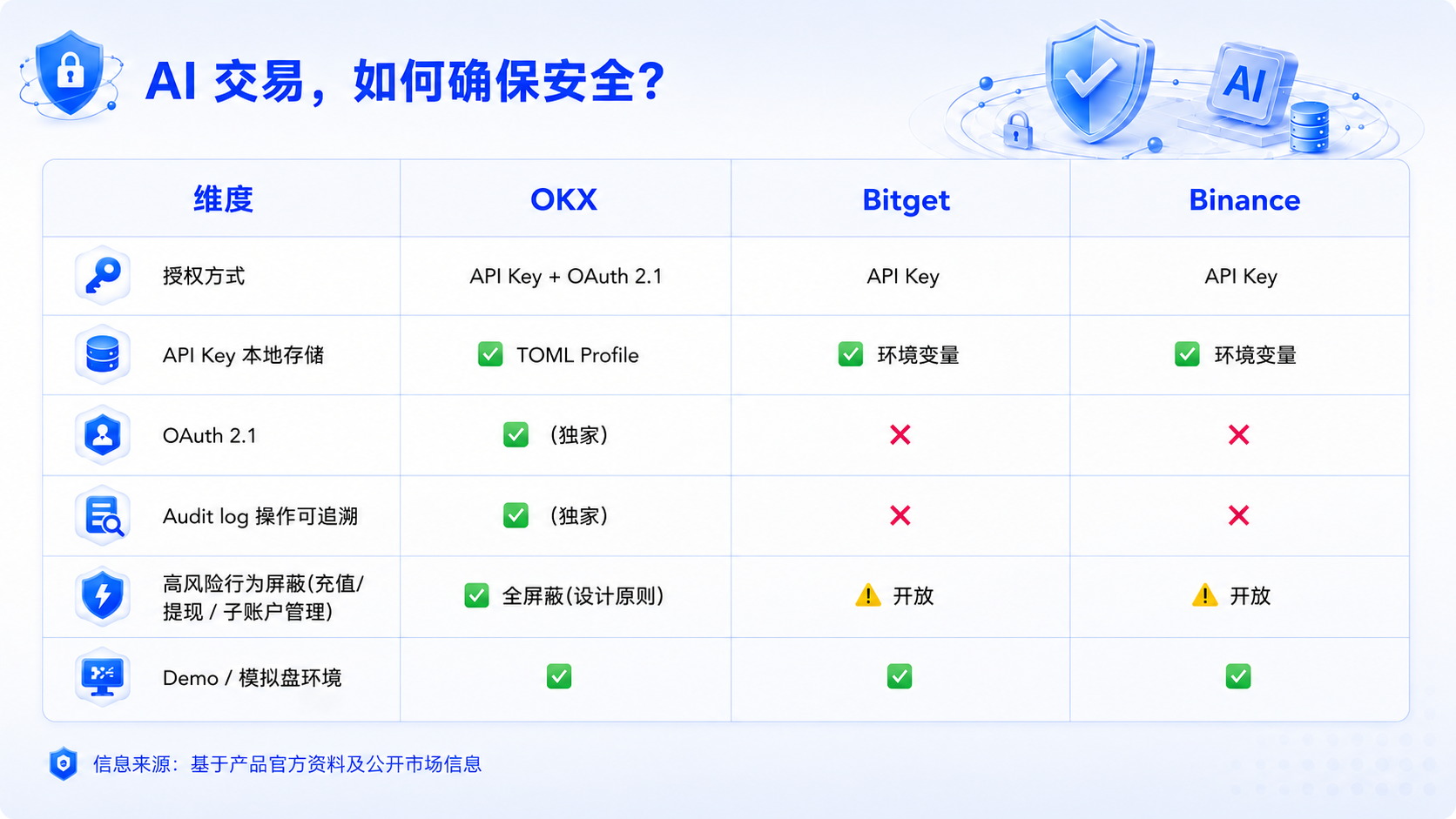
In contrast, OKX is currently the only platform able to simultaneously meet key isolation, high-risk operation shielding, and complete operation record requirements.
With API keys fully stored locally and AI models never seeing the keys, OKX Agent Trade Kit further introduces OAuth 2.1, providing more precise protection in areas such as short-term tokens, scope control, and browser flows. Simply put, OKX Agent Trade Kit ensures that AI never sees keys, tokens automatically expire when used, and even if the account is attacked, what attackers obtain is only an expiring temporary credential.
At the same time, many people may have noticed in the capability comparison above that for high-risk routes such as deposits, withdrawals, and sub-account management, Binance and Bitget choose to open permissions for greater flexibility, allowing users to impose constraints on API key permissions. In contrast, OKX Agent Trade Kit opts to directly shield high-risk entries like deposits, withdrawals, and sub-account management at the tool level. This means that even if an agent is attacked or malfunctions, it cannot physically trigger the transfer of funds.
Additionally, it is worth mentioning that OKX Agent Trade Kit uniquely supports audit log operations and is the only platform providing complete operation records (as of May 2025). This means that every time the AI agent calls a tool or performs an operation, it is traceable, which is particularly important in scenarios requiring retrospective tracking, compliance audits, or anomaly investigations.
Bitget, which also adopts the API key authorization mechanism, emphasizes a "isolation" security core concept: a four-layer isolation mechanism of identity isolation, memory isolation, permission isolation, and credential isolation, combined with dedicated sub-account sandboxes, cuts potential impacts of AI on the main account from multiple dimensions.
Safety as a fundamental guarantee is another key element that allows tool capabilities to be fully released, and that is large-scale access.
Simply put, can the commonly used Claude / ChatGPT be easily integrated?
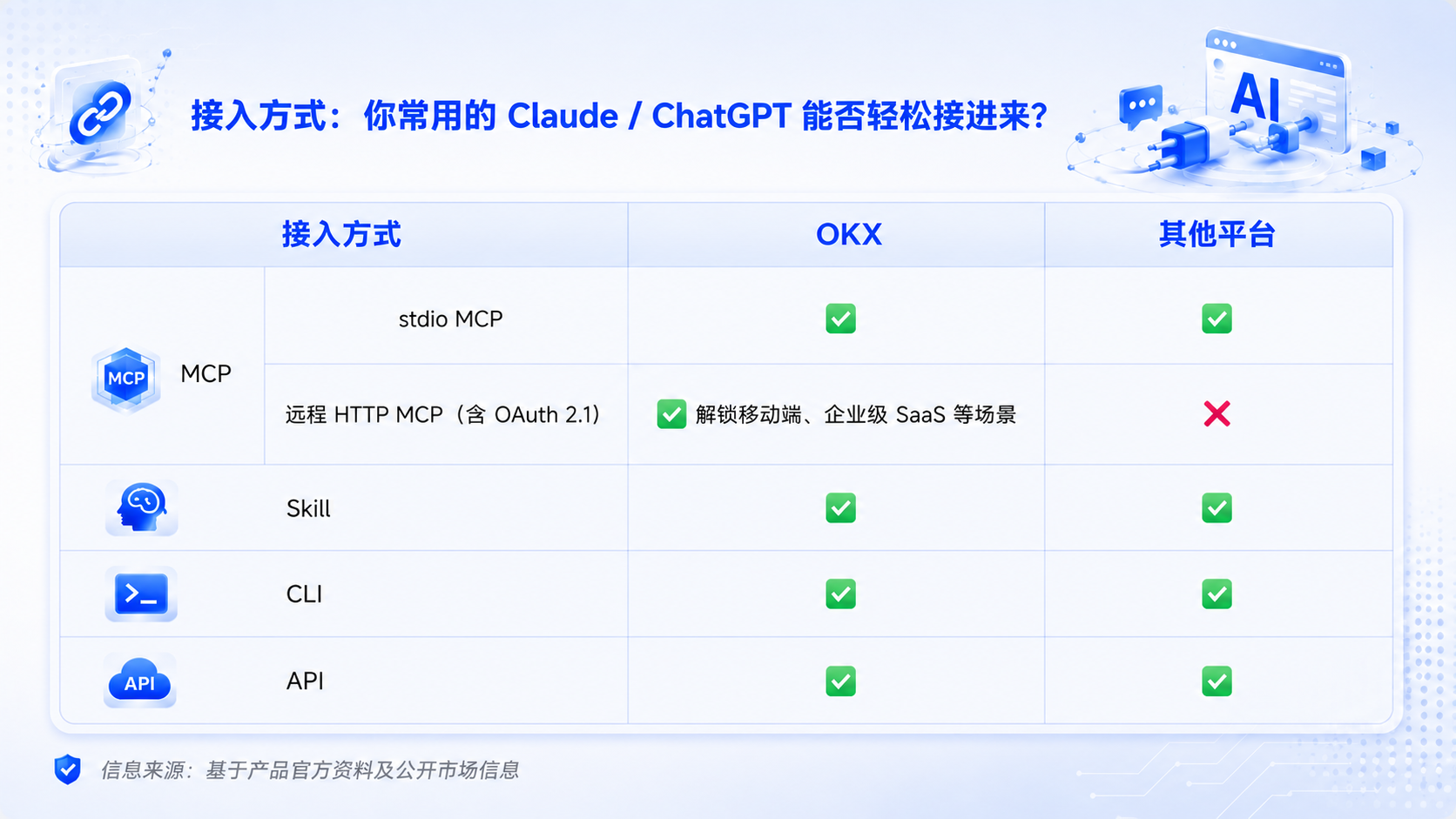
Mainstream access methods include MCP, Skills, CLI, API, etc., with almost all trading platforms' AIs offering basic support.
However, just because they all support it doesn’t mean they are comprehensive, and this is particularly evident in respect to MCP.
Most platforms support only the most basic local stdio MCP, which, combined with CLI and other methods, has already achieved integration support for most agent clients.
In this regard, OKX, which builds an "AI tool layer" with a foundational mindset, continues to extend its “comprehensive” product logic: in addition to supporting local stdio MCP, it further supports remote HTTP MCP (including OAuth 2.1) access methods.
This local + remote coverage not only unlocks mobile scenarios for OKX, making it the only CEX AI that supports "letting AI help me monitor and trade while I'm out," but also opens doors to enterprise-level SaaS scenarios for professional developers or institutions.
What Kind of User Are You? The Answer Is Here
So, after comparing so much, which CEX AI is the most suitable for you?
The answer is already quite clear.
Doing a good job on the entry point is equivalent to lowering the threshold, allowing a larger scale of users to come in to experience, learn, and grow.
For users who don't want to tinker or currently lack the capacity to set up an agent, built-in agents like Binance AI Pro and Bitget GetClaw will perfectly match their needs; they are ready to use right out of the box, quick to get started, and often perform better in handling occasional inquiries, checking market conditions, doing simple analysis, and execution.
Doing a good job on infrastructure is equivalent to raising the ceiling, allowing various agents to call upon rich tools in different scenarios to complete complex tasks.
Therefore, if you have a certain level of configuration capability and your needs for AI trading have reached a higher stage of automation, complex strategies, scheduled tasks, and derivatives analysis, then customizing your DIY process based on OKX's complete toolchain is a better choice. Not only can it build more complex strategies, but it also leads to higher task completion rates and more controllable costs. Regarding entry barrier issues, OKX has also introduced the "one-click quick connection" feature, significantly lowering configuration thresholds, allowing OKX to expand into higher-level areas while maintaining ease of use.
At the same time, for developers and institutional users in need of enterprise-level access, compliance audits, cloud deployments, and multi-agent collaboration, OKX ATK with Remote MCP + OAuth 2.1 + audit logs + open eval frameworks can better meet these demands.
Different stages, different needs, different choices.
Paths determine product forms, and products reflect user thinking.
In the rapidly evolving landscape of AI technology today, user habits are still forming, and each toolchain is still being completed; today's "basic support" may become "full support" tomorrow; today's "exclusive capabilities" may be copied by competitors next quarter.
Which path can lead the way for groundbreaking advancements and large-scale explosions in AI trading execution?
This may be the aspect worth observing in the ongoing competition of paths in the CEX AI arms race.
免责声明:本文章仅代表作者个人观点,不代表本平台的立场和观点。本文章仅供信息分享,不构成对任何人的任何投资建议。用户与作者之间的任何争议,与本平台无关。如网页中刊载的文章或图片涉及侵权,请提供相关的权利证明和身份证明发送邮件到support@aicoin.com,本平台相关工作人员将会进行核查。


