Author: Michael Saylor
Translator: Deep Tide TechFlow
Deep Tide Guide: The founder of MicroStrategy, Saylor, puts forward a theory of "digital asset stack," positioning Bitcoin as the base layer of digital capital, with five layers of digital credit, digital currency, digital yield, and digital equity stacked above it. The core claim is that Bitcoin itself does not need staking, does not need inflation, does not need to change the protocol; the returns are all created by the upper capital structure. This is the theoretical framework he finds for STRC and MSTR, and it is a direct response to debates such as "Should stablecoins pay interest?" and "Should Bitcoin learn from Ethereum?".
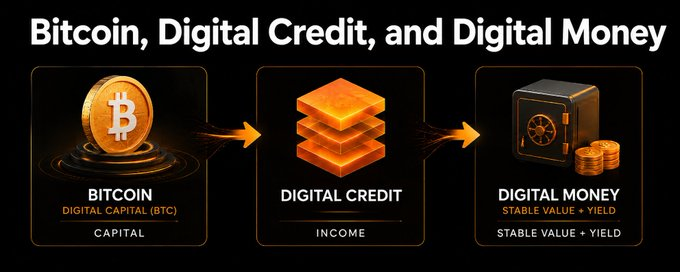
Modern Digital Asset Stack
Bitcoin is digital capital.
This is the foundation of the entire modern digital economy.
Bitcoin is scarce, globally circulated, highly liquid, programmable, divisible, and auditable; anyone connected to the internet can access it. It is not issued by a government, is not controlled by a corporation, has no tenants, no maintenance costs, has no borders, has no physical address, has no board of directors, and no central bank can dilute it.
It is the foundational layer of digital value.
But capital itself is only the starting point.
The next phase for Bitcoin is not simply holding BTC, but building an entire digital capital stack on top of BTC: digital capital, digital credit, digital currency, digital yield, digital equity.
This is how Bitcoin grows from a single asset into a global financial structure.
Bitcoin is still Bitcoin. The world is building on top of it.
This stack has five layers
The modern digital asset stack is divided into five layers.
The first layer, digital capital, is BTC, that pure, scarce, high-energy capital asset.
The second layer, digital credit, is similar to tools like STRC, income-generating tools backed by Bitcoin, designed to dampen volatility and provide returns.
The third layer, digital currency, is a stable value, income-generating tool. It is pegged to the dollar and can take the form of tokens, funds, preferred securities, accounts, or other packaged forms, with the underlying based on a combination of digital credit and fiat cash equivalents.
The fourth layer, digital yield, includes leveraged or structured yield products. This is for those investors willing to take on more risk, leverage, volatility, or poor liquidity.
The fifth layer, digital equity, is similar to MSTR's residual equity. It absorbs volatility in the subordinate tier, supports the entire credit structure, and captures the residual upside returns.
This is not about protocol changes, not about staking, not about currency inflation, nor is it another token pretending to be Bitcoin. This is the capital market built on Bitcoin.
First Layer: Digital Capital: BTC
The base of the stack is BTC.
BTC is equivalent to a digital version of gold, landmark real estate, and sovereign reserve assets, but with stronger liquidity, divisibility, scarcity, and global settlement capabilities. It is the highest energy asset in this system.
High energy brings volatility. Bitcoin can experience extreme fluctuations precisely because it is pure digital capital: scarce, liquid, global, and traded around the clock. This volatility is not a flaw but the raw material for building the digital capital market.
But not every investor can hold BTC directly. Family offices want capital appreciation, companies want treasury reserves, banks want collateral, insurance companies want yield, retirees want interest, payment companies want stable settlements, cryptocurrency exchanges want a true dollar-like asset that can actually pay interest to users, and savers in emerging markets want dollars, liquidity, and returns.
An asset with 40% volatility is perfect for some investors, but completely unsuitable for others.
The answer is not to change Bitcoin but to build products on top of Bitcoin that match each type of capital's needs.
Second Layer: Digital Credit: Bitcoin-backed Returns
Digital credit converts high-volatility digital capital into low-volatility returns.
STRC is an example: a high-tier, high-yield, short-duration income tool issued by a Bitcoin-backed company. BTC provides a long-term capital base, digital equity absorbs residual volatility, and digital credit sits above equity, distributing dividends to those investors who seek yields but do not want to directly take on BTC volatility.
The key is that digital credit does not always have a fixed volatility figure. It does not.
Credit instruments have low volatility in normal markets but may experience increased volatility in stressed markets. The spread may widen, liquidity may change, interest rates may fluctuate, the issuer's market image may shift, and market structures will evolve.
A more accurate statement is: the purpose of digital credit is to suppress the volatility of digital capital.
It achieves this through capital structure, priority, yield, face value mechanisms, liquidity support, and a subordinated equity buffer. The goal is to convert the high volatility of the original BTC capital energy into a more stable income stream suitable for credit investors.
Financial professionals have long understood this logic. A mortgage is not the same as a house, municipal bonds are not the same as cities, corporate bonds are not the same as common equity, preferred securities are not equivalent to the equity beneath them. Assets can be very volatile, but the credit layer does not have to be.
The goal of digital credit is not to eliminate risk but to intelligently allocate it. Equity holders accept residual volatility and upside, credit holders receive yields and superior claims, and digital currency holders gain another layer of stability and liquidity. Each investor selects a risk level that matches their authorization.
Bitcoin itself does not need to generate returns. It does not need staking, does not need inflation, does not need to change the protocol, does not need to become Ethereum. Returns are created by the capital structure above Bitcoin, without depreciating Bitcoin.
This distinction is critical.
Third Layer: Digital Currency: Stable Value Currency Built on Digital Credit
Digital currency is the next layer.
It is a stable value, daily redeemable tool that functions like money while providing a significant yield. Depending on jurisdiction, distribution channels, and investor types, it can take the form of tokens, funds, preferred securities, accounts, or other regulated packages.
The concept is simple: combine digital credit and fiat cash equivalents. Digital credit acts as the income engine, fiat cash equivalents provide liquidity and stability, the structure itself manages duration, redemption, credit exposure, reserves, and market risk, granting the holder a stable value asset that generates income.
For example, a product may hold Bitcoin-backed digital credit with yields around 10%-12%, combined with treasury bills, money market funds, repos, or bank reserves. After deducting liquidity reserves, fees, and risk buffers, the target yield for this digital currency tool may fall in the range of 6%-8%.
This is the breakthrough. Digital capital transforms into digital credit, digital credit plus fiat liquidity transforms into digital currency.
A stable value tool backed by Bitcoin can indeed pay interest. This is not magic; it's structured finance.
BTC is a capital asset, digital equity is the first loss and upside layer, digital credit is the income layer, and digital currency is the liquidity layer of stable value. The whole stack transforms the original volatility of Bitcoin into useful financial products without touching Bitcoin itself.
Stable Value Does Not Equal No Risk
This distinction is very important.
Digital currency should not be referred to as risk-free nor should it be sold as unconditional guarantees. It should be described as: designed to maintain stable value through reserves, liquidity, credit structure, transparency, and risk management.
A well-designed digital currency product should be measured against the same set of questions used by financial professionals to evaluate any money market, stablecoin, or short-duration credit product: What are the underlying assets? What is the credit exposure? How much liquidity reserve is there? How long is the duration? How is the redemption mechanism structured? What are the priorities? What is the collateral? What is the transparency level? Who bears the first loss? How does it perform under stress scenarios?
This kind of scrutiny is healthy.
Digital currency does not eliminate risk but packages, discloses, manages, and prices it, making it useful for depositors, businesses, payment networks, exchanges, and institutions.
Why Digital Currency Should Peg to Fiat
Many Bitcoin believers will ask: Why should digital currency peg to the dollar or other fiat currencies?
Because the world’s debts are still priced in fiat currencies.
Salaries are calculated in dollars, euros, yen, pesos, and local currencies; invoices are calculated in fiat; taxes are assessed in fiat; mortgages are denominated in fiat; credit cards are accounted for in fiat; corporate accounting is done in fiat. The banking system, insurance contracts, payroll systems, and financial statements are all priced in fiat.
Most people do not want their checking accounts to fluctuate 5% in a day. They want a stable unit of account.
The reason stablecoins find product-market fit is precisely this. The world wants a digital dollar because the dollar remains the dominant unit of account in global commerce.
However, current stablecoin models are incomplete. Stablecoins provide digital liquidity, but holders typically do not get the full economic benefits of reserve earnings. Bank deposits are convenient but often yield little. Money market funds yield returns but lack native 24/7 digital transferability. Staked assets can provide earnings but require users to accept price volatility and protocol risks.
Digital currency can bring together the best attributes: stable value, digital transferability, daily liquidity, transparent reserves, substantial earnings, and a capital structure backed by Bitcoin.
Fiat pegs solve the unit of account issue, while Bitcoin addresses capital preservation concerns. The dollar is the measure, and Bitcoin is the source of energy.
The Ideal Currency Experience
Good money should serve three functions: medium of exchange, store of value, and unit of account.
BTC is the strongest long-term store of value, but it is not yet a unit of account in most places worldwide. Digital currency addresses this bridging issue.
A dollar-pegged, Bitcoin-backed, yield-generating digital currency tool can act as a medium of exchange due to its stability and transferability; it can function as a store of value because it pays interest rather than lying idle; it can serve as a unit of account because it is priced in the currency that people already use for wages, bills, taxes, and debts.
This is not a denial of Bitcoin but a bridge from the world of fiat to the world of Bitcoin.
This is Bitcoin's Killer Use Case
Bitcoin's killer use case is not just payments.
The real killer use case is to rebuild global currency, credit, and capital markets on top of digital capital.
Bitcoin is the superior asset, but the world is not made up of just one type of investor. Some want original BTC, some desire yield, some seek stable value, some require collateral, some want leverage, some desire payments, some seek growth equity, some want treasury reserves, and some want a dollar balance that can be immediately transferred and still pay interest.
The digital asset stack enables Bitcoin to serve all these people. BTC serves capital allocators, digital credit serves yield investors, digital currency serves depositors and payment users, digital yield serves return-seeking investors, and digital equity serves growth investors. The same Bitcoin foundation supports each layer.
This is how Bitcoin expands from a trillion-dollar asset into a comprehensive global financial system.
Bitcoin does not need to replace all fiat currencies by tomorrow. It can underwrite the tools that the world already uses today: dollars, credit, accounts, funds, securities, payment assets, treasury products. This is that bridge.
Why This Holds for Financial Professionals
For financial professionals, this framework should feel familiar.
Innovation lies not in the disappearance of risk but in Bitcoin becoming the foundational collateral and capital asset of a modern layered financial system.
Traditional finance has long layered risks: common stock, preferred stock, senior debt, secured credit, money market tools, leveraged funds, structured products, bank deposits, payment balances. The digital asset stack applies the same logic to Bitcoin.
The key variables are conventional: priority, collateralization ratios, liquidity, duration, returns, credit spreads, redemption rights, market depth, disclosures, regulatory treatment, accounting treatment, tax treatment, counterparty exposure.
Bitcoin introduces a superior foundational asset, and the capital markets convert this asset into products aimed at different authorizations.
This is not anti-finance; it is better finance.
Why This Holds for Bitcoin Investors
For Bitcoin investors, the most important principle is simple: Bitcoin is still Bitcoin.
No need to change the protocol, no need for foundational layer returns, no need for staking, no need for inflation, no need to alter the 21 million supply cap; no one is forced to give up self-custody.
Those who want pure BTC can take pure BTC; those who want to run nodes can run nodes; those who wish to self-custody can self-custody.
The digital asset stack does not undermine Bitcoin's core principles; it merely extends its reach. This is disciplined expansion. The foundational layer should remain sacred, with most innovations occurring above it: custodial solutions, applications, securities, credit instruments, payment systems, wallets, exchanges, funds, capital markets.
This is how Bitcoin serves billions, without pushing everyone into a narrow adoption model. It can be a personal self-custody currency, a digital capital for companies, collateral for banks, reserves for nations, wealth for families, infrastructure for markets, and hope for anyone in economic distress.
The world is building on Bitcoin because Bitcoin is worth building on.
Why This Holds for MSTR Investors
For MSTR investors, the digital asset stack explains the role of digital equity.
Digital equity is the subordinate tier. It absorbs volatility, supports the credit structure, enjoys BTC appreciation, and captures the remaining upside once senior debt is satisfied, providing the capital structure that allows digital credit and digital currency to exist.
Equity like MSTR does not equal BTC, does not equal STRC, does not equal digital currency. Each role is different.
BTC is digital capital, STRC-like securities are digital credit, digital currency is stable value yield, digital yield is amplified returns, and MSTR-style common stock is digital equity.
Equity involves more volatility because it represents residual claims; credit has lower volatility because it is senior; currency is designed to be more stable because it combines credit and liquidity reserves. This is the logic of the capital stack.
Digital equity makes the upper layers possible because someone has to bear the residual risk and earn the residual return.
Why This Holds for Crypto Innovators
For crypto innovators, digital currency is a significant opportunity.
Stablecoins have proven that the world wants digital fiat. DeFi has shown that users want yields. Exchanges demonstrate that global markets want all-day liquidity. Wallets prove that value can move at internet speed. Bitcoin has shown that digital scarcity can be safe, decentralized, and global.
The next step is to combine these breakthroughs into better products.
A Bitcoin-backed, yield-generating, stable value dollar tool can become the native asset for wallets, exchanges, payment networks, fintech applications, DeFi protocols, treasury platforms, and global commerce.
It can compete with stablecoins that offer almost no yield to users, with bank deposits that pocket the spreads, with money market funds that yield returns but lack native 24/7 digital transferability, and with staked assets that require users to accept token volatility to earn returns.
This is constructive competition. Crypto does not need more speculative instruments. It needs financial products that are useful, durable, transparent, yield-generating, and solve real problems for real users. Digital currency is one of those products.
Digital Yield: Not Cash, But Useful
Above digital currency is digital yield.
Digital yield is not cash; it is an investment product.
It can be built using leveraged digital credit, leveraged digital currency, structured funds, private placement vehicles, or other tools aimed at investors pursuing higher returns who are willing to accept greater risks, leverage, volatility, or poor liquidity.
A leveraged digital currency strategy may aim for returns well above those of non-leveraged products. But that is not a checking account, not a stablecoin, and not a savings product for everyone. That is digital yield.
This distinction is essential. Digital currency is used for stability, liquidity, payments, savings, and working capital. Digital yield is for mature investors seeking amplified returns. Digital equity is for those pursuing residual upside. The power of the stack lies in the clarity of each product's role.
Three-layer Breakthrough
The key innovation is this three-layer transformation.
Digital capital: high volatility, high-energy BTC.
Digital credit: Bitcoin-backed returns, designed to suppress a significant portion of BTC's volatility through priority, structure, yield, and equity support.
Digital currency: combining digital credit with fiat cash equivalents and liquidity reserves to create a stable value, yield-generating tool.
This is the breakthrough. Bitcoin provides us with the world's most powerful digital capital asset, and the capital markets convert this asset into credit, converting credit plus liquidity reserves into currency.
The world does not need everyone to price coffee in clever sats tomorrow. The world today needs better money: moving at internet speed, maintaining stability in the user's unit of account, paying substantial yields, and ultimately driven by the historically strongest digital capital asset.
That is digital currency.
Why This is Good for BTC
Digital currency enhances BTC's utility.
Every dollar of digital currency built on Bitcoin-backed credit creates incremental demand for the capital structure underwritten by Bitcoin, generating new reasons to hold BTC, finance BTC, custodian BTC, audit BTC, insure BTC, and build services around BTC.
It also brings Bitcoin exposure to those investors who cannot tolerate the volatility of original Bitcoin. Retirees may not want the volatility of original BTC, and neither do companies, banks, or payment companies. But they may desire a stable value dollar asset, yielding 6%-8%, supported by Bitcoin-backed digital credit.
This brings new capital into the Bitcoin ecosystem. More capital means more adoption, more adoption means more liquidity, more liquidity means more resilience, and more resilience means stronger Bitcoin.
Why This is Good for the Crypto Industry
The crypto industry needs a better monetary foundation.
Many crypto users want dollars, many crypto investors want yields, many crypto builders want programmable assets, many crypto platforms want liquid collateral, and many crypto applications need stable units of account.
Digital currency built on Bitcoin-backed credit provides the industry with a better foundational product: a stable value, yield-generating digital dollar driven by Bitcoin.
It can exist in exchanges, in wallets, in funds, in accounts, in payment networks, and ultimately anywhere digital value flows. It does not require users to choose between zero-yield stablecoins and volatile staked tokens; instead, it gives them another option: a stable value, yield-bearing digital currency built on Bitcoin-backed capital. This is good for crypto.
Why This is Good for Investors
Investors should not be forced into a single risk profile.
The digital asset stack gives every investor a choice. Those who want digital capital can take BTC, those who want digital credit can take STRC-like tools, those who want digital currency can take stable value income tools, those who want digital yield can take leveraged or structured products, and those who want digital equity can take MSTR-like common stock.
This is a complete menu. Depositors can take digital currency, yield investors can take digital credit, growth investors can take digital equity, long-term believers can take BTC, and mature investors can take digital yield. The same Bitcoin foundation supports everyone. Bitcoin makes itself accessible to every kind of authorization.
Why This is Good for the World
The world needs better money.
Billions want dollars because they are liquid, familiar, and widely accepted. But they also want yield, transparency, liquidity, and protection from depreciation.
Today many people are forced to choose among unstable local currencies, low-yield bank deposits, zero-yield stablecoins, volatile crypto assets, or financial products that are out of reach.
Digital currency can improve this. It can provide stable value, digital liquidity, daily redemption, and substantial yields. It can help depositors, businesses, payment companies, emerging markets, exchanges, institutions, and anyone seeking better money who does not want to endure the volatility of original BTC.
The simulated world builds the economy on gold, real estate, banks, deposits, credit, equity, funds, and payment networks. The digital world will build on BTC, digital credit, digital currency, digital yield, and digital equity.
Bitcoin is digital capital. Digital credit converts it into returns. Digital currency transforms it into everyday utility. Digital yield amplifies it. Digital equity finances it.
The foundational layer remains sacred, and the capital stack remains open.
This is the modern digital asset stack. This is how Bitcoin becomes the foundation of a better financial system.
免责声明:本文章仅代表作者个人观点,不代表本平台的立场和观点。本文章仅供信息分享,不构成对任何人的任何投资建议。用户与作者之间的任何争议,与本平台无关。如网页中刊载的文章或图片涉及侵权,请提供相关的权利证明和身份证明发送邮件到support@aicoin.com,本平台相关工作人员将会进行核查。


