
Author: Azuma, Odaily Planet Daily

The World Cup has already started, and the total trading volume of prediction markets across the internet is continuously hitting new highs, but Kalshi, the industry leader, may not be feeling very good right now.
The reason is not due to fluctuations in Kalshi's own business data, but because another fierce competitor has suddenly appeared in front of Kalshi after Polymarket, and this opponent was once its most important ally.
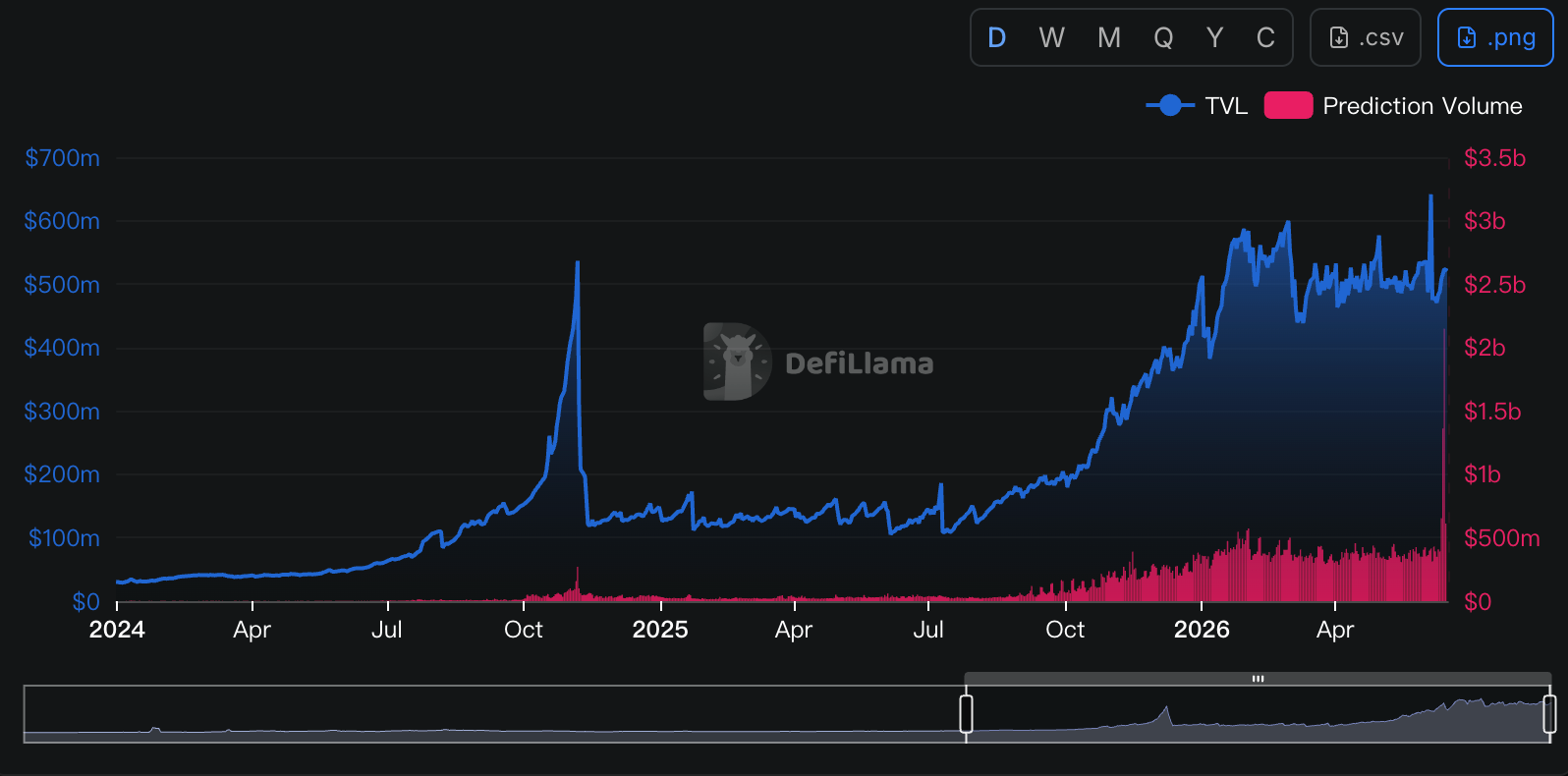
- Odaily Note: Data sourced from Defillama.
Kalshi's Most Important Traffic Channel — Robinhood
Rewind to March 2025. At that time, Kalshi announced a partnership with the US online brokerage Robinhood, which would leverage Kalshi to provide prediction market trading services for its users, allowing them to bet on events related to politics, the economy, and sports.
From a business model perspective, this was a typical "mutual benefit" — Robinhood, responsible for user entry and transaction distribution, could directly utilize Kalshi's mature products; Kalshi, responsible for the underlying market, matching, clearing, and regulatory compliance system, could access Robinhood's massive retail traffic pool.
The subsequent story also proved the "win-win" result of this cooperation. Through the distribution channel of Robinhood, Kalshi indirectly gained a huge number of users and trading volume, with Piper Sandler analysts estimating that "the trading volume completed through the Robinhood channel accounted for about 25%-35% of Kalshi's total trading volume." These orders ultimately converted into profits on both sides — Robinhood would charge separately for all Kalshi event contracts traded through that channel, collecting a fixed fee of $0.01 per direction per contract, and then sharing the revenue with Kalshi (the specific ratio was not disclosed).
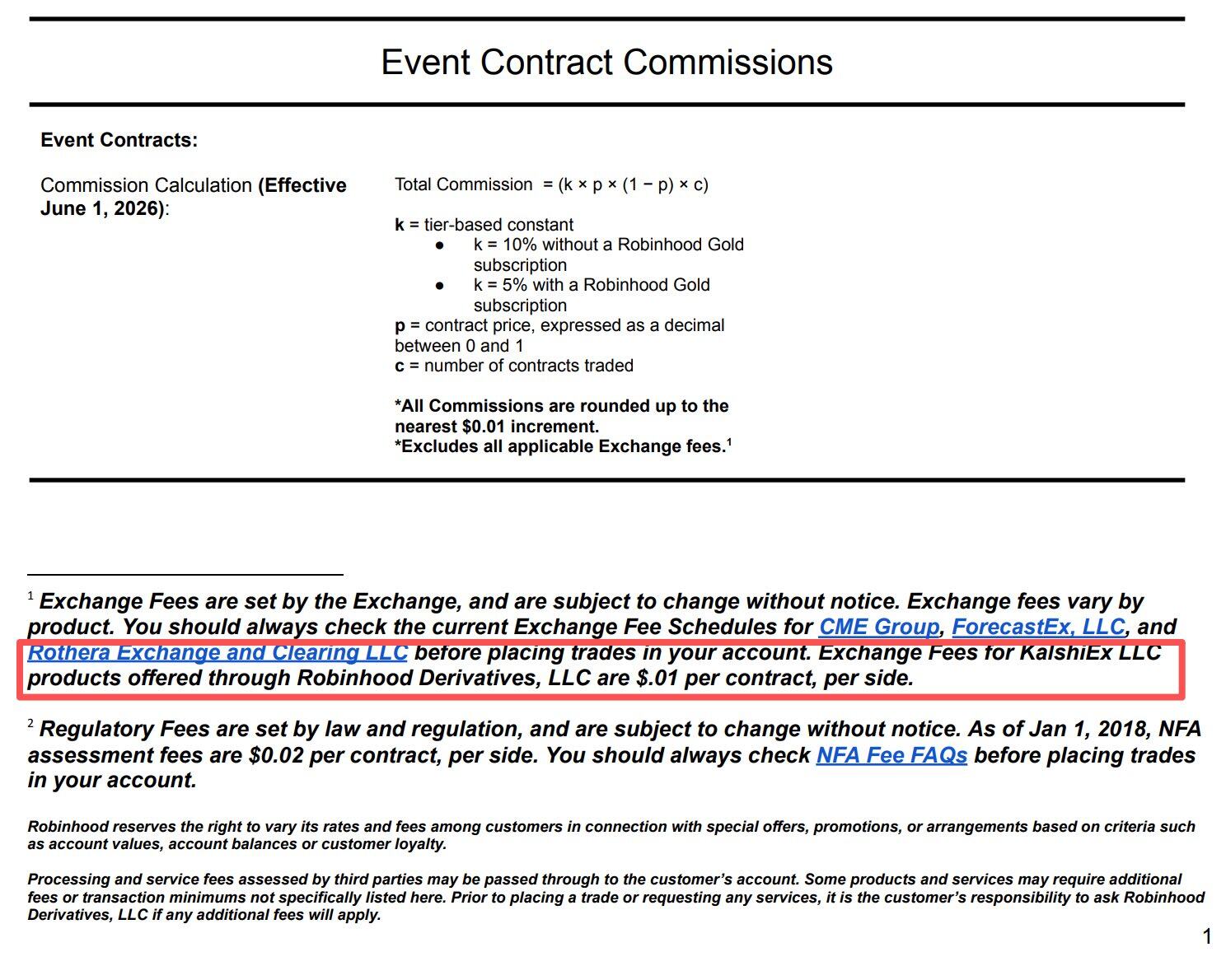
The Q1 earnings report disclosed at the end of April this year showed that Robinhood achieved 8.8 billion event contract trades in Q1 this year, driving "other trading revenue" up 320% year-on-year, reaching $147 million. The prediction market has become the fastest-growing new engine in Robinhood's product line.
But recently, there have been subtle changes in this relationship.
Robinhood's Ambition: Reclaiming the Cake Given to Kalshi
As history has proven countless times in the internet sector, when a channel gains enough power, it will no longer be satisfied with just being the channel itself. Robinhood is no exception.
Although the partnership with Kalshi brought considerable revenue to Robinhood, as the prediction market became one of the fastest-growing new businesses within the platform, Robinhood was no longer satisfied with the current revenue-sharing arrangement.
In the partnership model, Kalshi was responsible for providing the market and infrastructure, while Robinhood handled user and order flow. However, as the collaboration deepened, Robinhood gradually realized that what was truly scarce might not be the market itself, but rather the user entry point it firmly controlled. After all, for most Robinhood users, they don’t care if the orders ultimately transact on Kalshi or on other platforms — all users see is a trading entry within the Robinhood App, not the underlying infrastructure provider.
In other words, Robinhood always holds one of the most important resources for the prediction market — distribution capability. Since users belong to it, why should orders flow to others?
In fact, while Robinhood was quickly validating the demand for prediction markets through Kalshi, another set of B plan was also initiated shortly afterward.
In November 2025, Robinhood announced a joint venture with Wall Street quantitative trading giant Susquehanna and planned to acquire the CFTC-regulated derivatives exchange MIAXdx. According to the official statement, this joint venture would operate an independent futures and derivatives exchange and clearinghouse, with the prediction market being one of its key areas of focus. At that time, the outside world viewed it more as a infrastructure investment, but as more information was subsequently disclosed, people gradually realized that Robinhood's goal was far beyond just finding new partners for the prediction market.
In January 2026, the transaction was officially completed. Robinhood and Susquehanna gained 90% control of MIAXdx while taking over a complete CFTC regulatory framework, including Designated Contract Market (DCM) and Derivatives Clearing Organization (DCO) qualifications. Subsequently, MIAXdx was renamed Rothera Exchange, and its clearinghouse was renamed Rothera Clearing.
By then, Robinhood had acquired the core elements required for independently operating a prediction market, and what it lacked was merely a mature product comparable to Kalshi, but for Robinhood, which is rich in internet product development experience, this is clearly not a difficult task.
The Opportunity for Rothera: The World Cup
In June 2026, after about half a year of accelerated development, Rothera's product gradually took shape, and Robinhood finally made that almost inevitable move — gradually shifting orders originally directed to Kalshi into its own control system.
Robinhood specially chose a perfect battlefield for Rothera's debut — the World Cup. For prediction markets, the World Cup is undoubtedly one of the trading themes with the greatest traffic effect, whether it’s match outcomes, progression results, or championship titles, the related markets can attract a large number of new users to engage in trading in a short time. For the newly launched Rothera platform, there is no better scene than the World Cup to serve as a cold start.
According to Robinhood's official disclosure, during this World Cup, which consists of 104 matches, some event contracts will be directed to Rothera for matching and clearing, including results of single World Cup matches, final championship titles, total goals in individual matches, and so on. This is also the first time Robinhood has massively imported prediction market orders into its own trading system, compared to its previous complete reliance on Kalshi.
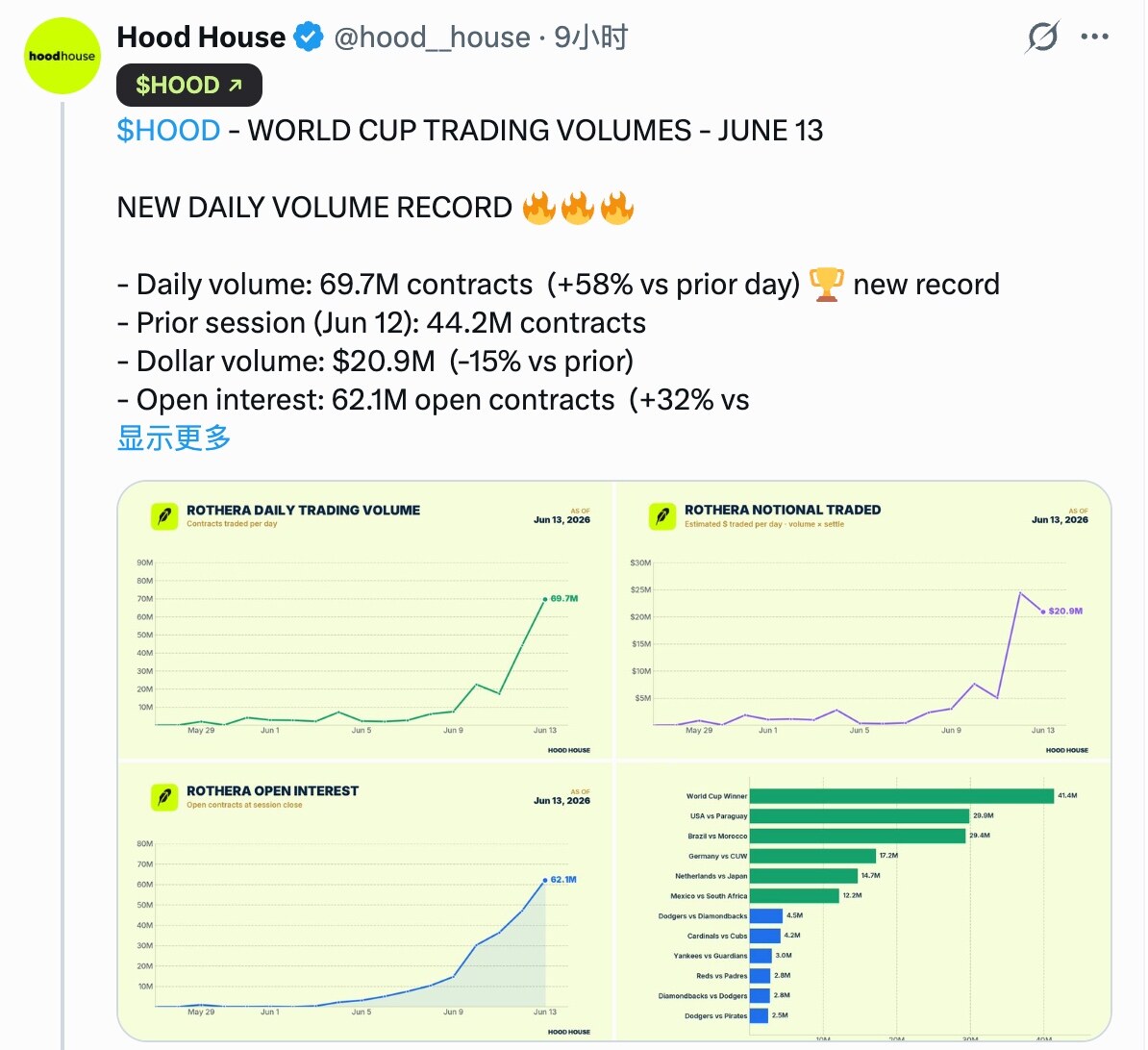
From the results, Rothera obviously seized this opportunity. According to data disclosed by the investment research self-media Hood House tracking Robinhood dynamics, on June 12, Rothera completed 44.2 million contract trades, corresponding to a dollar trading volume of about 24.4 million dollars; on June 13, Rothera completed another 69.7 million contract trades, corresponding to a dollar trading volume of about 20.9 million dollars... Although these figures still differ from Kalshi's popular markets often worth hundreds of millions, considering that Rothera had actually just launched for a few days, this performance is already successful enough.
For Robinhood and Kalshi, this means the balance of cooperation between them has started to tilt. From Robinhood's side, the commission revenue that originally needed to be shared with Kalshi can now remain more within its ecosystem; while from Kalshi's perspective, it signifies that one of its once most important growth engines has started to show signs of looseness.
And the World Cup is clearly just the start of Rothera eating into Kalshi's market. Looking further into the future, Robinhood will inevitably expand Rothera's coverage to more sports events as well as topics related to economics and politics; those orders that originally flowed to Kalshi will sequentially be diverted to Rothera.
Since Robinhood and Kalshi have never publicly disclosed the profit-sharing ratio (some reports say it's 50%:50%, but no official information has been seen), we cannot know the specific numbers of this diversion value; but considering Robinhood achieved $147 million in revenue related to prediction markets in Q1 alone, and given that Q2's World Cup and the upcoming midterm elections are clearly expected to bring even larger trading activity, the annualized value of this diversion might reach hundreds of millions of dollars.
Whoever Controls Distribution, Controls Everything
The storyline of Robinhood and Kalshi evolving from allies to adversaries once again illustrates a logic that has been repeatedly validated in the internet market — products are easy to create, but traffic is hard to find; whoever controls distribution controls everything.
In recent years, the market generally believed that Kalshi's core moat came from regulatory licenses, exchange qualifications, and clearing capabilities. Thus, whether it was a brokerage like Robinhood or various media, community, and traffic platforms, they essentially acted merely as channel partners and traffic entry points for Kalshi. However, the emergence of Rothera proves one thing: in today's environment of severe product homogenization, the product itself may not be the most important factor. What is truly scarce is always the user.
Wherever the users are, liquidity will follow; and wherever the liquidity is, the market will be. When Robinhood holds the entry for tens of millions of retail users, it completely has the ability to direct these users to any trading venue. For users, they don’t care if the orders ultimately transact on Kalshi or Rothera, as long as the experience is not significantly different, it doesn't matter who is facilitating and clearing behind the scenes.
If the past few years of the prediction market industry were characterized by the market competition between Polymarket and Kalshi, then the theme for the coming years may very well evolve into a channel war. Robinhood's incubation of Rothera is essentially a reverse integration initiated from the channel towards the market; and as more platforms with traffic entry points begin to recognize the strategic value of prediction markets, similar stories are likely to continue to unfold. Whether they are exchanges, brokerages, social platforms, or media platforms, all may become new entry points for prediction markets.
And when entry points start to control the market and channels start to gain pricing power, the ultimate winner in the prediction market industry may no longer be the platform responsible for matching orders, but rather the one closest to the users, capable of controlling distribution.
This is true in the internet age, and it continues to hold in the mobile internet era. This time, there's nothing surprising about it.
免责声明:本文章仅代表作者个人观点,不代表本平台的立场和观点。本文章仅供信息分享,不构成对任何人的任何投资建议。用户与作者之间的任何争议,与本平台无关。如网页中刊载的文章或图片涉及侵权,请提供相关的权利证明和身份证明发送邮件到support@aicoin.com,本平台相关工作人员将会进行核查。


