Author: Joseph Chalom, Sharplink CEO
Translated by: Yuliya, PANews
Editor's note: In the competition among many new public chains claiming "faster speeds," Ethereum remains at the top. Sharplink CEO Joseph Chalom pointed out after a visit to Asia that Ethereum has one million developers, which is its core competitive advantage. He emphasized that the competition in the crypto world is not just about network speed, but "where the best minds are building." With its deep cultural foundation, seamless "financial Legos," and forward-looking layout in facing technological challenges like quantum computing, Ethereum has surpassed simple parameter comparisons and built a truly insurmountable moat. Below is the translated original text:

I just returned from Asia, during which I engaged in in-depth discussions with Ethereum developers and leaders of the ecosystem. Special thanks to Nonce Classic, Four Pillars, and DSRV in Seoul, as well as our friends at SNZ in Hong Kong and the recently launched Ethereum Community Center. This center is Asia's first permanent physical Ethereum community space, supported by the Ethereum Foundation.
What impressed me most was not only the enthusiasm of the people but also the rigorous attitude and lofty ambitions displayed by the builders. I was inspired and genuinely admire the projects, experiments, and long-term thinking that are emerging from the Ethereum ecosystem.
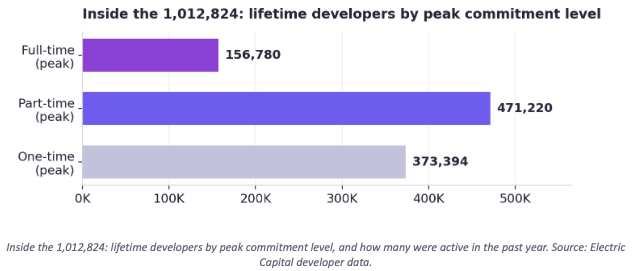
This also made an originally abstract number come to life: according to Electric Capital, the number of lifetime developers on Ethereum has surpassed one million, specifically 1,012,824 independent developers who have contributed to the ecosystem. In the crypto space, no other ecosystem comes close to this scale.
A milestone worth our attention
One million is an integer, and integers can sometimes feel hollow. But this number is anything but hollow. Behind it is the largest pool of technical talent gathered around an open, permissionless blockchain network in history. More importantly, this talent pool continues to deepen and expand.
Among these one million developers, approximately 232,000 developers have been active in the past 12 months.
Why Ethereum: The real core issue
For many years, discussions in the crypto space have revolved around speed, cost, and throughput. Every new chain claims to be "faster than Ethereum." However, the most important question in the crypto space has never been which chain is the fastest, but a completely different question:
“Where will the best builders choose to develop long-term?”
On this question, Ethereum remains unparalleled. This advantage is not merely technical; it is also reflected in its institutions, culture, economy, and composition, which is the result of ten years of sedimentation in developers, infrastructure, standards, tools, liquidity, research, applications, and social coordination, an achievement no other ecosystem can replicate.
Ethereum has become the default operating system for programmable finance and internet-native capital formation.
What is this million-strong army building today? And how does it deepen the moat?
The importance of one million developers largely comes from the challenges they are currently tackling. Today's focus is on the most difficult, riskiest issues in the industry: the scalability of core protocols, privacy protection, resistance to quantum computing, and the intelligent systems that will run on top of it.
Glamsterdam Upgrade—Innovating without compromising core principles. Planned for release in 2026, the Glamsterdam Upgrade showcases how Ethereum can achieve technological leaps while upholding its core values. Its core changes—including the separation mechanism for proposers and builders (ePBS) and block-level access lists (BALs)—will unlock parallel execution capabilities and significantly increase throughput, while it may also enhance the gas limits—this will greatly improve Layer 1 capacity. While expanding capacity for future demands, it firmly defends reliable neutrality, security, and fair MEV, thus creating a functioning moat.
Synchronous Composability—Letting many Rollup experiences feel like a single network. Composability has always been Ethereum's superpower; the next great leap is to extend it across all Layer 2s. Native and "layer-based" Rollups, combined with synchronous composability, perfectly resolve this issue. A contract on one Rollup can directly call contracts on the mainnet or another Rollup in a single atomic transaction. No need for cross-chain bridges, no waiting. The collaboration between Linea, Ethereum Economic Zone, Gnosis, Zisk, and the Ethereum Foundation is integrating this design with real-time proofs. The end result is that multiple Rollups no longer feel like disparate independent networks; they start to operate like a unified chain. This is the most powerful response to the criticism of ecosystem fragmentation.
Resistance to Quantum Computing—Ethereum's most significant leading advantage. In terms of preparing for the post-quantum era, no mainstream ecosystem is as ready as Ethereum. The "Lean Ethereum" roadmap, the dedicated Ethereum Foundation post-quantum security team formed in early 2026, the pq.ethereum.org center, and more than a dozen client teams already running weekly post-quantum interoperability developer testnets are culminating in a coordinated open-source migration effort aimed for around 2029. When the risks of quantum computing truly materialize, the institutions that manage trillions of dollars in assets will only care about one thing: which chain is prepared the earliest and most thoroughly.
The moat beyond developers: Composability, standards, and trust
Due to Ethereum's unique architectural approach, this developer talent pool has generated a powerful compounding effect. Its deepest network effect is not liquidity, but the depth of its composability. Various applications are like interlocking financial Lego blocks: lending, stablecoins, exchanges, wallets, tokenized assets, oracles, and Layer 2 Rollups that all interact through shared standards, thus developers never have to start from scratch. The EVM is the application layer of the crypto world, and the Solidity skills developers master can be seamlessly applied across Base, Arbitrum, Optimism, Polygon, zkSync, Scroll, Linea, and hundreds of other networks.
Learning the Ethereum tech stack provides maximum choice, which in turn drives a flywheel effect: attracting more developers, creating more tools, leading to more liquidity, attracting more institutions, and then attracting more developers to build composable protocols and assets. Liquidity breeds liquidity, and composability begets composability.
Moreover, Ethereum leads where real value accumulates, not merely where surface activity is the highest.
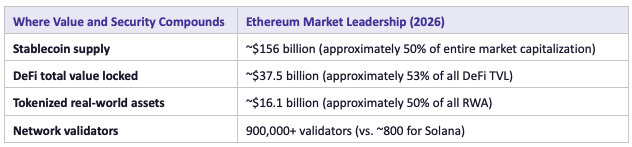
Three forces further consolidate this leading position:
Reliable Neutrality: Ethereum is secured by over 900,000 validating nodes, compared to around 800 for Solana, and large institutions place a very high premium on this level of decentralization and platform neutrality.
Modularity: Rollups like Base, Arbitrum, and Optimism have not led Ethereum into fragmentation; instead, they have expanded it into an increasingly interconnected modular internet economy while fully inheriting the security of the mainnet.
Culture: Ethereum particularly attracts the industry’s top researchers, cryptographers, and authors of EIP standards, who set the entire industry's development direction. This last advantage is the hardest to be replicated through hard forks.
There is only one Ethereum in the world
Merely creating activity on-chain is fundamentally different from becoming the long-term coordinating layer of internet-native finance trusted by the world's largest financial institutions. In the perceptions of the largest asset owners who prioritize trust, safety, and liquidity, Ethereum holds an absolute dominance. During my time at BlackRock, I witnessed all of this firsthand.
In the technology market, ecosystems always integrate over time around standards, liquidity, and developer mindshare. This is Ethereum's insurmountable moat.
After conversing with these developers, builders, and ecosystem leaders in Seoul and Hong Kong, I am more convinced than ever of Ethereum’s competitive advantage. I met the talent building the next generation of financial infrastructure, who are the founders of our industry's future, the architects of proxy finance. It is these people and these teams that will truly change the world.
The future of Ethereum is happening now.
免责声明:本文章仅代表作者个人观点,不代表本平台的立场和观点。本文章仅供信息分享,不构成对任何人的任何投资建议。用户与作者之间的任何争议,与本平台无关。如网页中刊载的文章或图片涉及侵权,请提供相关的权利证明和身份证明发送邮件到support@aicoin.com,本平台相关工作人员将会进行核查。


