Author: Claude, Deep Tide TechFlow
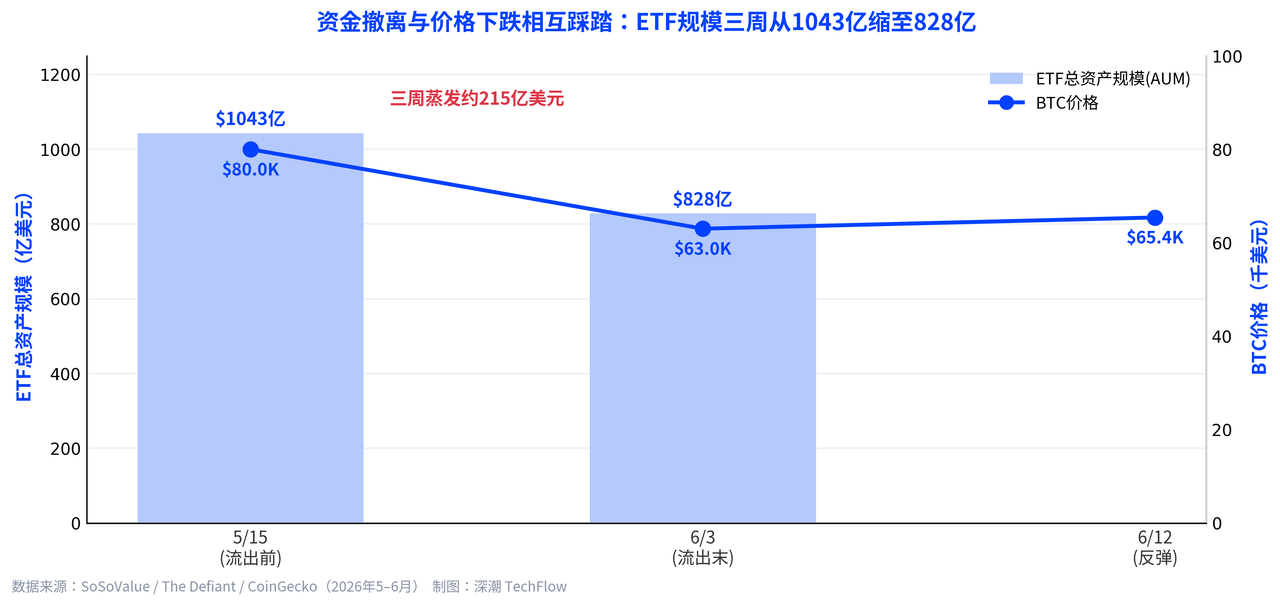
Deep Tide Guide: The U.S. Bitcoin spot ETF has just completed the most severe round of redemptions since its listing: a continuous net outflow for 13 trading days from May 15 to June 3, totaling 4.4 billion dollars, more than double the previous record from February 2025. Coupled with the drop in coin prices, the total scale of the ETF shrank from 104.3 billion dollars to 82.8 billion dollars in three weeks.
On June 12, 12 funds collectively recorded zero outflow, with a single-day net inflow of 85.84 million dollars, and Standard Chartered listed this signal as one of the three pieces of evidence that Bitcoin has bottomed out.
13 Days, 4.4 Billion Dollars, the Longest Outflow for Bitcoin ETF Since Listing
The money flow is the most direct measure of institutional attitudes towards Bitcoin.
These ETFs buy and sell spot Bitcoin in real time according to investor subscriptions and redemptions, meaning money comes in and goes out, reflecting the increase or decrease in institutional positions without verbal speculation.
In the past month, this measure has read out the worst numbers since listing. According to Galaxy Research, from May 15 to June 3, U.S. spot Bitcoin ETFs experienced a continuous net outflow for 13 trading days, totaling approximately 4.37 billion dollars, equivalent to about 59,000 Bitcoin. This was the longest continuous outflow since the launch of these products in January 2024, with the previous record being 8 days and 3.2 billion dollars in February 2025, which this round directly doubled.
Galaxy Research also pointed out that outflows at various time windows of 7 days, 10 days, and 20 days all set historical highs during this period, indicating that selling pressure did not erupt on a single day but persisted for quite a long time. This round of redemptions has brought the accumulated net inflow for 2026 to negative for the first time. Bloomberg ETF analyst Eric Balchunas confirmed that the cumulative fund flow has turned negative for the first time this year.
The most severe outflow was from BlackRock's IBIT. According to data from Farside Investors, throughout the outflow period, IBIT alone pulled out about 3.3 billion dollars, accounting for three-quarters of the total outflow. Fidelity's FBTC followed closely with an outflow of about 456.6 million dollars, and Grayscale's GBTC saw an outflow of about 303.6 million dollars. IBIT, which was originally the most effective fundraising product since its listing, became the epicenter of redemptions this time.
Funds Leaving and Falling Coin Prices Tread on Each Other, 21.5 Billion Dollars Evaporated in Three Weeks
The destructive power of the outflow has been amplified by the coin price decline during the same period.
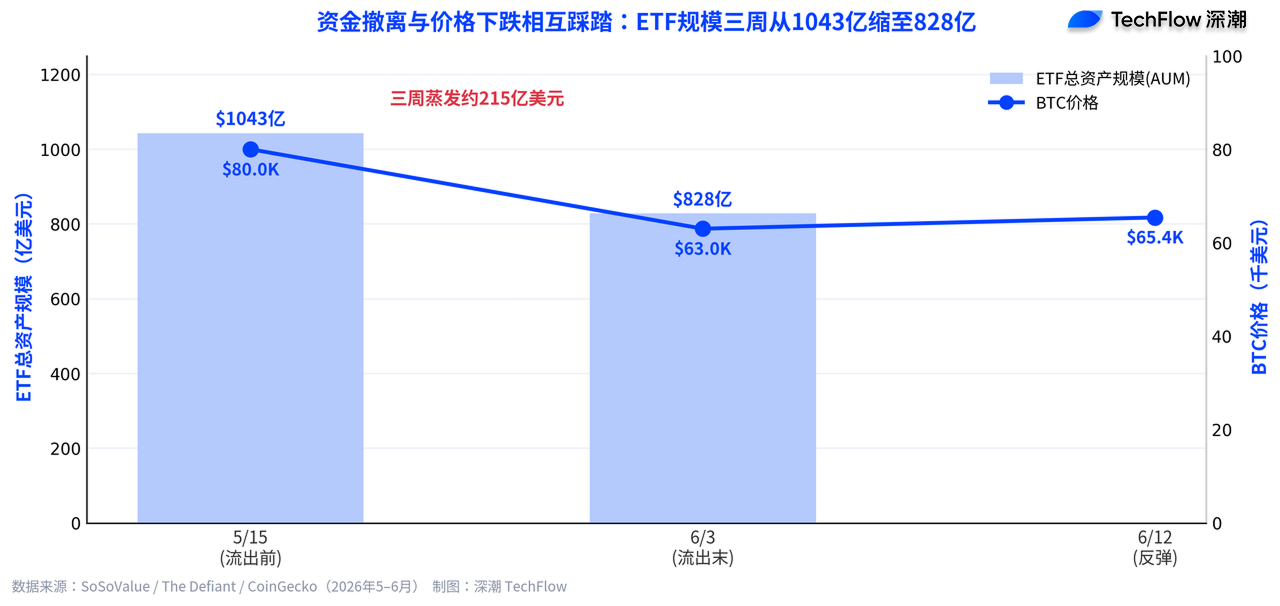
According to The Defiant, citing SoSoValue data, the total asset scale of all U.S. spot Bitcoin ETFs dropped from about 104.29 billion dollars on May 15 to about 82.83 billion dollars on June 3, shrinking by about 21.5 billion dollars in three weeks. This decline came from the combination of two forces: the redemptions themselves pulling out funds, along with Bitcoin's price falling from above 80,000 dollars to around 63,000 dollars, a drop of about 21%, which subsequently reduced the market value of holdings. The two factors tread on each other.
In terms of holdings, the ETF's Bitcoin holdings dropped to about 1.277 million coins, about 7.2% lower than the peak in October 2025. The Bitcoin held by these ETFs currently accounts for about 6.36% of Bitcoin's circulating market value, lower than the over 7% level during the peak in mid-May.
A particular redemption on May 28 stood out. On that day, BlackRock's IBIT experienced a net outflow of 527.8 million dollars, marking the second-largest single-day redemption in the fund's history. Throughout May, U.S. Bitcoin ETFs recorded a monthly net outflow of 2.43 billion dollars, setting a record for the largest monthly outflow, with the last week alone accounting for 1.42 billion dollars.
"Clean Rebound" After Outflows End, Standard Chartered Counts it as One of the Bottom Signals
The turning point appeared in early June.
On June 5, Bitcoin ETFs ended a 13-day continuous outflow with a slight net inflow of 3.05 million dollars. In this market size, 3.05 million dollars is almost negligible, but the direction has changed. On the same day, Ethereum ETFs also ended 17 days of continuous outflows, netting an inflow of 19.3 million dollars, all coming from BlackRock's ETHA fund.
The signal that institutions truly regarded as important was that of June 12 (Friday). According to SoSoValue data, on that day, U.S. spot Bitcoin ETFs recorded a single-day net inflow of 85.84 million dollars, with 5 funds seeing capital inflow, while the other 7 recorded zero net flow, with none recording net outflow. The collective lack of outflow from the 12 products, this "zero outflow by all," is a key indicator for the bullish side to observe whether the selling pressure has eased.
Geoff Kendrick, Global Head of Digital Asset Research at Standard Chartered, included it in his list of signals indicating Bitcoin has bottomed out. In a brief report to clients on Friday, Kendrick stated that crypto asset prices have reached the low point of this cycle, corresponding to about 59,000 dollars for Bitcoin, a 53% decline from its peak of 126,000 dollars. He mentioned three indicators to confirm: the Strategy report bought Bitcoin again last week, the ETF recorded positive inflow on Friday, and oil prices continue to fall. At the end of the report, he wrote: "The cold winter is over, welcome back to the spring of crypto."
However, a single-day inflow of 85.84 million dollars cannot reverse the 4.4 billion dollars outflow over three weeks. But a clean trading day is a starting point for observing whether selling pressure has peaked.
ETF fund flows now have an increasingly significant impact on coin prices. According to estimates cited by Cryptopolitan, ETF fund flows currently explain about 45% of Bitcoin's weekly price fluctuations. The cumulative net inflow of these Bitcoin ETFs since their listing in January 2024 still exceeds 55 billion dollars, less than 10 billion dollars away from the historical peak. Balchunas therefore judges that the 4.4 billion dollars outflow is a significant kinetic reversal rather than a structural collapse.
免责声明:本文章仅代表作者个人观点,不代表本平台的立场和观点。本文章仅供信息分享,不构成对任何人的任何投资建议。用户与作者之间的任何争议,与本平台无关。如网页中刊载的文章或图片涉及侵权,请提供相关的权利证明和身份证明发送邮件到support@aicoin.com,本平台相关工作人员将会进行核查。


