Author: Jae, PANews
Stablecoins, serving as the ballast and financial infrastructure of the crypto market, have become a battlefield for many parties.
In a landscape where the stablecoin market is dominated by the two oligarchs USDT and USDC, a dark horse with a unique gene has successfully entered the finals. The dollar stablecoin USD1, issued by the DeFi protocol World Liberty Financial (WLFI) led by the Trump family, has seen its market cap rise to $4.6 billion in just over one year since its launch, quickly entering the top five stablecoins.
The unique background allows USD1's growth path to leap beyond traditional frameworks at its starting phase. A breakout battle combining political dividends, capital backing, and business interests is currently underway.
Cross-sector entry of political and business capital, leveraging heavy investment for tenfold growth of USD1
The stablecoin race has never been short of players, but among them, USD1 is unique in having "someone in the White House".
According to Bloomberg, the shares of WLFI held by U.S. President Trump and his family are valued at approximately $2.6 billion, making it the largest single asset in their total family assets.
The capital boost followed suit, coinciding with the crucial moment of power transfer in the U.S. Last January, just four days before Trump's inauguration, the private investment entity Aryam Investment, backed by the Abu Dhabi royal family (Tahnoon), invested $500 million to acquire 49% of WLFI's equity. The entry of Middle Eastern capital not only injected early liquidity for WLFI's issuance of USD1 but also paved the way for its international expansion.
Coincidentally, Pakistan also signed a memorandum of understanding with WLFI's affiliated entity in January to explore the integration of USD1 into its national payment and cross-border settlement infrastructure. Such backing from sovereign credit will also break the stereotype of USD1 as a "shadow banking tool," allowing it to become a digital asset that aids sovereign countries in optimizing foreign exchange clearing and combating domestic currency inflation.
USD1 possesses an innate political halo, precisely positioned during the policy dividend period of the U.S. crypto industry. The deep interweaving of political and business landscapes grants USD1 a level of political sensitivity and public trust that ordinary crypto protocols find hard to achieve.
The issuance timing of USD1 coincides with Congress's full push for the "Genius Act." On July 18 last year, Trump officially signed the "Genius Act," which stipulates that qualifying payment stablecoins do not fall under the jurisdiction of federal securities or commodities laws, thus expediting the long-standing regulatory conflict between the SEC and CFTC, officially placing regulatory authority with federal banking regulators.
This historic rule change has allowed USD1 to capture a wave of compliance dividends. As a payment stablecoin under the act's framework, USD1 is issued by the regulated WLFI entity, with reserves fully backed in high-liquidity assets at a 1:1 ratio.
In terms of business model design, WLFI demonstrates the pragmatism and efficiency of political and business capital:
Stable interest income: WLFI has chosen BitGo as its primary custodian. With a reserve size of $4.6 billion and an annualized yield of about 3.5% on U.S. Treasury bonds, USD1 is expected to generate about $150 million in annual interest income for WLFI, becoming the strongest "money printer" at the protocol's base layer;
Ambition to connect directly with the Federal Reserve: WLFI is applying for a national trust bank license from the Office of the Comptroller of the Currency (OCC), attempting to complete the identity transition from "crypto asset" to "formal financial instrument";
Ecosystem symbiosis with giants: In March last year, Abu Dhabi’s sovereign investment agency MGX settled its investment in the leading centralized exchange Binance with $2 billion in USD1. Since then, USD1 has maintained a close cooperation with Binance. According to Forbes, Binance holds about 87% of USD1 and provides its holders with exclusive incentives such as zero transaction fees and airdrops of WLFI governance tokens, effectively accelerating the early settlement network expansion for USD1. Thanks to WLFI's substantial subsidies for user transactions with USD1 and Binance's support for USD1 as collateral, USD1's average daily trading volume increased from $200 million before subsidies to currently $2 billion, achieving a tenfold increase in trading scale.
In the past six months, WLFI has spent more than $115 million on interest subsidies, resulting in over $1.2 billion in market cap growth for USD1, equivalent to leveraging ten times.
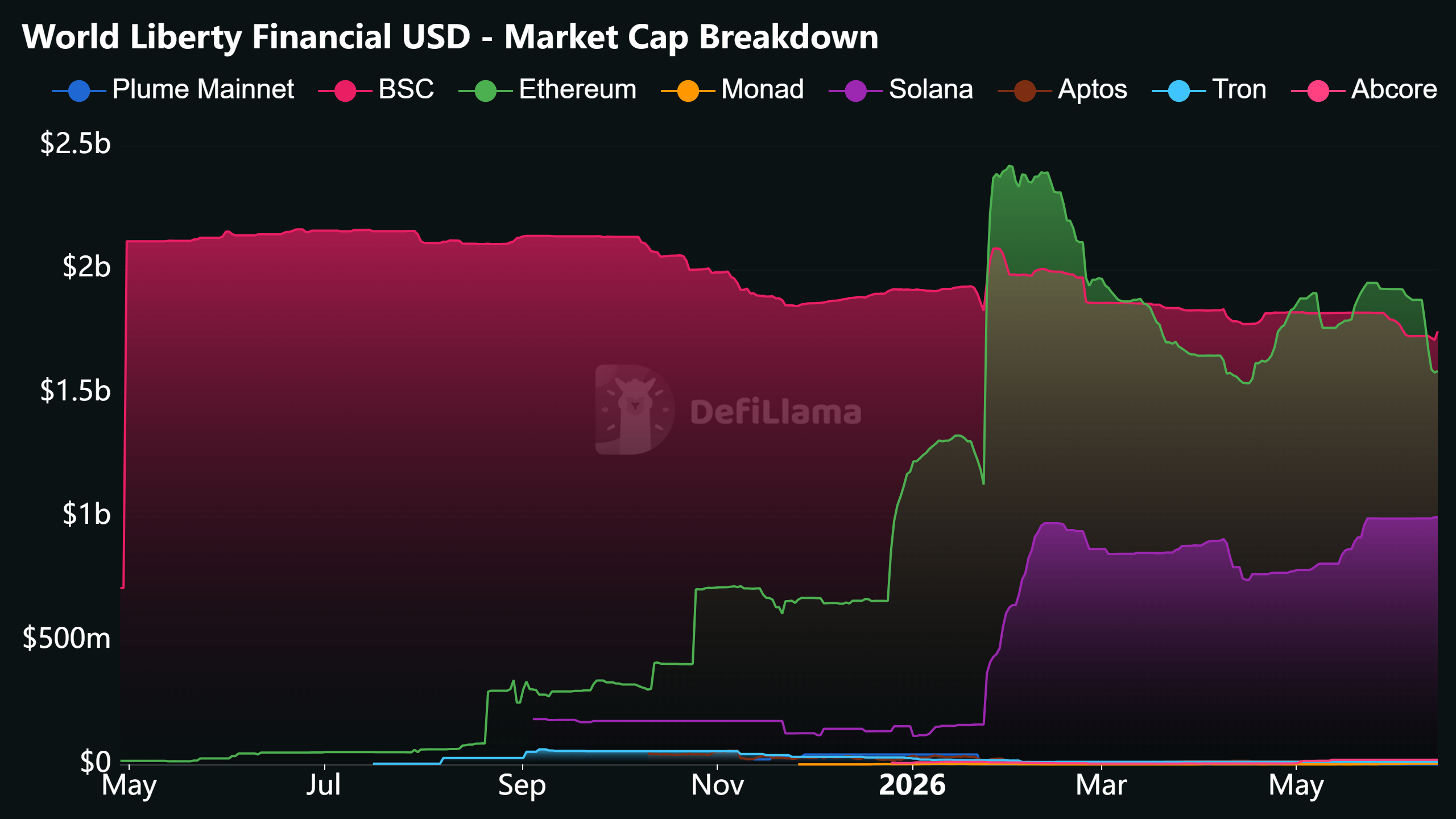
On-chain data indicates that most of the growth has come from Solana. At the beginning of the year, USD1's supply on Solana exceeded $160 million, and it is now nearly $1 billion, an increase of about $840 million, with the rest of the growth mainly concentrated on Ethereum.
However, behind the glory, the political and business relationships also leave "opportunities" for competitors. The U.S. House of Representatives has already initiated a special investigation into issues such as the share transaction between WLFI and Aryam Investment, as well as potential conflicts of interest, demanding the project party to retain all communications records and compliance documents. Under the spotlight, every step of USD1's expansion will face more stringent regulatory scrutiny.
Reshaping the dollar on-chain, steering towards borderless payments
Mainstream stablecoins have become carriers of "the dollar on-chain," and USD1 is no exception. Its strategy is to smooth the friction between traditional finance and DeFi, ensuring that on-chain liquidity takes root in the global real economy and redefining the boundaries of dollar on-chain applications.
However, conventional approaches face two major structural challenges:
Single scenarios: Even when the dollar is on-chain, it has long been trapped in crypto-native scenarios such as trading, lending, and market making, making it hard to penetrate large-scaled into the real economy and everyday consumption;
Geographic limitations: In areas and populations where ground networks are limited, the dollar on-chain cannot truly reach the "last mile" of the real economy, leaving stablecoins collectively voiceless.
In short, while the traditional dollar on-chain path has achieved tokenization, issues of friction costs and coverage gaps remain significant.
WLFI seeks to break through these limitations, aiming to transform USD1 into a unified settlement layer connecting bank accounts, payment networks, and even global communication infrastructure.
In February this year, WLFI co-founder Zak Folkman revealed at the Hong Kong Consensus conference that the project plans to launch a foreign exchange and cross-border remittance platform called World Swap.
This is an enticingly large market: the daily global foreign exchange trading volume has surpassed $9.6 trillion, and the annual scale of the personal remittance market is nearly $892 billion, but this century-old system has consistently been "heavily taxed" by traditional remittance networks represented by SWIFT.
World Swap's breakthrough strategy is to use USD1 as the settlement medium, bypassing the complex intermediary network to directly connect on-chain stablecoins with global debit cards and bank accounts. This direct processing will reduce cross-border remittance settlement costs to "a fraction" of traditional remittance institutions, enabling low-friction, real-time clearance around the clock.
Beyond currency exchange, WLFI also launched the DeFi lending protocol World Liberty Markets in January. As of now, the platform's funding scale has exceeded $600 million.
Seamless connections among savings, lending, and currency exchange, USD1 thus constructs a complete on-chain financial ecosystem, breaking out of the single payment attributes of traditional stablecoins.
USD1's ambitions do not stop within the realm of land-based internet. While most protocols are still deeply engaged in online scenarios, WLFI has set its sights on the vast low-orbit space. Through a strategic partnership and token swap agreement with the satellite communications startup Spacecoin, USD1 will be natively integrated into Spacecoin’s DePIN (Decentralized Physical Infrastructure) network.
This cross-sector combination addresses a long-standing payment pain point: in remote or disaster-stricken areas lacking ground infrastructure and traditional gateways, users cannot conduct transactions through traditional financial channels. Low-orbit satellites from Spacecoin can independently carry on-chain settlement flows, enabling users to complete cross-border payments and micro-settlements using USD1 the first time they connect to the satellite network.
From ground wirelines to low-orbit satellites, USD1 will extend the circulation boundaries of the digital dollar to corners that traditional payment networks cannot reach, allowing stablecoins to truly achieve "unrestricted by geography."
Filling the gap in AI infrastructure, capturing the "silicon-based economy" trend
Strategic positioning in policies and the expansion of physical payments is USD1's strategy for capturing the existing financial ecosystem, while focusing on AI payment infrastructure serves as its incremental bet on the future digital economy.
As agents play increasingly independent roles in workflows, a pressing impasse emerges: agents lack payment systems that fit their characteristics.
Traditional financial account opening requires physical KYC and cannot support high-frequency, low-value agent-to-agent (A2A) settlements. Regular crypto wallets may lack opening thresholds, but they also lack a refined on-chain budget control system, making it difficult to connect to offline physical consumption. On one side are rapidly evolving agents, while on the other is a lagging payment infrastructure, exacerbating demand-supply contradictions.
In this context, WLFI has released the open-source toolkit AgentPay SDK, aiming to fill this gap. The modular technical architecture of AgentPay SDK distinguishes between AI's "hands and feet" and the user's "pocketbook." It sets USD1 as the default settlement token, allowing agents to execute, manage, and settle accounts independently under decentralized and user-managed conditions.
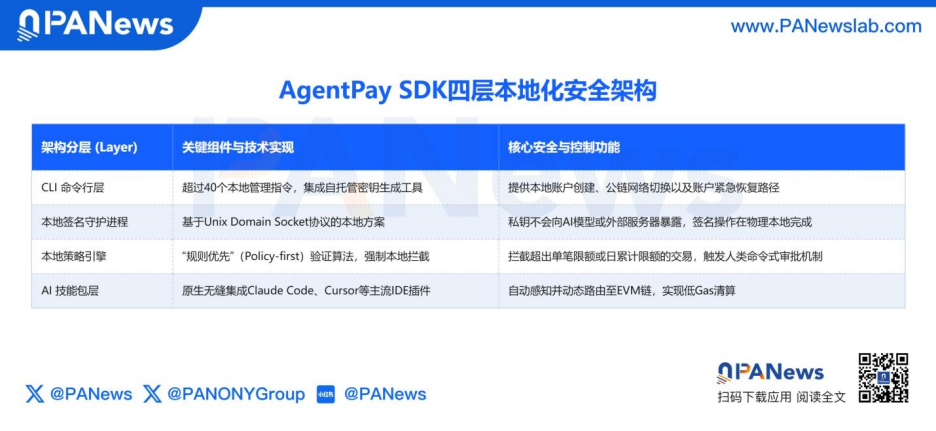
To accommodate the characteristics of agent transactions, AgentPay SDK introduces a "recoverable workflows" mechanism. When an agent fails to execute tasks such as purchasing computing power or subscribing to APIs due to insufficient wallet balance or lack of Gas, the SDK does not return a cold and unyielding error code but outputs a prompt message to the agent, containing the type of Gas token, the corresponding chain ID, and a recharge QR code, ultimately providing a user-friendly feedback to the user. Once the recharge is complete, the system will automatically retry, significantly enhancing the continuity of automated workflows.
Beyond online settlements, WLFI has also expanded offline consumption scenarios. By integrating with global gift card and telecom service giant Bitrefill, agents equipped with AgentPay SDK can use USD1 to autonomously purchase virtual credit cards, global eSIMs, and various life service gift cards. This means that cloud-running agents can not only pay computing bills and subscribe to online APIs but also independently book flights, arrange communication services, and purchase physical goods.
From on-chain settlements among agents to covering everyday consumption needs, USD1 will utilize AgentPay SDK to lay out a two-way trading channel of "on-chain-physical," shaping a commercial landing prototype for the nascent agent economy.
As a stablecoin project directly endorsed by the Trump family, USD1 has restructured the competitive landscape of the stablecoin market in just over a year, leveraging clever political positioning and heavy adoption of sovereign capital.
The next phase of challenges for USD1 will lie in whether it can step out of the "policy dividend haven" and shift towards internally-driven growth propelled by cross-border remittance settlements and agent payments.
On the fertile ground of the stablecoin race, USD1's rise is a special gamble, and its background halo has nurtured its growth. The real test, however, lies in whether it can translate the blueprints of "borderless payment" and "silicon-based economy" into reality.
免责声明:本文章仅代表作者个人观点,不代表本平台的立场和观点。本文章仅供信息分享,不构成对任何人的任何投资建议。用户与作者之间的任何争议,与本平台无关。如网页中刊载的文章或图片涉及侵权,请提供相关的权利证明和身份证明发送邮件到support@aicoin.com,本平台相关工作人员将会进行核查。


