Author: Seven Research
Previously, a senior recommended I check out Huang Zheng's "Turning Capitalism Upside Down." After the recommendation, I looked for it and read it, and then I casually wrote down some thoughts after finishing it.
Why do I want to bring this up? Because many might not even think about it—how a person like Huang Zheng, known for e-commerce and "low prices, cutting prices," has anything to do with blockchain. But after reading that article, I realized there is indeed a connection, and he pointed it out himself.
1. The Underlying Logic of Pinduoduo: A Business about "Uncertainty"
First, let's talk about what this article is about.
Most people see Pinduoduo as cheap and focused on lower-tier markets. But Huang Zheng himself said that what he does is actually an "insurance" business—a business about "uncertainty."
He posed a heart-wrenching question: Why does money always flow to the rich?
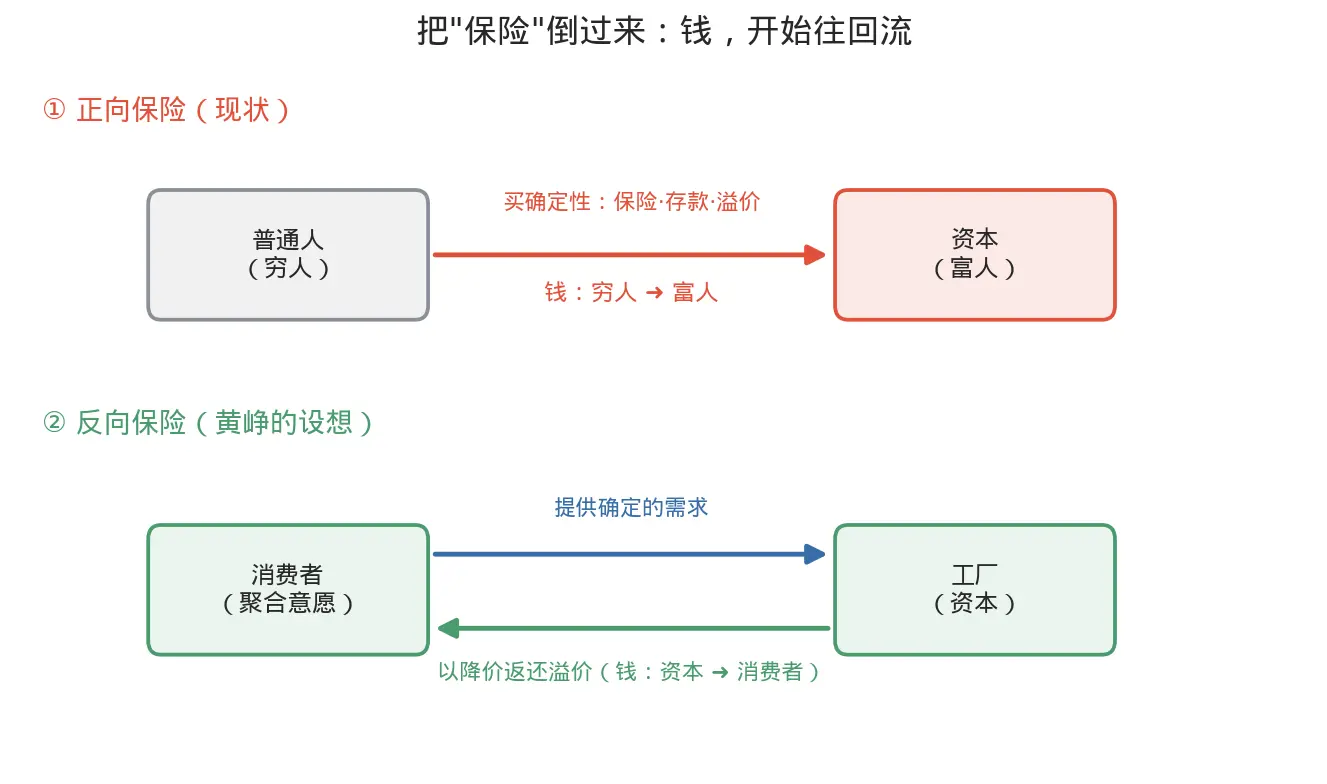
His answer was: Because the rich bear the "uncertainty" for others. Life, death, illness, unemployment, and serious illness—when these misfortunes befall someone, the probability is roughly the same; however, the same blow means something different for the poor and the rich. The poor might be knocked down, while for the rich, it’s just a minor fluctuation that can be calculated. Therefore, the poor are willing to spend to buy "peace of mind"—by purchasing insurance, depositing money in banks for low interest, or preferring to pay a bit more for goods in exchange for immediate delivery. Money flows bit by bit from the bottom to the top. This is the "positive" flow.
2. "Reverse Insurance": Turning Capitalism Upside Down
So can it be reversed, allowing ordinary people to sell "certainty" to capital?
The difficulty lies in that individual promises are not worth much. Online orders can be canceled at any time with no cost, and merchants have no way to deal with this; they can only stock more and pass the cost back to prices. Huang Zheng's statement was harsh:
“Your behavior is treated as a statistical fluctuation, not a promise that must be fulfilled.”
But one person can't do it; what about ten thousand people? Pinduoduo's group buying and time-limited offers are essentially about seizing the moment before you can hesitate, compressing ten thousand people's "intention to buy" into one single moment, creating a solid order and mitigating the risk of "products produced but not sold" for factories. Grateful for this certainty, factories convert the originally risk-adjusted premium back into "price reductions." Money flows back a bit. This is what he calls "reverse insurance."
3. The Last Piece of the Puzzle: Blockchain
Talking about this, you might not yet see its relation to blockchain. To be honest, I didn't either at first.
Until the article was nearing its end, Huang Zheng himself posed a question—he said, to productize, standardize, and monetize this "certainty," it relies on decentralized methods to prevent fraud and form a cycle where good money drives out bad money; then he asked: Isn't blockchain inherently born for this kind of "reverse insurance"?
Just that one sentence left me stunned. A person in e-commerce was led around in a big circle, and in the end, landed on blockchain. He didn’t elaborate further, but upon reflection, it really makes sense.
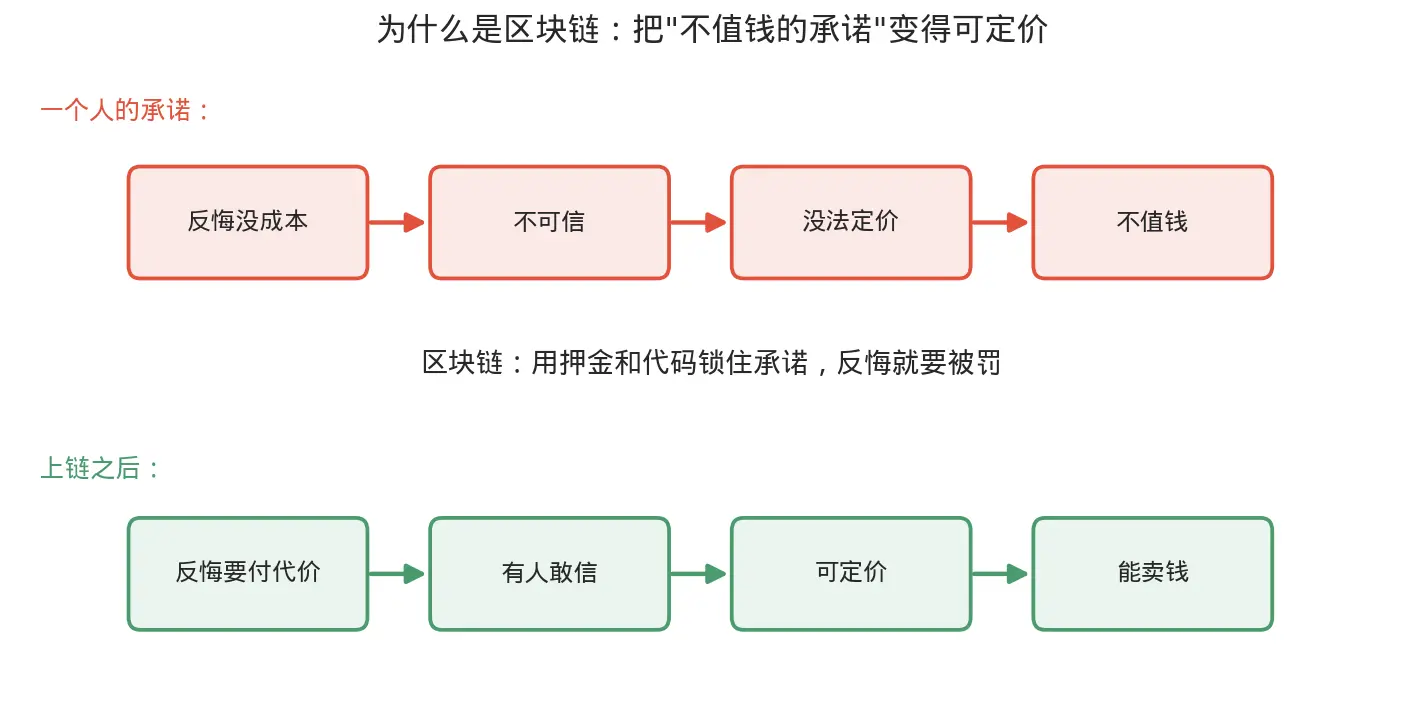
The biggest deadlock in reverse insurance, as mentioned earlier, is that "ordinary people's promises are not worth money"—they have no cost, are unreliable, and cannot be priced. Blockchain happens to remedy this issue:
By using smart contracts to firmly bind your promise to a deposit; if you want to back out, the deposit is forfeited, and you will face penalties.
This way, your "intention to buy" transforms into a real promise that incurs consequences for backing out and can be enforced, allowing the factory to trust it and arrange production accordingly.
In the end, it transfers the matter of "trust" from reliance on people to reliance on rules. You see, the piece of the puzzle he is looking for—making promises credible, priceable, and not siphoned off by middlemen—is precisely the inherent capability of blockchain.
4. Extended Thoughts: Two Paths to Create Certainty
Following his statement, I couldn't help but think about Bitcoin in another layer (a professional habit; don't mind me for constantly linking it to currency).
Bitcoin is, in fact, the purest sample of "trust relying on rules": a fixed total supply, open algorithms, and unmodifiable rules.
The certainty of fiat currency relies on the restraint of the money issuers, it is dependent on human control;
The certainty of Bitcoin relies on cold, unfeeling code that does not negotiate, it is based on the rule of law.
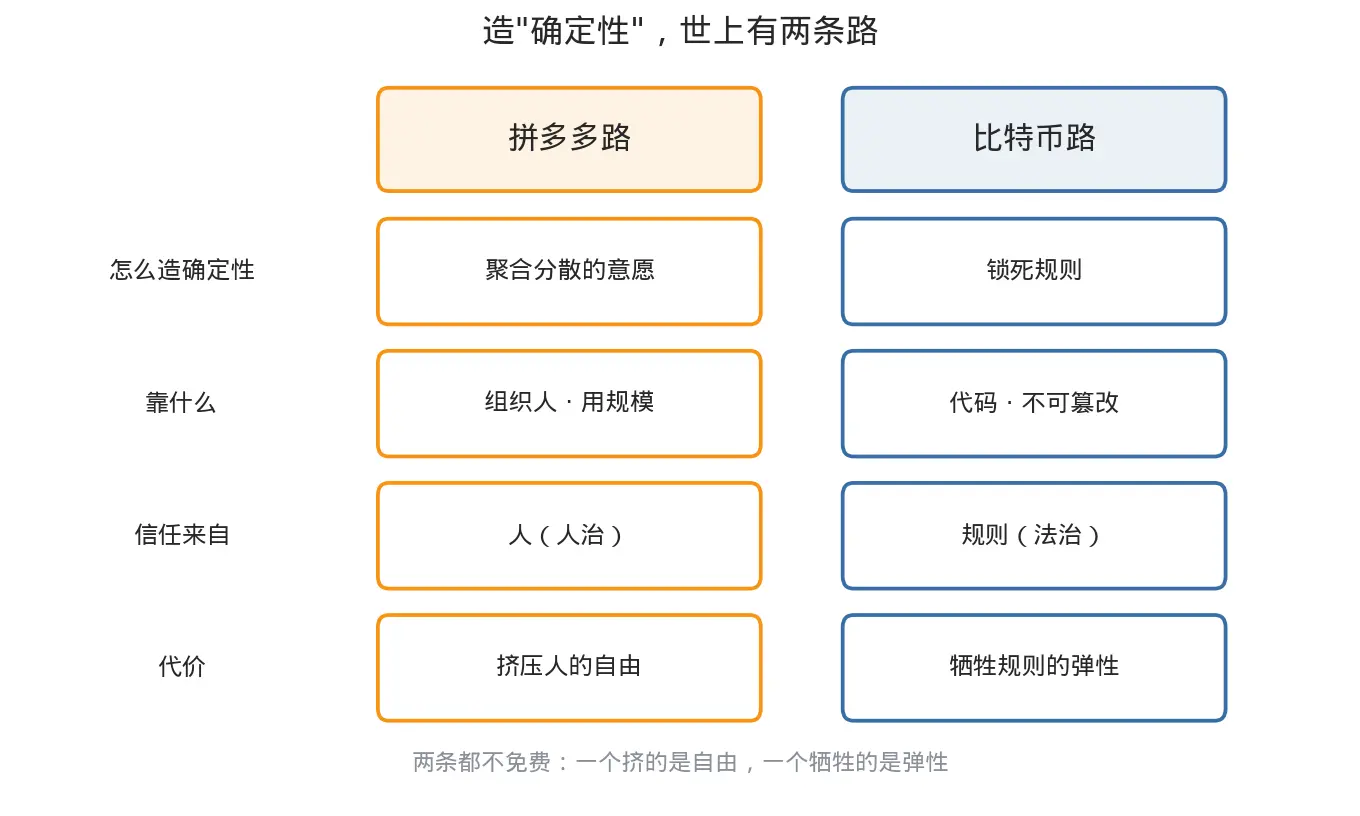
One relies on people, the other relies on rules. So, in terms of creating certainty, there are actually two paths in the world:
One path is the Pinduoduo way: consolidating dispersed intentions into power, using scale to hard press out uncertainty;
The other path is the Bitcoin way: completely locking down the rules, leaving no loopholes for human intervention.
Neither path is without cost; the former sacrifices individual freedom, while the latter sacrifices the flexibility of the rules.
If you're interested, you can also reread the article "Turning Capitalism Upside Down."
免责声明:本文章仅代表作者个人观点,不代表本平台的立场和观点。本文章仅供信息分享,不构成对任何人的任何投资建议。用户与作者之间的任何争议,与本平台无关。如网页中刊载的文章或图片涉及侵权,请提供相关的权利证明和身份证明发送邮件到support@aicoin.com,本平台相关工作人员将会进行核查。


