The competition for tokenized stocks is accelerating
Written by: ChandlerZ, Foresight News
On June 11, Binance announced the launch of its tokenized securities product bStocks, simultaneously opening five trading pairs for Circle (CRCLB), Micron (MUB), Nvidia (NVDAB), Sandisk (SNDKB), and Tesla (TSLAB).
bStocks are issued by Binance's affiliated company BTech Holdings Limited, with each token backed on a 1:1 basis by U.S. stocks held by a regulated custodian, deployed on the BNB Chain, supporting 24/7 trading, self-custody withdrawals, and DeFi applications. This is the first batch of tokenized securities products officially approved and included in the official securities list by the ADGM Financial Services Regulatory Authority (FSRA).
In the first half of 2026, Binance has been expanding into traditional financial assets. In January, it launched gold and silver TradFi perpetual contracts, in April, it connected to prediction markets, in May, it launched SpaceX Pre-IPO perpetual contracts, and in early June, it opened commission-free trading for U.S. stocks. bStocks enable users to convert their existing U.S. stocks into tokens on the BNB Chain, signifying that for Binance, bStocks transform a distribution channel into infrastructure where stocks are no longer the end, but rather an input for on-chain finance.
Product structure of bStocks
To understand bStocks, it's essential to differentiate between the two layers of U.S. stock products launched by Binance in June.
The first layer is traditional U.S. stock trading. On June 1, Binance opened commission-free trading for over 7,000 U.S. stocks and ETFs to non-U.S. users, allowing them to purchase real stocks with USDC, USDT, or BNB. Trading is facilitated through the ADGM licensed broker Nest Trading Limited, with clearing, custody, and dividends handled by the New York brokerage infrastructure company Alpaca Securities. This layer is traditional securities trading, following the trading hours of the U.S. stock market.
The data from a week after this product launch is quite telling, with Binance Research reporting that U.S. stock trading AUM surpassed $400 million in seven days. 84% of trading volume came from emerging market users, a quarter of users are under 25 years old, and nearly 40% of trading amounts are under $100. Shunyet Jan, head of Binance's spot and derivatives business, said this indicates that demand is concentrated in demographics traditionally underserved by conventional platforms, including emerging markets, youth, and small traders. In terms of fund flows, the IT sector attracted 57% of the allocation in the first week, with semiconductors and hardware accounting for 44%, reflecting users' focused bets on AI infrastructure. 70% of users choose to hold positions overnight, indicating that most users are positioning buyers.
The second layer is tokenization of bStocks. Users can autonomously convert the stocks held in the first layer into BEP-20 tokens on the BNB Chain at a 1:1 ratio. The conversion comes with no fees, no lock-up period, and no minimum holding requirements, allowing users to revert to direct stock ownership at any time. Once converted to bStocks, these tokens are free from the trading hour restrictions of U.S. stocks, supporting trading around the clock, with settlements completed within seconds.
The core distinction of this design is that users initiate the tokenization operation themselves, converting their already held stocks into on-chain assets. Most tokenized stock projects involve issuers pre-mining a fixed batch of tokenized assets for trading, while Binance grants the conversion rights to users. It is important to note that the price tracking of bStocks relies on oracle price feeds to keep the token value in sync with the underlying stock value, with on-chain settlements executed instantly, but if users wish to redeem bStocks back to direct ownership, the redemption operation must still be executed within the regular trading hours of the U.S. stocks.
The issuer BTech Holdings Limited is a special purpose vehicle (SPV) registered in the Abu Dhabi Global Market (ADGM), with bStocks legally classified as “Certificates representing certain Financial Instruments,” meaning holders do not directly own shares of the underlying listed company. The FSRA has approved the issuer's prospectus, and bStocks are among the first tokenized products included in the FSRA's official securities list.
What on-chain stocks can do
According to the bStocks Conversion Product Terms effective June 11, this conversion service is a closed-loop operation within the Binance ecosystem, allowing only stocks bought and held in the NTL comprehensive account through Binance stock trading (i.e., the first layer) to be converted into bStocks, with users unable to transfer stocks from external brokers for tokenization.
The counterparty for conversion is Nest Trading Limited (NTL), which acts as a market maker for every conversion transaction with users, allowing them to sell stocks to NTL in exchange for Certificates, or sell Certificates back to NTL in exchange for stocks. Users do not directly obtain tokens from the issuer BTech Holdings.
bStocks are based on the BEP-677 token standard on the BNB Chain, designed specifically for real-world assets, with a core capability that includes a multiplier mechanism to automatically manage dividends and stock splits by adjusting the balance displayed without minting or burning tokens.
For users, this means two things: first, dividends are automatically credited. When the underlying company distributes dividends, the net dividend value (after deducting the U.S. 30% withholding tax) is automatically reinvested through the on-chain multiplier, requiring no user action, and directly increasing wallet balance. Binance claims the efficiency of this process exceeds the traditional brokerage's T+2 settlement cycle. Second, stock splits are effortlessly completed. If the underlying stock undergoes a split, the on-chain multiplier adjusts in sync, automatically updating the number of tokens held and their displayed value without requiring manual action.
Self-custody is another key feature, allowing users to withdraw bStocks to Trust Wallet, Binance Wallet, or any compatible BNB Chain wallet address for on-chain self-custody. This means bStocks are removed from Binance's closed ecosystem and can be used in DeFi protocols on the BNB Chain for lending, providing liquidity, or as collateral.
Users can trade via the Convert function with amounts as low as the equivalent of 0.01 USDC, and all underlying assets of bStocks can be verified in real-time through Binance's Proof of Collateral page. The trading fees for the first five trading pairs are waived until September 1.
The track for tokenized stocks is accelerating
As of June 2026, the total market capitalization for tokenization of real-world assets has reached $31.8 billion, a 589% increase since the beginning of 2025. Among them, bonds and money market funds contributed $6.5 billion in increments, while stock-like assets expanded by 422% during the same period. A recent report by the Binance Research Institute suggests that even at a moderate adoption rate, tokenized assets will reach $16 trillion by 2030, with crypto exchanges capable of introducing $5 trillion in new equity capital to the global market.
Tokenized stocks remain a newer subclass within RWA but have started to accelerate in growth, with CoinGecko reporting that when tokenized stocks were launched in July 2025, monthly spot trading volume was only $2.33 billion. Despite a decline in the following two months, the spot trading volume for tokenized stocks has exceeded $4 billion for four consecutive months since then.
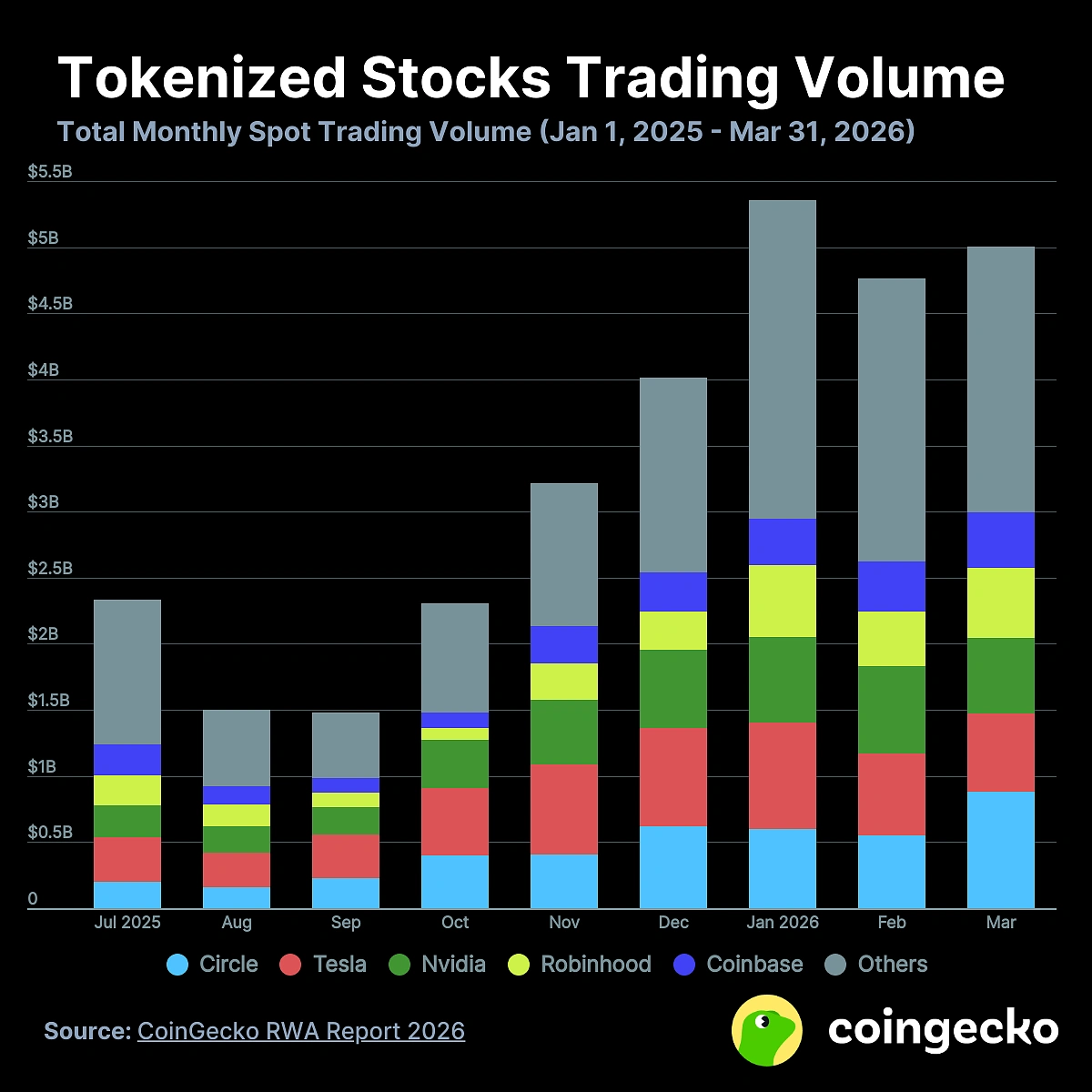
Similar to tokenized gold, the total spot trading volume for tokenized stocks reached $15.12 billion in the first quarter of 2026, surpassing the last two quarters of 2025 combined at $14.84 billion.
The trading volume for Tesla, Circle, and Nvidia contributes the most to tokenized stocks, with their average monthly trading volumes so far being $540 million, $450 million, and $440 million respectively.
Despite integration with several centralized exchanges, the trading activity of the top 5 tokenized stocks remains negligible compared to their real-world counterparts, accounting for less than 1% of the total trading volume in the TradFi stock market.
免责声明:本文章仅代表作者个人观点,不代表本平台的立场和观点。本文章仅供信息分享,不构成对任何人的任何投资建议。用户与作者之间的任何争议,与本平台无关。如网页中刊载的文章或图片涉及侵权,请提供相关的权利证明和身份证明发送邮件到support@aicoin.com,本平台相关工作人员将会进行核查。


