
Author: BitalkNews
On June 12, SpaceX will go public with a valuation of $1.8 trillion, but only about 556 million shares will actually be in circulation, corresponding to a market cap of about $75 billion, which is 4.2% of the total valuation.
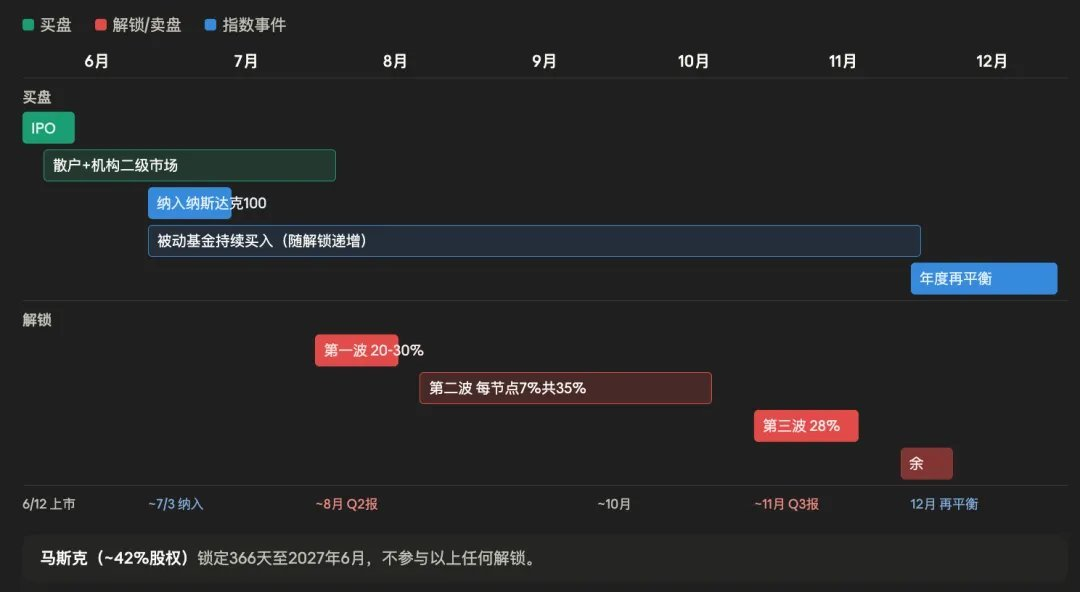
In the early stages of the listing, the circulating shares are very small, but buy orders will arrive in three waves.
The first wave is the IPO subscription on June 12. Institutions and retail investors will buy the newly issued 556 million shares at a fixed price of $135. About 70% of these shares will be allocated to institutional investors, and 30% to retail investors, with the retail allocation being three times that of conventional large IPOs, allowing retail investors to subscribe through platforms like Robinhood and Fidelity. Current subscription demand has already exceeded $250 billion, nearly 4 times oversubscribed.
The second wave is trading in the secondary market after the opening. After the IPO subscription is completed, the stock will be listed on Nasdaq, and the opening price is likely to be higher than $135. The price at this stage will be determined by market supply and demand.
The third wave is the mandatory buying from passive funds, which is the most noteworthy part. The Nasdaq 100 is one of the most important indices in the US stock market, containing the 100 largest non-financial stocks, including Apple, Nvidia, and Microsoft. Over $600 billion in funds globally track this index, and they must hold positions according to the weight of each stock in the index.
Normally, newly listed companies have to wait several months to be eligible for inclusion, but Nasdaq has specifically modified the rules for SpaceX, allowing it to be quickly included just 15 trading days after listing, while also removing the original 10% minimum public float requirement and introducing a new weight rule: even if SpaceX's actual float is only 5%, the index will compute its weight at a maximum of 15% at 3 times the highest. Once included, hundreds of funds tracking this index will need to concentrate their purchases of SpaceX within a few days, and with a public float of only $75 billion, a concentrated influx of buy orders in the short term can easily drive up prices. These funds do not look at valuations and do not make judgments; they just buy when the rules dictate.
The three waves of buying will almost seamlessly connect in the first month after the listing.
However, this supply-demand imbalance will not last forever.
SpaceX has not adopted the traditional 180-day lockup period for IPOs but has designed a phased release.
To understand this mechanism, one must first comprehend the equity structure after listing: the new shares issued in the IPO account for about 4.2% of the total share capital, Elon Musk holds about 42%, and the remaining approximately 54% is held by VC, early employees, and other internal shareholders. The newly issued shares can be traded upon listing, while Musk's share is locked for 366 days without any movement; the phased unlocking applies only to the remaining 54% in the middle.
Specific timetable:
- First wave, two days after the Q2 financial report is released, locked shareholders can sell up to 20% of their locked shares. If the stock price remains above 30% of the IPO price and meets the criteria for 5 out of 10 trading days, an additional 10% will be unlocked. This means that the earliest batch of insiders may start selling in early August.
- Second wave, on the 70th, 90th, 105th, 120th, and 135th days after the IPO, 7% will be unlocked at each node, totaling 35% over five nodes.
- Third wave, another 28% will be unlocked after the Q3 financial report is published, with the remaining released at the 180-day expiration.
Elon Musk himself is locked for 366 days and does not participate in any early releases. He controls over 85% of the voting rights, and this commitment is an important support for market confidence in SpaceX in the short term.
From the listing until the end of the year, the market will undergo a demand-supply transition lasting six months. In the first half, the public float is locked, and the buying certainty is extremely high; in the second half, the chips are gradually released, and each financial reporting node is a test of selling pressure.
It is worth noting the timing design: by mid-December during the Nasdaq 100 annual rebalancing, the vast majority of insider shares will have been gradually unlocked in previous rounds. After a significant increase in the public float, Nasdaq will accordingly increase SpaceX's index weight, requiring passive funds to buy additional shares. This equates to using systemic forced buying to support the market after several months of insider selling.
免责声明:本文章仅代表作者个人观点,不代表本平台的立场和观点。本文章仅供信息分享,不构成对任何人的任何投资建议。用户与作者之间的任何争议,与本平台无关。如网页中刊载的文章或图片涉及侵权,请提供相关的权利证明和身份证明发送邮件到support@aicoin.com,本平台相关工作人员将会进行核查。


