Holding ETH has incurred losses exceeding 8.5 billion; how can BitMine promise a fixed dividend of 9.5%?
Written by: Oluwapelumi Adejumo
Translated by: Saoirse, Foresight News
Key Points Overview
- BitMine plans to issue 3 million perpetual Class A preferred shares, with a maximum fundraising target of $300 million for its Ethereum holdings.
- The 9.5% annual dividend will bring new funds to the company for purchasing coins and expanding staking nodes, but the annual new dividend cost is approximately $28.5 million.
- The company's Ethereum holdings have incurred an unrealized loss of over $8.5 billion; if staking returns do not meet expectations, dividend funds may rely on cash reserves, selling off assets, or subsequent refinancing.
Led by Thomas Lee, BitMine intends to raise funds through the preferred share market, relying on a fixed annual dividend of 9.5% to attract investments and enhance its Ethereum strategy. The company disclosed its plan on June 3: to issue 3 million perpetual Class A preferred shares with a par value of $100 and an annual fixed dividend of 9.5%, aiming to raise a maximum of $300 million. Once approved, the product will be listed on the NYSE under the stock code BMNP, with Moelis & Company and Cantor serving as joint book-running underwriters.
If the full amount is sold, the company's annual dividend liabilities will increase to $28.5 million, and dividends will be distributed weekly following a board resolution. At the time of this fundraising, the heavily invested Ethereum company is facing a severe test of its business model: due to the continuous decline in coin prices, the market price of Ethereum is far below the company's average holding cost, with BitMine's relevant holdings realizing an unrealized loss exceeding $8.5 billion.
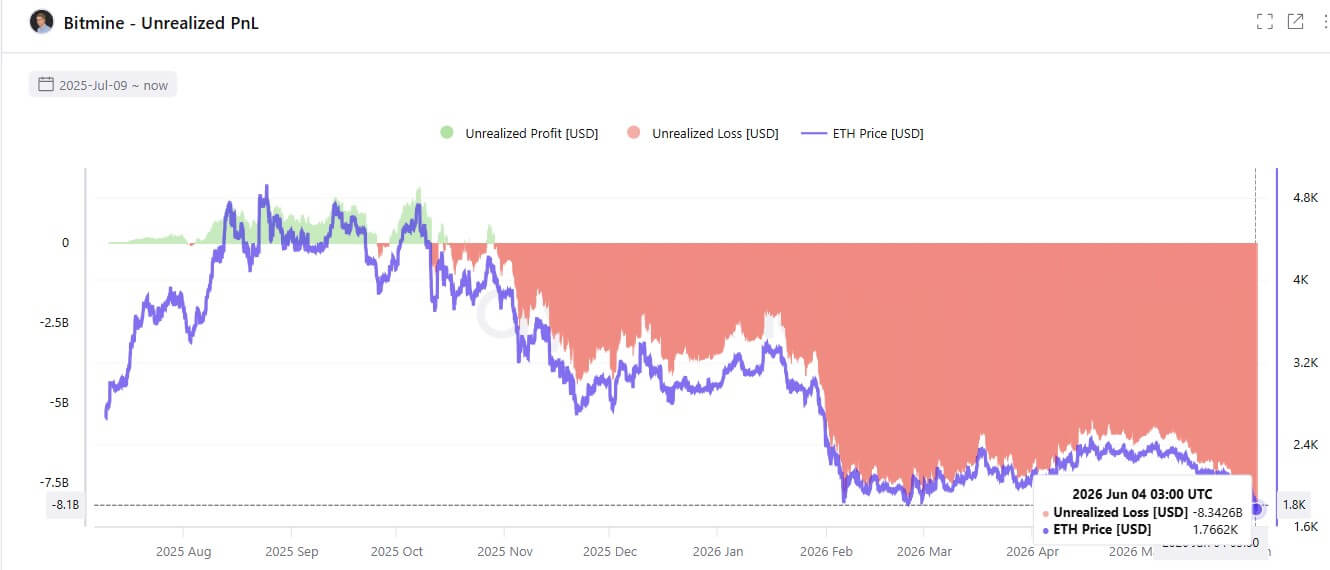
The unrealized loss of Ethereum assets held by BitMine (Data Source: CryptoQuant)
This fundraising will further bind the company's balance sheet, staking business, and secondary market investors, assisting the company in continuing to accumulate Ethereum at low prices.
Supporting Dividend Logic with Ethereum Staking Returns
BitMine states that the funds raised can be used for the company's regular operations: increasing holdings in Ethereum and other digital assets, expanding staking validation nodes, supplementing operating liquidity, pursuing strategic investments in the Ethereum industry, and repurchasing its own common stock. This fundraising is not only for repairing unrealized losses but also helps the company continue to accumulate coins during a bear market, solidifying its position as a leading publicly listed Ethereum treasury company globally.
Over the past year, the company has continuously purchased Ethereum in large amounts, currently holding over 5.3 million coins, accounting for about 4.5% of the total circulating supply of Ethereum; the vast majority of its assets are staked, continuously earning on-chain block rewards.
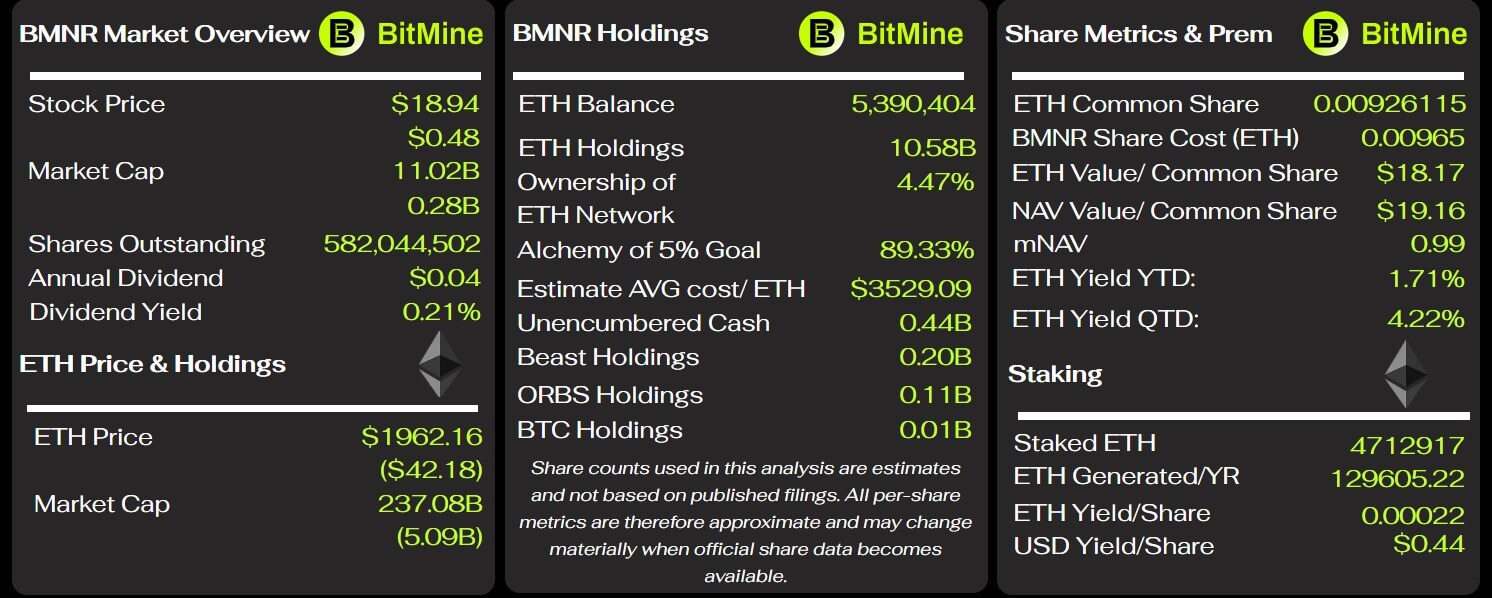
Key Indicators of BitMine (Data Source: BitMineTracker)
Chairman Thomas Lee has stated: earning income from staking is a core advantage for Ethereum treasury companies compared to those heavily invested in Bitcoin. Bitcoin does not generate passive income, but Ethereum can profit continuously through staking, allowing holders to acquire cash flow without selling their principal. This income logic underpins the current preferred share issuance: after raising the full $300 million, the weekly dividend expenditure is approximately $548,000. BitMine disclosed that its annual staking returns reach several hundred million dollars, and under regular market conditions, the dividend cost is far lower than staking revenues.
Research by staking provider Everstake shows that by 2025, staking income will account for 60% of the total disclosed revenue among publicly listed Ethereum treasury companies in the industry, making staking monetization a mainstream profit model. Industry data supports that BitMine's business model of relying on Ethereum yields to cover fixed dividends has industry-wide relevance.
The company is not merely hoarding coins but transforming its massive Ethereum reserves into sustainable cash flow to engage with capital market financing. However, from the prospectus, it is clear that this model is not risk-free.
BitMine has not designated a special staking income fund for preferred share dividends. The documents specify that sources for dividend payments include the company's cash, staking profits, sale of held securities, subsequent refinancing, or other channels. The company also warns of extreme market risk: staked Ethereum cannot be redeemed immediately for cash during market pressure, and there is a possibility of staking returns falling short of expectations. The preferred share issuance essentially transforms BitMine's Ethereum investment position into a rigid regular cash payout obligation.
Benchmarking Strategy Model, but Significant Differences Exist in Product Terms
BitMine's financing strategy mirrors that of Michael Saylor's heavily Bitcoin-focused Strategy: both companies rely on publicly listed preferred shares to raise funds and continuously accumulate coins and optimize capital structure through secondary market funds; by creating income-bearing securities, regular investors can engage in the crypto treasury space without holding coins directly. Both face market risks from the drastic price fluctuations of underlying assets and the rigid payout of fixed dividends.
However, the rules of the two preferred share products differ significantly: the STRC preferred shares issued by Strategy are floating-rate products that adjust dividends monthly to stabilize the stock price near the $100 par value; BitMine's Class A preferred shares adopt a fixed annual interest rate of 9.5%, with dividends paid weekly after resolution, lacking a floating adjustment mechanism to stabilize the stock price. If BitMine fails to pay dividends on time, overdue interest accumulates weekly, with a maximum penalty interest rate of 15% annually.
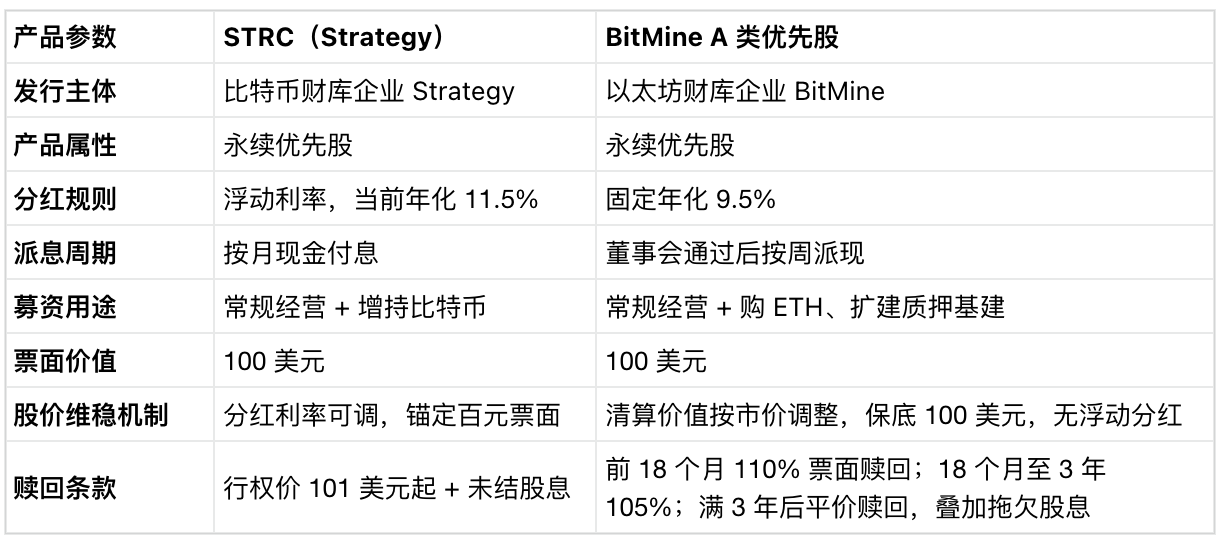
The initial liquidation benchmark price of the preferred shares is set at $100, dynamically adjusted according to market price formulas, with a minimum not lower than par; redemption comes with a change of control trigger that grants investors resale rights.
The 9.5% fixed annual payout not only attracts fixed-income investors but also indirectly reflects that in a bear market, companies heavily invested in Ethereum assets must pay a higher risk premium for financing.
免责声明:本文章仅代表作者个人观点,不代表本平台的立场和观点。本文章仅供信息分享,不构成对任何人的任何投资建议。用户与作者之间的任何争议,与本平台无关。如网页中刊载的文章或图片涉及侵权,请提供相关的权利证明和身份证明发送邮件到support@aicoin.com,本平台相关工作人员将会进行核查。


