When AI steps out of the chat box: three.ws begins to shape bodies for Agents.
Written by: KarenZ, Foresight News
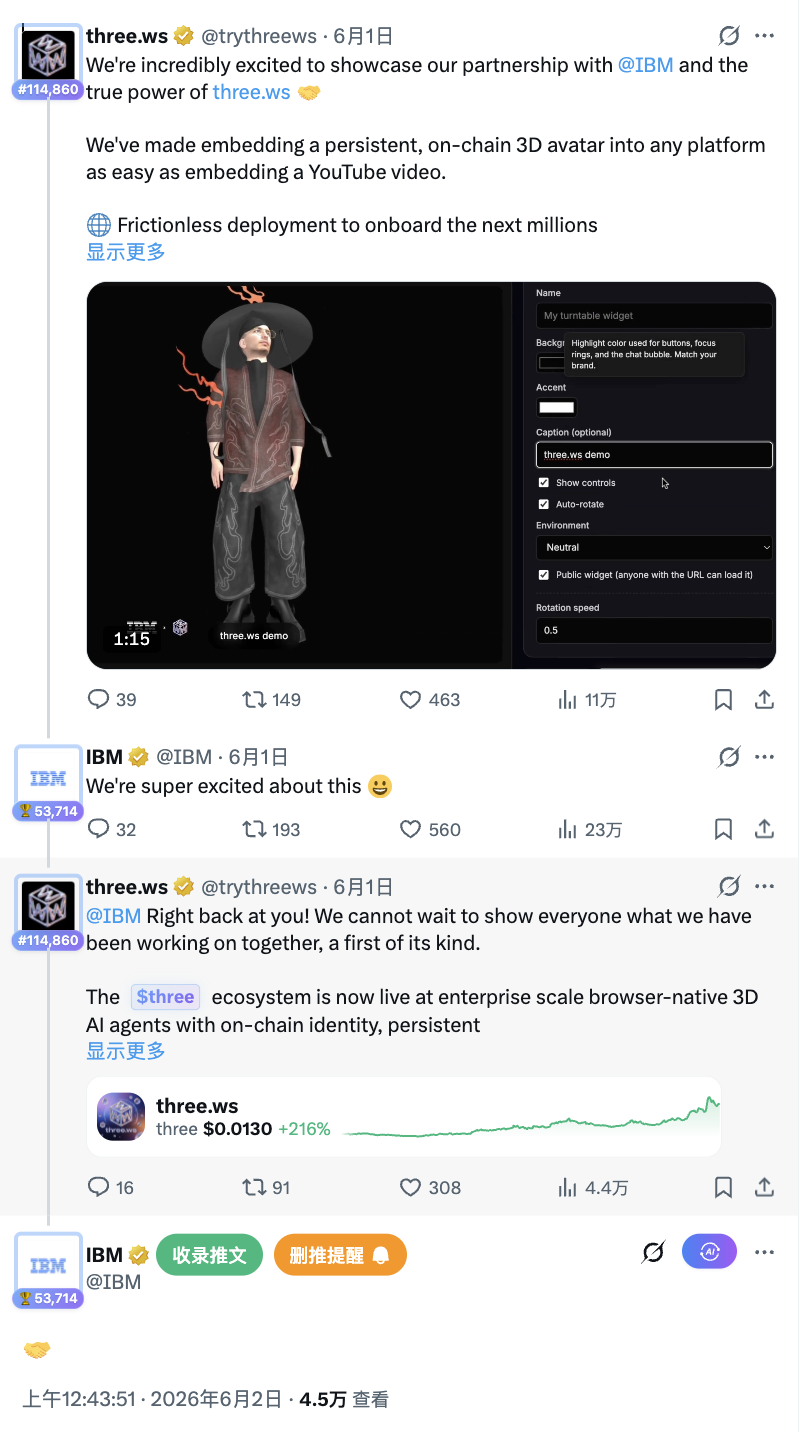
A news of collaboration with IBM has quickly brought the Solana ecosystem project three.ws into the market spotlight, and the three token of three.ws has also achieved a 50-fold increase.
The direct catalyst for the price increase comes from IBM. From the night of June 1 to the early hours of June 2, IBM's official Twitter account responded twice to the collaboration announcements made by three.ws.
During the fermentation of this news, the three token rapidly increased in value. According to GMGN data, the market capitalization of three went from around $300,000 before IBM's response to a peak of $16.38 million on June 4, marking an increase of up to 53 times. Currently, the market capitalization of three is fluctuating around $13 million.
It can be seen that this is not a market that has been continuously heating up since the token issuance. Three was actually issued on the Solana chain at the end of April, with major price increases concentrated around IBM's public responses and the announcement of collaboration.
However, if we only understand three.ws as a Solana AI project backed by IBM's collaboration, we ignore the real problems it aims to solve: Currently, most AI Agents are still hidden in chat boxes and background programs, users cannot see them and find it difficult to identify, own, or invoke them across different websites, devices, and chain environments.
Three.ws aims to provide AI Agents with bodies, memories, identities, wallets, and distribution channels, enabling them to become 3D digital characters that can appear on web pages, perform actions, and conduct transactions.
Putting AI from the chat box onto the web
Three.ws defines itself as the "3D Agent Layer" of the internet. Founder @nichxbt currently has over 20,000 followers on Twitter and is verified with a blue V.
The project is currently live on AWS Marketplace and Alibaba Cloud International Market and has joined the Google Cloud for Web3 Startups program. Three.ws has also been listed in the Anthropic official MCP Registry and is a participant in the W3C contributor and Solana Frontier Hackathon.
From the existing code and documentation of the project, three.ws's fundamental capabilities include loading, checking, and displaying 3D models on the web side, and it has integrated large language models, memory, voice, skills, on-chain identity, and payment features.
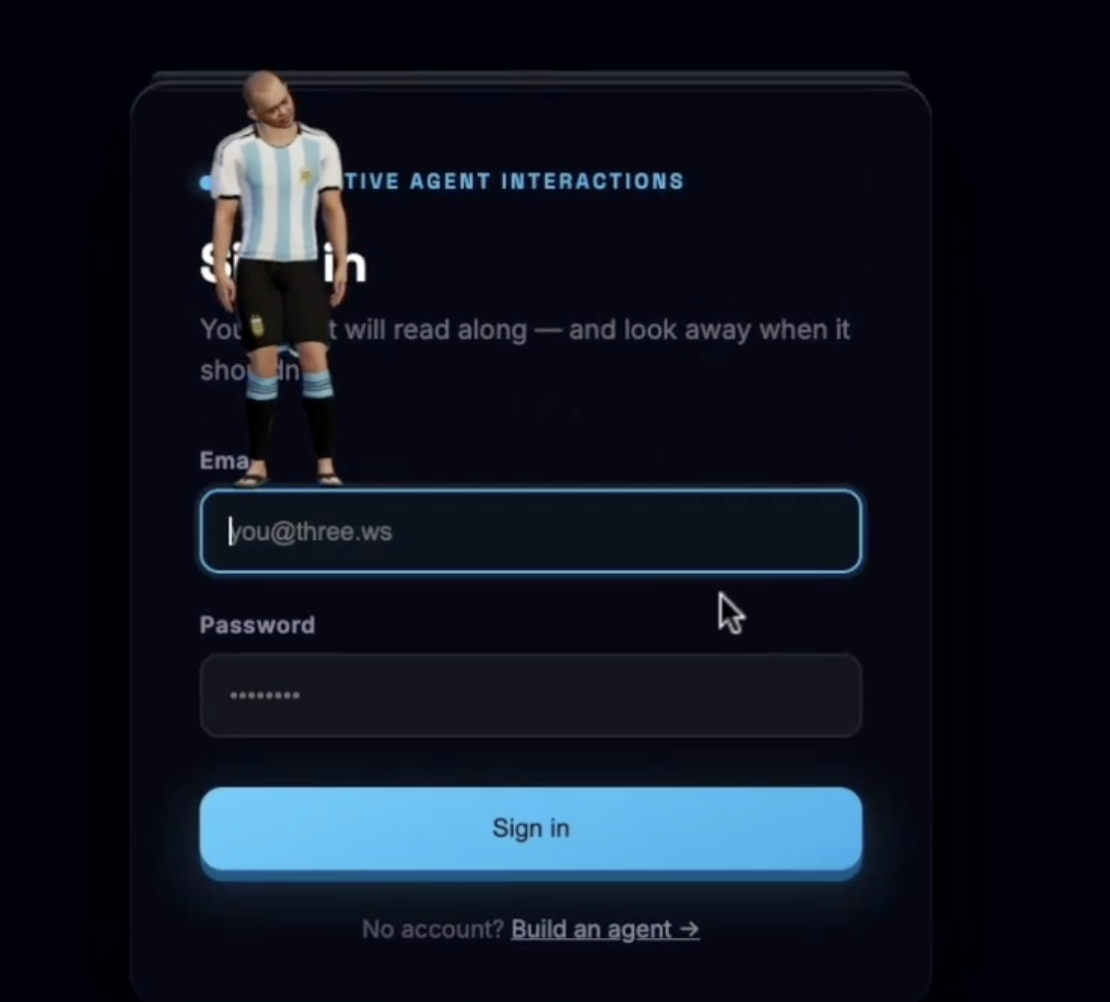
Simply put, developers can create a 3D character on the platform, connect it to a large language model, memory system, voice, and skills, and then embed it into a website through an agent-3d> web component.
For example, businesses can deploy a 3D shopping Agent on a product page to introduce products, answer questions, and showcase product features through actions. Developers can also build digital customer service, virtual teachers, game characters, or personal AI assistants.
This process is somewhat similar to embedding a YouTube video. Developers do not need to build complex 3D pages separately; once they add the component and Agent ID, users can see and interact with the Agent in their browsers.
Three.ws offers multiple ways to create characters. Users can upload selfies to generate a 3D image capable of executing animations in about 60 seconds; they can also generate models through text or images, upload their own GLB or glTF files, or use the character editor to create them.
Once the character is generated, developers can configure it with different large language models, voices, and skills.
Three.ws has also integrated on-chain capabilities for Agents. Agents can hold Solana wallets, pay USDC for paid interfaces through the x402 protocol, and can register identities as Metaplex Core assets on Solana or register on EVM chains through ERC-8004. It is important to differentiate between identity and funds: on-chain identity is used to prove who the Agent belongs to and where its information points; the wallet is responsible for payments and executing transactions.
How does a 3D Agent operate?
Three.ws consists of four mutually independent and interchangeable technical layers. Developers can use combinations of the four layers or only a portion of them.
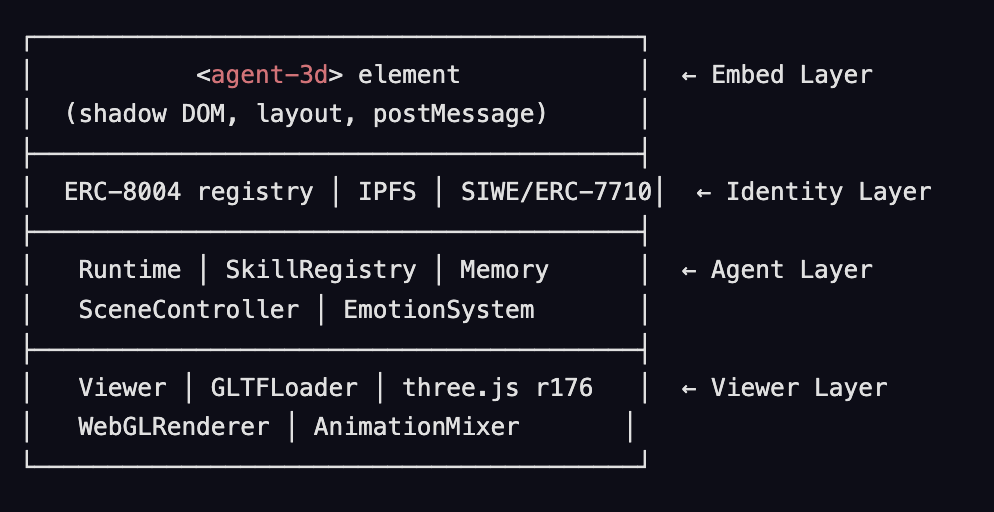
The bottom layer is the Viewer layer, or the rendering layer.
This layer is responsible for loading and displaying 3D models in the browser, including lighting, cameras, materials, and animations. It is built on top of three.js and does not inherently know whether there is AI, wallets, or on-chain identity behind the models. Therefore, even without connecting to an Agent, the Viewer can independently serve as a 3D model viewer.
The second layer is the Agent layer, which is the brain and behavior system of the character.
After a user inputs content, the large language model makes decisions based on character settings, historical memory, and installed skills. If a user asks the character to wave, the model will call the corresponding tool, and the scene controller will play the waving animation; if the character needs to remember something, the memory module will save the relevant information.
This layer also includes an emotion system. Characters can change expressions, gaze, and actions based on events, such as appearing happier after completing a task or showing concern when an operation fails.
The third layer is the identity layer. This layer is an optional module.
The identity layer ensures that the Agent maintains the same identity across different websites, devices, and sessions. The Agent's information, memory patterns, and resource addresses can be written into a Manifest file and stored via IPFS or the platform’s servers.
According to the official documentation of three.ws, its Solana Agent has supported registration of on-chain identity through Metaplex Core, but the on-chain reputation registration and validation registry related to ERC-8004 are currently only available on the EVM side, where the validation registry is still in the testnet phase.
The fourth layer is the embedding and distribution layer. This layer is responsible for bringing the Agent to the user. Developers can add the character to websites, applications, and enterprise interfaces via web components, iframes, Widgets, or SDKs.
In simple terms, the rendering layer is responsible for the body and actions, the Agent layer provides the brain, memory, and skills, the identity layer offers optional digital passports, and the embedding layer is responsible for deploying this character to websites and applications.
The fee structure of three.ws should be understood from two dimensions: what channels users use to access or purchase services? And what fees are required after using the platform?
In terms of purchase/use channels, users can subscribe directly, choosing between the free version, Pro ($49 per month), or an enterprise package based on usage needs. AWS Marketplace serves as a channel for enterprise procurement.
Upon subscribing to three.ws, developers can use x402 to set prices for the Agent’s chat, content generation, or API calls, with payers using USDC for per-use payments. Platform fees will be deducted from the income earned by developers: during the public testing of the free version, the platform fee is 0%, and the rate after testing has not yet been announced; the Pro version has a platform fee of 2.9%, while the corporate version's platform fee is customized based on agreements.
IBM adds enterprise capabilities, while platforms like AWS handle distribution
For 3D AI Agent projects, creating a digital character that can demonstrate functionality is not difficult. The real challenge lies in how to get products into the enterprise procurement system and meet requirements such as billing, deployment, verification, and AI governance.
Three.ws is filling these gaps through platforms like IBM and AWS Marketplace.
On May 27, three.ws announced its membership in the AWS Partner Network (APN) and subsequently went live on AWS Marketplace. This means that enterprise customers can procure three.ws services through their existing AWS accounts.
Afterward, three.ws published a technical article regarding SaaS product billing on the AWS Builder Center blog. This solution connected the customer verification, usage-based billing, and subscription management of AWS Marketplace with the x402 payment interface on-chain.
In terms of collaboration with IBM, three.ws plans to integrate its 3D Agent technology with IBM's enterprise AI, hybrid cloud, and market channels, as well as access IBM's Granite series models for use in conversational AI, image understanding, semantic matching, market prediction, and enterprise governance.
AWS Marketplace helps three.ws enter the enterprise procurement and billing system, while IBM provides it with enterprise AI technology and commercial channels. Both collaborative relationships point towards the same goal: transforming the 3D AI Agent from a captivating demonstration in a browser into a service that enterprises can procure, deploy, and manage.
In a bear market, IBM's public responses have given three.ws the rare attention of the market.
However, after the excitement, the project still needs to address more practical questions: Do enterprises and developers really need an AI Agent with a body, skills, and digital identity, and what role will three ultimately play in this system?
免责声明:本文章仅代表作者个人观点,不代表本平台的立场和观点。本文章仅供信息分享,不构成对任何人的任何投资建议。用户与作者之间的任何争议,与本平台无关。如网页中刊载的文章或图片涉及侵权,请提供相关的权利证明和身份证明发送邮件到support@aicoin.com,本平台相关工作人员将会进行核查。


