
Author: Nancy, PANews
The situation in the Middle East has suddenly escalated, pressing the pause button on Wall Street's weeks-long revelry. The U.S. stock market's nine-day winning streak has abruptly ended, and the cryptocurrency market has become one of the first to feel the impact amid a retreat in liquidity.
In the past month, the AI frenzy has supported new highs for U.S. stocks, while Bitcoin has faced downward pressure. As market sell-offs surged and capital accelerated its withdrawal, Bitcoin has directly lost multiple key psychological thresholds.
Bitcoin's rebound ends; ETF funds continue to flee
The two-month rebound has declared an end, and Bitcoin has returned to a downward trajectory. With market risk appetite cooling and funds continuously flowing out, Bitcoin has recorded negative returns over several consecutive trading weeks.
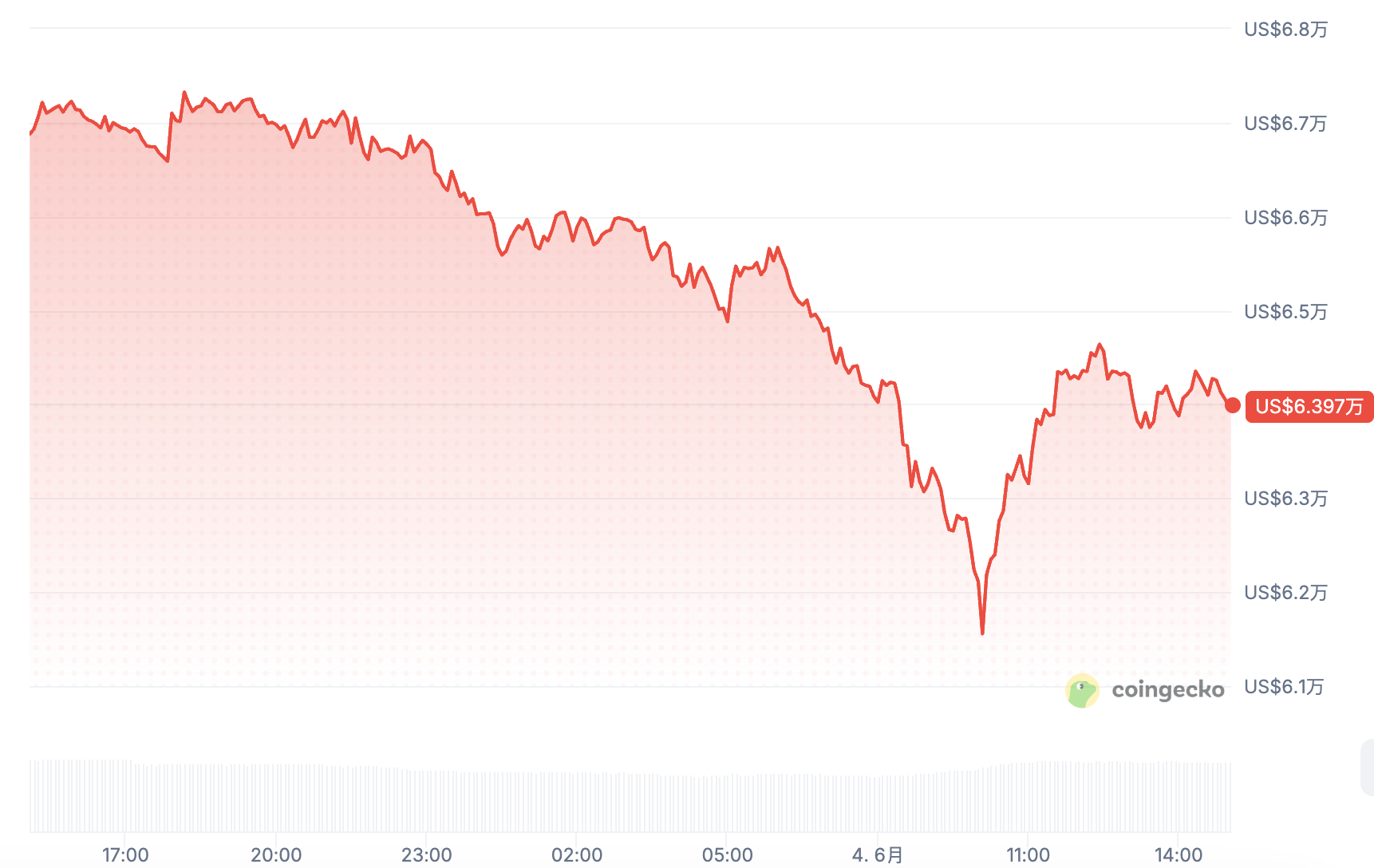
According to CoinGecko, in the past 30 days, Bitcoin has cumulatively dropped by 20.1%, dipping below $62,000 at one point, reaching a new low since February of this year, a nearly 50% retreat from the historic high set in October last year.
As prices continue to weaken, Bitcoin's global asset status has once again declined. According to the latest data from 8MarketCap, the total market capitalization of Bitcoin has been surpassed by Tesla, Meta, and Samsung, dropping to 16th place in the global asset market capitalization ranking, and becoming the only asset in the Top 100 global assets with a double-digit decline in the past seven days.
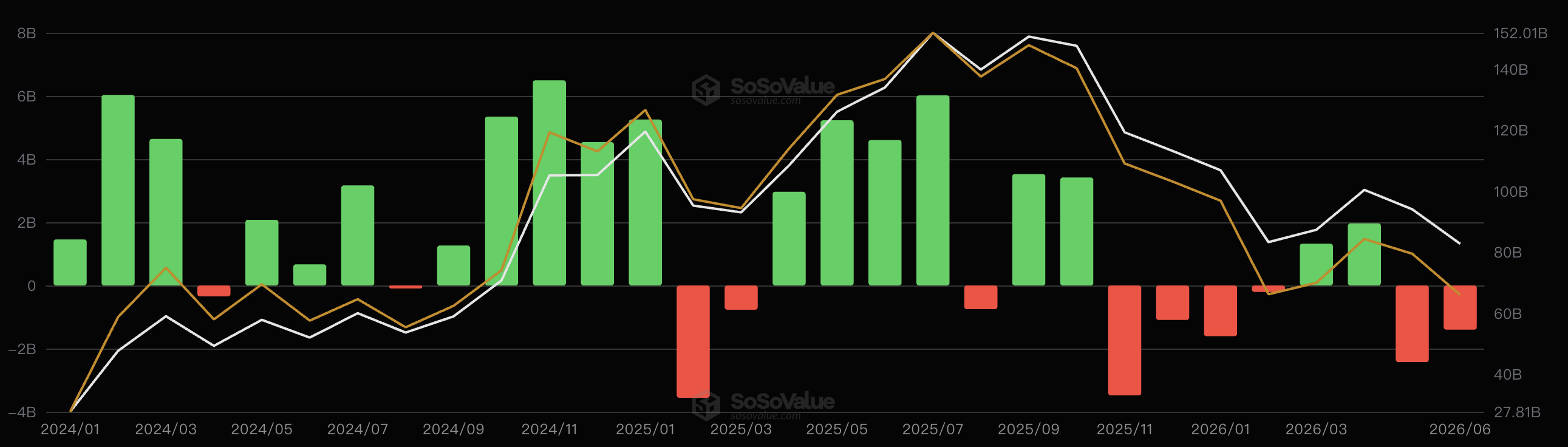
From a capital perspective, the continuous outflow of spot ETFs has become the main reason for the recent pressure on the market.
SoSoValue data shows that as of June 3, the total net asset value of Bitcoin spot ETFs was $82.88 billion, with the net asset scale of ETFs accounting for 6.36% of Bitcoin's total market capitalization. Since May of this year, Bitcoin spot ETFs have seen a cumulative net outflow of about $3.83 billion, with approximately $1.4 billion flowing out in just the first three trading days of June. Among them, BlackRock's IBIT had a net outflow of $2.58 billion during the same period, becoming the main force behind this round of ETF fund outflows.
In addition to continuous ETF blood loss, a series of events have also amplified market pessimism and triggered short-term panic selling.
Recently, Strategy's first sale of Bitcoin in four years has drawn market attention. Although the sale size was only 32 Bitcoins (about $2.5 million), which is almost negligible compared to its holding of over 840,000 Bitcoins, this action broke the long-held market expectation of its "never selling coins," undermining the confidence of some investors.
At the same time, movements in the bear market "old actor" Mt. Gox wallet have once again raised concerns about potential selling pressure. Arkham data shows that Mt. Gox recently transferred 10,422.65 Bitcoins from cold wallets, valued at over $739 million. Most of the funds were transferred to new addresses, with another 116.3 BTC flowing to its known hot wallet. This is the largest on-chain transfer for Mt. Gox in months, and its creditor's payment deadline is October 31, 2026. Currently, Mt. Gox still holds approximately 34,504 Bitcoins awaiting distribution, valued at about $2.43 billion.
Institutions and whales have also become the selling pressure driving the market decline. For example, cryptocurrency asset management firm Abraxas Capital continues to reduce its holdings by 1,469 BTC, transferring the 1,469 BTC (worth $98.45 million) into Kraken and bringing back 22.71 million USDC. In the past day or so, it has cumulatively reduced holdings by 2,469 BTC, valued at $166 million. At the same time, Santiment released data indicating that Bitcoin whales and sharks (addresses holding 10 to 10,000 BTC) sold 24,602 Bitcoins (a reduction ratio of about 18%) in the past week.
Macroeconomic headwinds; AI and super IPOs intensify capital siphoning
Changes in the macroeconomic environment and shifts in geopolitical risks have also made Bitcoin face a liquidity test.
JPMorgan analyst Nikolaos Panigirtzoglou stated that as signs of easing in the Middle East situation emerge, investors are gradually withdrawing from the Bitcoin and gold markets. The devaluation trades that had driven demand for both are losing momentum. In the past two weeks, both Bitcoin and gold-related ETFs have seen significant outflows, and institutional positions in the CME futures market have also weakened accordingly. This trend indicates that investors are withdrawing from macro-hedge trades that had become popular due to inflation concerns and global instability, and it is not a case of Bitcoin funds shifting to gold; rather, both asset classes are facing reduced demand simultaneously since the Iran conflict, with Bitcoin being a key representative of "devaluation trades."
QCP Capital further analyzed that escalating tensions in the Middle East and a stalemate in U.S.-Iran negotiations have driven international oil prices higher, with the risk premium related to the Strait of Hormuz returning to market attention. Meanwhile, the latest U.S. job openings data exceeded expectations, further weakening market expectations for a short-term Federal Reserve rate cut, reinforcing the market consensus of "high interest rates persisting longer."
More noteworthy than the macro headwinds is the change in the global capital allocation logic. In the past month, driven by the AI frenzy, the technology sector of the U.S. stock market has continuously refreshed historical highs, with a large amount of capital accelerating towards a few leading AI companies.
Binance Research pointed out that the recent weakness of the cryptocurrency market is due to the high concentration of funds in the U.S. stock market. The CBOE's dispersal index has risen to 42, marking the third-highest level in history, reflecting the concentration of funds within the S&P 500 index toward a few popular themes, thus marginalizing Bitcoin.
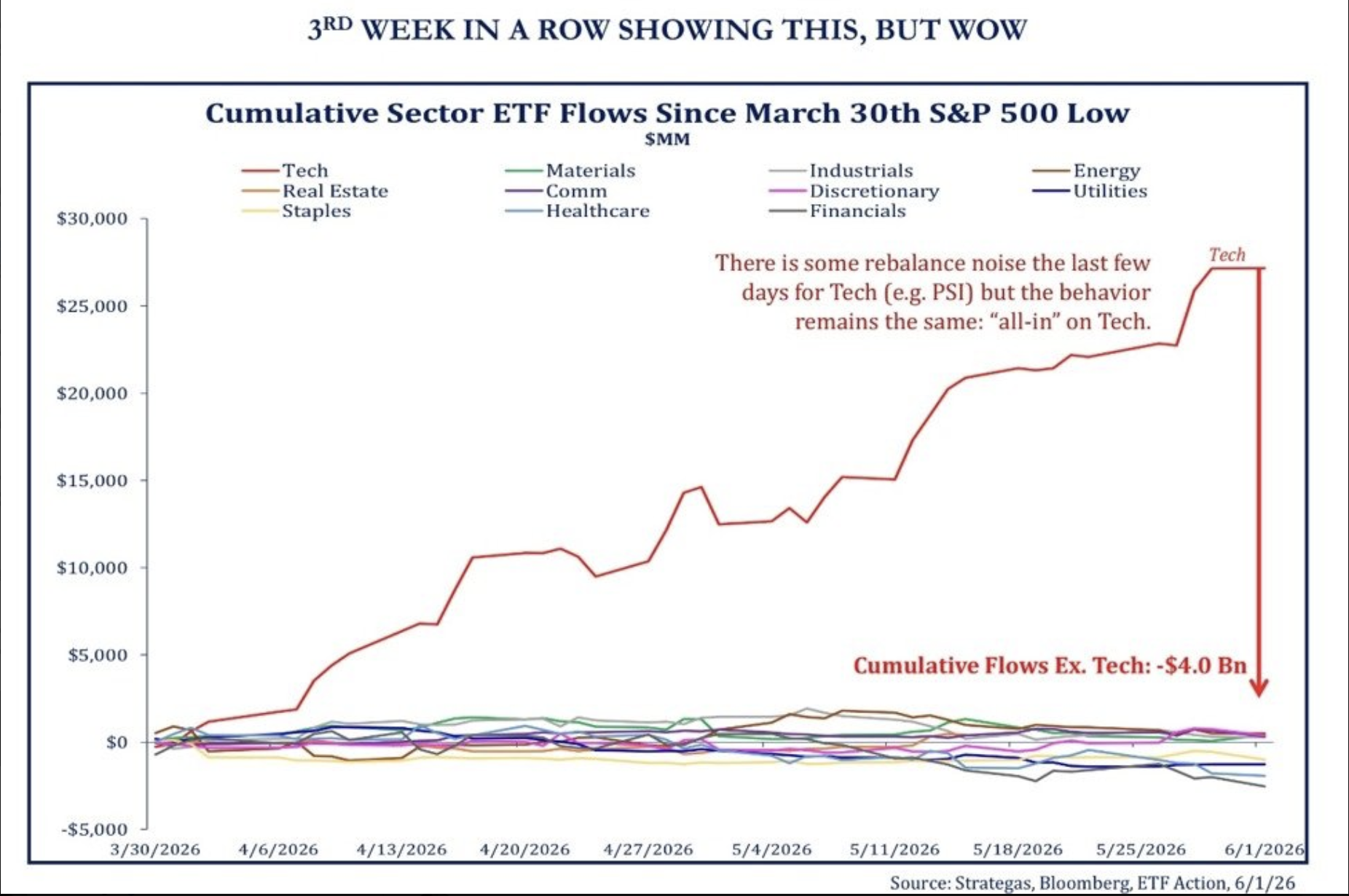
According to The Kobeissi Letter, since the S&P 500 index reached a phase low on March 30, the cumulative net inflow into U.S. technology sector ETFs has reached $27 billion, while net outflows from all other sectors combined during the same period total $4 billion, marking a historically extreme level of capital differentiation.
Ned Davis Research strategist Rob Anderson and BTIG analyst Jonathan Krinsky further pointed out that the proportion of S&P 500 component stocks outperforming the index has dropped to its third-lowest level since 1972, with index increases highly tied to a few leading AI stocks.
For investors, with AI-related assets continuously rising, the opportunity cost of holding Bitcoin is steadily increasing. For investors, as AI-related assets continue to rise, the opportunity cost of holding Bitcoin is steadily increasing.
Bitcoin finds itself in a rather awkward position, unable to outperform AI assets when rising, yet dropping even more when falling. Just last night, after high-level adjustments in the three major U.S. stock indices, Bitcoin's downward trend was noticeably amplified, with intraday declines exceeding 7% at one point.
The capital siphoning effect of the U.S. stock market is expected to strengthen further, as super unicorns SpaceX, OpenAI, and Anthropic successively advance IPOs, likely introducing nearly $4 trillion in market value to the public market; this capital feast is expected to initiate a new competition for capital, making it difficult for the cryptocurrency market to remain unaffected.
Key support levels under testing; Bitcoin may enter a turbulent summer
With capital continuing to flow out and market sentiment weak, Bitcoin's key support levels are facing a severe test, and price recovery in the short term still meets considerable resistance.
QCP Capital believes that soft spot demand, rising oil prices, higher real interest rates, and increasing macro uncertainty are collectively suppressing the performance of risk assets. The current market is more inclined to allocate downside protection tools rather than actively increase risk exposure. Investors are waiting for a clearer direction from the macro environment between the scenarios of "economic soft landing" and "high inflation, high interest rates, low liquidity." They expect Bitcoin's first major support range to be between $63,000 and $64,000. If this range is lost, the market will further focus on the $62,000 support level, followed by the psychologically significant $60,000 mark, and the next key defense line is around $58,000.
BIT holds a similar view, pointing out that Bitcoin is still in a correction cycle, with $63,445 being a key support level that needs to be closely monitored. If the price can stabilize in that area, this decline can still be seen as a phase correction within a bull market; if it effectively breaks down, it may enter a deeper adjustment and consolidation phase.
K33 Research head Vetle Lunde views Bitcoin's weakness as reflecting a reduction in institutional demand, substantial outflows from ETFs, and increasing fragility in the derivatives market. As funds chase AI stocks, external capital is unwilling to enter, and existing holders are reducing their exposure, the market may face a turbulent summer.
"The cryptocurrency market cycle is resetting." Wintermute believes that the market environment over the summer months appears relatively weak, but some long-term investors are beginning to increase their positions through over-the-counter trading platforms, as they do not want to precisely predict the bottom but find the current price levels attractive from an 18-month perspective.
CryptoQuant founder Ki Young Ju noted that while the current Bitcoin price is roughly equivalent to two years ago, the market structure has undergone significant changes. In this cycle, the group that entered the market between 6 months and 2 years ago currently accounts for 53% of realized market value, compared to only 15% two years ago. In the last cycle, when this group accounted for 68%, Bitcoin reached its bottom. Currently, short-term holders are gradually evolving into long-term holders.
Right now, Bitcoin faces not merely a price adjustment but a test concerning liquidity and market confidence.
免责声明:本文章仅代表作者个人观点,不代表本平台的立场和观点。本文章仅供信息分享,不构成对任何人的任何投资建议。用户与作者之间的任何争议,与本平台无关。如网页中刊载的文章或图片涉及侵权,请提供相关的权利证明和身份证明发送邮件到support@aicoin.com,本平台相关工作人员将会进行核查。


