The phrase "US Stocks on Chain" looks like a product name, but it actually resembles an entrance battle.
Written by: Liu Honglin
2026 will be a year when the lines between crypto finance and traditional finance become increasingly blurred, where you are in me, and I am in you.
Previously, exchanges loved to promote new coins, memes, new public chains, and contract competitions. Now, coming our way are Nvidia, Tesla, Apple, the S&P ETF, and a bunch of traditional finance packaged as stock tokens, perpetual stocks, and stock gateways.
Before, it was brokers wanting to learn from exchanges, understanding their 7x24 trading, account experience, and global customer acquisition. Now it's the exchanges learning from brokers. They are no longer satisfied with just allowing users to buy coins, but want users to view stocks, buy stocks, leverage stocks, and perform asset allocation with stocks, all within their own accounts.
This isn't because exchanges have suddenly fallen in love with traditional finance.
The phrase "US Stocks on Chain" looks like a product name, but it actually resembles an entrance battle. Whoever can bring the most consensual equity assets into stablecoins, wallets, contracts, lending, and multi-asset accounts has the opportunity to upgrade crypto accounts into the next generation of financial accounts.
The New Entrance Battle Has Begun
Exchanges are competing for the US stock on-chain track, the first reason being that user attention has changed.
In the past, the crypto market provided enough new narratives for users. From new public chains, DeFi, NFTs, memes, to various AI concept tokens, there has always been a group of people willing to stay at exchanges waiting for the next hundred-fold coin opportunity. However, in the last one or two years, the presence of US stock news has become increasingly strong on the screens of many ordinary players. Exchanges, of course, do not want to see this group of users change stablecoins back to fiat for buying US stocks, transfer their money to brokers, and shift their trading habits to another app. Once users leave, what returns is not just the principal problem, but also attention and account stickiness.
The second reason is that stablecoins have already paved the way for "on-chain dollar accounts."
If there were no stablecoins like USDT and USDC, trying to hard-sell on-chain US stock entrances would feel very awkward for crypto exchanges. Many users already use stablecoins for capital parking, and are accustomed to using a crypto account for cross-border transfers, spot trading, contract margin, and yield products. Once the US stock exposure is integrated, exchanges can tell users: there is no need to move the money away; you can see cash in USD, crypto assets, and US tech stocks all in the same account.
This is where exchanges find true excitement. Stocks themselves are not the end; once stocks are connected to accounts, there’s still margin, lending, portfolio strategies, yield tools, API access, and institutional liquidity to consider. A platform that only charges for crypto-to-crypto transactions finds it hard to compete with a multi-asset platform that covers stocks, ETFs, gold, government bonds, stablecoin yields, and contracts.
The third reason is that traditional financial infrastructure has also entered the game.
If only crypto exchanges shouted "US Stocks on Chain," it would still resemble internal industry competition. In January 2026, NYSE's parent company ICE announced the development of a tokenized securities platform, planning to support 24/7 trading of US-listed stocks and ETFs with instant settlement and stablecoin funding arrangements. In March 2026, Nasdaq also proposed a token equity scheme centered on issuers, emphasizing the integration of on-chain records with formal shareholder registration and corporate action systems.
This indicates that traditional exchanges, brokers, and infrastructures are also exploring how to move securities trading to a faster, longer-lasting, and more automated network. If crypto exchanges do not compete for this entry point now, users may later be attracted away by Robinhood, Nasdaq, NYSE, brokers, and banks using a more familiar and compliant approach.
According to CoinGecko’s 2026 RWA report, the market capitalization of tokenized stocks grew from $209 million on June 30, 2025, to $486.69 million on March 31, 2026; the trading volume of tokenized stocks in Q1 2026 reached $15.12 billion, surpassing that of $14.84 billion in the second half of 2025. This figure is still small compared to the traditional US stock market; the trading volume of tokenized stocks is still less than 1% of the traditional stock market. However, for exchanges, early market entry is necessary to grab the entrance.
Exchanges Blooming
Market demand exists, but the solutions vary.
In June 2025, Kraken phased the rollout of 60 tokenized US stocks and ETFs to qualified non-US customers through Backed’s xStocks. Kraken emphasizes "on-chain availability": these xStocks can be moved from the exchange to self-custody wallets, transferred on-chain, and enter subsequent DeFi scenarios. The key here is not whether AAPL, NVDA, or TSLA is displayed on the front end, but how the issuer Backed arranges the underlying stocks, custody, redemption, transfer, and geographic admission.
During the same period, Robinhood launched Stock Tokens for EU users, providing price exposure to over 200 US stocks and ETFs for eligible customers, while also announcing future development of a Robinhood Layer 2 based on Arbitrum. This approach resembles the on-chain transformation of a brokerage app: the user does not buy actual stocks, but rather derivative contracts that track prices and are recorded on-chain. In other words, it does not turn you into a shareholder of Apple or Nvidia, but allows you to gain related price exposure within Robinhood's legal structure.
Gate’s approach is more interesting as they have explored several formats simultaneously. In 2025, Gate launched an xStocks region, using Solana SPL or ERC-20 format stock-related tokens and contracts to service trading users. By June 1, 2026, Gate officially introduced stock trading services, specifically announcing that this is not the stock tokenization or RWA mapping commonly mentioned in the market, but by connecting with compliant brokers, allowing users to trade more than 10,000 US stocks and ETFs on the platform using USDT. In other words, Gate has moved from a stock token and contract region to walking towards a "broker entry in a crypto account."
MEXC followed the Ondo distribution route. In March 2026, MEXC announced a partnership with Ondo Finance to launch tokenized US stocks related to the defense and energy sectors; in April, it continued to launch multiple batches of Ondo tokenized stock trading pairs. The focus is not on designing an entire securities issuance structure but on integrating assets like Ondo Global Markets into exchange spot trading, market making, and perpetual products. Users see a trading pair at the front end, but in the background, it needs to be clear: is this a spot token, or a perpetual stock price? Is it holding an on-chain asset, or exposing a contract?
In March 2026, Coinbase launched perpetual contracts for US stocks for eligible users outside the US, settled in USDC, allowing users to trade synthetic exposure to US stock prices 24/7. The focus is not on "holding stock tokens," but on transforming US stock prices into contract varieties that can be leveraged, longed, shorted, or hedged. In the words of the exchange itself, this is an additional new variety that can be traded, leveraged, and incurs funding rates; in users' terms, you are betting on price direction, not obtaining shares in a listed company.
In May 2026, OKX announced that OKX CeDeFi supports over 260 tokenized US stocks provided by Ondo Finance. This line appears to embed on-chain assets into its capital and product system: users enter through OKX, the underlying assets come from Ondo, and it can interact with wallets, on-chain protocols, and stablecoin funding in the future. What exchanges do is provide entry points, experience, risk control, and liquidity packaging, while what truly determines investor rights remains the issuance documents and platform terms.
On June 1, 2026, Binance's announcement brought this competition to a climax. It announced the provision of trading access for over 7,000 US-listed stocks and ETFs to qualified users through Nest Trading Limited under the ADGM Abu Dhabi Global Market framework, with orders executed, cleared, settled, and custodied by Alpaca. At the same time, Binance hinted at the upcoming launch of bStocks. Here, there are two layers to consider: the currently announced access for trading US stocks and ETFs, and the future anticipated bStocks, which are the tokenized securities; Binance also clarified that bStocks are not the stocks themselves, and holders do not directly own the underlying shares of listed companies, with issuance pending approval from the ADGM Financial Services Regulatory Authority.
On June 2, 2026, Bitget launched Stocks 2.0, issued by Reality, emphasizing 1:1 economic mapping, dividend and corporate action handling, and integrating stock tokens into margin, strategy, and yield ecosystems. Bitget’s ambition is not just to allow users to "buy a stock token," but to turn stocks into financial components within the platform.
This image can be placed before this paragraph for a more intuitive view:
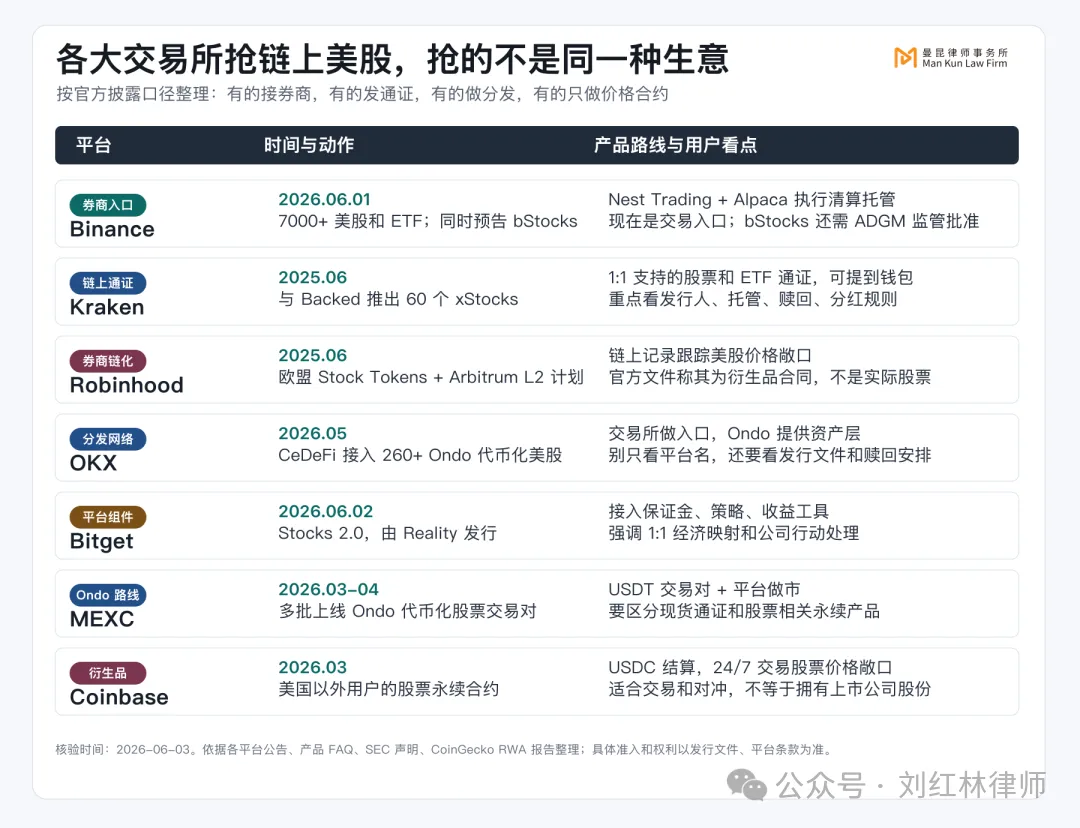
Horizontal comparison of the on-chain US stock product routes across major exchanges
I Know You Are Anxious, But Please Don’t Rush
On-chain US stocks have indeed made the experience smoother. Trading hours are longer, funding thresholds are lower, and settlement can be in stablecoins; some products can even be withdrawn to wallets, and might enter on-chain collateral, lending, or portfolio strategies in the future. When looking at the actions of the previous platforms together, ordinary users can easily be misled by the same name: since they are all called buying US stocks, and can use stablecoins for orders, the differences seem minimal.
But the outsiders see the commotion while the insiders see the profound details.
You need to clarify what exactly you are buying. Is it the stock itself, equity rights, structured certificates, derivative contracts, or perpetual contracts? Are there dividends or equivalent treatment? Who has the redemption rights? In cases of platform bankruptcy, issuer default, or custody institution issues, do you have claims on the underlying assets?
These answers are usually not found in the K-lines, but in issuance documents, risk disclosures, platform terms, FAQs, and applicable regional restrictions.
For example, Bybit's xStocks FAQ clearly states that Bybit is a secondary market, and users cannot redeem xStocks directly on Bybit; only clients who complete Backed identity verification and anti-money laundering processes may be able to redeem directly from Backed at net value. Bybit also explains that currently, xStocks do not allocate dividends to holders.
The issue of user identity is of course a sensitive one; expanding too much on it is indeed not very meaningful, but it is a matter that all friends cannot pretend does not exist. Platforms will typically exclude Americans, users within the US, individuals in sanctioned areas, and any users who do not meet admission requirements. Using a VPN, proxy identities, overseas phone numbers, or false documents to gain entry might allow trading in the short term, but once risk control, freezes, clearing, or disputes are triggered, defending one’s rights will be very difficult.
In February 2026, eight departments, including the People's Bank of China and the China Securities Regulatory Commission, released new documents regarding risks associated with virtual currencies and the tokenization of real-world assets, continuing to clarify that domestic businesses related to virtual currencies are subject to prohibitive policies and that the tokenization activities of real-world assets, intermediaries, and information technology services are brought under regulatory scrutiny. On May 22, 2026, the China Securities Regulatory Commission and eight other departments issued a comprehensive rectification plan targeting illegal cross-border securities, futures, and fund operating activities, focusing on combating the marketing and solicitation of foreign institutions, account opening, processing of trading instructions, and fund transfers within the domestic market.
Therefore, domestic users should not interpret "on-chain" as a new loophole to bypass cross-border securities, foreign exchange, virtual currency, and anti-money laundering regulations.
The pragmatic suggestion is: if you just want to long-term invest in the S&P ETF or several US tech stocks, using traditional licensed brokers, compliant funds, QDII, or other legal channels is often simpler. The value of on-chain US stocks mainly lies in their ability to integrate with stablecoins, wallets, cross-asset trading, collateralized lending, and strategy tools into the same system. Those who do not need these capabilities do not have to bear the additional risks of issuers, platforms, on-chain, stablecoin, and cross-border disputes just for a more convenient button.
For entrepreneurs, on-chain US stocks will certainly bring opportunities. However, the most dangerous direction is to help retail investors detour to buy US stocks.
If a team builds a channel for domestic users to do account opening, kickbacks, deposit tutorials, Chinese customer service, community investment advice, trading signals, or helps foreign platforms gain customers for US stock tokens in the domestic market, it would be hard to claim they are merely providing technical services. Changing the entry from brokerage apps to wallets, and settling from USD to stablecoins, does not change the potential risks of cross-border securities business, virtual currency trading services, or marketing leads they might participate in.
The more noteworthy businesses may still be the underlying ones. For instance, issuers need custody integration for underlying assets, proof of reserves, daily verifications, audit reports, handling of corporate actions, dividend tax processing, on-chain contract audits, and redemption processes. Trading platforms need identity verification, anti-money laundering measures, risk monitoring for on-chain transactions, sanctions list checks, regional restrictions, suitability management, price deviation monitoring, and dispute record-keeping. Wallets and on-chain protocols need to understand whether such assets can be transferred, used as collateral, how to handle suspensions, which prices to use for settlement, and how to map corporate actions to balances and prices. Providing corresponding solutions to these issues may sound less exciting, but is closer to long-term businesses and is also safer.
Conclusion
Crypto exchanges competing for the on-chain US stock arena appears on the surface to be a product line extension, but upon deeper examination, it is actually about redefining accounts.
Past crypto accounts primarily answered a very narrow question: what coin do you want to buy? Future trading accounts will answer a different question: can your USD, stocks, government bonds, gold, Bitcoin, Ethereum, stablecoin yields, and derivative exposures be managed within the same funding, risk control, and clearing system?
Once this question is answered, the role of exchanges will change.
They will not just be platforms for listing coins, matchmaking, executing contracts, and collecting fees, but will increasingly resemble a new generation of financial asset hybrids that includes brokers, custodians, clearing portals, wallets, banks, and asset management tools.
免责声明:本文章仅代表作者个人观点,不代表本平台的立场和观点。本文章仅供信息分享,不构成对任何人的任何投资建议。用户与作者之间的任何争议,与本平台无关。如网页中刊载的文章或图片涉及侵权,请提供相关的权利证明和身份证明发送邮件到support@aicoin.com,本平台相关工作人员将会进行核查。


