The strategy betting dispute has evolved from a single contract conflict into a collective inquiry into Polymarket's entire settlement system by the market.
Written by: Oluwapelumi Adejumo
Translated by: Saoirse, Foresight News
A nearly $150 million prediction market contract has fallen into chaos: the Polymarket platform refuses to pay rewards to traders who accurately predicted that Strategy would sell part of its Bitcoin. The core of this dispute lies in the misalignment between the actual time of the transaction and the official disclosure time, exposing fundamental institutional loopholes in how centralized prediction markets handle large contract settlements. Traders are caught in a tug-of-war over a rule detail, facing the risk of a total loss of millions of dollars in expected profits.
Previously, asset management company Strategy (formerly MicroStrategy), which held nearly $60 billion in Bitcoin assets, submitted an 8-K filing with regulators on June 1, confirming that the company sold 32 bitcoins between May 26 and May 31, amounting to approximately $2.5 million in market value. For participants in the Polymarket contract "Did Strategy sell Bitcoin before May 31?", this regulatory disclosure was supposed to be ironclad proof for a winning bet on "Yes," yet the current dispute resolution trend is heavily leaning toward the "No" camp.
After the contract deadline, the Polymarket operator added new rule clarifications: since the official disclosure of this sale occurred on June 1, exceeding the deadline, this transaction would not count as an effective basis for the contract's determination. The platform's sudden rule change has prompted numerous accusations of market manipulation, as the decentralized betting-like settlement mechanism faces intense scrutiny from the industry at a crucial moment for gaining a compliant traditional financial identity.
Complete Timeline of the Disputed Contract
This turmoil originates from the original contract provisions: the contract stipulates that before 11:59 PM EST on May 31, as long as Strategy actually sells any number of bitcoins, it will be determined as a win for "Yes"; the rules explicitly state that company public disclosure documents and on-chain data serve as the two main decision-making evidences.
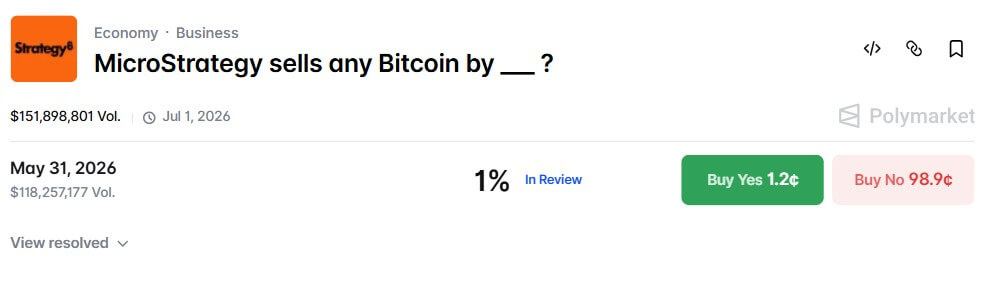
The contract regarding the disputed sale of Bitcoin by Strategy on Polymarket (Source: Polymarket)
When Strategy submitted its statutory disclosure document on June 1, the contract trading channel remained open. Multiple traders, upon seeing the disclosure information, noticed an arbitrage opportunity and quickly jumped in: user willo2 bet $527,000 all-in on "Yes," while the market odds still implied an 80% probability that there would be no sale; this trader originally expected to achieve a 20% arbitrage profit. However, with the large buy orders coming in, Polymarket later supplemented the rules, declaring that the disclosure date was too late to count as valid evidence, resulting in the user losing all their principal.
willo took to platform X to complain: "This limitation was never written in the contract rules, and the logic is completely nonsensical. Polymarket itself also did not follow this standard previously. If disclosure had to fit on May 31, the contract should have been stopped outright on May 31, yet trading continued normally afterward."
Industry analysts collectively criticized the platform's contradictory operational logic. Jeff Dorman, Chief Investment Officer of Arca Asset Management, pointed out a fatal flaw: if the contract rigidly required May 31 at midnight as the final cutoff, the platform should have directly halted trading at that time; instead, it allowed users to open positions normally on June 1, while later retroactively chasing the requirement for the disclosure time to align with the cutoff date, which essentially digs a pit for traders following the contract's literal regulations. Jonatan Pallesen, a data researcher deeply involved in decentralized projects, bluntly stated:
The platform's failure to explicitly mark hidden practices in advance and its later rule additions constitute implicit fraud; institutional players familiar with the platform's hidden rules exploit the regulatory vacuum to reap profits from ordinary retail investors, who assume "actual transactions mean payouts" but end up suffering losses.
UMA Oracle Hides Structural Flaws
The Strategy betting dispute has evolved from a single contract conflict into a collective inquiry into Polymarket
免责声明:本文章仅代表作者个人观点,不代表本平台的立场和观点。本文章仅供信息分享,不构成对任何人的任何投资建议。用户与作者之间的任何争议,与本平台无关。如网页中刊载的文章或图片涉及侵权,请提供相关的权利证明和身份证明发送邮件到support@aicoin.com,本平台相关工作人员将会进行核查。