Binance is growing into a new species
Written by: ChandlerZ, Foresight News
The New York Stock Exchange closes every day at four in the afternoon, which is five in the morning for a trader in Tokyo. When Nvidia releases its earnings report after hours, he wakes up to the news, but the market has already closed, and he must wait several more hours to act. Geopolitical conflicts erupted over the weekend, causing severe fluctuations in global asset prices, and he can only adjust his U.S. stock holdings when the market opens on Monday. This time misalignment is a friction faced by hundreds of millions of non-U.S. investors globally; no matter how well a brokerage app is designed, it cannot change the clock in New York.
The division of funds is another layer of more subtle friction. The same user has U.S. stocks with a broker, crypto assets on an exchange, and gold possibly on a third platform. Want to convert Nvidia's profits into Bitcoin? Sell the stock, wait for T+1 settlement, withdraw to the bank, transfer to a crypto exchange, and then buy BTC; the entire process may take two to three business days. There are walls separating assets by accounts, platforms, and settlement cycles.
Now, the same user opens the Binance app, buys NVDA perpetual contracts with USDT, and can trade 24/7, immediately reacting to breaking news at three in the morning. Want to switch exposure from U.S. stocks to BTC spot? Using the same account and the same funds, it can be done almost instantaneously.
In January 2026, Binance announced the launch of TradFi perpetual contracts, offering perpetual futures for traditional assets and supporting round-the-clock trading in traditional markets. By the third week of May, Binance's trading volume for perpetual contracts on traditional financial assets had reached $60.3 billion, accounting for 10.3% of the total trading volume on the platform. 51 traditional financial trading pairs contributed one-tenth of the trading volume among 627 trading pairs, with the trading volume of Brent crude oil perpetual contracts reaching 10.4% of the global equivalent futures market, and silver peaking at 11.5%.
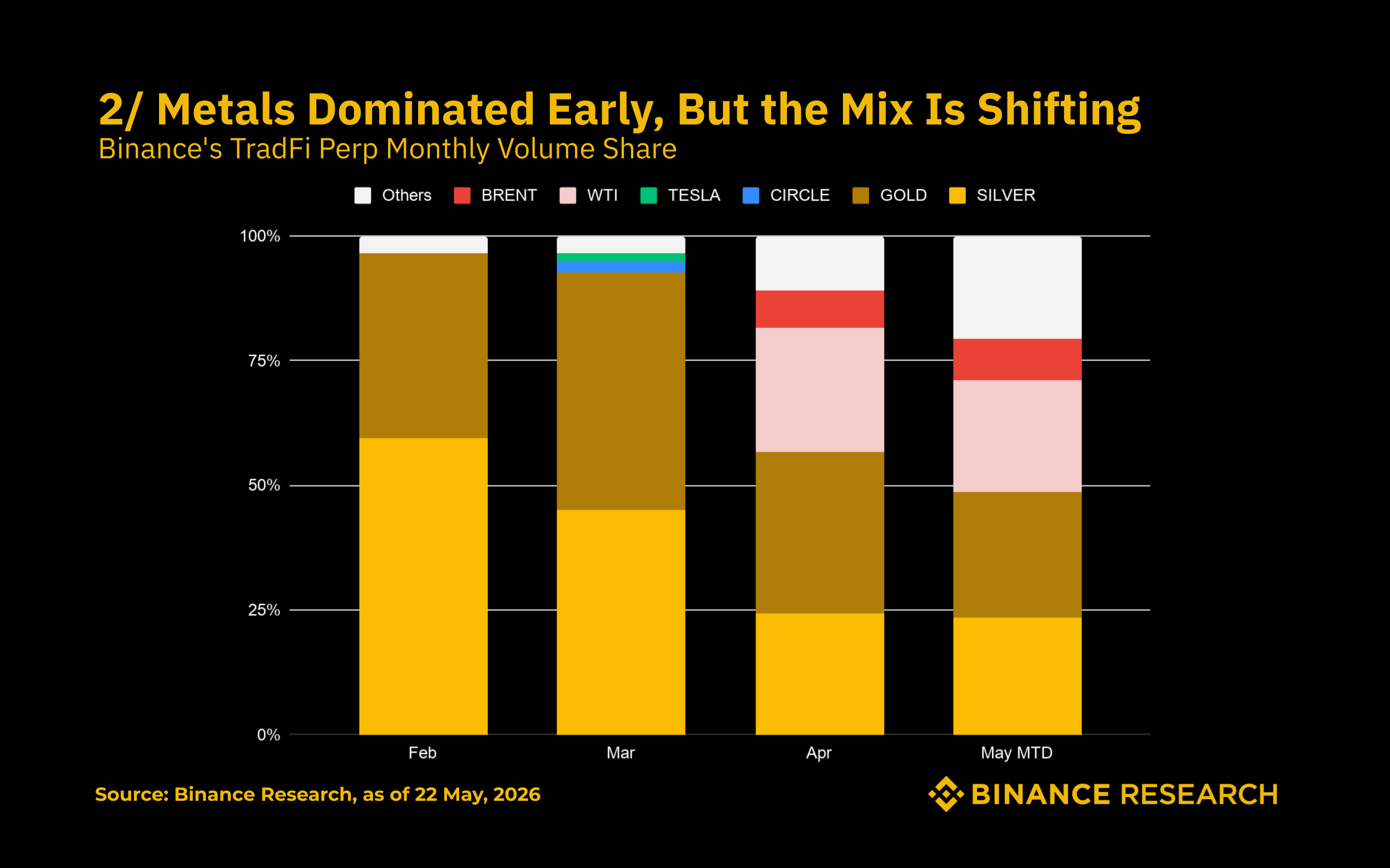
SpaceX Pre-IPO perpetual contracts went live for a week, accumulating a trading volume of $400 million, and Binance quickly captured 65% of the Pre-IPO perpetual contract market share.
What does it mean when crypto exchanges start providing U.S. stock products? Is it an overlap of functions or the birth of a new species?
Overflow of U.S. Stock Demand
The level of global investor thirst for U.S. stocks far exceeds most people’s intuition.
In May 2026, the total market capitalization of U.S. stocks broke $75 trillion for the first time, an increase of $3 trillion since the beginning of the year. The S&P 500 and Nasdaq both set historical highs on May 27. The S&P 500 has risen for nine consecutive weeks, with the Nasdaq reaching an 8% increase for the month of May. U.S. stocks account for nearly 50% of the total market capitalization of global stock markets, firmly maintaining the top position worldwide. The long-term performance of U.S. stocks not only significantly outperforms Europe and Japan but also far surpasses most emerging markets.
Thanks to the continuous profit growth of large tech giants led by the Mag 7, Nvidia's revenue for Q1 of fiscal year 2027 reached $81.6 billion, a year-on-year increase of 85%. The AI capital expenditure cycle has fully launched, with the seven major tech giants collectively budgeting capital expenditures of $680 billion to $725 billion in 2026, a step up from the $400 billion in 2025.
In specific sectors, May's U.S. stocks saw a comprehensive explosion. According to Dow Jones market data, the Philadelphia Semiconductor Index (SOX), known as the barometer of the global semiconductor industry, has soared 79.3% this year, with the memory chip sector being even crazier—SanDisk's annual increase has exceeded 4000%, and Micron Technology went from a $500 billion to a $1 trillion market cap in just 48 days; the U.S. space theme sector has attracted over $1.3 billion in new funding in the past month, with assets under management skyrocketing to $3.3 billion.
The profit growth of U.S. tech giants, the launch of the AI capital expenditure cycle, and the safe-haven characteristics of U.S. dollar assets are continuously attracting global funds to New York.
Data on fund flow directly verifies this attraction. In 2025, net inflows into U.S. equity ETFs exceeded $650 billion, with total inflows into the U.S. ETF market reaching a record $1.49 trillion. And this is just the appeal of listed assets; the combined market cap of SpaceX, OpenAI, and Anthropic alone exceeds $3.5 trillion, about to enter the public market. Each super IPO pushes the enthusiasm for global investors to participate in U.S. stocks.
But for a large number of non-U.S. investors, U.S. stocks are a visible but inaccessible market. Among almost 6 billion adults worldwide, fewer than 1 billion have securities accounts, and the number of users who can conveniently trade U.S. stocks is significantly lower due to hurdles in account qualifications, funding channels, and trading experiences.
Since the second half of 2025, this supply-demand mismatch has intensified. Some cross-border brokerage channels in the Asia-Pacific region have tightened, forcing existing users to seek alternatives. The affected users are widespread, from Southeast Asia to East Asia, including retail investors to moderately sized active traders. These traders already have experience trading U.S. stocks, understand the products, and demand execution quality, with many holding positions in U.S. technology stocks and ETFs. What they need is not an "available" alternative, but a "usable" one.
In fact, the core demands of these users can be broken down into three points: the security of funds, trading liquidity, and product richness. These three demands naturally point towards an existing platform that already has a large user base and deep liquidity—an entry point that does not need to build trust from scratch.
Binance's U.S. Stock Product Matrix
Breaking down the U.S. stock-related products that Binance currently offers reveals a clear layered structure.
The first layer is perpetual contracts. This is the most extensive entry point with the most active trading volume. There are 39 U.S. individual stock perpetual contracts, plus four ETFs: SPY, QQQ, IBIT, GLD, along with Pre-IPO index contracts and SpaceX contracts. Synthetic derivatives that do not hold underlying stocks provide pure directional exposure. Settled in USDT, with a maximum leverage of 20 times, and available for trading 24/7.
The significance of perpetual contracts is that they lower the threshold for trading U.S. stocks to the minimum. Users do not need U.S. dollars, do not need a brokerage account, and do not have to wait for the New York opening—they can trade Nvidia, Tesla, and Apple using the USDT they already have. For those who only wish to gain directional exposure to U.S. stocks, this is the lowest-cost, shortest path option.
The explosive growth of Pre-IPO contracts is also noteworthy. Binance launched the SpaceX Pre-IPO perpetual contract on May 21; prior to its launch, other platforms had an average daily trading volume of only $20 million, but within days of Binance entering, it captured 65% of the market share. By May 27, the cumulative trading volume reached $400 million, with daily trades exceeding $100 million on four separate days. After the launch of the OpenAI Pre-IPO perpetual contract, 85% of the total market trading volume occurred on Binance, with $53 million traded in the first two days.
The second layer is tokenized securities. Through Binance Alpha and Binance Wallet, Binance has integrated tokenized U.S. stocks and ETFs provided by Ondo Global Markets. Unlike perpetual contracts, tokenized securities have on-chain tokens that correspond to real underlying stocks; they can be self-custodied and used in DeFi protocols. This represents a mode of distribution that involves third-party issuance and Binance distribution.
Tokenized securities cater to another type of demand; users want to genuinely "hold" U.S. stock assets on-chain, wish to place them in their own wallets, and want to use them for collateral, combinations, and cross-protocol asset allocation. These users are more mature, with a clear preference for asset programmability and self-custody. One example that has already been implemented is that Ondo's tokenized U.S. stocks, after being integrated with Chainlink price feeds, can be used as collateral in DeFi lending protocols such as Euler Finance. Users hold tokenized S&P ETF exposure while lending out USDT for other operations. In the traditional brokerage system, the stock pledge financing process is measured in days, whereas on-chain, this operation can be completed in minutes.
The third layer is real stock trading. On June 1, Binance launched zero-commission trading for over 7,000 U.S. stocks and ETFs for non-U.S. users, with trading available five days a week, 24 hours a day. In terms of payment, users primarily use USDC for stock purchases; it also supports BNB, USDT, U, and USD1, with orders automatically converted to USDC for transaction completion, and the proceeds from stock sales will also be returned to the user's funds account in USDC. Beyond zero commission, Binance has launched a limited-time discount event for stock and ETF trading fees, which will reduce the spread for orders exceeding $350 from 0.10% to 0.05% from June 3, 20:00 until July 1, 2026, 7:59.
For the first time, a crypto exchange provides a stock holding experience that is completely equivalent to that of traditional brokerages while retaining the convenience of a crypto platform. Users do not need to open a separate brokerage account, do not need to hold U.S. dollars, and can purchase real Apple, Nvidia, and Tesla stocks using crypto assets. The coverage depth of 7,000+ targets also exceeds that of most cross-border brokerages aimed at non-U.S. users.
Building on this, Binance is about to launch tokenized stocks, bStocks, allowing users to convert real stocks they hold into on-chain tokens on BNB Chain, retaining their equity while gaining programmability and composability for on-chain assets. The announcement clearly defines bStocks as "certificates representing specific financial instruments," noting that bStocks holders do not directly own the equity of the underlying listed companies.
These layers of products form a complete spectrum of demand. Users looking to speculate can use perpetual contracts, which have the lowest threshold and flexible leverage. Users wanting to hold on-chain and create DeFi combinations can use Ondo tokenized securities; those wishing for actual stock trading now have a new option. From speculation to holding, from synthetic exposure to real equity, users at different levels can find an entry point that suits them.
The expansion of the product matrix is still ongoing, and based on Binance's current roadmap and industry trends, the combinations of derivative tools, more asset coverage, and deeper stock channels will become more diverse in the future. This multi-layered product architecture is something traditional brokerages find challenging to replicate within a single service system.
Why Binance
Many participants are laying out U.S. stock products within crypto exchanges. Bitget was early in non-crypto asset trading, Bybit and Coinbase are discussing joint distribution of tokenized U.S. stocks, and Backpack is partnering with Superstate to issue SEC registered on-chain equities. The question is, in an overcrowded field, why is Binance's position different?
As of the end of 2025, Binance's global registered users have surpassed 300 million, covering more than 180 countries and regions, meaning there is one Binance user for every 27 people globally. This user base directly determines the depth of liquidity. Binance has long held the top position globally in CEX trading volume, with smaller spreads and lower slippage, resulting in lower impact costs for large trades. For users transitioning from traditional finance, trading costs and execution quality are the most sensitive indicators. They have become accustomed to the depth of the Nasdaq and will immediately feel the difference when faced with insufficient liquidity on crypto platforms.
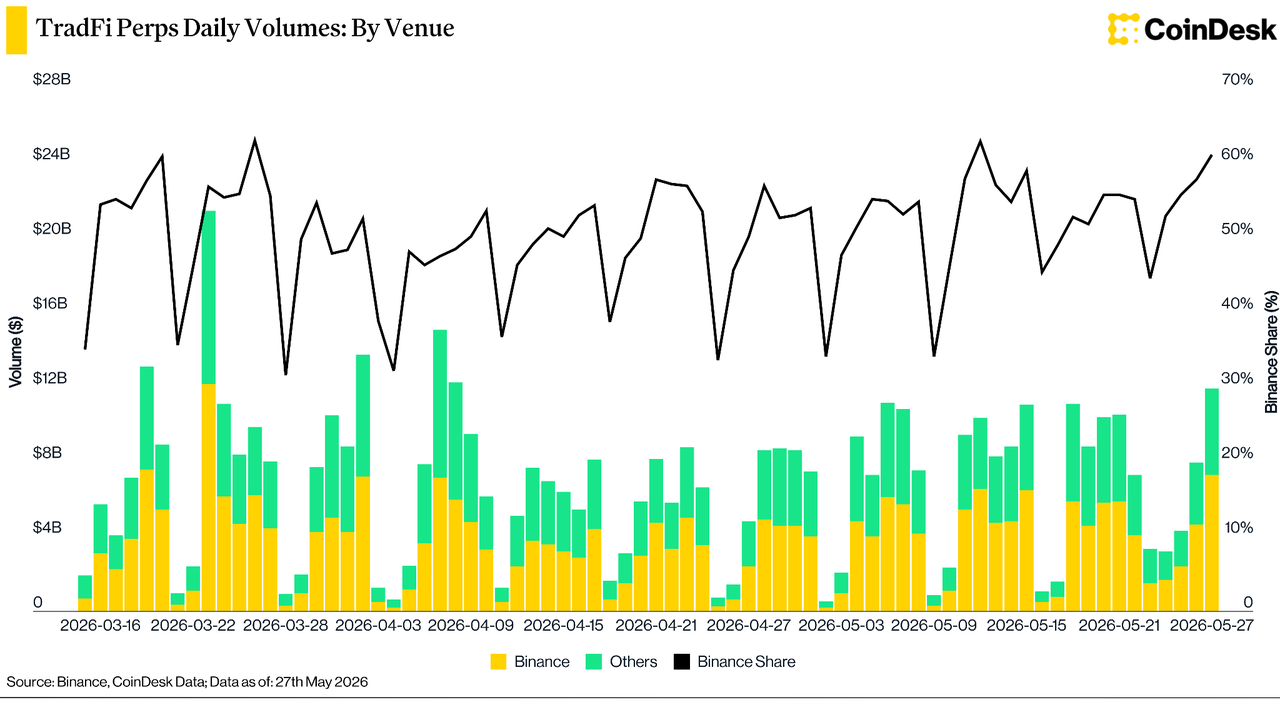
This existing advantage is clearly reflected in the U.S. stock product line. According to CoinDesk data, over the past two months, the average daily scale of the TradFi perpetual contract market has been around $7 billion, with Binance alone capturing 45% to 60% market share, and over 60% in the commodities sector. In the Pre-IPO perpetual contract space, Binance gained 65% of the market share within days of launching. New product categories do not require customer acquisition from scratch; a significant proportion of the 300 million users have a natural demand for exposure to U.S. stocks, and funds have already accumulated in the form of USDT on the platform, so there are ready buyers and sellers as soon as the product is launched. Traditional brokerages must start building a user pool from scratch whenever they enter a new market; Binance only needs to add an entry in the existing users' app.
In the first five days after the launch of the SpaceX perpetual contract, it recorded a trading volume of $280 million, SNDK saw a single-day volume of $500 million, and MU reached $391 million. New product categories do not require customer acquisition from scratch; a significant proportion of the 300 million users have a natural demand for exposure to U.S. stocks, and funds have already accumulated in the form of USDT on the platform, so there are ready buyers and sellers as soon as the product is launched. Traditional brokerages must start building a user pool from scratch whenever they enter a new market; Binance only needs to add an entry in the existing users' app.
On a technical architecture level, the matching engine, clearing and settlement system, wallet infrastructure, and risk control models of crypto exchanges can be directly reused for traditional asset trading; the underlying logic of handling BTC/USDT and NVDA/USDT is the same, so the marginal cost of expanding new product categories is very low. In contrast, Wall Street is pursuing an acquisition route to enter the Pre-IPO and tokenization space: Charles Schwab spent $660 million to acquire Forge Global for a private equity trading platform, and Morgan Stanley spent $350 to $450 million to acquire EquityZen. Crypto platforms can expand categories using the same engine, while traditional finance must spend billions on acquisitions to fill capability gaps, highlighting the stark differences in path costs.
Meanwhile, Binance has made the largest compliance investments in the crypto industry in the past two years, with operational licenses in multiple jurisdictions, ongoing dialogues with regulators, and transparent disclosures of the Security Asset Fund for Users (SAFU). In December 2025, Binance announced it received complete regulatory authorization from the Abu Dhabi Global Market (ADGM) Financial Services Regulatory Authority (FSRA), becoming the first crypto exchange to obtain a global license under the ADGM framework. In January 2026, Binance submitted an MiCA license application in Greece to advance its compliance expansion in the European Union. SB Seker, Binance's Head of Asia-Pacific, stated in March that Binance plans to obtain five new licenses in Asia within 2026, increasing the number of licensed jurisdictions globally to over 20. According to publicly disclosed reserve proof data, Binance holds approximately $150 billion in user assets, about 8.2 times that of the second-ranked trading platform.
In 2025, the platform's institutional trading volume increased by 21% year-on-year, while OTC fiat trading volumes surged by 210%. The choice of institutional fund flow itself is an indicator of security; when the most cautious fiduciaries choose to place their money on one platform, it provides trust backing that is more effective than any advertisement for new users entering the market.
User base, liquidity depth, infrastructural reuse capabilities, and compliance investment all support each other to create positive feedback. Each new product line reinforces this cycle. The nature of a flywheel is that the faster it turns, the harder it is for newcomers to catch up. In today's highly mature competitive landscape of the crypto industry, the moat effect of this first-mover advantage will become increasingly prominent.
The Super Gateway to the New Financial World
Crypto exchanges engaging in U.S. stocks may seem like a horizontal expansion of product lines at first glance. From another perspective, this is the formation of a new type of financial access.
The service architecture of traditional finance is categorized by asset classes: stocks are found with brokerages, futures with futures companies, crypto assets with crypto exchanges, and forex with forex brokers. If users wish to switch between different asset classes, they must jump between different platforms. Different accounts, different pools of funds, different KYC processes, and different trading interfaces. Each jump is friction; friction consumes time, depletes the efficiency of funds, and erodes the user experience.
Binance's answer is to consolidate crypto assets, U.S. stock exposure, tokenized securities, and derivatives into the same entry point. Users can circulate between different asset classes using the same account and pool of funds. Trade BTC spot in the morning, go long on Nvidia perpetual contracts in the afternoon, and buy tokenized S&P ETF exposure in the evening—all done without needing to withdraw, exchange currency, or switch platforms in between. Funds flow within a single system, minimizing friction.
Binance has added 100 million users in just 18 months, with a peak of 180,000 new users in a single day. This growth means that for many users, their first point of contact with financial markets is through a crypto exchange; they have no path dependency on traditional brokerage account openings, T+1 settlements, or trading time limitations. For these users, the ability to buy BTC and NVDA on Binance seems completely natural, and the classification of "exchange" and "broker" never existed from the start. Their mental model contains only one concept: access. Wherever the access point covers all their investment needs, that’s where they will stay.
Six months ago, Binance's TradFi perpetual contract trading volume was zero. Today, it holds over 45% market share in this category, over 65% in the Pre-IPO realm, and has launched spot trading for over 7,000 real U.S. stocks and ETFs. From zero to dominance, it took less than six months. The cross-asset service system that traditional finance took decades to build is being reassembled by a crypto-native platform at a completely different speed.
This speed itself is the answer: Binance has grown into a new species.
免责声明:本文章仅代表作者个人观点,不代表本平台的立场和观点。本文章仅供信息分享,不构成对任何人的任何投资建议。用户与作者之间的任何争议,与本平台无关。如网页中刊载的文章或图片涉及侵权,请提供相关的权利证明和身份证明发送邮件到support@aicoin.com,本平台相关工作人员将会进行核查。