Written by: Hunter Killer (@memekiller365)
Formerly from one of the Big Four accounting firms, with extensive experience in real estate private equity. Currently focused on cross-market investment research in the U.S. stock market, Hong Kong stocks, A-shares, and the cryptocurrency market, specializing in uncovering asymmetric opportunities from a fundamental perspective.
On May 22, 2026, CIBC Capital Markets upgraded BlackBerry (NYSE: BB) from neutral to outperform, raising the target price from $6 to $8.5. On that day, BB surged 18%, with trading volume three times the daily average. By June 2, the BB stock price had already exceeded $11.
On April 21, when I first publicly recommended BB on X, many people's first reaction was: Isn't BlackBerry already dead?
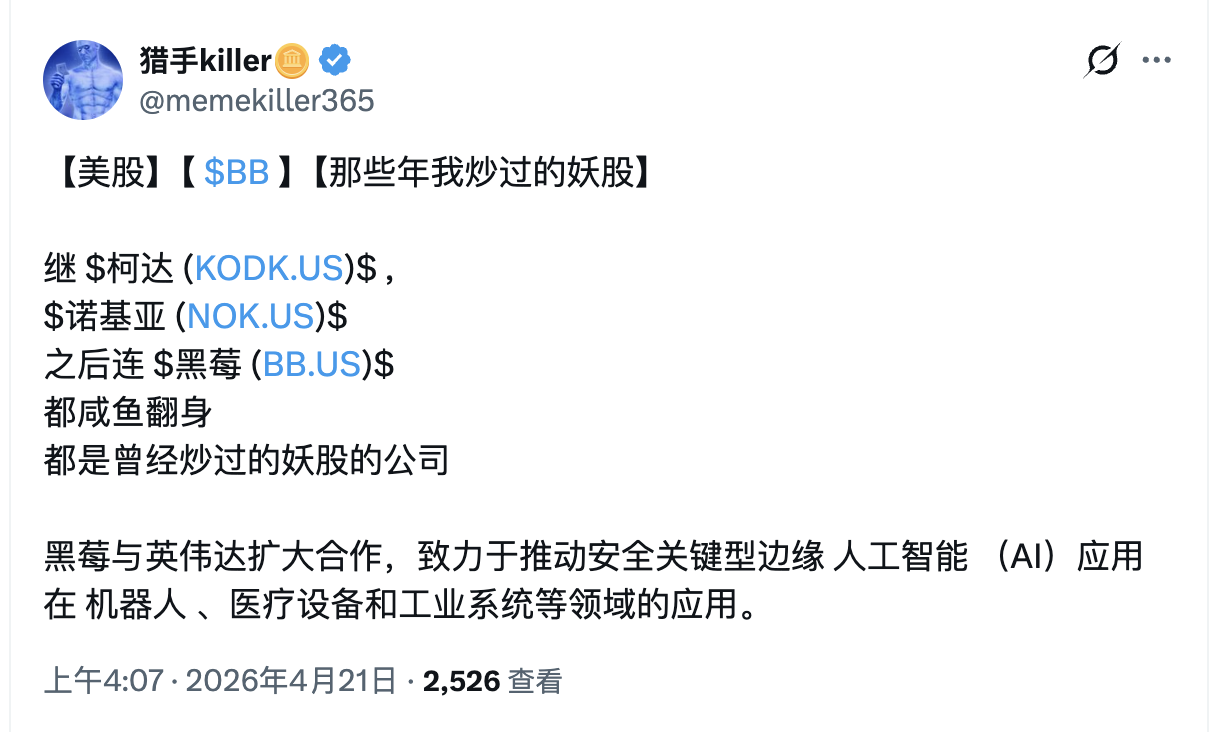
This reaction itself is the reason for this article's existence. The market is pricing an AI security infrastructure company using the framework of a "dead phone company." The gap between these two frameworks represents all of BB's opportunities and all of its risks.
Real Death and Rebirth
The most widely known story of BlackBerry occurred between 2007 and 2013. The iPhone was released, Android rose, and the iconic physical keyboard was completely abandoned by the market. The pain was real. In June 2008, BlackBerry (then called RIM) reached its historical peak stock price of $147.55, with a market cap of about $75 billion. Five years later, in 2013, the stock price dropped to single digits, and the market cap evaporated by more than 90%.
In the fall of 2013, Canadian investment giant Fairfax Financial proposed to take BlackBerry private at a price of $9 per share, at a total price of $4.7 billion. This was a typical attempted distressed acquisition. However, Fairfax ultimately couldn't even come up with the financing, and the privatization fell through. After the failed deal, CEO Thorsten Heins stepped down, and Fairfax instead led a $1 billion cash infusion to keep the company alive.
The new CEO brought in by Fairfax was John Chen, who had worked at Sybase for twelve years and turned a dying database company into one that was acquired by SAP for $5.8 billion. After taking office, Chen did something that no one understood at the time: he did not attempt to save the phone business but instead placed all bets on two departments that ordinary consumers had never heard of, QNX real-time operating system and secure communication.
In 2016, BlackBerry officially closed its hardware department and outsourced phone production to TCL. The external view was that this was a death announcement. But internally, this was a desperate measure for survival, and from then on, every dollar of revenue for BlackBerry came from software and licensing.
Then, BlackBerry disappeared from everyone’s sight for a decade.
QNX: You may not have heard of it, but you rely on it every day
QNX is a leading hard real-time operating system (Hard RTOS) worldwide. The most direct way to understand it: a car equipped with an autonomous driving system must perceive, judge, and brake within 0.001 seconds while traveling at 120 km/h on the highway, ensuring that every command is executed accurately within the given time without any delays, and this layer of assurance is what QNX provides.
QNX has taken a completely opposite path from the Linux operating system that most people are familiar with. Linux is open, flexible, and free, making it the mainstream choice for car cockpit screens and navigation systems. QNX, on the other hand, is closed, controllable, and verifiable. This closure is a disadvantage in consumer electronics but is a core asset in the world of security certification. Certification agencies require that code paths be completely traceable and not externally modified; Linux's open kernel means any third-party code can intervene, which is a nightmare in security audits. QNX sells an "already proven safe system," rather than a "theoretically could become safe system."
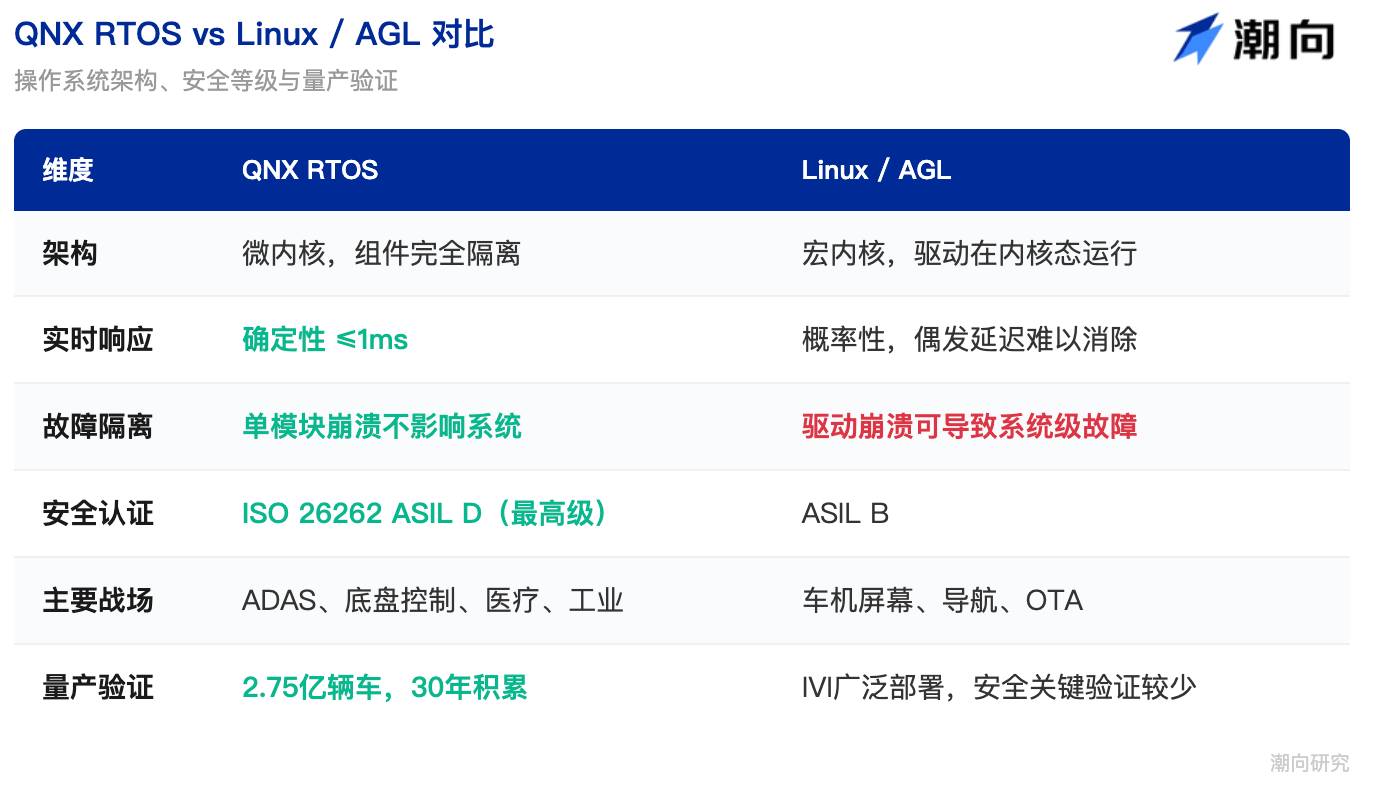
It is very common for both QNX and Linux to run in a modern car. QNX manages the braking and ADAS at the base level, while Linux runs navigation and streaming on the central screen. Each takes care of its own tasks.
QNX's real competitors are not in the Linux camp but several RTOS vendors in the same field. In April 2026, ABI Research published a ranking of functional safety RTOS, where QNX ranked first overall, followed closely by Wind River’s VxWorks due to its deployment scale and mature hardware support. Green Hills Software's INTEGRITY is known for safety isolation capabilities, and SYSGO’s PikeOS takes the mixed-criticality design approach. In the automotive safety-critical systems niche market, QNX holds a market share of about 35% to 38%, with VxWorks and INTEGRITY being the two main competitors.
However, QNX has two moats that competitors find difficult to replicate: the production validation records of 275 million vehicles can only be accrued over time and cannot be purchased; 24 out of the top 25 electric vehicle OEMs worldwide have already chosen QNX. This customer retention means that even if newcomers technically catch up, it is very difficult to break into the existing market.
NVIDIA is here, and the valuation story has changed
If QNX were just a steadily growing automotive OS business, the market would have a fixed valuation algorithm: traditional embedded software, 6 to 8 times PS, reasonable. But starting in 2026, a new variable entered the equation.
NVIDIA's IGX Thor chip is being deployed in factory robots, surgical equipment, and autonomous vehicles, responsible for AI inference, helping machines figure out what to do. But after figuring it out, a layer of system is needed to ensure that these decisions are executed safely and deterministically. NVIDIA chose QNX.
On April 20, 2026, BlackBerry announced that QNX OS for Safety 8.0 had achieved OS-level technical integration with NVIDIA IGX Thor and Halos Safety Stack for regulated industries such as robotics, medical devices, and industrial automation. Upon this announcement, the BB stock price rose about 13% to 14% that day.
It is important to differentiate: the relationship between NVIDIA and BlackBerry is that of a technical integration partner, while its relationship with Nokia involves a $1 billion strategic equity investment. The former is "I choose you as a partner," while the latter is "I buy your stock." The levels are different. BB’s position in the NVIDIA ecosystem is real, but technical collaboration should not be equated with capital endorsement; the signal strength of both is different.
That said, the concept of "Physical AI" itself also needs to be examined. It is currently more of a positioning language used by NVIDIA and QNX officials; true large-scale physical AI deployment (full factory automation, mass production of L4 and above autonomous driving) is still in its early stages. QNX's positioning in this direction is real, but the timeframe from positioning to revenue realization is lengthy, entailing OEM purchase cycles and regulatory certifications.
This allows QNX to potentially upgrade from an automotive OS supplier to a broader AI security infrastructure supplier. When the valuation framework changes, the multiples change: automotive OS at 6-8x PS, AI infrastructure at 15-20x PS. The same revenue could be valued two to three times differently.
Alloy Kore: From selling components to selling integrated solutions
At CES in January 2026, QNX and German automotive software giant Vector jointly launched Alloy Kore, winning the CES Best Development Tool Award.
The logic is straightforward: OEMs previously needed to individually purchase QNX, separately acquire Vector middleware, hire engineers to assemble, and conduct certifications themselves, taking 2 to 3 years and costing tens of millions of dollars. Alloy Kore packages QNX safety OS and Vector functional safety middleware into a pre-integrated, pre-certified solution, compressing the development cycle from 3 years to a few months.
The commercial significance can be summarized in one number: the ASP per vehicle jumps from $8 to over $30 to $50, a 4 to 6 times price increase without needing a new customer.
Timeline of progress:
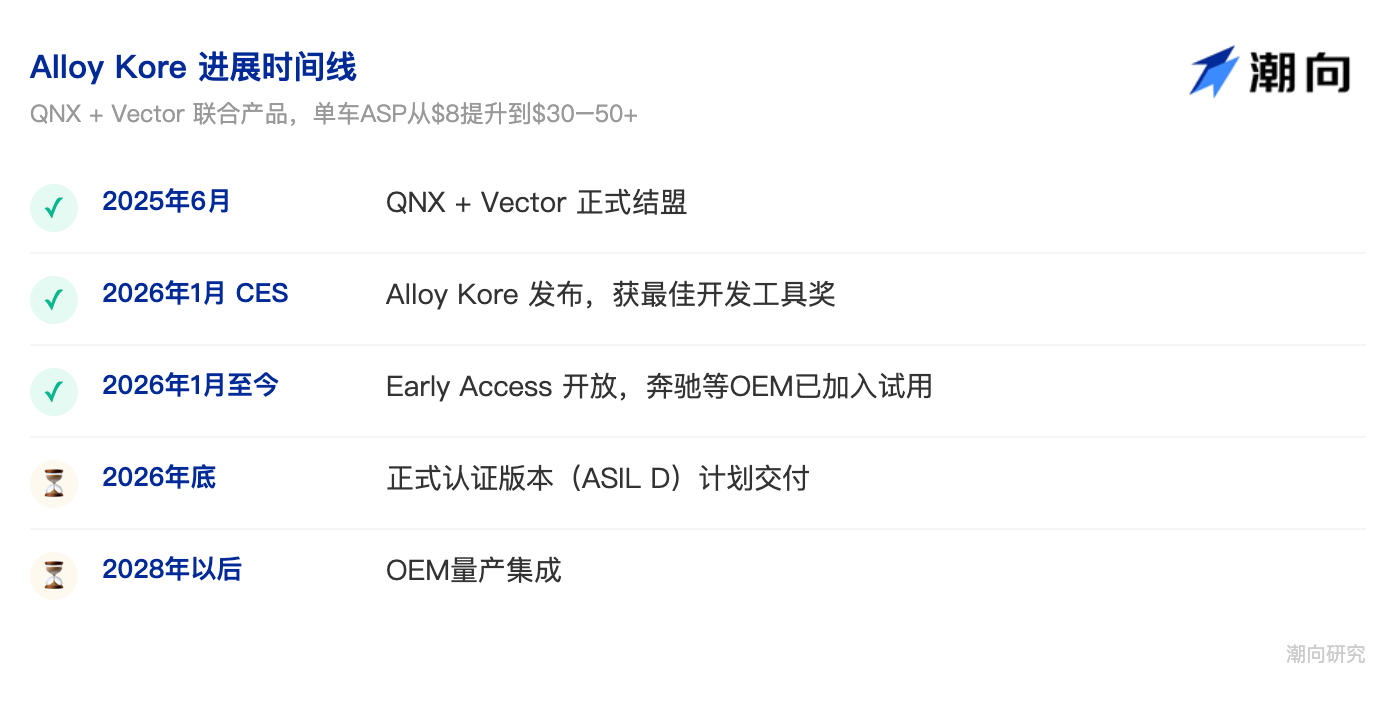
It must be clarified: Mercedes is currently a trial customer, not a signed customer. One of the key signals in the financial report on June 25 is whether there will be any OEMs upgrading from Early Access to formal design wins.
What do the numbers say?
BlackBerry FY2026 (for the year ending February 2026) core data:
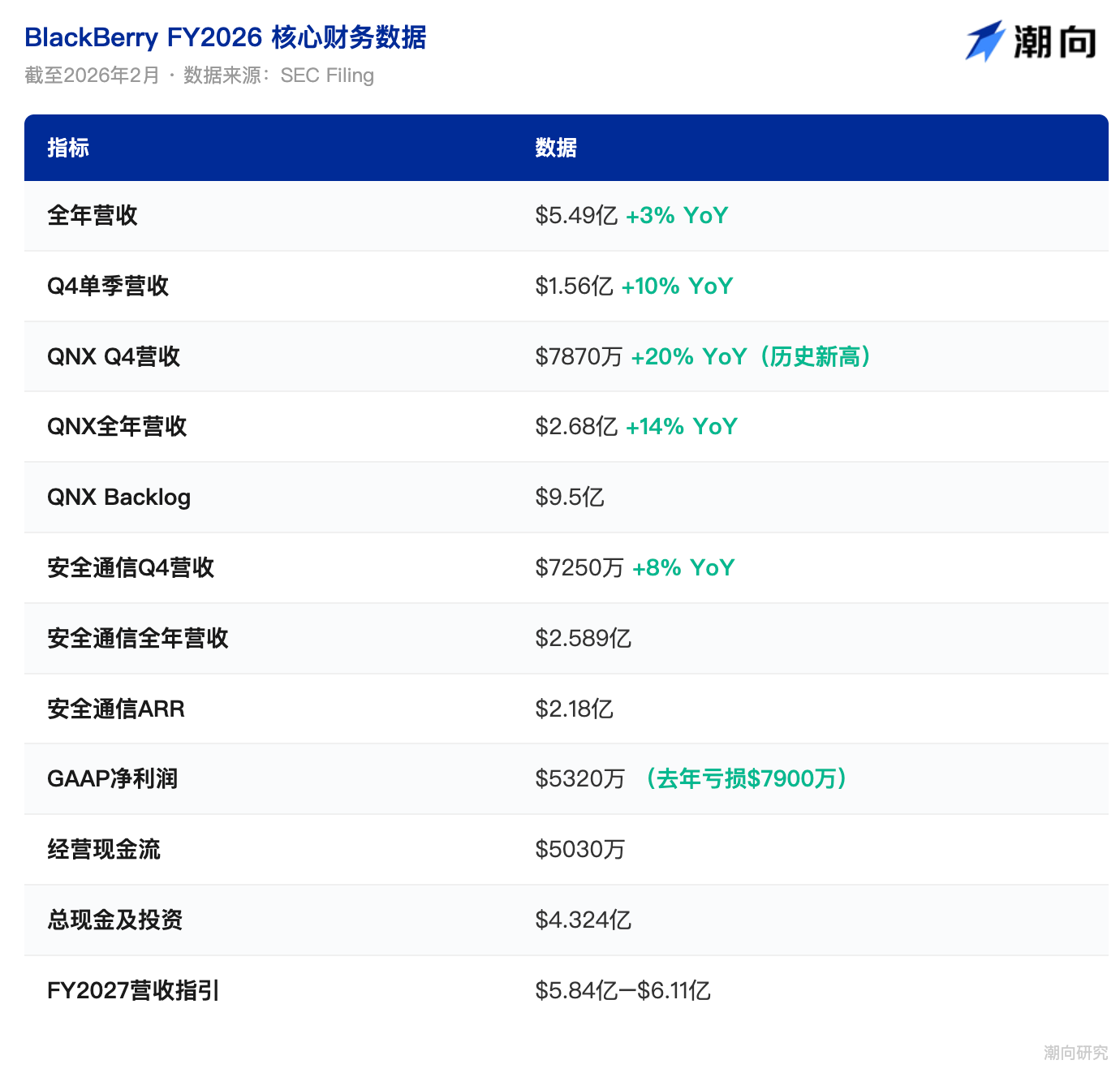
Several numbers are worth highlighting.
QNX revenue increased by +20%, reaching a record high, with a backlog of $950 million. This is hard data, a 14% annual growth rate is quite healthy for an embedded OS.
Secure communication is BlackBerry's other leg, accounting for nearly half of revenue, but has been shrinking over the past few years. This business was originally part of the endpoint security platform Cylance, acquired for $1.4 billion in 2019. Cylance continued to suffer losses under pressure from CrowdStrike and Palo Alto Networks, and BlackBerry ultimately sold it for $160 million to Arctic Wolf in early 2025, buying at $1.4 billion and selling at $160 million. This transaction was the most painful lesson in the John Chen era. The silver lining is that after shedding Cylance, the remaining secure communication business (AtHoc emergency management platform, SecuSUITE government encrypted communication) has begun to stabilize, with Q4 revenue growing by 8% year-on-year, and AtHoc achieving the highest level of FedRAMP certification, being the only emergency management cloud platform that reaches this safety level for the U.S. government. However, the DBNRR is only 94%, indicating that existing customers are still slightly declining.
EPS turned positive from a loss, improving for eight consecutive quarters. Management renewed the NCIB stock buyback plan on May 8, authorizing the repurchase of up to 26.8 million shares. In FY2026, 18.1 million shares were repurchased at an average cost of $3.85. Now, with the stock price above $9 and continuing to buy back, this tells the market with real money that management believes the stock is undervalued.
Can BlackBerry replicate Nokia's journey?
Nokia (NOK) is a useful reference. Both are "dead phone companies," both completed a transformation into infrastructure, and both established deep relationships with NVIDIA. NOK rose from a low of about $6.8 in 2025 to over $14 in 2026, more than doubling.
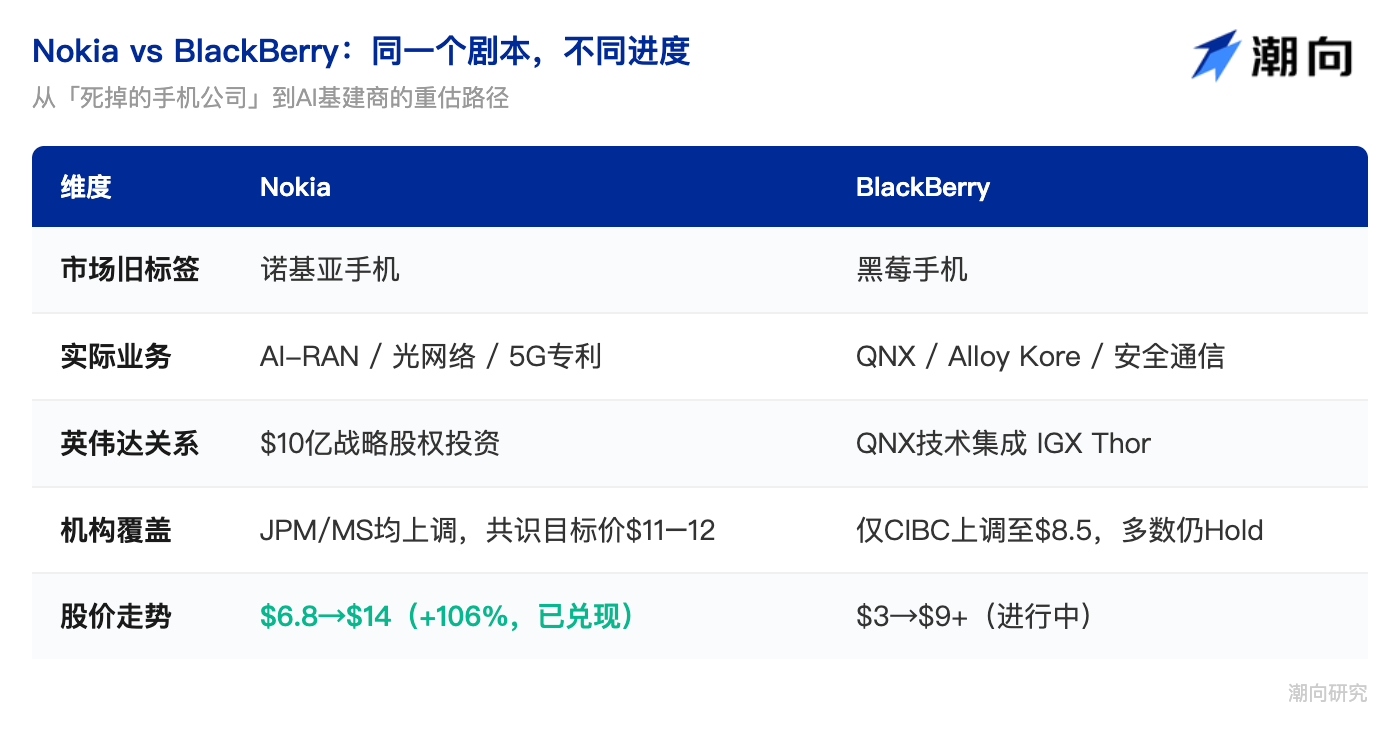
However, the differences between the two are equally important. NVIDIA made a real monetary equity investment in Nokia (about $1 billion, holding approximately 2.9%), whereas the relationship with BlackBerry is a technical collaboration. Nokia's AI-RAN ecosystem has operator and hardware partners like T-Mobile and Dell already conducting Field Trials, while QNX is still in the earlier Expo demonstration phase of physical AI. Nokia's institutional coverage is far more comprehensive than BlackBerry's, which is both a gap and a potential opportunity: if more sell-side analysts begin to cover BB, there is significant room for upward revisions of consensus price targets.
From BANG to fundamentals: a chapter of stock culture that should not be ignored
Many people first heard about BlackBerry stock, and it had nothing to do with QNX or John Chen. What attracted them were the four letters: BANG.
In January 2021, retail investors from WallStreetBets launched a squeeze that went down in history on Wall Street, with GameStop soaring from $20 to $483. In the wake of this war, a batch of stocks that were similarly heavily shorted by institutions and carried brand memories were packaged into an acronym, BANG: BlackBerry, AMC, Nokia, GameStop. Four stocks, four "dead old brands," four containers of retail collective memory.
BB surged from $5 to $25 in that rally, then fell back. AMC shot up from $2 to $72, then fell back. That round was purely emotional, with no fundamentals underneath.
But five years have passed, and the four BANG brothers have taken vastly different paths.
AMC and GameStop are still trapped in the meme stock cycle, being lifted intermittently by tweets or memes and then crashing back down, with no substantial change in company fundamentals. Nokia and BlackBerry, on the other hand, have quietly undergone rebirths. NOK has risen from $6.8 to $14, relying on AI-RAN and NVIDIA's $1 billion equity investment, with both JPMorgan and Morgan Stanley having upgraded their ratings. BB rose from $3 to $9+, driven by record high QNX revenue, positive EPS, and NVIDIA's technical integration.
Something interesting is happening with these two stocks: their meme attributes have not disappeared, but the underlying memes have shifted from "emotion + short positions" to "emotion + fundamental improvement."
When retail investors rushed in in 2021, they only had a story and anger in hand. If retail investors flood in again in 2026, they will find that there is an additional layer beneath them: QNX quarterly revenue +20%, CIBC upgrading ratings, NVIDIA cooperation—these are real things.
This is also the core difference between BB and pure meme stocks. Each lift of GME and AMC is leveraging emotions because the companies themselves are not getting better. Each lift of BB and NOK at least partly reflects real business improvements. The former is musical chairs while the latter is a cognitive correction.
For investors, the question of "Will BANG come back for another round?" is not as important. What is more worth thinking through is: when the meme memory layer is reactivated by some catalyst (an upgrade from an institution, a Bloomberg feature, or a picture from Keith Gill), is there a fundamental improvement underneath this time? NOK has already proven that the answer is yes.
BB's answer will be revealed on June 25 in the financial report, which will provide the first test point.
Risks that must be clarified
BB's direction may be correct. But the distance between being right and making money includes an underestimated variable: time.
Alloy Kore currently only has early access customers, and formal wins have not yet been announced. The timeline from Early Access to OEM mass production integration extends to 2028 and beyond. Options will expire, sidelines will erode patience, and the pace of fundamental improvement may not keep pace with expectations.
The DBNRR for secure communication is only 94%, indicating that retention rates are still not healthy enough. The lesson from Cylance demonstrates that BlackBerry does not always make the right acquisition decisions.
The competitive landscape is changing. Both NVIDIA and Qualcomm are expanding their own software layers and may choose to build RTOS capabilities in the future. The trend of vertical integration among OEMs (Tesla and NIO both have the motivation to develop their own OS) is also compressing the addressable market for third-party RTOS.
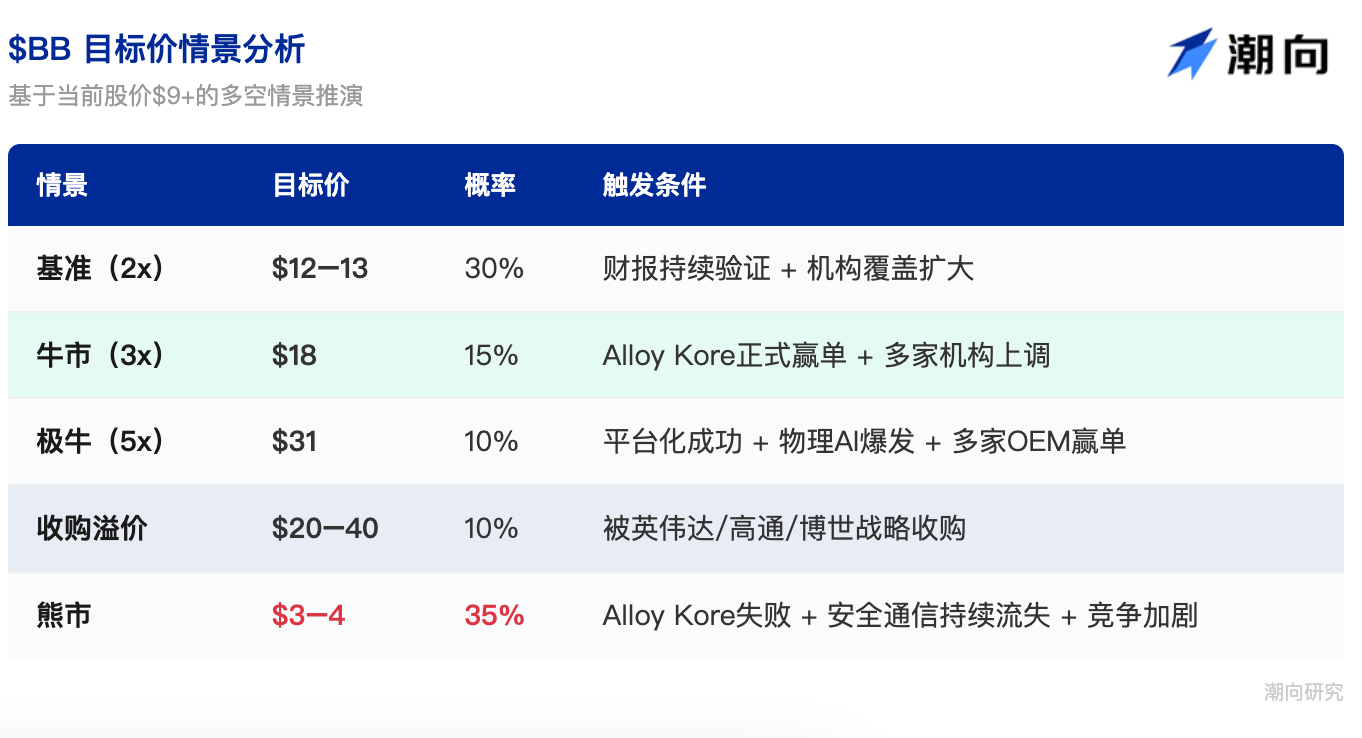
Target price scenario analysis
In my opinion, BB has a floor supported by $432 million in cash and investments, and the management continues to buy back at an average cost of $3.85; the upside has a 2 to 5 times range, with even higher scenarios for acquisition. This creates an asymmetric odds structure.
However, asymmetric odds and good investments are still separated by a 35% bear market probability. This is not a trade that can be blindly placed. On June 25, the financial report will focus on three things: whether Alloy Kore has made formal wins, whether the ARR for secure communications can stop the decline, and whether FY2027 guidance can be achieved.
The current stock price of BlackBerry is pricing an embedded AI security company using the framework of a phone company. This framework mismatch is real. But the speed of mismatch correction depends on whether the company can continuously prove the new story with numbers, rather than using the new story to cover old problems.
Stay tuned for June 25.
Disclaimer
This article is based on public information and independent analysis by the author and does not constitute investment advice. Investment carries risks; proceed with caution.
Data sources: BlackBerry FY2026 financial report (SEC filed, April 2026) · CIBC Capital Markets research report (May 22, 2026) · SEC institutional holding data · ABI Research RTOS functional safety ranking (April 2026) · QNX official website · Macrotrends historical stock price data
免责声明:本文章仅代表作者个人观点,不代表本平台的立场和观点。本文章仅供信息分享,不构成对任何人的任何投资建议。用户与作者之间的任何争议,与本平台无关。如网页中刊载的文章或图片涉及侵权,请提供相关的权利证明和身份证明发送邮件到support@aicoin.com,本平台相关工作人员将会进行核查。


