Author: Claude, Deep Tide TechFlow
Deep Tide Guide: GameStop disclosed its Q1 performance for the fiscal year 2026, achieving a net profit of $389.6 million, the highest in company history, with a revenue increase of 14% year-on-year to $835.3 million, significantly exceeding Wall Street's expectations. However, looking at the numbers, $268.4 million of the profit came from unrealized gains from options derivatives accumulated during the acquisition of eBay. On the same day, the board approved a $2 billion buyback plan, and after-hours shares rose over 7%.
GameStop (NYSE: GME) released its Q1 results for the fiscal year 2026, ending on May 2, on June 2, showing the most profitable quarter since the company's establishment.
Net profit was $389.6 million, a year-on-year increase of 770%; Q1 operating profit was $143.3 million, also setting a record for Q1, while the same period last year saw a loss of $10.8 million. Revenue reached $835.3 million, a 14% increase year-on-year, exceeding analysts' expectations of $767 million. Non-GAAP earnings per share were $0.30, nearly double the market consensus estimate of $0.16.
According to reports from Reuters and several media outlets, following the announcement, GME's after-hours stock price rose by over 12% at one point.
Nearly 70% of net profit came from unrealized gains on eBay derivatives
The net profit figure of $389.6 million needs to be broken down.
According to the notes in the financial report, GameStop recorded $268.4 million in "unrealized gains on derivatives assets" in Q1, originating from the put/call pairs established for the acquisition of eBay. These derivatives provided economic exposure to eBay common stock, corresponding to about 34.5 million shares of eBay stock at an exercise price range of $84.74 to $114.96.
In other words, this paper gain alone accounted for 68.9% of net profit.
After excluding unrealized gains from derivatives, digital asset gains, and impairment non-recurring items, the adjusted net profit was $179.3 million, a year-on-year increase of 115.8% (compared to $73.1 million in the same period last year). Adjusted EBITDA was $163.4 million, up from only $38.6 million in the same period last year.
This derivative gain is directly linked to GameStop's ongoing eBay acquisition plan. On May 3, GameStop submitted a non-binding acquisition offer to eBay's board at $125 per share, with a total valuation of approximately $55.5 billion, with 50% cash and 50% stock payment. GameStop has accumulated about 6.5% economic exposure to eBay through derivatives and direct holdings, and has submitted an antitrust filing. eBay had previously rejected the proposal.
The company has pledged $983.3 million in cash as collateral for derivatives, recorded under the "pledged derivatives collateral" category on the balance sheet.
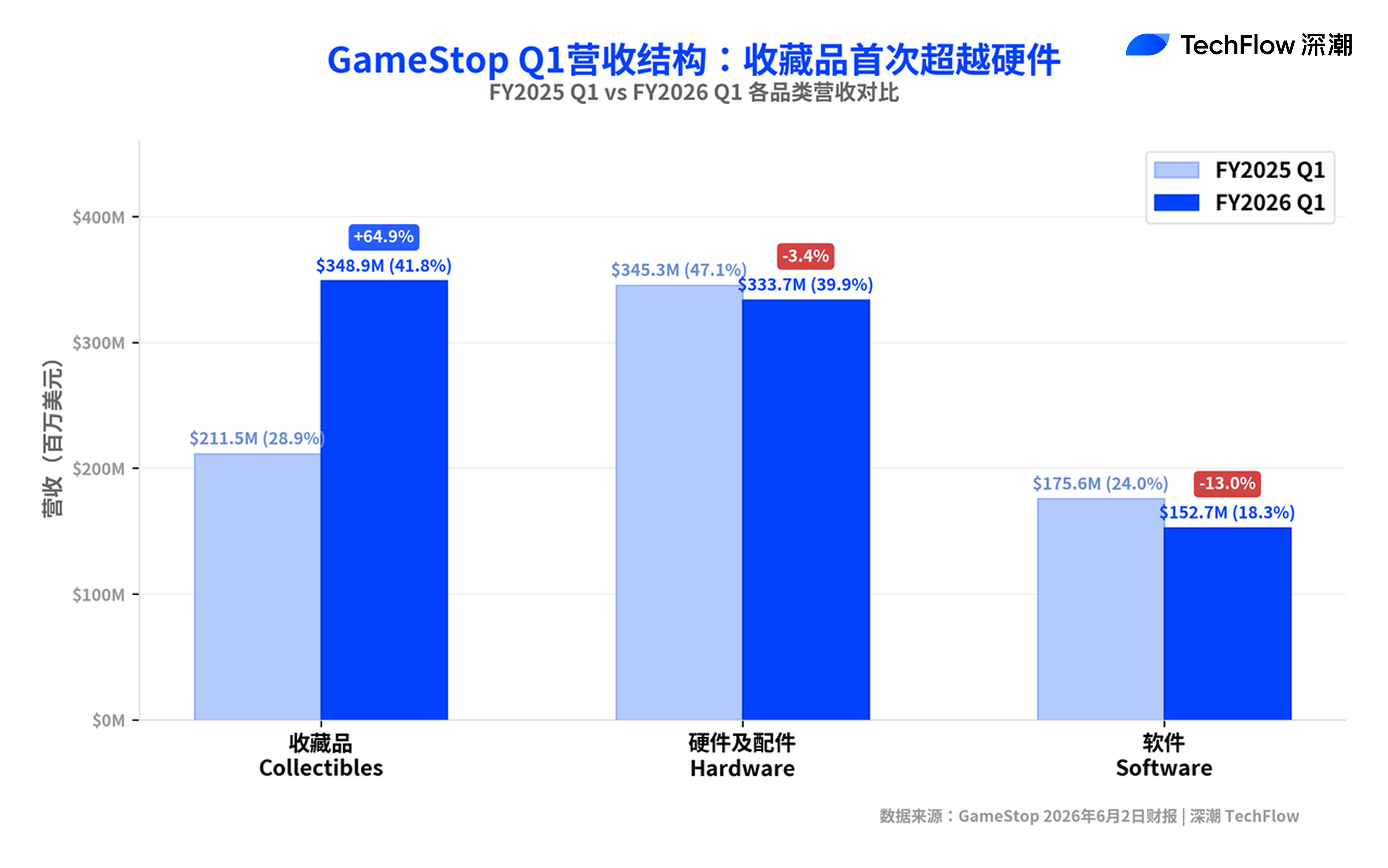
Collectibles have surpassed hardware to become the largest source of revenue
On the main business side, the most significant structural change in Q1 was the replacement of hardware by collectibles as GameStop's largest source of revenue.
By category breakdown: collectibles revenue reached $348.9 million, accounting for 41.8%, a year-on-year increase of 64.9% (compared to $211.5 million in the same period last year, accounting for 28.9%); hardware and accessories made up $333.7 million, accounting for 39.9%, a year-on-year decrease of 3.4%; and software revenue was $152.7 million, accounting for 18.3%, a year-on-year decrease of 13.0%.
Revenue growth was almost entirely driven by collectibles, including clothing, toys, trading cards, and card grading services. This continues GameStop's transformation over the past two years from a traditional game retailer to a retail platform for trendy toys and trading cards.
Gross margin increased from 34.5% in the same period last year to 40.7%, and SG&A expenses decreased from $228.1 million to $201.6 million, a decline of 11.6%.
$9.7 billion "financialized" balance sheet: cash, Bitcoin, convertible bonds, and derivatives
As of the end of Q1, GameStop's cash, cash equivalents, and marketable securities totaled $8.4 billion (compared to $6.4 billion in the same period last year), with digital assets and related receivables amounting to about $400 million (4,710 bitcoins), and derivatives collateral of approximately $1 billion, totaling about $9.7 billion.
The company's market capitalization is approximately $9.4 billion, with current liquid assets exceeding the market value.
On the liabilities side, long-term debt rose from $1.48 billion in the same period last year to $4.166 billion. This was mainly due to GameStop's two issuances of zero-coupon convertible senior notes: $1.5 billion notes maturing in 2030 issued in April 2025, and an additional $2.25 billion notes maturing in 2032. Both notes clearly state that the proceeds will be used to purchase Bitcoin, mirroring the "debt issuance for purchasing coins" strategy of Strategy (formerly MicroStrategy).
GameStop currently holds 4,710 bitcoins, valued at approximately $384 million according to The Block data, ranking 11th among publicly traded companies in terms of Bitcoin holdings. The Q4 financial report had previously disclosed that the company pledged 4,709 bitcoins as collateral for a covered call option strategy.
$2 billion buyback plan and after-hours stock price reaction
On the same day, the GameStop board unanimously approved a stock buyback authorization of $2 billion, effective until June 2, 2029, replacing the previous authorization established in March 2019.
With the current market capitalization of about $9.4 billion, the $2 billion buyback size accounts for about 21.3% of the total market value. Considering the company's cash reserves of $8.4 billion, there is ample financial space for the buyback.
According to Stocktwits and several media reports, following the release of the earnings report, GME's after-hours stock price rose by 7% to 12%. During regular trading hours that day, GME closed at around $22.40, with a 52-week trading range of $19.93 to $31.05.
免责声明:本文章仅代表作者个人观点,不代表本平台的立场和观点。本文章仅供信息分享,不构成对任何人的任何投资建议。用户与作者之间的任何争议,与本平台无关。如网页中刊载的文章或图片涉及侵权,请提供相关的权利证明和身份证明发送邮件到support@aicoin.com,本平台相关工作人员将会进行核查。


