Author: Zen, PANews
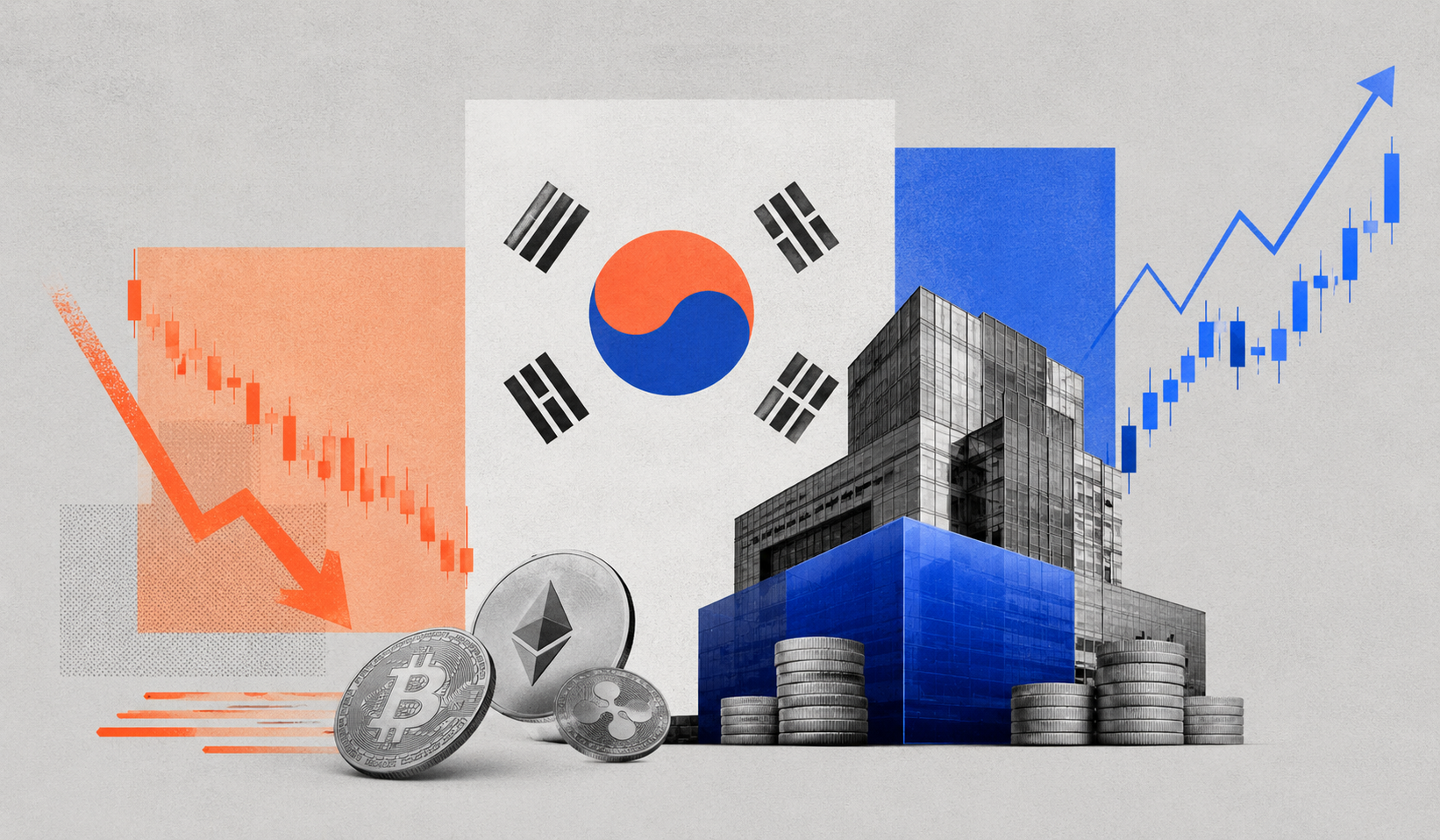
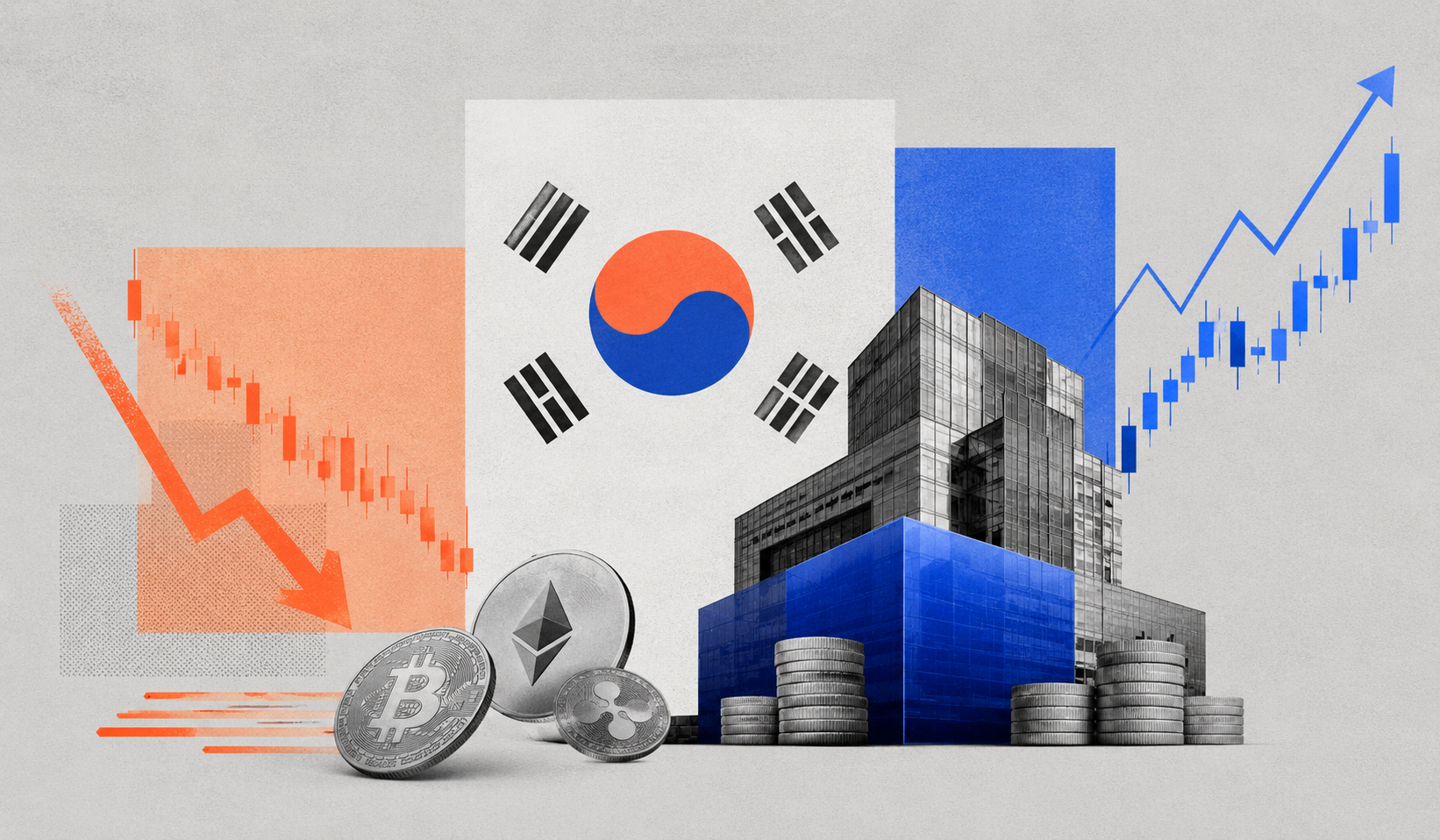
On July 24 last year, the trading volume of South Korea's five major cryptocurrency exchanges (Upbit, Bithumb, Coinone, Korbit, and Gopax) reached 16.919 trillion Korean won, surpassing the 15.007 trillion Korean won of the KOSPI (Korea Composite Stock Price Index) on the same day. However, the two markets subsequently entered completely different development trajectories.
As KOSPI trading volumes surged since the end of last year and the cryptocurrency market continued to decline, the gap between them rapidly widened. By the end of May, the daily trading volume of KOSPI was 118.267 trillion Korean won, while the 24-hour trading volume of the five major cryptocurrency exchanges was only 2.713 trillion Korean won, representing just 2.03% of the Korean stock market. Amidst the current AI boom, it seems that retail investors in South Korea are no longer keen on trading cryptocurrencies; Samsung and SK Hynix are now the favored options.
However, unlike retail funds withdrawing from the cryptocurrency secondary market, institutions have not exited the cryptocurrency industry; instead, they are doubling down on investing in exchange equity and regulatory licenses. Large financial groups, securities firms, tech companies, and foreign cryptocurrency institutions in South Korea have begun to intensively acquire equity in cryptocurrency exchanges.
Regulatory Entry Becomes a Scarce Asset, Exchange Equity Enters a Competitive Phase
In South Korea, where regulations are strict, the barriers to entry for cryptocurrency exchanges are quite high. From licenses, accounts, compliance systems to future business channels, cryptocurrency exchanges are actually one of the scarcest infrastructures in South Korea's digital financial system. To truly achieve scale, they not only require qualifications as virtual asset service providers but also need anti-money laundering systems and the ability to connect with the banking system for Korean won inflows and outflows.
If South Korea's digital asset regulatory framework gradually takes shape, compliant exchanges could evolve from mere spot trading platforms to important gateways for stablecoin circulation, RWA trading, STO-related services, custody collaborations, and institutional digital asset businesses. Institutions entering the equity level of exchanges are betting not just on current trading fees but on the potential value of these compliant gateways in the next phase of the digital financial market.
The equity acquisition of Coinone serves as the most direct example. At the end of May, Korea Investment & Securities signed an agreement with OKX to jointly acquire nearly 20% of the shares of South Korean cryptocurrency exchange Coinone, thereby becoming the third-largest shareholder. The acquisition primarily occurred through a new stock issuance, while the operating rights of the current major shareholders remain unchanged.

The significance of this transaction lies not in the current trading scale of Coinone, but in the fact that the combination of traditional brokerages and global exchanges is penetrating the local entrance in Korea. Through this acquisition, Korea Investment & Securities will advance digital asset businesses such as token securities issuance and circulation, attracting institutional clients, and large-scale brokerage. For Coinone, bringing in local securities companies and global cryptocurrency institutions can improve its capital structure, enhance business synergies, and possibly provide a foundation for future institutional clients, cross-border liquidity, and new product expansions.
In comparison to Coinone, the competition surrounding the operators of South Korea's largest cryptocurrency exchange Upbit, Dunamu, better illustrates the value of top-tier entries. Recently, large financial and tech institutions like Hana Bank, Hanwha Investment & Securities, Samsung Securities, and Samsung SDS have successively acquired or increased their stakes in Dunamu.
Among them, Hana Bank will invest approximately 1.0033 trillion Korean won to acquire 6.55% of Dunamu, and Hanwha Investment & Securities plans to raise its shareholding from 5.94% to 9.84%; Samsung Securities, Samsung SDS, and Samsung Card collectively acquired 4% of Dunamu. Behind the intensive trading, Upbit is no longer just the largest cryptocurrency trading platform in South Korea but has become an important gateway for traditional financial institutions to enter the digital asset market.
Beyond the leading players, Flybit illustrates that smaller exchanges also possess licensing and compliance value. WeHub, the holding company of the largest shareholder of Busan Digital Asset Exchange Bdan, is in the process of acquiring shares of Flybit's operator. Once the transaction is completed, WeHub will hold 40%, with WeHub's major shareholder Yang Jae-suk holding 25%, and Flybit representative Kim Seok-jin holding 15%. Although Flybit has not yet obtained a real-name account for Korean won, this transaction allows Bdan to expand from the tokenization of physical assets such as gold and silver to stablecoin and cryptocurrency trading.
Betting on the Next Generation of Digital Finance
From the above three equity acquisition cases, it is evident that institutions bottoming out South Korean cryptocurrency exchanges should not be understood as institutions being bullish on a certain short-term market trend, but rather as a preparatory positioning for the next generation of digital financial infrastructure. Specifically, three main lines are currently forming.
The first is Korean won stablecoins. Institutional discussions surrounding stablecoins in Korea are ongoing, but key differences have not yet been fully resolved. The discussions on Korea's "Basic Digital Asset Law" were initially filled with high hopes, but there are still divergences on issues such as the issuing entities of Korean won stablecoins, reserve accumulation methods, redemption obligations, and shareholder ownership restrictions of exchange major shareholders; relevant bills have not yet entered substantive deliberation.
Once stablecoins are institutionalized, the importance of exchanges will change. In the past, exchanges primarily served as trading venues for retail investors buying and selling coins; in the future, they may become important nodes for the issuance, exchange, custody, circulation, and compliance monitoring of stablecoins. Especially in a market like South Korea, where the banking account system is deeply intertwined with exchanges, whoever controls the inflow and outflow of Korean won will be closer to the core liquidity of stablecoins and on-chain payments.

The second is RWA and tokenized securities. South Korea has been discussing the tokenization of physical assets, security tokens, and blockchain financial infrastructure in recent years. The combination of Bdan and Flybit is a reflection of this direction: one end is the tokenization of physical assets such as gold and silver, and the other end consists of existing cryptocurrency exchange licenses and systems. For traditional financial institutions, exchange equity may also become a precursor for future participation in tokenized securities issuance, distribution, clearing, and secondary trading.
The third is corporate and institutional digital asset services. Domestic exchanges in South Korea have primarily served individual investors, but if regulations gradually ease regarding corporate accounts, institutional custody, compliant trading, and digital asset investment products, the customer structure of exchanges may shift from being dominated by retail investors to involving institutions. For exchanges, this means that revenue structures can expand from solely trading fees to include custody, settlement, market making, asset issuance, investment products, and technical services. For traditional financial institutions, holding exchange equity in advance means gaining early access to the future compliant digital asset market.
Long-Term Bets in a Lackluster Cryptocurrency Market
However, the crowded entry of institutions does not mean that the South Korean cryptocurrency industry will immediately re-enter an upward cycle. The fund preferences in the South Korean market over the past year have clearly shifted from once led by retail investors in a cryptocurrency trading boom to stocks regaining the status of the primary battlefield for funds and sentiment.
Due to restrictions on corporate and institutional participation, foreign capital entry limits, real-name account systems, and regulatory constraints, South Korean exchanges still rely more heavily on local individual investors for trading. In terms of operational flexibility, they cannot compete with foreign exchanges that diversify income sources through institutional business, custody, stablecoins, derivatives, payments, and asset management.
In terms of revenue structure, South Korean cryptocurrency exchanges are highly dependent on trading fees, with Dunamu's trading platform fee revenue in the first quarter amounting to 228.7 billion Korean won, accounting for 97.49% of total revenue; Bithumb's fee revenue percentage is nearly 99.99%. This means that during this "winter" of the cryptocurrency market, South Korean exchanges face a more severe impact on income than overseas platforms. Dunamu's consolidated revenue in the first quarter was 234.6 billion Korean won, a 54.6% decline compared to the same period last year; Bithumb's revenue during the same period dropped from 194.7 billion Korean won to 82.5 billion Korean won, a decrease of 57.6%.
Besides the "vulnerability" of business operations, there are also uncertainties in Korean regulation. The digital asset basic law is still under ongoing discussions, the issuing entities of stablecoins and reserve rules have not been fully clarified, and shareholder ownership restrictions of exchange major shareholders may also affect existing equity structures. Whether interest in cryptocurrency assets in the South Korean market can be restored depends on global conditions, regulatory implementation, product innovation, and changes in local fund risk preferences.
Nevertheless, the exit of retail investors puts short-term performance pressure on exchanges, which to some extent also creates a window for the reorganization of equity prices, shareholder structures, and strategic resources. Thus, this round of South Korean institutions "bottoming out" is not merely about the bottom of cryptocurrency prices but rather the cyclical bottom of exchanges as digital financial infrastructure.
When the market is at its quietest, retail investors see a shift in narrative and the disappearance of wealth effects. Meanwhile, institutions see the entry points needed for the next phase of stablecoins, RWA, tokenized securities, and institutional digital asset services.
The equity battle for South Korean cryptocurrency exchanges has begun in this contrast.
免责声明:本文章仅代表作者个人观点,不代表本平台的立场和观点。本文章仅供信息分享,不构成对任何人的任何投资建议。用户与作者之间的任何争议,与本平台无关。如网页中刊载的文章或图片涉及侵权,请提供相关的权利证明和身份证明发送邮件到support@aicoin.com,本平台相关工作人员将会进行核查。


