Written by: KarenZ, Foresight News
Tianya is back.
On June 1, 2026, the Tianya community, which had been offline for three years, officially resumed access. For many old users, this is not just a restart of an ordinary website, but like a sudden brightness from an old era.
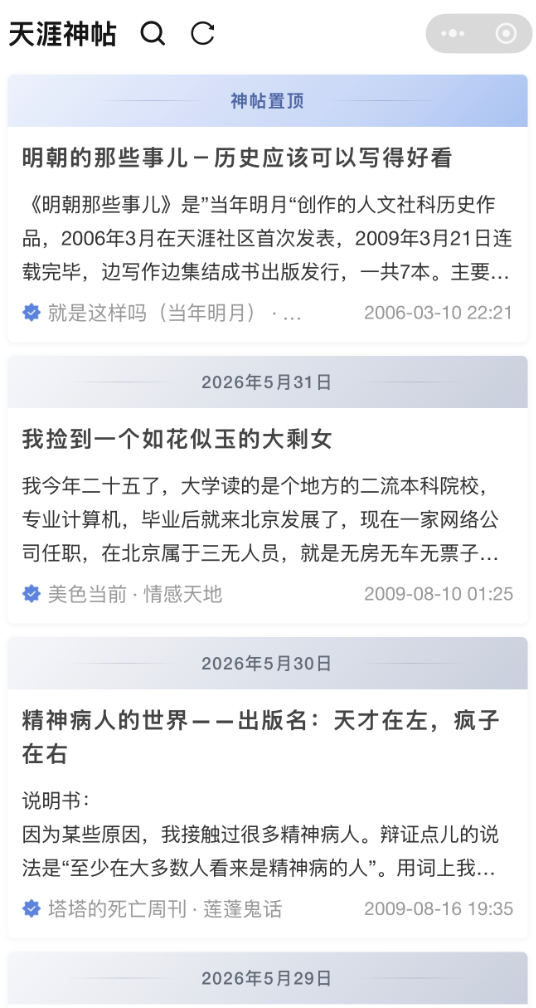
The place that once held countless famous posts, gossip, long articles, debates, and late-night stories reappears on the screen. The first phase of the Tianya community’s restoration prioritizes browsing selected posts, while interaction functions such as login, posting, and private messaging will gradually resume according to data migration and compliance progress.
However, unlike many people's imagined "return of the elderly," what is being put forward in this return of Tianya is not only old posts and memories but also the "New Tianya Genesis Membership Package" priced at 1999 yuan that had already begun selling earlier.
A Chinese forum born in 1999 is telling its restart story with a digital collectible membership package priced at 1999 yuan. This fact is very Tianya and very current.
Digital badges became tickets, governance, distribution, and equity imagination have all been packed in
There is also a key entity: Chengdu Tianya Ke Network Technology Co., Ltd.
According to a public letter from the Tianya community on February 9, 2024, the newly established investment entity "Chengdu Tianya Ke Network Technology Co., Ltd." is the core force behind the platform's restart and the construction of New Tianya.
The New Tianya plan includes the upcoming online and offline integrated Tianya Ke network platform (a global travel and fashion consumption social platform), the Tianya community, and overseas Tianya based on the Web3.0 platform (decentralized community governance, IP copyright digital asset trading).
The Tianya Ke membership store page shows that this package has a limited issuance of 9999 copies, with benefits including a Tianya Re-starter digital badge, a Tianya Ke premium membership gift box, 10 years of free reading rights in the official Tianya famous posts paid area, Tianya Metaverse, 10 years of member discount privileges, and 1999 Tianya gold beans.

According to an announcement from Tianya Ke on May 31, the "Tianya Re-starter Digital Badge" has been minted on the Ant Chain, serving as a digital badge for identity verification, honor display, and commemorative features. The badge supports compliant circulation, limited to three transfers within a year, and transfers must be completed through national compliant cultural property trading institutions or officially designated compliant platforms.
Notably, the announcement binds this badge to a complete set of "New Tianya core rights."
The first is governance rights. Genesis members holding badges are defined as "foundational nodes" of New Tianya, able to participate in the formulation and modification of community rules both domestically and internationally, submit suggestions for platform function optimization, ecological construction, and future development, and earn interaction points rewards for their contributions to governance.
This sounds close to the governance narrative commonly found in Web3 communities: identity credentials, rule voting, contribution incentives, and point rewards being packaged into the same rights framework.
The second is offline space rights. The announcement states that Genesis members can prioritize becoming the main operators or partners of Tianya Ke chain social spaces in cities around the globe. This means Tianya wants to transform the user relationships from the forum era into cultural travel, social spaces, and local consumption networks.
The third is e-commerce distribution rights. The Tianya Ke membership e-commerce primarily features cultural and travel products, and genesis members holding badges can prioritize becoming "product recommendation officers" and "product marketing officers" in the membership store, recommending global quality products and cultural travel routes on the supply chain side, and also earn Tianya gold beans through product promotion and distribution.
This aspect closely aligns with community e-commerce logic: the identity of old users is further directed toward recommendations, marketing, distribution, and point incentives.
The fourth is equity-related channels. The announcement also states that Genesis members holding a specified number of badges and who pass a qualification review can voluntarily apply to participate in a special limited partnership enterprise managed by licensed private equity managers, seeking to indirectly invest in New Tianya's equity.
It is essential to understand the limiting conditions here: it requires a "specified number of badges," also necessitates "qualified investor" status, and requires passing the corresponding review. In other words, ordinary users purchasing a 1999 yuan package do not automatically gain equity.
This rights list tells a compelling story. Governance rights create a sense of "ownership," the main operators and partners carry the imagination of offline entrepreneurship, the good product recommendation officers and marketing officers facilitate e-commerce distribution, and the equity channel elevates future expectations.
These words together make it hard not to take a closer look: digital badges, limited issuance, genesis members, numbering, metaverse, famous post rights, consumption scenarios, governance, equity channels. It packages a digital collectible into a comprehensive entry point for community identity, consumer rights, business roles, and capital imagination.
The more comprehensive the rights, the more specific the issues
With governance, distribution, and equity established, the answers are still not solid enough.
As mentioned earlier, the announcement has provided an outline of the governance rights. The real question to pursue is how this governance operates. For instance, which matters will enter the voting process, and which will only be soliciting suggestions? What does the formulation and modification of community rules include? Are there any critical matters such as creator revenue distribution and digital asset circulation rules?
Execution issues are equally critical. Once a vote is passed, does the platform have to execute it? What about the execution cycle, the publicizing of results, dissent handling, and the design of a review mechanism? How are interaction point rewards calculated? If these mechanisms lack public details, governance rights can easily remain at a "participation possible" stance rather than representing a true system that constrains the platform, protects users, and distributes responsibility.
The distribution rules for product recommendation and marketing officers also need to be more transparent. How are Tianya gold beans obtained, how are they redeemed, and how do the applicable ranges change?
The equity channel also needs caution. Once expectations are raised, subsequent disclosures must be more thorough. What is the specified number, how is valuation determined, what is the exit mechanism, and are the risk warnings sufficient? These cannot be automatically compensated by sentiment.
A platform that has been dormant for many years, desperately needing cash flow and proof of its user appeal, is trying every means to save itself. Tianya is using Web3 language to package a traditional internet-style member self-rescue.
The digital badge here resembles a self-rescue tool. It compresses identity, commemoration, consumer rights, governance narratives, distribution roles, and equity imagination, certainly creating a quite complete entry into "New Tianya." But precisely because it is packed too full, its form noticeably runs ahead of the facts.
At the Web3 level, the truly valuable parts are right confirmation, transparency, profit sharing, and governance.
- Right confirmation is knowing who owns the content.
- Transparency means users know where the money comes from and where it goes.
- Profit sharing ensures that creators and content contributors are not forever just free fuel.
- Governance means that so-called "co-builders" are not just consumers but can genuinely participate in community rules and future directions.
From the perspective of community revival, what can truly save Tianya may not be digital collectibles but three simpler things:
- Can the content come back?
- Can people come back?
- Can trust come back?
If these foundations cannot be established, no matter how many digital badges or metaverses there are, they may eventually just be a short-term recovery. Of course, for an old platform, being willing to try is still an opportunity.
Tianya did not just start wanting to try Web3 today
Tianya's interest in Web3, the metaverse, and digital collectibles did not emerge in 2026.
In July 2022, the Tianya community released the "Tianya Virtual World White Paper 1.0," announcing the advancement of constructing the "Tianya Virtual World" metaverse platform and issuing the "Tianya Yuanzuan." In that vision, users could integrate content produced in the Tianya community and their related personal data into "Yuanzuan." Each Yuanzuan has a unique identity number, which can be gifted or exchanged, and can also be collected as a digital collectible.
The announcement also mentioned that Tianya users' personal written works or related IP could be generated on-chain as digital collectibles with one click via "Tianya Yuanzuan" and circulated within legal and regulatory permissible means.
As of 2026, "Tianya Yuanzuan" is no longer the main character; the stage has shifted to the "Tianya Re-starter Digital Badge." After the metaverse craze subsides, Tianya has switched its keywords to AI digital life, overseas Tianya, decentralized community governance, IP copyright digital asset trading, and compliant alliance chain digital collectibles.
The name has changed, but the underlying impulse has not.
This direction is not completely illogical. Tianya indeed possesses scarce content assets. A large number of early native narratives, public discussions, and folk texts from the early Chinese internet were once accumulated in this forum.
In an era where AI training, IP adaptation, content copyright, and digital identity are being revalued, Tianya's data is not without value. However, whether that value can be unlocked still depends on how well the subsequent mechanisms can keep pace.
Summary
Tianya's predicament is a real dilemma for an old community: content is valuable, but cash flow is insufficient; sentiment runs deep, but the product has been stagnant for too long; the brand still has points of recognition, but user attention has long shifted to short videos, social media, and AI content platforms.
1999 yuan can buy a badge and a sense of identity as a "genesis member," but cannot return to the BBS era. In that era, users were willing to spend hours writing a long post, willing to reply to a stranger at midnight, willing to argue about public events until dawn.
The next thing to prove is whether, after Tianya's return, besides selling a digital ticket to "New Tianya," it can also regrow a community where people talk, argue, create, and are willing to stay.
In other words, the most observable aspect of Tianya's restart is not whether it has caught up with Web3, nor whether it will package itself as the next decentralized community. The real question is: after Tianya has tried almost all possible methods, can it land these concepts back to a most fundamental goal, to bring users back, to let content flow again, and to revive the community's vitality.
In an exclusive interview with Xing Ming, the founder of Tianya community, on February 12 by The Science and Technology Innovation Board Daily, Xing Ming attributed Tianya's past failures to insufficient commercialization awareness, a singular monetization model, and missing the critical window for internet commercialization. He mentioned that Tianya relied primarily on self-funded rolling development in its early days, putting little commercial pressure on it, thus preserving the community atmosphere, but this also led the team to miss the best commercialization opportunity. Subsequently, Tianya relied almost entirely on traditional brand advertising income, and advertising placement could not be too dense, otherwise, it would damage the community atmosphere, further compressing growth space.
Xing Ming stated in the interview that the core logic of this restart is to abandon the previous single advertisement monetization model and rely on Tianya's user accumulation, community atmosphere, and IP accumulation, combined with resources from the Hainan Free Trade Port, using a membership-based e-commerce as the primary monetization path, while deploying both domestic e-commerce and overseas Web3 dual paths. He mentioned earlier that the funds required for the restart are in the hundreds of thousands yuan range, and with the support from initial external investors and "New Tianya" co-creation members, this is enough to ensure the Tianya community resumes access on June 1, 2026.
The most tension-filled aspect here is that Xing Ming emphasizes avoiding excessive commercialization from consuming user sentiment while also having to provide sufficient business plans to prove that Tianya can continue to survive.
免责声明:本文章仅代表作者个人观点,不代表本平台的立场和观点。本文章仅供信息分享,不构成对任何人的任何投资建议。用户与作者之间的任何争议,与本平台无关。如网页中刊载的文章或图片涉及侵权,请提供相关的权利证明和身份证明发送邮件到support@aicoin.com,本平台相关工作人员将会进行核查。


