Author: David, Shenchao TechFlow
There is a kind of poverty that you did nothing wrong to deserve; yet when you wake up, you find yourself poorer than everyone around you.
Koreans have coined a term for this kind of poverty, called 벼락거지. Literally translated, it means “lightning poor person”. Struck by lightning, instantly turning from an ordinary person into a poor person.
This term became popular during the skyrocketing housing prices in Korea in 2020, describing those who did not buy a house; their income remained the same, but compared to the soaring property prices, they became poorer for no reason.
Recently, it has become popular again. Because the Korean stock market is now producing lightning poor people in bulk.
In the past six months, the Korea Composite Stock Price Index (KOSPI) has surged from around 4000 points to over 8000 points, and today the Korean stock market even triggered a circuit breaker due to a sudden rise. The two AI memory chip stocks, Samsung Electronics and SK Hynix, have lifted the entire country's stock market to the sky.
As a result, Seoul's online forums are filled with self-deprecating comments: the person sitting across from me at the same company made ten years' worth of salary from semiconductors, while I did nothing and became a lightning poor person.

The most painful thing about this is actually for people in the cryptocurrency world.
The disappointment of "everyone else is rising, but I am standing still" is felt deeper, earlier, and is less willingly acknowledged by those holding cryptocurrencies. The once often-quoted best asset, BTC, has been in a slump since the significant drop last October.
If you’re still sticking around in the crypto space waiting for opportunities, it feels more like a comfort for those not good at stock trading, adding a layer of suffering for the lightning poor.
Structural Miss, Lightning Poor
Missing out actually comes in two types, and the degree of discomfort varies greatly.
The first type is collective misses in a bear market. Everyone loses, your account is in the red, your friends' accounts are even more in the red, and not a single person in the entire market is making money. This kind of miss isn't too painful because there are no points of comparison.
You didn’t get in; missing out feels like dodging a bullet. This is how everyone in the crypto space has managed through the bear market over the past few years—getting used to it.
This year's situation is something else entirely. The crypto space is currently in astructural miss awkwardness.
Money hasn't vanished; it just relocated. Gold moved in, the U.S. stocks moved in, even the retirement funds of Korean uncles shifted into semiconductors. Global liquidity is like a powerful pump, sucking money from all directions and sending it into one after another record-high asset.
But it completely bypassed cryptocurrency.
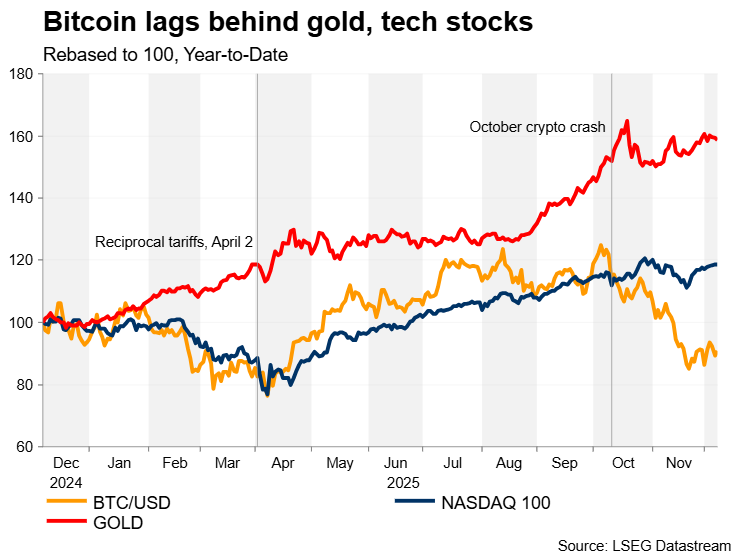
This is different from a situation where "no one has money." Everyone has found an escape route, and you stand still and watch money flow by your door without a cent coming in. This miss is far more devastating than a bear market.
BTC doesn't have the safe-haven capability of gold, and while tech stocks are hitting new highs, it hasn't kept up. When the market panics, it's the first to be sold off along with risky assets. It’s neither brought along in the rise nor discarded in the fall; it occupies neither end.
Those holding coins want to hedge; it doesn’t hedge; want to capitalize on volatility; it doesn’t bounce. The two things they initially bought it for haven’t been realized this year either.
When you lose money, at least there’s a clear reason to resent; you misjudged the direction. But missing out is different; you didn’t do anything wrong, the money just went past you, and you can’t even find something specific to blame.
So the entire crypto community has become like that popular term in the Korean stock market, lightning poor people.
But people in the crypto space inherently have a sharp acumen and a spirit of striving; the real response of more lightning poor people is not to lie flat but tomigrate with the trend.
On social media and community forums, where they used to talk about which altcoin could double, now KOLs still mention crypto tickers in their profiles, but the discussions have already shifted to Nvidia's earnings reports and Tesla's support levels.
Everyone has brought over the skills they honed in trading coins; watching K-lines, chasing hot narratives, enduring volatility—only the targets have changed from altcoins to U.S. stock codes. Some people have even directly modified the scripts they used for trading coins to create a small tool for monitoring U.S. stocks, complete with tracking, alerts, and automatic orders.
No skills were wasted; they were just applied elsewhere.
On the other hand, crypto exchanges are also actively saving themselves and adjusting, launching various on-chain U.S. stock trading products in response to the trend, after all, Hyperliquid has set an example for the entire crypto market.
So exchanges selling stocks is a quiet attempt to retain users. Users want assets that hit new highs; then let’s invite those assets in to keep them. From retail traders watching the market to exchanges listing coins, the entire industry is doing the same thing:
Finding ways to catch that wave of momentum they missed out on, ultimately it’s still a trend-following FOMO.
Whether proactive or passive, everyone knows a basic fact: if they don’t adjust their thinking, what’s genuinely rising will never be the piece they hold.
Don’t let missing out force you to jump on the last train
Those who don’t want to leave may still have some ammo; whether it’s dollar-cost averaging into BTC or finding niche stories, it’s okay if the coin hasn’t risen, as long as my U hasn’t decreased. Just sit still in the bear market and wait for the next wave to come.
If your principal is still there, can you treat missing out as if it never happened?
At the beginning of 2025, the RMB to USD exchange rate was still between 7.2 and 7.3, but entering 2026 it strengthened all the way, breaking the 6.8 level in May for both onshore and offshore rates, reaching the 6.7 range, a three-year high.
What does this mean? Suppose you remain inactive, maintain strict discipline without chasing highs or cutting losses. In that case, holding U is still a loss. Missing out is at least someone else has earned, and you haven’t; you’re standing still. Now you’re standing still, and the ground beneath your feet is sinking.
Waiting isn’t a cost-free endeavor; waiting itself is burning money.
Thus, a very natural thought arises: since the coin isn’t performing, why not clear the position and FOMO into those that are rising? This thought may be far more dangerous than the miss itself.
The feeling of missing out needs to dissolve, but maybe not by chasing it.
Let’s be frank: cryptocurrency really isn’t performing this round, and you can’t comfort yourself with "it will come back later." The past logic was a four-year cycle; halving, bull market, new highs, and if you missed it, you’d wait for the next round.
Now the play has changed. ETFs have turned Bitcoin into an entry on institutional balance sheets, and money on-chain is busy buying U.S. stocks; even exchanges have switched to selling stocks... this round of cryptocurrency isn’t the same as the one you remember that increased tenfold overnight.
Expecting it to give you another cycle like the old script is itself an act of carving a boat to seek a sword. But acknowledging that cryptocurrency is on a downhill path doesn’t mean that the stock market is a safe haven.
If you rush in to chase gold, chase U.S. stocks, chase Korean chips, what you’re actually earning isn’t your vision; it’s the rising tide’s money. Right now, global liquidity is lifting all boats at once; the water level is high, and anyone looks like they can swim. The problem is, the tide will eventually recede.
The real test isn’t whether you got on the train at the start. It’s whether you can switch your chips back to shore before the water goes down?
And this is precisely what ordinary people are least good at. Time and again, we’ve proven on NFTs, on altcoins, that we can catch the rise, but successful ones who took profits are rare. We always think it can rise again until it goes to zero.
In another market, these weaknesses won’t automatically disappear. Packing the coin trading skills into trading U.S. stocks will likely bring along that "unable to let go of selling" mindset.
So whether you’ve missed out or not, it may be a false proposition. Taking profits off the table is the ultimate key.
The Koreans created the term “lightning poor person” originally to self-deprecate for not catching on. The English term FOMO likely carries a similar meaning. But if you let yourself measure against someone else’s balance sheet, forcing you to jump into a pool you can’t navigate at the highest water level, that’s actually quite dangerous.
The real lightning is never the train you missed.
It’s that you finally squeezed onto the next train, yet again, forgot which stop you were supposed to get off at.
免责声明:本文章仅代表作者个人观点,不代表本平台的立场和观点。本文章仅供信息分享,不构成对任何人的任何投资建议。用户与作者之间的任何争议,与本平台无关。如网页中刊载的文章或图片涉及侵权,请提供相关的权利证明和身份证明发送邮件到support@aicoin.com,本平台相关工作人员将会进行核查。


