KAIO is a mechanism fund's on-chain distribution layer that allows investment starting at $100, breaking the traditional million-dollar barrier of private equity.
Written by: ChandlerZ, Foresight News
Tokenized RWA is one of the fastest-growing crypto tracks of 2026. As of May, the total scale of on-chain tokenized assets reached approximately $31.4 billion, growing more than fourfold from $5.9 billion at the beginning of 2025. Among these, U.S. Treasury products account for the largest share, close to 50%, exceeding $15.2 billion, with BlackRock's BUIDL fund managing about $2.58 billion and Circle's USYC leading with approximately $2.9 billion. Traditional financial institutions are accelerating their entry, with an unprecedented supply of assets.
However, the doors for buyers are almost closed. BUIDL was initially designed for institutions, offering exposure to cash and U.S. Treasuries, limited to qualified investors, with a minimum subscription amount of $5 million, and restricted to qualified purchasers holding at least $25 million in investable assets. Tokens can only be transferred between wallets verified through a whitelist. The barriers for traditional private equity and venture capital funds are similarly high, with minimum subscriptions typically ranging from $1 million to $5 million. According to a survey by CACEIS, 58% of asset owners cite regulatory constraints as the primary obstacle to entering crypto asset investments.
This results in a market with a booming supply side while the buyer side is severely limited, leading to an expansion in the scale of on-chain tokenized assets, but the participating investor pool remains confined to institutions and ultra-high-net-worth individuals. Deloitte's report on fund tokenization mentions that the critical bottleneck faced by the industry lies on the buyer side, lacking a sufficiently broad and active investor base, making it difficult to form depth and continuity in the secondary market.
The asset tokenization protocol KAIO attempts to enter this gap. On May 6, the RWA tokenization infrastructure protocol incubated by Nomura Securities' Laser Digital and led by Tether completed its TGE, reducing the minimum investment threshold for institutional funds to $100. Coinbase also announced new support for KAIO (KAIO), while exchanges such as Bitget, Gate, and KuCoin went live with KAIO, and Bitget Launchpool launched KAIO.
TGE First Day Amplitude 9900%, Four Institutions Linked
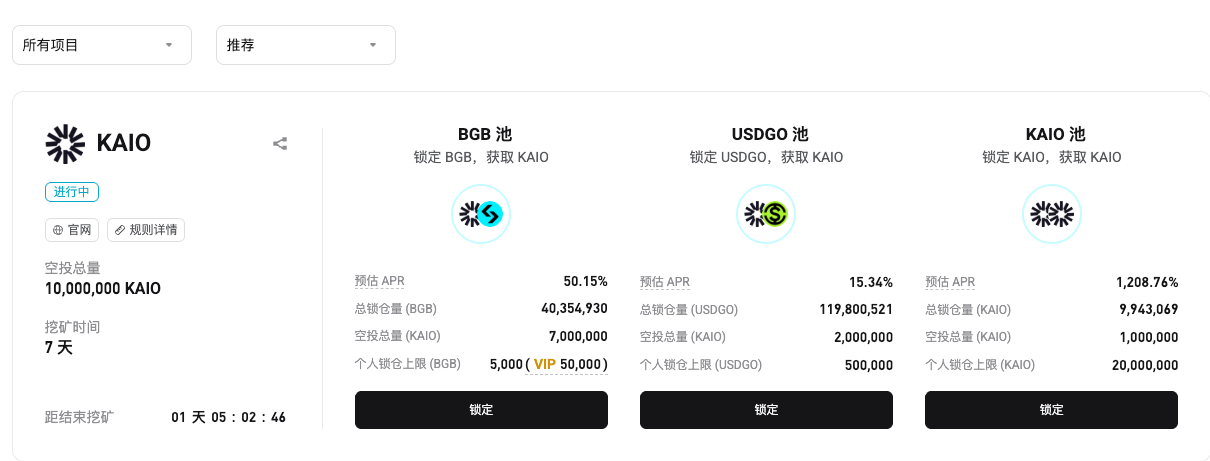
On the same day KAIO was launched, Bitget launched a Launchpool event, with a mining period of 7 days, airdropping a total of 10 million KAIO, divided into three pools. As of May 12, 2026, the BGB pool airdropped 7 million tokens, with a total locked amount of approximately 40.35 million BGB, and an estimated APR of 50.15%; the USDGO pool airdropped 2 million tokens, with a total locked amount of approximately 119.8 million USDGO, and an estimated APR of 15.34%; the KAIO pool airdropped 1 million tokens, with a total locked amount of approximately 9.94 million KAIO, with an estimated APR of up to 1208.76%.
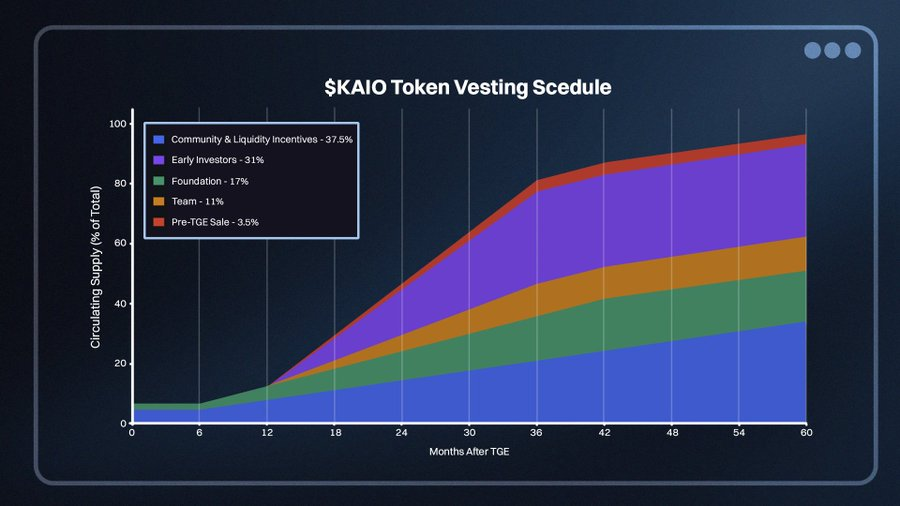
According to official disclosures, the KAIO token adopts a fixed total supply model, with a total supply of 1 billion tokens, with no inflationary issuance. In the allocation plan, community and liquidity incentives account for the largest share, reaching 37.5%, of which 12.5% will be unlocked on the day of the TGE for liquidity supply. Early investors receive 31%, the foundation receives 17%, the team receives 11%, and another 3.5% is allocated for Pre-TGE sales.
After the launch of the KAIO token, prices fluctuated drastically, peaking at $0.247 during the day, with daily amplitude once reaching 9900%.
The simultaneous launch across multiple exchanges, coupled with the concentrated release of early circulation, created a volatile market environment on the first day. Looking at the recent TGE performances of RWA tracks, KAIO's launch momentum has already ranked among the top of similar projects.
Incubated by Nomura, Led by Tether, Sovereign Capital Enters
KAIO is backed by a rare traditional financial pedigree in the RWA space. The project is incubated by Laser Digital, a digital asset subsidiary of Nomura Securities, headquartered in Abu Dhabi, holding licenses from three locations: Abu Dhabi Global Market (ADGM), the Cayman Islands, and Singapore, forming a compliant network covering the Middle East, offshore financial centers, and Asia-Pacific.
In terms of financing, KAIO has raised a total of $19 million. According to CoinDesk, KAIO's latest round of $8 million in strategic financing was led by Tether, with Systemic Ventures, Further Ventures, and Laser Digital participating, while Brevan Howard Digital, as an existing shareholder, also joined in.
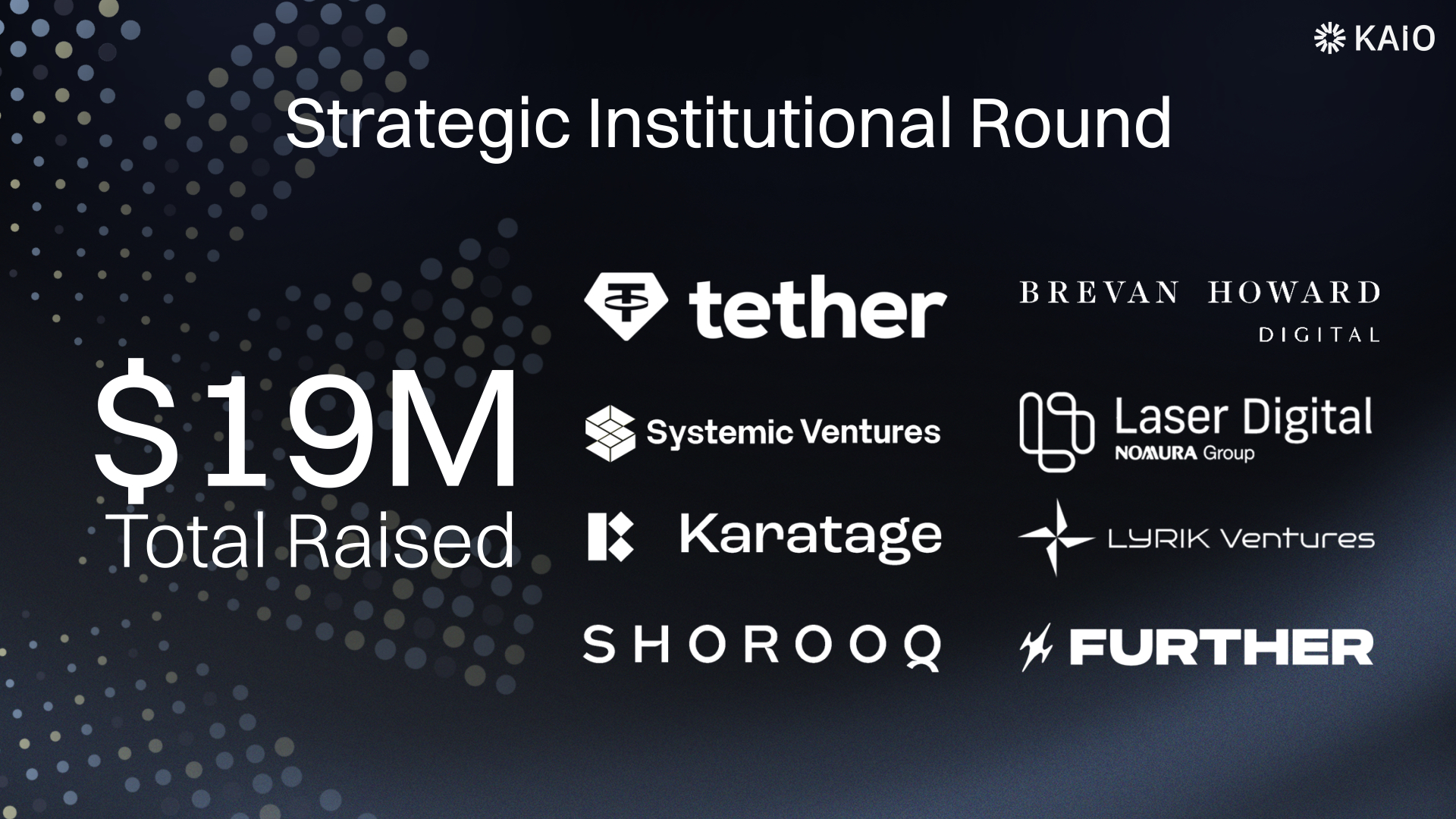
After this funding injection, KAIO's total financing amount has reached $19 million. The company stated that the new funds will be used to expand its business from existing fund tokenization services to a broader range of asset classes including credit products, structured investment tools, and exchange-traded funds.
KAIO's investors span both traditional finance and crypto-native circles, with Tether being the world's largest stablecoin issuer, Brevan Howard managing over $35 billion in a global macro hedge fund, and Laser Digital backed by Nomura Securities' institutional resources. This financing structure, recognized by both stablecoin giants and traditional hedge funds, is rare in the RWA space.
Additionally, in December 2025, UAE sovereign wealth fund Mubadala Investment Company announced a partnership with KAIO, where Mubadala Capital, its alternative asset management agency managing assets of approximately $385 billion, will jointly launch on-chain funds with KAIO to explore opening its private market investment strategies to qualified institutions and accredited investors through tokenization. This marks the first in-depth deployment of sovereign capital from the Middle East in the on-chain fund distribution space, providing KAIO with a credibility backing that other RWA protocols find difficult to replicate.
From $1 Million to $100, the Retail Experiment of Institutional Funds
KAIO's core product is a full-stack tokenization infrastructure for asset managers, covering the complete lifecycle of token issuance, compliance checks (KYC/AML), jurisdiction logic, secondary transfers, redemptions, and cross-chain liquidity. Asset managers do not need to build their own on-chain infrastructure; by accessing KAIO, they can complete the tokenization and distribution of fund products.
As of May 12, 2026, KAIO has tokenized fund products from institutions such as BlackRock, Brevan Howard, Hamilton Lane, and Laser Digital, with on-chain assets exceeding $100 million and a cumulative transaction volume over $500 million. The platform is deployed on more than 10 Tier-1 public chains, including Solana, Sei, Sui, Aptos, etc., connecting EVM and non-EVM ecosystems through a self-developed cross-chain gateway.
Traditional private equity funds usually set minimum investment amounts above $1 million with qualified investor certification requirements, but KAIO has reduced this threshold to $100. The significance of this design lies in opening pathways for fund products from top institutions like BlackRock and Hamilton Lane, which used to be available only to ultra-high-net-worth clients and institutional LPs, to a broader crowd of investors through on-chain tokenization.
KAIO plans to launch a retail product, KASH, in the second quarter of 2026, which will further simplify the process for ordinary users to participate in RWA returns, marking KAIO's extension from serving institutional clients to the retail end.
Market Positioning: Securitize does the U.S., Ondo does Treasuries, what does KAIO do?
In the current tokenized RWA market of over $30 billion, leading players have established their own bases at different levels. Securitize is an SEC-registered transfer agent and broker, with over $4 billion in tokenized assets, clients include BlackRock, Apollo, KKR, Hamilton Lane. Ondo Finance focuses on programmable treasury products, with flagship products USDY and OUSG totaling over $600 million in TVL, providing Treasury yield exposure to non-U.S. retail investors. Centrifuge focuses on DeFi-native credit and multi-asset pools.
KAIO's differentiation is first evident in its geographical anchor points. Securitize is focused on U.S. compliance and direct issuance to large institutions, Ondo leans towards standardized Treasury products, and Centrifuge targets DeFi lending, with all three emphasizing Western markets. In contrast, the on-chain distribution of institutional funds in the Middle East and Asia is still an underdeveloped blue ocean. KAIO precisely targets this gap, leveraging collaborative relationships with licensed partners across multiple jurisdictions to provide a one-stop tokenization and distribution channel for global asset managers. At the same time, KAIO plans to significantly lower investment thresholds for institutional-grade assets through retail products such as KASH, scaling down from the million-dollar direct limit of traditional private equity to $100, creating a complete distribution link from the institutional side to the retail side.
Conclusion
The tokenized RWA sector has completed the leap from proof of concept to scalability over the past few years, with $31.4 billion in on-chain assets proving the maturity of the supply side. However, the growth bottleneck in this market is shifting from "whether assets can be put on-chain" to "who will buy and how." Million-dollar investment barriers, qualified investor certifications, and compliance friction across jurisdictions have excluded the vast majority of potential buyers.
KAIO's value proposition is established on this dividing line, aiming to assist asset managers in completing tokenized issuance using a full-stack infrastructure while tearing open entry points for buyers at extremely low thresholds. Nomura's incubation provides institutional trust, Tether's leading role bridges crypto-native liquidity, and Mubadala's collaboration anchors the distribution needs of Middle Eastern sovereign capital. The three regional licenses cover the two fastest-growing markets outside the U.S.
Of course, the $100 million on-chain asset scale and the yet-to-launch retail product KASH indicate that this story is still in its early realization phase. How far KAIO can go depends on its ability to convert institutional trust advantages into scale effects on the buyer side. For an RWA protocol that has emerged from within the traditional financial system, TGE is the starting point; the subsequent product landing and asset growth will be the real test.
免责声明:本文章仅代表作者个人观点,不代表本平台的立场和观点。本文章仅供信息分享,不构成对任何人的任何投资建议。用户与作者之间的任何争议,与本平台无关。如网页中刊载的文章或图片涉及侵权,请提供相关的权利证明和身份证明发送邮件到support@aicoin.com,本平台相关工作人员将会进行核查。


