The SEC Chairman Paul Atkins' Project Crypto is about to take a crucial step.
Written by: ChandlerZ, Foresight News
According to Bloomberg, sources reveal that the U.S. Securities and Exchange Commission (SEC) is set to introduce an "innovative exemption" policy for tokenized stocks as early as this week, establishing a new framework for trading digital securities on-chain. This exemption allows tokens linked to publicly traded company stocks to be traded on decentralized platforms and crypto-native venues, where platforms may not need to obtain full broker-dealer or exchange registration under certain circumstances. The core impact of this framework lies in its terms; the exemption covers tokenized stocks issued by third parties, allowing issuers to issue them without obtaining consent from the publicly listed companies.
In other words, anyone can create a tokenized version of Apple or Amazon on-chain, and Apple and Amazon have no veto power over it, nor do they even need to know that it is happening. Previously, there may also have been some compliance solutions emerging between Anthropic, OpenAI, and crypto Pre IPO.
The SEC categorizes tokenized securities into two types: the first type is led by the issuer or its agents and extends the traditional securities issuance process to on-chain. The second type is created by unrelated third parties, which is precisely what the innovative exemption covers. These third-party tokens can circulate on DeFi platforms but may not include voting rights or dividends. Additionally, the SEC will initiate an experiment to verify whether a parallel market for listed stocks can operate effectively while separating from the regulatory framework designed to ensure fair pricing, transparency, and investor protection. SEC officials are still formulating the terms of the exemption, and specific details may change before the release.
The "innovative exemption" policy is part of the Project Crypto workflow launched by SEC Chairman Paul Atkins in mid-2025. The SEC's crypto working group has been organizing tokenization roundtable meetings since May 2025, during which the industry has submitted several consultation drafts. During the March meeting of the Investor Advisory Committee (IAC), staff discussed the draft with external experts, progressively shaping the outline of the final terms of the exemption.
Dual Tracks Forming, Exchanges Use Old Pipelines, Crypto Platforms Pursue New Exemption Pipelines
According to the publicly disclosed policy framework outline, this exemption is designed as a temporary arrangement lasting between 12 to 36 months, after which the SEC will decide whether to extend it, transition it to formal rules, or terminate it. During the sandbox period, platforms entering the exemption list must comply with exposure limits, whitelist access, and periodic reporting obligations to the SEC. The information disclosure standards will mirror those of securities requirements, but certain processes may follow a simplified pathway. Anti-money laundering, custody, and clearing obligations will continue to be retained, with execution details left to each platform's design.
Tokenized stocks may not necessarily carry traditional shareholder rights such as dividends and voting; if the platform chooses not to provide these rights to token holders, the SEC is considering additional restrictions. This means that even if the exemption is implemented, there will still be significant gaps in the rights relationship between on-chain tokens and the underlying stocks. In January 2026, the SEC issued interpretive guidance reaffirming that the tokenization of securities does not alter their legal attributes, and federal securities laws continue to apply based on economic substance. This exemption does not overturn that principle but offers a new compliance pathway under it.
The compliance paths for tokenized stocks have diverged into two parallel tracks by 2026. In March, the SEC approved Nasdaq's tokenized stock rules, and in April, it also approved similar rules for the NYSE. Both traditional exchanges allow tokenized versions of blue-chip stocks and ETFs to be listed synchronously within the existing market structure, relying on the DTCC pilot for custody and settlement, using the existing Reg NMS and self-regulatory organization (SRO) rule systems. This innovative exemption, however, targets crypto-native venues, DeFi protocols, and cross-chain settlement scenarios, exempting certain registration requirements under sandbox terms, existing alongside the exchange pathways.
Internal Divergences Within the SEC
During the advancement of the exemption, public divergences have emerged within the SEC commission, with Chairman Paul Atkins and Commissioner Hester Peirce being the core proponents. Atkins has consistently emphasized, in multiple public speeches, the need to transition the SEC from a law enforcement agency back to a builder of market infrastructure, while Peirce has long advocated for a crypto innovation sandbox, with both sharing a highly aligned vision.
Democrat Commissioner Caroline Crenshaw raised key concerns during the IAC meeting on December 4, 2025. She pointed out that tokenized stocks are often promoted as wrapped securities, claiming to provide exposure to underlying assets, yet in reality, they are far from a one-to-one replication of the underlying assets, with ownership often unclear and possibly completely disconnected from the underlying asset issuers. Crenshaw clearly stated that:
"Modifying existing regulatory standards to accommodate these new processes would pose significant risks to market integrity and investor protection."
She further questioned the true purpose of tokenized trading, arguing that if the goal is efficiency in settlement, it starkly contrasts with allowing tokenized stocks to trade with zero investor protection up front, as the latter would create a regulatory arbitrage environment against the traditional stock market. Commissioner Crenshaw's term is nearing its end, and after her departure, the committee's policy balance is expected to tilt further toward the exemption framework.
Industry organization SIFMA submitted multiple comment letters during the consultation period, expressing concerns on five levels. First, the dispersal of custody and settlement responsibilities. Decentralized platforms lack a clear central counterparty, with dispute resolution lacking a standardized path. Second, inconsistencies in AML and KYC standards. Crypto-native platforms and traditional brokerages bear equal market roles, yet there exists a significant gap in anti-money laundering investment and execution capabilities. Third, a single stock may appear in multiple token versions. Under third-party issuance mechanisms, a single blue-chip stock may have different versions of tokens appearing in over ten crypto venues, leading to dual chaos in price discovery and ownership attribution. Fourth, issues of corporate governance penetration. If a publicly listed company has not authorized token issuance, the chain of communication for its investor relations, shareholder meetings, and dividend distributions will be cut off. Fifth, inequities in competition. Existing broker-dealers bear substantial compliance costs, while the cost structure for those receiving exemptions is significantly lighter, raising industry concerns that this move would constitute a counter-incentive for licensed institutions.
Current Players Have Jumped Ahead
Meanwhile, Wall Street has already been casting its votes with its feet. In early May, Bullish, a crypto exchange led by former New York Stock Exchange President Tom Farley, acquired stock transfer agent Equiniti for $4.2 billion, directly entering the infrastructure layer of stock ownership records and dividend distributions.
Additionally, the Depository Trust & Clearing Corporation (DTCC) has announced that its DTC tokenization service has begun collaboration with over 50 financial institutions. This includes traditional financial institutions and crypto entities such as BlackRock, JPMorgan, Circle, Ondo Finance, Robinhood, and Citadel Securities. This service will support the tokenization of real-world assets managed by DTC, providing rights and investor protections identical to traditional forms. DTCC plans to launch its first limited production trades in July 2026 and formally unveil the service in October.
As of May 19, 2026, RWA.xyz data shows that the total on-chain value of RWA has reached $33.7 billion, with $15 billion in tokenized U.S. Treasury bonds, leading this sub-category, and the tokenized stock market approximately reaching $1.4 billion. The xStocks issued by Kraken's Backed Finance has accumulated over $25 billion in trading volume in its 8 months since launch, while Coinbase has partnered with Yahoo Finance to list over 8,000 tokenized stocks.
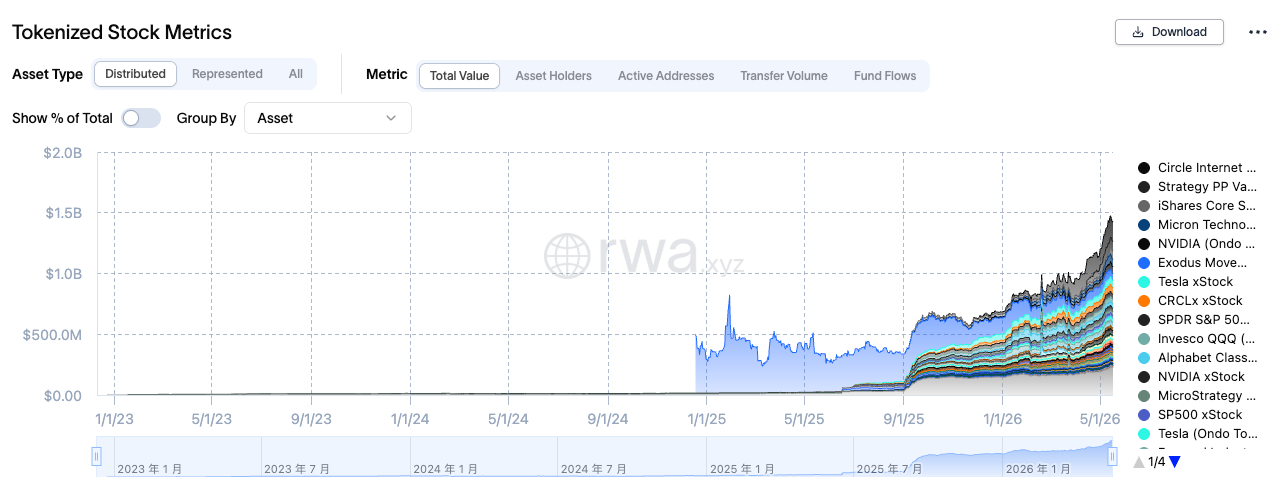
Once the exemption is officially announced, the compliance cost structures and external disclosure requirements for the aforementioned platforms will face a reshuffle. Coinbase has previously emphasized its hope to legally establish its tokenized stock business without obtaining a full broker-dealer license, which aligns closely with the exemption framework.
Currently, the SEC has not released the exemption text on its official website. Officials are still finalizing the details, and the ultimate plan may adjust from its current direction.
免责声明:本文章仅代表作者个人观点,不代表本平台的立场和观点。本文章仅供信息分享,不构成对任何人的任何投资建议。用户与作者之间的任何争议,与本平台无关。如网页中刊载的文章或图片涉及侵权,请提供相关的权利证明和身份证明发送邮件到support@aicoin.com,本平台相关工作人员将会进行核查。


