Author: Claude, Deep Tide TechFlow
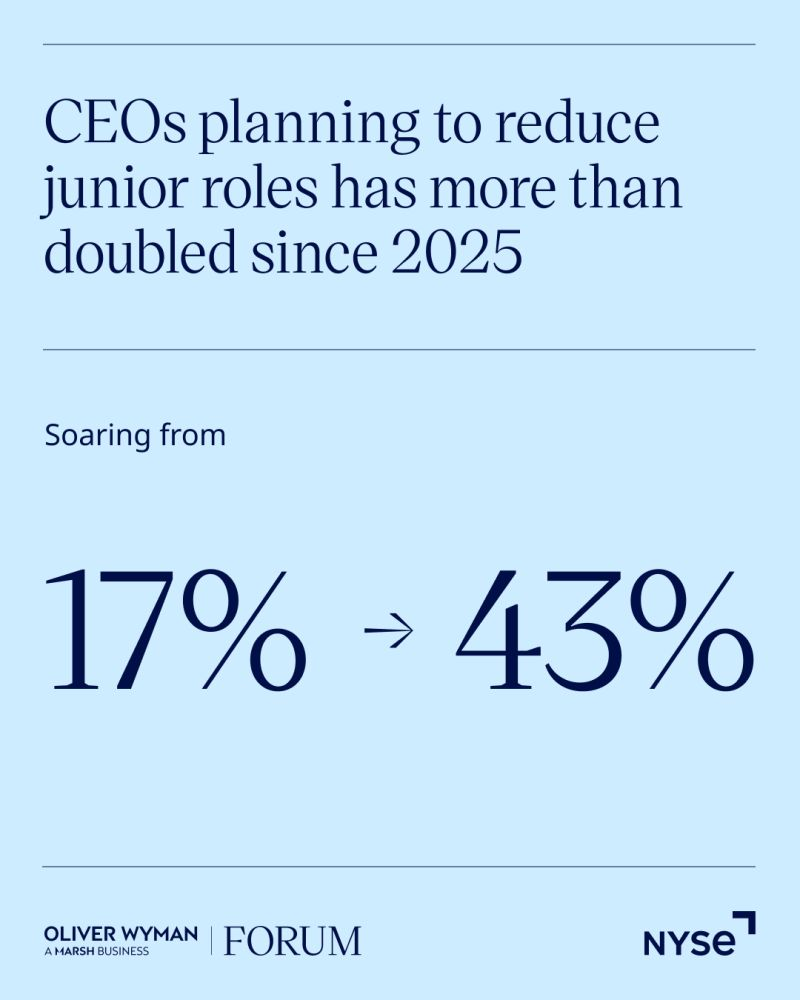
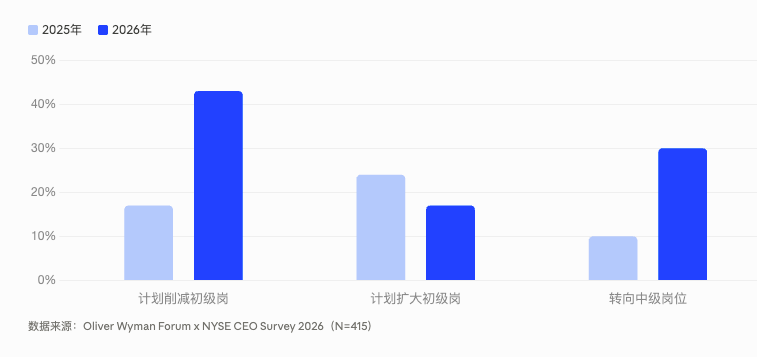
Deep Tide Overview: A recent survey by Oliver Wyman in collaboration with the New York Stock Exchange of 415 CEOs globally shows that 43% of CEOs plan to cut entry-level positions in the next one to two years, shifting towards mid-to-senior talent allocation. This proportion has more than doubled from last year's 17%. AI is systematically replacing routine tasks previously undertaken by junior employees, while experienced workers are becoming more valuable due to their judgment and experience. Goldman Sachs previously estimated that AI is net eliminating about 16,000 jobs in the US each month, with Generation Z being the most affected.
In past waves of layoffs, older and higher-paid employees were often the first to be targeted. However, the logic of the AI era is reversing.
According to a Bloomberg report on May 16, a survey by management consulting firm Oliver Wyman in collaboration with the New York Stock Exchange regarding the 2026 CEO agenda shows that over 40% of CEOs plan to reduce entry-level positions in the next one to two years, shifting their workforce structure towards mid-to-senior employees; only 17% of CEOs indicate they will increase the proportion of entry-level positions. A year ago, these numbers were almost entirely reversed.
The survey covered 415 CEOs (266 from publicly listed companies, and 149 from private companies), with the sample of publicly listed companies accounting for about 10% of the global market capitalization, including 65 CEOs from Fortune 500 companies.
John Romeo, head of the Oliver Wyman Forum, stated in an interview with Bloomberg, "The difficulty for entry-level employees to enter the workforce has indeed increased. CEOs now value mid-to-senior employees more to drive productivity."
43% of CEOs Cut Entry-Level Positions, AI "Qualification Bias" Effect Emerges
The logic of this shift is not hard to understand: the tasks that AI agents can currently perform are highly concentrated within the typical scope of responsibilities for entry-level employees. Writing code, assessing sales leads, reviewing documents, compiling data reports—these routine cognitive tasks previously handled by junior employees are being rapidly replaced by AI systems.
However, what AI currently cannot replicate is the judgment that requires years of industry experience to develop. Future work consultant Ravin Jesuthasan told Bloomberg that companies' attitudes are shifting to "I need someone who has truly done this job, because her experience, judgment, and problem-solving skills make her more valuable than AI."
This phenomenon is supported by academic data. A paper by Harvard researchers Seyed M. Hosseini and Guy Lichtinger analyzed resumes and hiring data covering 62 million employees and 285,000 US companies. The results showed that since early 2023, in companies actively adopting generative AI, the number of entry-level employees has decreased by 7.7% relative to non-adopters over six quarters, while the number of senior employees has remained largely unaffected. The key finding is that this decline mainly stems from a slowdown in hiring rather than mass layoffs. In other words, it’s not about layoffs, but rather halting recruitment.
Oliver Wyman’s report states the implications of this trend more directly: "CEOs with the longest planning cycles are the most likely to plan for staff reductions. This indicates they expect their organizations to become leaner with the enhancement of AI, not as a means of cutting costs, but as an end state."
Goldman Sachs Estimates: AI is Net Eliminating 16,000 Jobs in the US Each Month, Generation Z Most Affected
Goldman Sachs economist Elsie Peng estimated in an April research report that over the past year, the replacement effect of AI has eliminated about 25,000 jobs each month, while the enhancement effect of AI has added around 9,000 jobs monthly, resulting in a net loss of about 16,000 jobs. Frontierbeat
The impact is highly unevenly distributed. Among the occupations most exposed to AI replacement, the unemployment rate gap between entry-level employees under 30 and senior employees aged 31 to 50 has significantly widened compared to pre-pandemic times. The salary gap has worsened in parallel; Goldman Sachs’ regression analysis estimates that for every one standard deviation increase in AI exposure, the salary gap between entry-level and senior employees expands by approximately 3.3 percentage points. Fortune
Generation Z is disproportionately concentrated in routine white-collar jobs such as data entry, customer service, legal support, and billing, which are precisely the areas where AI excels in automation. They lack the experience buffer that senior employees possess. Fortune
A study from Stanford University last November further corroborated this: In fields with the greatest exposure to AI, young employees are 16% more likely to be unemployed than other groups. Fortune
Long-term Risks of a Broken Talent Pipeline
Cutting entry-level positions can lower costs and improve efficiency in the short term, but its hidden costs are raising alarm.
Helen Leis, global leader of Oliver Wyman's Leadership and Change practice, pointed out to Bloomberg that if companies want mid-to-senior talent to manage AI-driven workflows in the future, "these people need to learn the job within the company first." Not hiring entry-level employees means cutting off their own talent pipeline.
Andrew McAfee, co-director of the MIT Initiative on the Digital Economy, previously expressed similar concerns to the Harvard Business Review: Besides on-the-job learning and training apprenticeships, how can people learn how to do a job?
Data from a Monster survey shows that nearly 90% of the graduating class of 2026 is concerned that AI or automation will replace entry-level jobs, a sharp increase from 64% in 2025. Fortune
These concerns are not unfounded. According to a report from SignalFire, the number of entry-level job postings from the 15 largest tech companies in the US dropped by 25% between 2023 and 2024. The situation is even more severe in the UK, where entry-level positions in the tech sector dropped by 46% in 2024, and is expected to decline by another 53% by 2026. 免责声明:本文章仅代表作者个人观点,不代表本平台的立场和观点。本文章仅供信息分享,不构成对任何人的任何投资建议。用户与作者之间的任何争议,与本平台无关。如网页中刊载的文章或图片涉及侵权,请提供相关的权利证明和身份证明发送邮件到support@aicoin.com,本平台相关工作人员将会进行核查。


