The Japanese government bond market is experiencing drastic changes not seen in decades, prompting global asset management institutions to re-examine a long-ignored risk: will Japanese investors, who hold about $1 trillion in U.S. Treasuries, move their money back home?
According to a recent report from the Financial Times, several investment institutions have begun preparing for a large-scale repatriation of Japanese funds, betting that Japanese investors will gradually sell U.S. Treasuries in favor of Japanese government bonds (JGB) with continuously rising yields.
Japanese bond yields surge to decades-high levels
On Friday, the yield on Japan's 10-year benchmark government bond rose to 2.73% during trading, the highest level since May 1997.
The 30-year JGB yield has also surpassed 4% for the first time—this level has never been reached since these bonds were first issued in 1999. Yields on 5-year and 20-year government bonds also set historical records earlier this week.
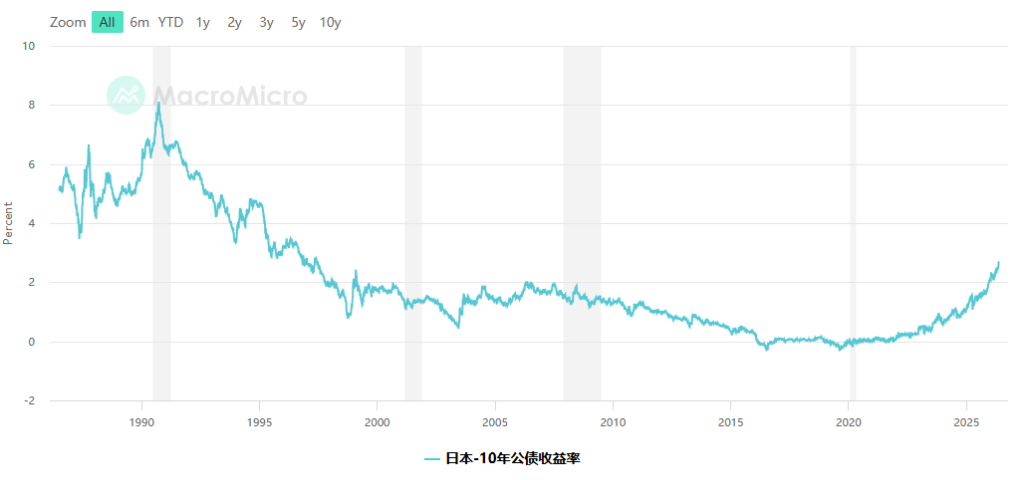
Japan's Finance Minister Satsuki Katayama stated to reporters on Friday that government bond yields in major global markets are rising, “These dynamics interact with each other, creating a cumulative effect.”
Analysts expect Japanese bond yields to continue rising. The Bank of Japan raised its policy interest rate to 0.75% last December, the highest in thirty years, and the market widely expects another hike of 25 basis points to 1% in June this year.
The trillion-dollar "return to Japan" logic
To understand this bet, one must first understand why Japanese investors hold such substantial assets overseas.
For decades, Japan has maintained ultra-low interest rates, with almost no returns on domestic bonds. In pursuit of yield, institutional investors such as Japanese insurance companies, pension funds, and banks ventured overseas in large numbers, buying U.S. Treasuries, European bonds, and various global assets.
Currently, Japanese investors hold about $1 trillion in U.S. Treasuries, making them the largest offshore holders of U.S. debt, far surpassing other countries.
Now, with Japanese bond yields rising significantly, this logic is reversing. Mark Dowding, Chief Investment Officer at the British asset management firm BlueBay, directly pointed out this shift. BlueBay launched its first Japan bond fund in March this year.
Dowding said, “New funds will no longer be allocated overseas. They will not flow into U.S. corporate bonds, will not flow into U.S. Treasuries, but will return to allocation within Japan.”
Funds have begun to "trickle back"
Market data shows that signs of fund repatriation have already appeared, although the scale remains small.
According to data from fund monitoring institution EPFR, in March of this year, investors experienced a net inflow of about $700 million into Japanese sovereign bond funds, setting a record for the largest monthly inflow in this category. The net inflow in April was $86 million, returning to recent normal levels.
Ruffer fund manager Matt Smith has a more direct assessment of this situation. He stated, “Pressure is building—long-term domestic yields continue to rise, and at the institutional level, the signal is also 'please bring the money back to Japan'. We believe the appreciation of the yen will happen slowly at first, then suddenly accelerate.”
Smith also noted that Ruffer currently holds a long position in yen, viewing it as a core hedging tool. “Once market turmoil occurs, especially turmoil centered around the U.S. credit market, Japanese investors will bring capital back home, at which point the yen will strengthen.”
Repatriation has not yet occurred on a large scale, and there are concerns about JGBs themselves
However, analysts warn that Japanese institutional investors are still in a net buying position for foreign bonds.
Abbas Keshvani, an Asian macro strategist at RBC Capital Markets, pointed out that although Japanese bond yields have “apparently provided better compensation for investors,” Japanese investors have still net bought about $50 billion in foreign bonds in the past 12 months.
The reason lies in the uncertainty within the JGB market itself. After Prime Minister Sanae Takaichi won the election in February, her campaign promises included expanding government spending and subsidizing inflation pressures. Analysts are increasingly warning that the government will be forced to prepare a supplementary budget later this year, which will further depress JGB prices and push yields higher.
Keshvani stated, “Supply and demand dynamics all point to rising yields. As an investor, if you know yields will continue to rise, it is difficult to have a willingness to buy now.”
Previously, the Bank of Japan was the most important buyer in the market, purchasing large amounts of JGBs through quantitative easing and yield curve control policies. As the Bank of Japan gradually withdraws, the market is returning to traditional supply-demand logic, leading to increased volatility in JGB prices.
What this means for the U.S. Treasury market
The potential scale of repatriation from Japan necessitates that the U.S. Treasury market take this risk seriously.
Japan is the largest foreign holder of U.S. Treasuries, with holdings of about $1 trillion. If Japanese institutional investors begin systematic reductions, the impact on the supply-demand pattern of U.S. Treasuries will be substantial.
Currently, Wall Street's bets are more of a forward-looking layout rather than a reaction to already occurring facts. However, as Japanese bond yields continue to rise—analysts consider the target of 3% for the 10-year JGB later this year to be realistic—the logic behind this bet will become increasingly clear.
免责声明:本文章仅代表作者个人观点,不代表本平台的立场和观点。本文章仅供信息分享,不构成对任何人的任何投资建议。用户与作者之间的任何争议,与本平台无关。如网页中刊载的文章或图片涉及侵权,请提供相关的权利证明和身份证明发送邮件到support@aicoin.com,本平台相关工作人员将会进行核查。


