Author: @giantcutie666
The two largest traditional exchanges in the world—CME (Chicago Mercantile Exchange) and ICE (Intercontinental Exchange, the parent company of the New York Stock Exchange)—have teamed up to file a complaint with the US Congress and CFTC, demanding strict regulation of the cryptocurrency derivatives platform Hyperliquid.
Hyperliquid is a decentralized exchange (DEX), and according to the version of the "Clear Act" released by the Senate yesterday (
), it does not require user KYC.
It originally operated independently from traditional exchanges, mainly doing cryptocurrency contracts.
But last October, it launched a feature called HIP-3—allowing direct trading of traditional assets like oil and stocks on-chain.
At the end of February, the US and Israel took joint action against Iran, and mainly did so on weekends!
The problem arises—traditional futures markets are closed on weekends.
Thus, this enormous wealth flowed to Hyperliquid...
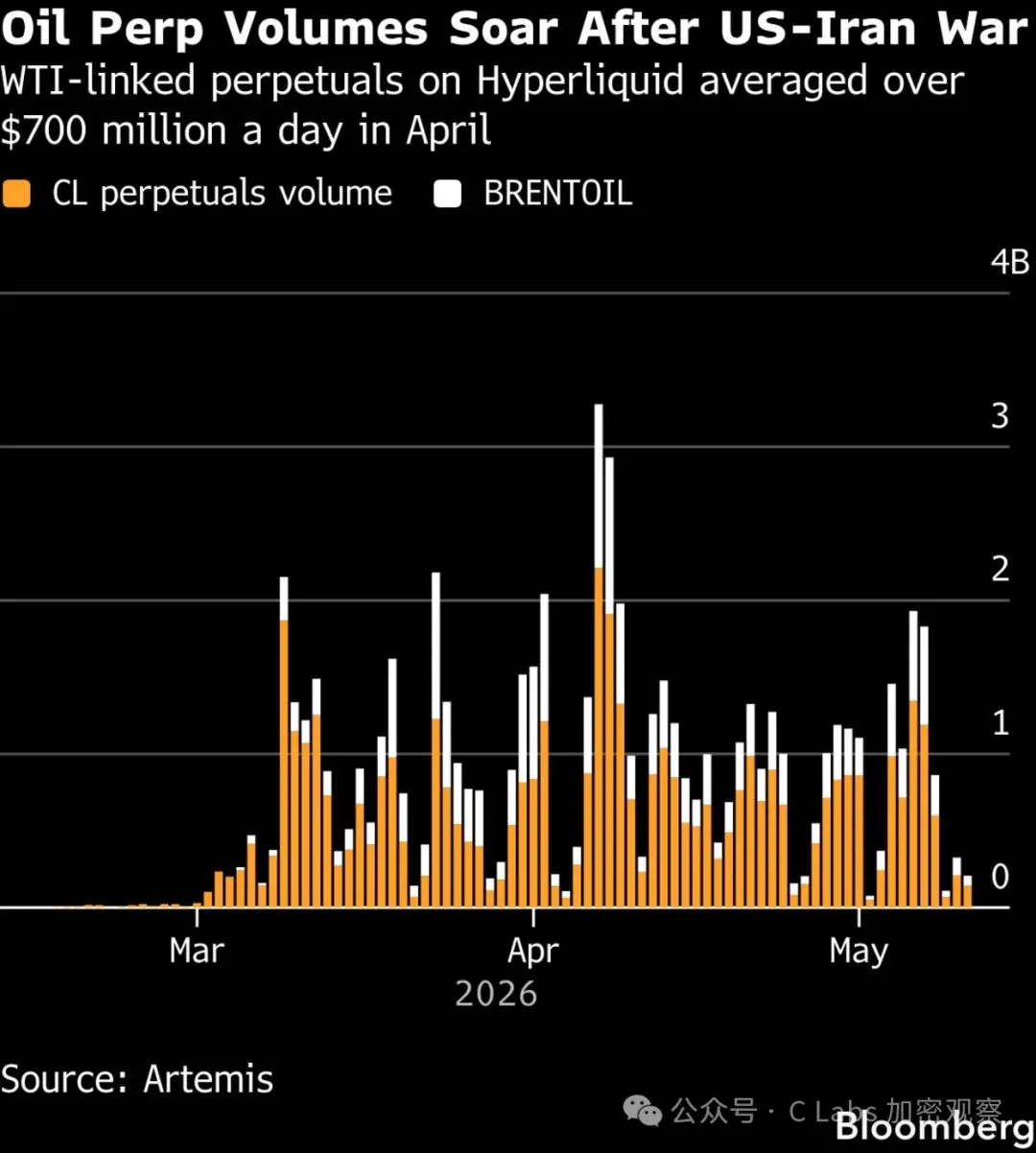
Before the conflict with Iran, Hyperliquid’s oil contracts averaged only a few million dollars in daily trading volume.
After the conflict broke out, this number surged to an average of 700 million, peaking at 1.7 billion in a single day. From the end of February to mid-March, it totaled over 10 billion.
CME and ICE each make over 5 billion dollars a year from their futures businesses, while Hyperliquid is expected to earn over 1 billion this year.
What’s worse is that Hyperliquid’s growth rate far exceeds theirs, and it specifically targets the time periods they neglect—weekends and late at night.
Thus, the two have gone to Washington together. Their demands are very specific: they want Hyperliquid to register with the CFTC, implement KYC, and accept trading monitoring.
Hyperliquid originally attracted global users through anonymous trading; enforcing KYC would directly undermine the product logic.
CFTC Chairman Michael Selig recently stated: Hyperliquid "may affect prices on our registered platforms".
The Trump administration has shown a friendly attitude towards cryptocurrencies, but this friendliness has its limits: protecting domestic crypto companies (like Coinbase and Kraken) is acceptable, but allowing offshore DEXs to take away jobs from US regulated exchanges is not.
Hyperliquid is also fighting back. In February, it established the Hyperliquid Policy Center, engaging a number of lawyers and lobbyists to actively negotiate with the CFTC, seeking a differentiated regulatory framework.
However, the chances of success are likely not high.

Hyperliquid claims to be "decentralized," but its foundation is quite fragile—there are only 31 validators, and the capital bridge relies on a single 3-of-4 multi-signature wallet for custody.
If the CFTC decides to take action, the enforcement path is very clear: given Hyperliquid's current level of decentralization, the CFTC could simply choose not to recognize it as a DEX.
In the past, BitMEX, Polymarket, and OOKI DAO were dealt with this way; the templates are already available.
If that's the case, in the future Hyperliquid will either be forced to compromise and register or completely exit the US market.
The derivative line for oil and stock in HIP-3 is likely to be incorporated into the existing regulatory framework.
免责声明:本文章仅代表作者个人观点,不代表本平台的立场和观点。本文章仅供信息分享,不构成对任何人的任何投资建议。用户与作者之间的任何争议,与本平台无关。如网页中刊载的文章或图片涉及侵权,请提供相关的权利证明和身份证明发送邮件到support@aicoin.com,本平台相关工作人员将会进行核查。


