Author: Curry, Deep Tides TechFlow
Esteemed U.S. stock traders have had quite a fortunate six months.
The S&P 500 and Nasdaq 100 have taken turns hitting historical highs, and the story of AI capital expenditure is becoming increasingly grand, resulting in rising account net values. In contrast, Bitcoin has fallen from $126,000 in October last year to around $80,000, a drop of 37%, leaving holders feeling just two words:
Agonizing.
This emotional gap is fermenting a new narrative on social media: Investing in U.S. tech stocks is generally better than investing in Bitcoin.
Today's crypto section on Reddit has a post that even concretizes this sentiment. A user posted a comparison chart, showing that over the past five years, the Nasdaq 100 has increased by 132.8%, while Bitcoin has only risen by 43.8%.
It's worth noting that this chart uses the European DD/MM/YYYY date format, covering the actual window from May 12, 2021, to May 12, 2026, and is based on ETFs priced in euros.
Since 2021, the dollar has appreciated by about 18% against the euro, which further amplifies the increase of dollar assets from a euro perspective. Converted to a dollar nominal price, the Nasdaq 100 has increased by about 121% during the same period, while Bitcoin has increased by about 43%, with a significant gap remaining.
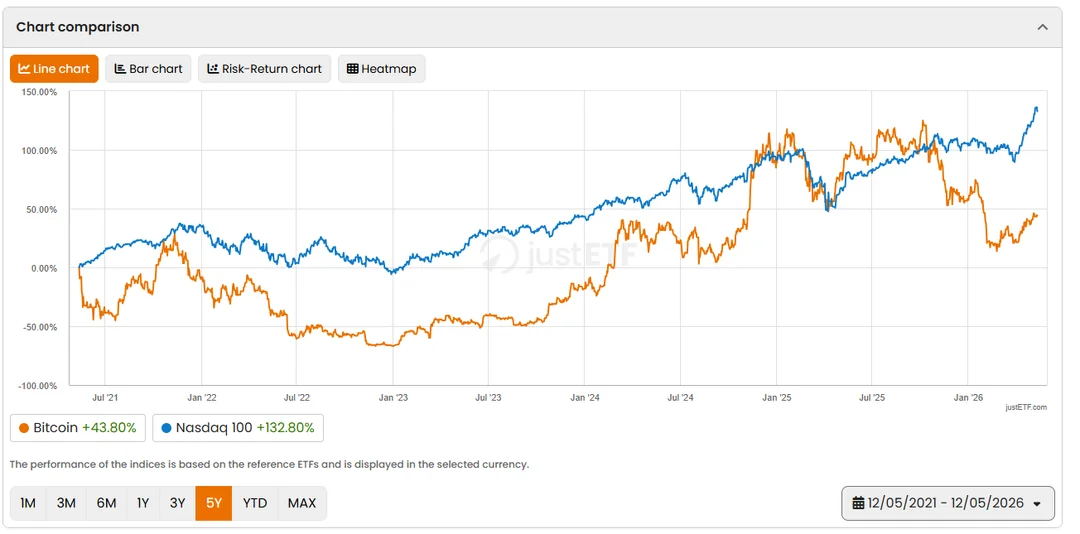
The poster's own summary is more pointed: "What is going on? I guess the answer is that AI has changed everything."
Bloomberg also did a similar report in February this year, with a title that was even more blunt: "Bitcoin's Five-Year Returns Lag Behind S&P 500, Nasdaq 100, and Gold."
Investments Have an Expiry Date
The five-year window in the chart above starts in December 2021.
At that time, Bitcoin had just pulled back from the cycle high of $69,000 to around $48,000, while the Nasdaq 100 was around 16,300 points, and the AI narrative had yet to kick in. This means that Bitcoin's starting line was set at a high-level plateau at the end of the bull market, while the Nasdaq's starting line was set on the eve of the AI super bull run.
Emotionally, it is understandable to promote U.S. stocks as stronger than BTC; but does the data ultimately bear this out when looked at over a longer timeframe? If we shift the start point forward or backward by a few months to years, the win-lose relationship can dramatically flip.
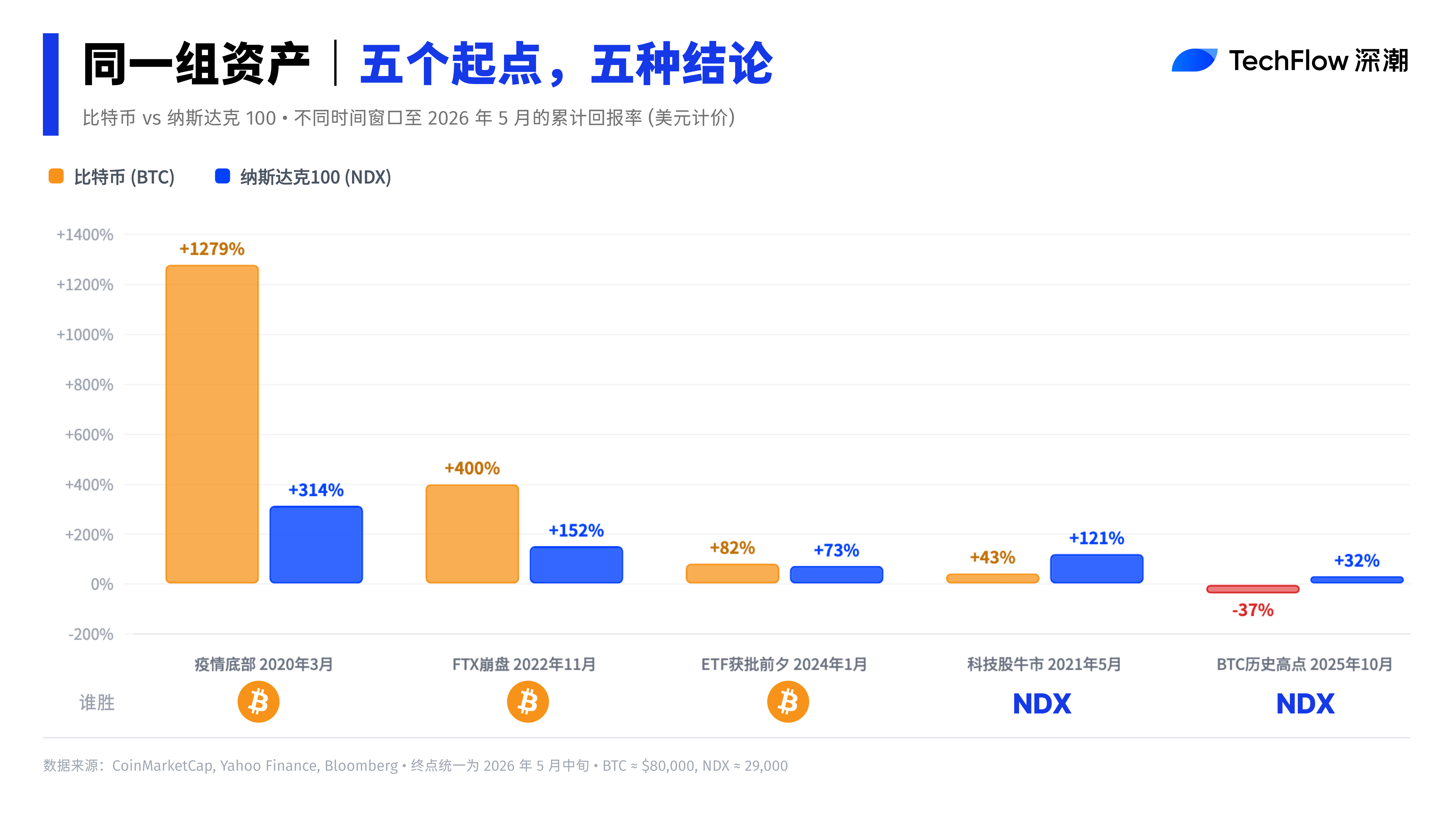
We conducted a simple little statistic, looking at the following five time windows, with a unified end point of May 2026 (BTC around $80,000, Nasdaq 100 around 29,000 points), and the starting points corresponding to five key nodes in the crypto and macro markets:
Pandemic Bottom (March 2020) → Now:
Bitcoin has risen from about $5,800 to $80,000, an increase of about 1,279%. The Nasdaq 100 has risen from about 7,000 points to 29,000 points, an increase of about 314%. Bitcoin's return is over four times that of the Nasdaq.
FTX Collapse Bottom (November 2022) → Now:
Bitcoin has risen from about $16,000 to $80,000, an increase of about 400%. The Nasdaq 100 has risen from about 11,500 points to 29,000 points, an increase of about 152%. Bitcoin's return remains 2.6 times that of the Nasdaq.
Pre-Approval of Bitcoin ETF (January 2024) → Now:
Bitcoin has risen from about $44,000 to $80,000, an increase of about 82%. The Nasdaq 100 has risen from about 16,800 points to 29,000 points, an increase of about 73%. The two are effectively even, with Bitcoin slightly ahead.
This Cycle of Tech Stocks (May 2021) → Now:
Bitcoin has risen from about $48,000 to $80,000, an increase of about 67%. The Nasdaq 100 has risen from about 16,300 points to 29,000 points, an increase of about 78%. Nasdaq leads.
Bitcoin Historical High (October 2025) → Now:
Bitcoin has fallen from about $126,000 to $80,000, a drop of about 37%. The Nasdaq 100 has risen from about 22,000 points to 29,000 points, an increase of about 32%. Nasdaq significantly leads, and the direction is completely opposite.
So the conclusion is: in the five windows, Bitcoin wins in three, and Nasdaq wins in two. The Reddit post selected happens to represent one of the windows where Nasdaq has the highest winning potential.
Cyclical Assets VS Trend Assets
The difference in starting point sensitivity between Bitcoin and Nasdaq 100 lies in their fundamentally different volatility structures.
The Nasdaq 100 consists of 500 large non-financial companies, backed by cash flow and profits, with a long-term upward trend. Even after experiencing a 33% pullback in 2022, the recovery speed is relatively smooth.
Choosing any non-extreme starting point will yield long-term returns that fall within a relatively stable range.
In contrast, Bitcoin is a typical cyclical asset. Historically, every bull and bear cycle has seen a pullback of between 75% and 85% from peak to trough (this was true in 2014, 2018, and 2022), and the pullback from October 2025 to early 2026 also reached about 50%.
This severe volatility means that where the starting point falls within the cycle almost determines the final return numbers.
An analysis by Nasdaq.com puts it more plainly: Bitcoin is essentially a leveraged version of the S&P 500.
In 2024, when the S&P increases by 24%, Bitcoin rises by 135%; in 2023, the S&P rises by 26%, and Bitcoin rises by 147%; in 2022, the S&P drops by 19%, and Bitcoin drops by 65%. The direction is the same, but the magnitude is amplified 3 to 5 times.
This means that choosing a starting point that happens to be at the peak of the Bitcoin cycle to compare and conclude that "stocks outperform Bitcoin" is statistically almost inevitable. Conversely, the same applies.
The Current BTC May Be in the "Cyclical Undervaluation Zone"
Setting aside the starting point game, the current market structure itself is worth noting.
After peaking in October 2025, Bitcoin experienced a typical cyclical correction. In February 2026, it briefly dropped to about $65,000, then rebounded to around $80,000, still down about 37% from its peak. Meanwhile, the Nasdaq 100 has been repeatedly hitting new highs, driven by the continuous expansion of AI capital expenditure.
This divergence is not uncommon historically. In 2019, during Bitcoin's rise from $3,000 to $12,000, it almost decoupled from the S&P 500. In 2022, both fell sharply at the same time, with correlation soaring to 0.92. The correlation between the crypto market and U.S. stocks is dynamic and cyclical, not a fixed positive correlation.
Alex Thorn, research director at Galaxy Digital, offered an interesting perspective in December 2025:
If measured by the purchasing power of the dollar in 2020, Bitcoin's nominal peak of $126,000 actually never broke through $100,000. Inflation accumulated about 24% from 2020 to 2025, creating a systemic bias in cross-year nominal price comparisons.
At the time Bitcoin is down 37% from its historical high while U.S. stock indices are simultaneously setting historical highs, the narrative of "stocks outperform Bitcoin" will naturally dominate social media.
However, during every time the narrative peaks, it is usually close to the bottom of the Bitcoin cycle. At the end of 2022, following the FTX collapse, similar "Bitcoin is dead" sentiments also rose, yet Bitcoin then increased from $16,000 to $126,000 over the next 18 months.
It's easy to analyze the aftermath; it's hard to place bets in advance. Debating which asset has a larger increase has no micro-level significance; any conclusion drawn from a single time window of "A is always superior to B" cannot withstand the test of shifting the starting point.
A generation's version reigns supreme, but timing and profit-taking are the difficult parts across generations.
免责声明:本文章仅代表作者个人观点,不代表本平台的立场和观点。本文章仅供信息分享,不构成对任何人的任何投资建议。用户与作者之间的任何争议,与本平台无关。如网页中刊载的文章或图片涉及侵权,请提供相关的权利证明和身份证明发送邮件到support@aicoin.com,本平台相关工作人员将会进行核查。


