Written by: Xiao Bing, Deep Tide TechFlow
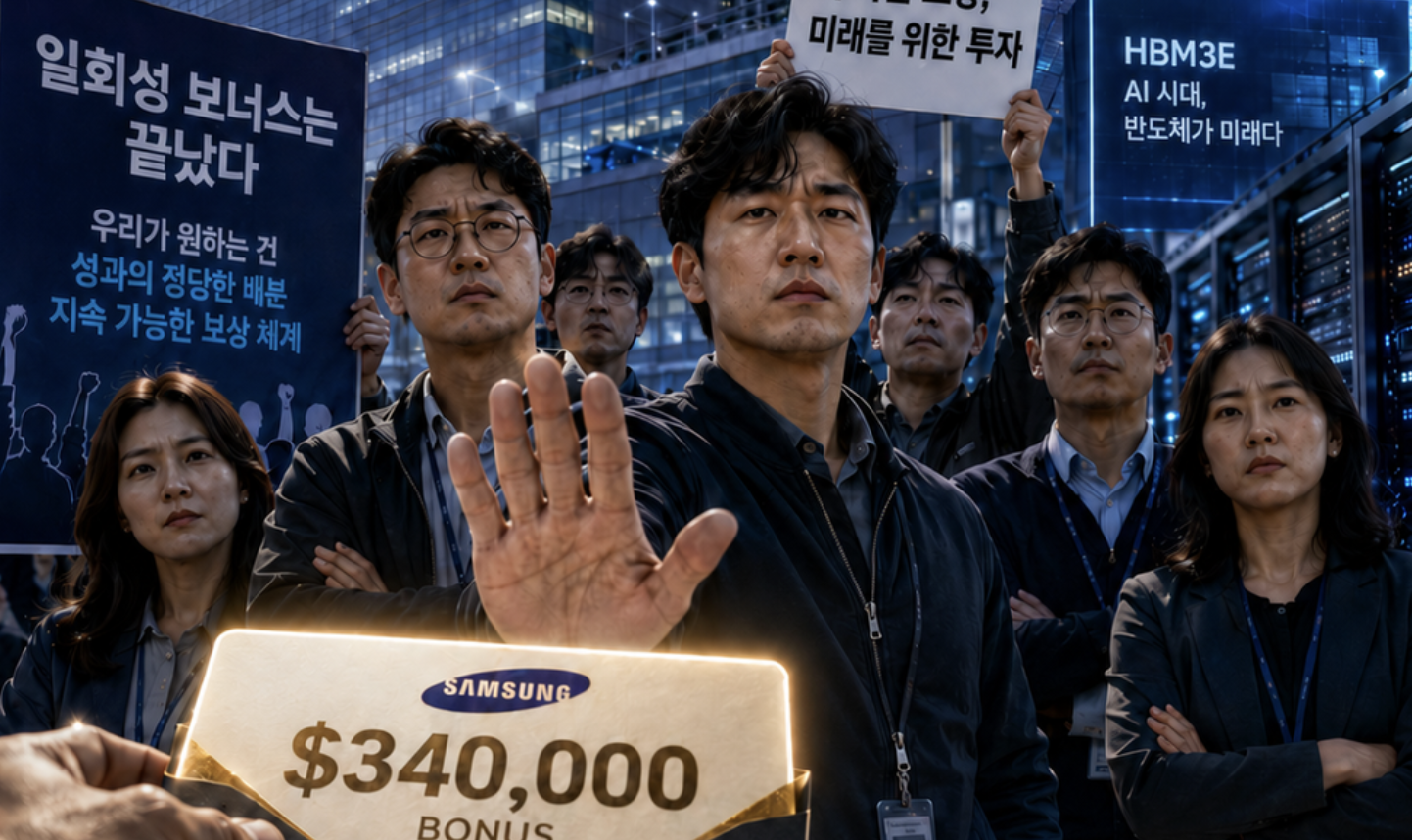
The labor negotiations at Samsung Electronics have finally reached the brink of a strike.
Late at night on May 12, mediation presided over by the Korean National Labor Commission broke down. Choi Seung-ho, president of the Samsung Electronics union, told reporters as he left the meeting room, "There is no point in waiting any longer." Unless an unexpected development occurs, the union will launch an 18-day strike starting on May 21, continuing until June 7.
The union currently has about 74,750 members, with the semiconductor division (DS) accounting for roughly 80%. According to Choi, about 41,000 people have expressed their willingness to participate in the strike, and the final number could exceed 50,000. Considering the participation rate in labor actions over the past two years at Samsung, industry analysts estimate that actual participation in this strike could be between 30,000 and 40,000, making it the largest labor action in Samsung's history. A one-day partial strike once led to a 58% reduction in output for some night shifts on the production lines. If the strike lasts for 18 consecutive days, TrendForce estimates it could impact 3-4% of global DRAM capacity and 2-3% of NAND capacity. JPMorgan estimates that based on the current disagreements, Samsung Electronics' operating profit could decrease by over 40 trillion Korean won for the entire year.
The real highlight of the story is not the strike itself, but the proposal rejected by the union.
A 13% Proposal that Failed to Reach Agreement
According to the Financial Times, the negotiating parties have recently narrowed their differences from the initial gap to a very small range. The union's initial demand was to allocate 15% of the semiconductor division's operating profit as a bonus pool, abolish the 50% bonus cap, and implement a 7% wage increase. The management's initial response was to offer 10% plus some additional benefits. After back and forth, both sides reportedly came close to the figure of 13%.
But they got stuck.
The union wants to write the 13% into the agreement and distribute it according to this formula every year. The management is willing to disburse a one-time payment at this ratio but only this once, equivalent to a one-off bonus of about 340,000 US dollars per person based on current profit levels.
It doesn't sound like such a big difference, but the union rejected it.
For employees, the distinction is not complicated:
The logic of a one-time bonus is that the company makes a lot this year, so it gives you a payment. Whether it can make a lot next year, whether it will give payment, and what formula will be used must be renegotiated each year.
The logic of annualized profit-sharing is that, according to the agreement, a certain percentage of operating profit inherently belongs to the employees. As long as the AI bonus continues, employees will share in it; when the bonus disappears, they accept that too.
Both models are "bonuses," but they correspond to different identities. The former is a temporary gift from the company, while the latter is something that should be shared institutionally. Under similar amounts, the two arrangements mean employees will have to wait for management to make decisions every year, while there is also a predictable, written rule.
This is the core that the union is holding onto.
SK Hynix Has Paved This Road
The union's assurance comes from its neighbor.
In the second half of last year, SK Hynix reached an agreement with the union to abolish the existing bonus cap and allocate 10% of annual operating profit as the employee profit-sharing pool for the next ten years. In February 2026, SK Hynix issued its first bonus under this new mechanism, amounting to 2,964% of the base salary, averaging almost 100,000 US dollars per person.
In Q1 2026, SK Hynix's operating profit soared more than fivefold year-on-year, with an operating profit margin of 72%, a figure that is extremely rare in the hardware industry. The reason is clear: it holds over 50% of the global HBM (High Bandwidth Memory) market share and is the major supplier of HBM for NVIDIA's H100 and H200. The more AI data centers built, the more it earns.
As profit expectations continue to rise within the year, some Korean media and foreign media estimate that under optimistic scenarios, SK Hynix employees may receive an average bonus of around 470,000 US dollars this year; if the high-profit forecasts from firms like Macquarie in 2027 materialize, it could theoretically approach 900,000 US dollars. These figures should be viewed cautiously as they are based on optimistic profit assumptions, not cash already received. However, even if calculated just based on already issued amounts and conservative expectations for the second half of the year, the absolute numbers still far exceed Samsung's current proposal.
Since December last year, around 200 Samsung employees have jumped ship to SK Hynix, according to statistics from Samsung's union. This is an unusual migration direction within the engineering community, as SK Hynix has been suppressed by Samsung for the past decade. But this time, with the change in bonus structure, people chose to move.
Samsung Management is Hard to Compromise
From an external perspective, Samsung seems stingy, but from the management's viewpoint, the situation is more complicated than it appears.
Samsung Electronics is not a purely memory chip company. It has various business lines including mobile phones, home appliances, display panels, foundry services, and memory. Just because semiconductors are making good profits this year, it doesn't mean other departments can enjoy the same cycle. In the first quarter, the operating profit of the DX division has already declined. If semiconductor profit is separately defined as a 15% share, internal questions will quickly arise: why do they get shares while we do not?
According to external analysts' calculations, if Samsung's semiconductor division truly provides 15% of its operating profit to employees, the corresponding bonus pool would reach 40 trillion to 45 trillion Korean won, an amount higher than SK Hynix's total annual operating profit. This is not due to the company being "stingy," but because institutionalizing such a large-scale cash outflow would be difficult to reverse in the future.
The management is most reluctant to formalize "formulaic profit-sharing" in the contract; once this precedent is set, next year's DX union and panel unions will negotiate using the same logic. The entire internal compensation order within the Samsung group would be reshuffled, and the labor contracts within the Korean chaebol system would also be referenced similarly.
Thus, Samsung would rather endure losses from a strike and face union and media criticism for being "stingy" than concede on the term "annualized."
This Issue Will Not Be Limited to Korea
The specific compromise between the union and management can be reached on any given day, but in the long term, that is not the most important aspect.
What matters is: the scarce positions in the AI industry chain have already begun to be re-negotiated.
Over the past thirty years, Silicon Valley's script has been to bind employees' fates to the company's stock price through equity incentives, but this script has two implicit premises: the company must go public, and employees must catch up with the early hires. Latecomers cannot obtain anywhere near what those who started earlier would receive after dilution of their options.
SK Hynix has found a second path: becoming profit-sharing partners without waiting for an IPO or worrying about stock prices, using cash distributions. The benefits are transparent formulas, timelines, and predictability. The cost is that the company needs to acknowledge that employees are not merely cost items, but also part of profit.
Once this path is successfully established at SK Hynix and a version is negotiated at Samsung, the next to be asked the same questions may not be limited to Korean companies.
How do TSMC engineers view how much NVIDIA earns for every GPU sold? How do ASML workers perceive the two-hundred-million-dollar price tag of each EUV lithography machine? Will veterans from old industries supplying liquid cooling, electricity, and transformers to data centers suddenly realize that they hold scarce resources?
Not all questions will have immediate answers, but the questions have already been raised.
Over the past two years, the capital market has already provided a round of answers to "who gets the AI dividends": NVIDIA shareholders were the first to receive the dividends, followed by TSMC, SK Hynix, and Samsung, who earned industry dividends through capacity and pricing, which reflects distribution between companies.
The distribution within companies has only just begun.
The 18 days starting on May 21 may end with the union's victory or with some compromise, where management concedes on the "annualized" issue, writing a shorter-term agreement to leave room for retreat. The specific outcome will impact the amount of this contract but will not affect the real direction.
Employees at SK Hynix have already received their first profit-sharing entry ticket. Samsung employees are striving for theirs through the strike. Who will receive the next one, when it will be issued, and in what form, may be one of the most notable undercurrents to track within the AI industry chain over the next three to five years.
免责声明:本文章仅代表作者个人观点,不代表本平台的立场和观点。本文章仅供信息分享,不构成对任何人的任何投资建议。用户与作者之间的任何争议,与本平台无关。如网页中刊载的文章或图片涉及侵权,请提供相关的权利证明和身份证明发送邮件到support@aicoin.com,本平台相关工作人员将会进行核查。


