Author: Josh Swihart, Founder of ZODL
Translated by: Felix, PANews
Editor's Note: Zcash was once regarded as a pioneer in the privacy coin space but has long been trapped in governance stalemates and user growth challenges. After three years of adjustment, Zcash has undergone a transformation. Josh Swihart, founder of ZODL (former CEO of ECC), is a key driver of this transition. This article is his systematic exposition of Zcash’s past, present, and future. Below are the details of the content.
I really enjoy reading various theories about Zcash, which has been gaining strength since the end of last year, but few delve into the specifics. Here, I will review the past three years and try to clarify the reasons behind Zcash’s current strong momentum and everything it has gone through to get to this point.
Three years ago, Zcash delivered world-changing cryptographic technology, but it was struggling. At that time, the trading price of ZEC lingered around 30 dollars for a long time. Less than 11% of the supply was in the anonymous pool. The community forum was in disarray, filled with governance disputes and infighting. Two entities (ECC and the Zcash Foundation) effectively had veto power over the evolution of the protocol through a U.S.-based trademark agreement. Meanwhile, these two entities were guaranteed development funding regardless of execution outcomes.
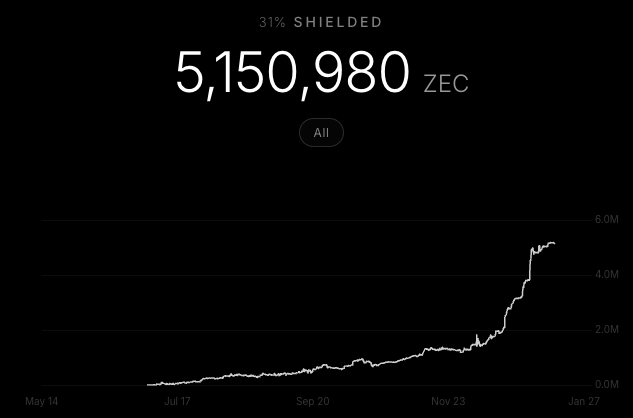
Now, the price of ZEC is about 600 dollars, with an annual increase of approximately 1500%. About 31% (worth more than 3 billion dollars) of funds are stored in user-controlled anonymous wallets. By mid-March, the proportion of anonymous transactions had risen to 86.5%. Tachyon, an expansion project aligned with community goals, received funding support. NU6 completely abolished the direct funding model and reset the development funding model of the protocol itself. ZODL completed 25 million dollars in funding from institutions such as Paradigm, a16z crypto, Winklevoss Capital, and Coinbase Ventures.
Everything has its cause and effect. Below are the key breakthroughs and reasons for the accelerated growth.
Release of Governance Shackles
In its first eight years, Zcash allocated 20% of each block reward to two fixed entities (later adding the Zcash Community Fund). This created a problem of vested interest monopoly. These entities controlled governance but had no pressure to enhance their influence, and the community was unable to reallocate resources. During my time at ECC, I witnessed firsthand the negative impacts of this distorted incentive mechanism.
The situation changed. In May 2024, ECC unilaterally announced it would no longer accept direct funding. This move forced the issue to the surface: if the largest beneficiaries refuse to participate, the old model cannot be maintained. NU6 reduced direct funding, allocating 8% to the Zcash Community Fund (ZCG) for ecosystem grants, while another 12% was deposited into a protocol-controlled "vault" for retrospective distribution to those who made significant contributions by ZEC holders.
This model clearly defines a time limit. The 8% and 12% funds will expire at the third halving at the end of 2028. The community can choose to renew, but this is not guaranteed and must achieve overwhelming consensus within the community.
Then, in August 2024, ECC officially issued a notice to terminate the trademark agreement, which had granted ECC and ZF "2-of-2 multisignature control" over the protocol. Six months later, the Zcash Foundation (ZF) announced it would no longer interfere with governance using trademark rights. The monopoly on Zcash governance was broken, and holders and other groups within the ecosystem could finally have a voice. No single entity, including ZF's ZCAP, can monopolize the interpretation of community opinion.
Zcash has finally gained freedom.
Release of Product Shackles
In January 2024, we (then known as ECC) shifted focus to user growth. This was a fundamental change compared to the past few years.
For years, the engineering team focused on cryptographic research, core protocol, and enhancing privacy. While these efforts made Zcash's privacy technology exceptional, they did not attract new users. In fact, by 2023, the community scale even began to shrink.
On the X platform, Zcash holders complained about stagnant prices and regulatory pressure, questioning whether "privacy coins" still had a future. At that time, 60% of tweets were negative or neutral. A survey initiated by ZURE (a.k.a. @peacemongerz, current marketing chief of ZODL) showed that the Net Promoter Score (NPS) of ZEC holders was as low as -60, indicating extreme user dissatisfaction.
We listened to the feedback and began to develop products that users genuinely wanted to use. This was our guiding principle then and now, leading to the development of the Zodl wallet, Zallet command line wallet, and even the core protocol.
Zashi (later rebranded as Zodl) was launched in March 2024, embodying this new strategy: default anonymity, support for hardware wallets, and cross-currency exchanges. We delivered a world-class privacy currency, wrapped in an easy-to-use interface.
The impact is evident. By the end of 2025, the anonymous supply grew from about 11% to about 30%, representing an absolute value increase of over 400% in ZEC. Every token in the anonymous pool is self-custodied by users. By mid-March, the proportion of anonymous transactions reached 86.5%. Since last October, the wallet has processed more than 600 million dollars in ZEC exchanges. This is not the wash trading of centralized exchanges or the accumulation of treasury assets, but real users opting for privacy and controlling their own private keys.
Release of Narrative Shackles
Zcash has faced positioning issues. The label of "privacy coin" led it to be delisted by exchanges, scrutinized by regulatory agencies, and avoided by institutional investors. The real value of the project was obscured: a cryptocurrency with a Bitcoin-like monetary policy that achieves verifiable and private payments through advanced cryptography.
Today, Zcash has become an unstoppable privacy currency. Zcash is the protocol, ZEC is the asset, and Zodl is the gateway to autonomy, free speech, trading freedom, and sovereign independence through privacy. This is structural: a protocol governed by the community, a scarce asset used for private value storage and payments, and a gateway that competes solely on product quality, not linked to protocol governance. This is the "trinity" of privacy coins.
With this framework, exchanges, ETF issuers, and infrastructure providers can support the asset without having to take a stance on how users utilize the protocol. This lays the groundwork for ZEC entering multi-chain ecosystems, listings on Robinhood, disclosures of positions by Multicoin, Grayscale filing for ETF applications, and Foundry launching mining pools. The value proposition is now clear for allocators who previously could not underwrite this asset.
Release of Organizational Shackles
In January 2026, after disputes with the board of Bootstrap (a U.S. 501(c)3 nonprofit organization), the entire ECC team collectively left to establish the Zcash Open Development Laboratory (ZODL). The core of the dispute was control: a small group of board members who did not participate in the actual work or the team itself. The board prioritized its own interests, forcing the team to leave and restart under a mission-focused organizational structure.
Nonprofit organizations struggle to scale. Building consumer-grade products at the speed required by Zcash demands startup-like capital, rapid hiring, and efficient decision-making processes. The 25 million dollars in funding received by ZODL from institutions such as Paradigm and a16z is a strong signal, recognizing the team and the mission to scale. An "Avengers" of the industry has come together.
Current Market Sentiment
The strongest sentiment indicator is the size of the anonymous pool. Users do not move ZEC into self-custodied anonymous addresses for speculation. They do it out of trust and belief. The anonymous pool grew from 11% of the supply to 31%, representing hundreds of thousands choosing self-custody and protecting their privacy through independent decisions.
LunarCrush data shows that discussions about ZEC have increased by 15,245% in the past year, while Bitcoin's increased by 190%. ZEC ranks second in AltRank across the entire cryptocurrency market. Positive sentiment accounts for 81%. GitHub contribution speed has increased by about 20% year-on-year. Forum discussions have shifted from governance complaints to products and technology work.
What’s next?
In short, the recent focus is on user experience, scalability, and preparations for the post-quantum era.
Zodl Wallet: We are further optimizing performance, adding more exchange options, funding channels, and features that users expect while keeping it simple and easy to use. The @zkDragon team has also joined to help develop in-app voting features for token holders.
Scalability: With block time reduced from 75 seconds to 25 seconds and the Tachyon project led by @ebfull, scalability will be significantly enhanced. Tachyon reconstructs the protocol around a stateless wallet with recursive zero-knowledge proofs, eliminating the years-long synchronization bottleneck, targeting throughput at Visa/Mastercard levels. In this process, we will deprecate the old zcashd node and migrate to the modern Rust-written zebrad.
Anti-quantum: A "quantum recoverable" wallet is expected to be released within a month, achieving full anti-quantum status within 12 to 18 months. This will protect user funds from the cryptographic changes that the financial system must face in the next decade.
As the work matures, the next network upgrade will gradually transform these key areas into protocol changes. Specific details are still being refined through ZIP discussions.
In summary, Zcash will be faster, easier to use, feature-rich, scalable, and quantum secure.
Related reading: Behind the 70% Surge: Why Did the Forgotten Zcash Suddenly "Rise" in 2026?
免责声明:本文章仅代表作者个人观点,不代表本平台的立场和观点。本文章仅供信息分享,不构成对任何人的任何投资建议。用户与作者之间的任何争议,与本平台无关。如网页中刊载的文章或图片涉及侵权,请提供相关的权利证明和身份证明发送邮件到support@aicoin.com,本平台相关工作人员将会进行核查。


