Author: Deep Tide TechFlow
Introduction
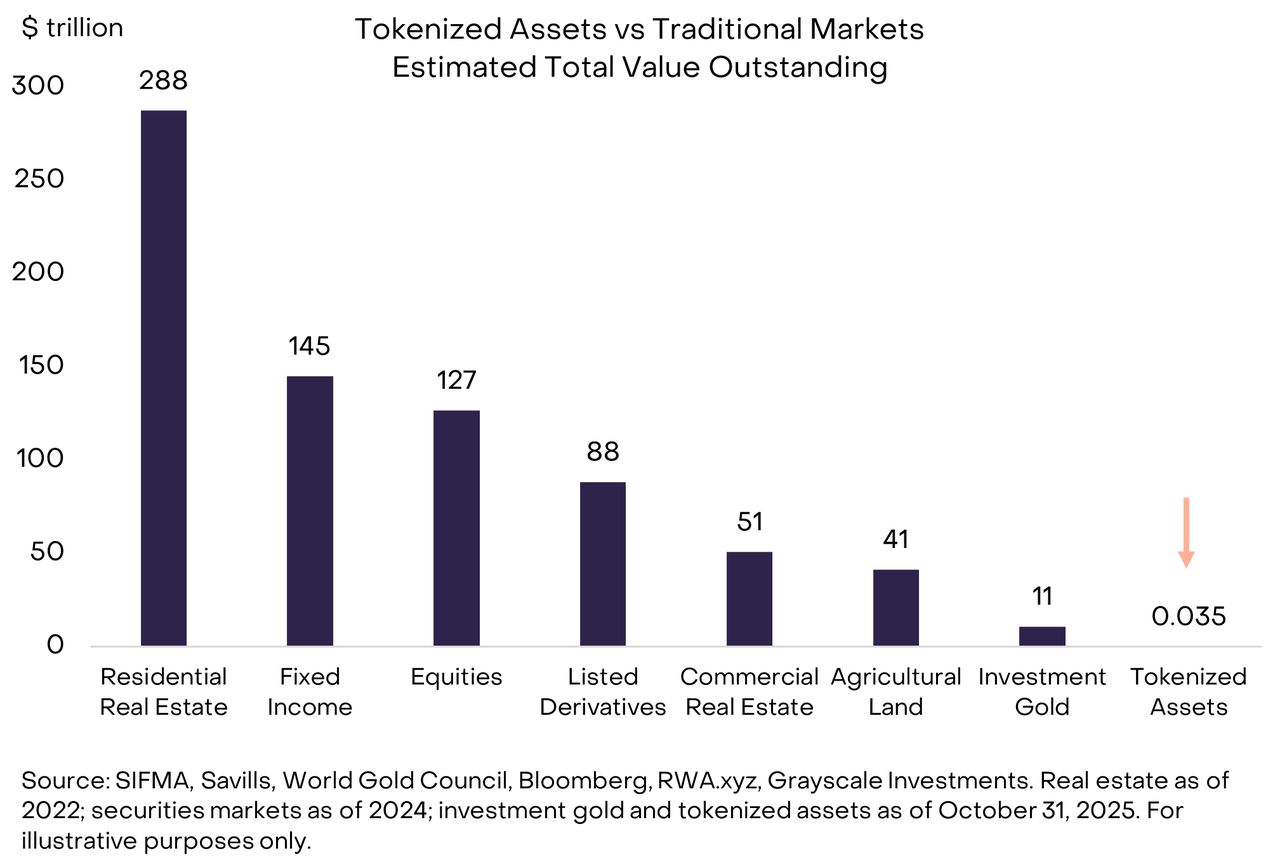
Grayscale calls 2026 the "Dawn of the Institutional Era" in its "2026 Digital Asset Outlook," predicting that the scale of tokenized assets may grow by nearly 1,000 times by 2030.
1,000 times may sound radical at first, but it is not unimaginable.
On one hand, the growth trend has already emerged: according to data from rwa.xyz, the on-chain RWA asset value has increased from 21.45 billion USD to 31.12 billion USD since January 1, 2026, achieving nearly 10 billion in growth in just a few months;
On the other hand, the scale of tokenized assets currently accounts for only 0.01% of the total market value of global stocks and bonds. As on-chain infrastructure continues to improve and regulatory frameworks become clearer, institutional capital will be further attracted, becoming a major variable for on-chain financial growth.
Thus, a more critical question arises:
When trillions in assets truly start to go on-chain, who will become the main base for this migration?
Institutions have already provided an answer with action.
Previously, several traditional financial giants, including Goldman Sachs, Nasdaq, JPMorgan Chase, Broadridge, Franklin Templeton, Moody's, and Mellon Bank, announced they would move their real business to the Canton Network.
Entering 2026, this list of institutional partners continues to welcome heavyweight new members:
On March 25, 2026, Visa announced it would become a super validator node for the Canton Network, and 6 days later, Circle joined as well, with both payment giants from Web2 and stablecoin leaders from Web3 choosing to become key participants on the same public chain within a week.
On April 20, 2026, the Asian market made another breakthrough, as several institutions including Mizuho Financial Group, Nomura Holdings, and Japan Securities Clearing Corporation jointly announced they would explore digital collateral management scenarios for Japanese government bonds based on the Canton Network.
Standing at the starting point of 1,000 times growth, with institutions becoming the main narrative of growth, the forces from the East and West are accelerating their convergence at Canton.
As a chain known for customizable privacy, compliance trust, and designed specifically for institutions, the true reality of the "on-chain financial" landscape rapidly constructed based on institutional cooperation in Canton is worth seriously reviewing.
Behind the 2.24 million USD fee income:The real on-chain business of 288 institutions
Let’s start with a number.
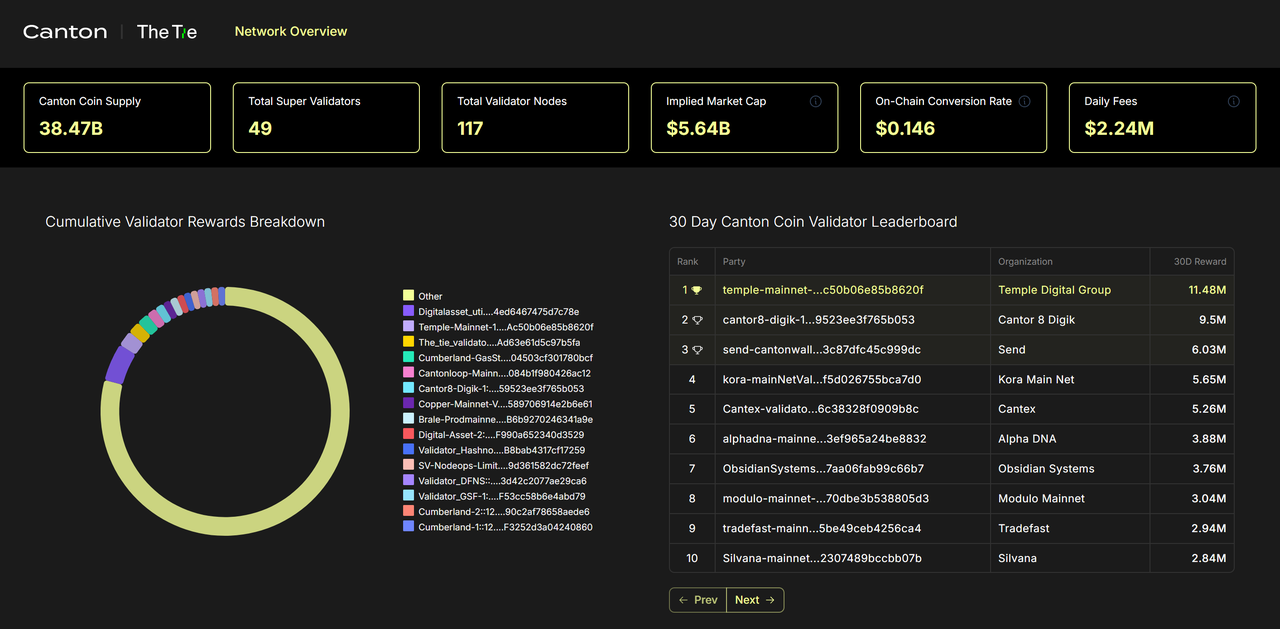
According to data from The Tie, Canton’s daily fee income exceeds 2.24 million USD.
Under the current market environment, this figure has even surpassed that of established mainstream public chains like Ethereum, Solana, and BNB Chain during certain periods.
The high fee income is closely related to trading scale and activity:
According to official data disclosure, currently, Canton's daily transaction count is about 1.1 million, with daily repo trading volume around 384 billion USD, and annual cumulative repo trading volume approaching 9 trillion USD, having processed over 6 trillion USD of real-world assets.
The high per-trade value and strong business stability under high trading frequency are unique trading characteristics of institutions, and also a reflection of increasing numbers of large financial institutions choosing to genuinely move their specific business into Canton.
According to the ecosystem page on the official website, there are currently over 288 partner institutions in Canton, covering multiple key areas such as clearing, asset management, and payments.
Clearing is the earliest large-scale institutional scenario successfully implemented in the Canton ecosystem:
Broadridge, which has moved repo agreement settlement into the Canton Network, is not only a super validator for Canton and a member of the Canton Foundation but also the most mature and largest production-level application in the Canton ecosystem, having processed trillions of dollars in tokenized real-world assets. Beyond Broadridge, clearing institutions like DTCC and Euroclear are continuously exploring the tokenization of government bonds in the United States, the UK, and other countries, further bringing the trillions of dollars in traditional finance, safety, and regulatory certainty into Canton.
Meanwhile, banks aiming to provide liquidity, custody, validator, and tokenization pilot support are also core pillars of the network ecosystem:
Canton's bank partners include BNP Paribas, Bank of America, HSBC, Citibank, and Bank of New York Mellon, whose roles go far beyond mere "endorsement." On one hand, they participate in network governance as validator nodes; on the other hand, they directly contribute real assets and collaborate to promote on-chain applications, integrating their own liquidity and customer networks into the Canton ecosystem.
Additionally, issuing institutions serve as the supply-side driving force of the Canton ecosystem, striving to achieve the tokenization of real-world assets on-chain:
Goldman Sachs has already been operating Canton Daml smart contracts in a production environment through GS DAP and has completed several institutional-level bond and fund issuances; JPMorgan Chase announced the native deployment of its institutional-grade USD deposit token JPM Coin to the Canton Network for institutional-grade stablecoin settlement and funds management; institutional-level tokenization platform T-RIZE Group announced it would build a digital bond program for Horizon Group based on Canton for up to 500 million USD, achieving 24/7 trading, instant/atomic settlement, and multi-party collaboration under privacy protection, significantly enhancing capital efficiency and reducing costs.
Of course, as the pace of traditional financial businesses moving on-chain accelerates, Canton is not satisfied with being a "high-end but closed" island, but continuously connects with a broader on-chain world through collaboration with more on-chain infrastructures.
In March 2026, LayerZero became the first officially launched interoperability protocol on Canton. After integration, institutions on Canton can route tokenized real-world assets to over 165 public chains while preserving privacy protection and compliance standards.
Furthermore, Chainlink also announced that its data standards have been deployed on Canton, and CCIP will soon support Canton, providing real-time pricing, valuation, collateral verification, and secure cross-chain transfer capabilities for tokenized real assets.
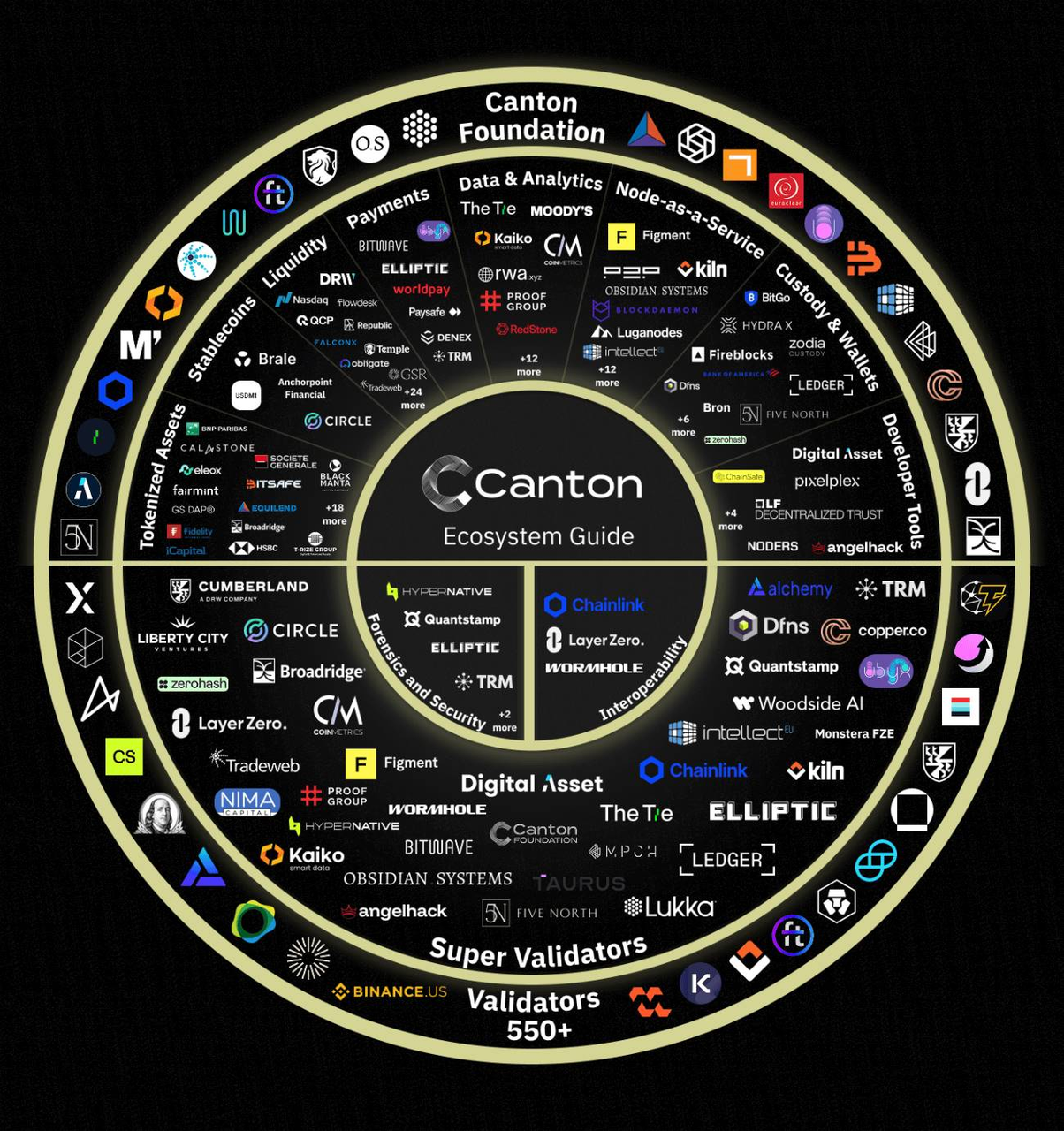
A long list of prominent names represents the entry of institutions into the core segments of global finance:
Canton’s ability to serve institutions moving on-chain is fully showcased;
Meanwhile, as trillions in real-world business is established on-chain, Canton gradually becomes more confident in departing from the narrative of "a single network accommodating RWA," possessing an overall framework of an institutional-grade on-chain financial system.
With the respective entries of Visa and Circle, this on-chain financial ecosystem map is beginning to genuinely grow veins and arteries.
Visa and Circle's entry, bridging "entry" and "medium"
It should be noted that the positions obtained by Visa and Circle are not ordinary validators, but super validator nodes with a weight directly raised to Weight 10.
In the design of Canton, only highly trusted institutions qualify to become super validator nodes: they serve both as "maintainers" of network security and "rule-makers" of the network: on one hand, they are mainly responsible for coordinating cross-domain trading synchronization of the network, ensuring that different participants can achieve atomic settlement without accessing the specific contents of the transactions; on the other hand, super validator nodes also hold substantial governance voting rights and can participate in major decisions, such as network upgrades, parameter adjustments, and economic policies.
Regarding the operational logic of Canton, we previously released an article, which interested readers can review:
From Wall Street to Hong Kong: Top Institutions Turn to On-Chain, Why Choose Canton Network?
In simple terms, the key of this mechanism lies in: handing the core power to the participants most trusted by the institutional world, further enhancing the network's compliance, stability, and trustworthiness.
Therefore, Visa and Circle's entry is not only noteworthy for institutional endorsement but also for what they will bring to the network.
Visa’s strategy aims to explore the integration of mature Web2 payment infrastructure with on-chain scenarios.
On the business level, Visa will engage in attempts to bring payments, settlements, and financial management on-chain, while further expanding its stablecoin business. As of early 2026, Visa's stablecoin settlement annual volume had reached 4.6 billion USD, covering over 130 stablecoin-related card projects across more than 50 countries. Regardless of the extent to which Visa’s exploration proceeds, it will import settlement traffic in real payment scenarios into Canton.
As a core governance role, Visa will also attempt to bring its decades of trusted framework, governance experience, and risk control systems from the payment industry into Canton, infusing a sense of order familiar to traditional finance into the chain, which can attract banks and financial institutions to move stablecoin payment, settlement, and funds management processes on-chain without changing the existing compliance framework.
Circle’s value lies in its complete mature USD liquidity network.
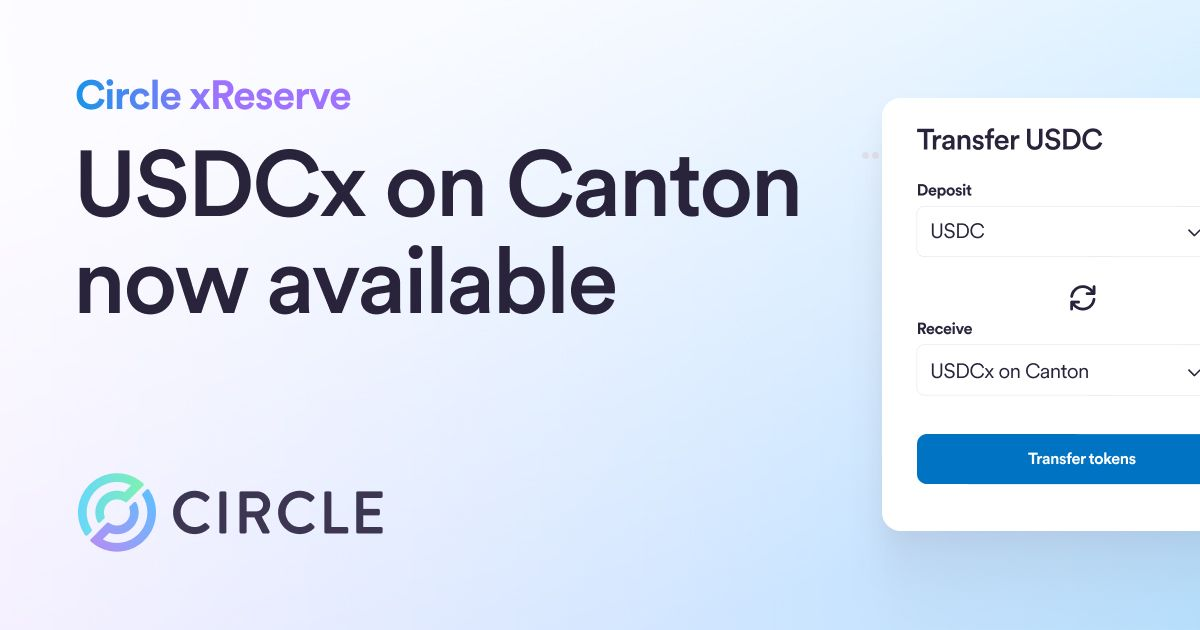
Currently, USDCx has been launched on Canton. As a stablecoin supported by USDC and equipped with complete Canton privacy protection features, USDCx provides a compliant, private, and natively linked settlement tool to the outside USD system for participants in the Canton ecosystem, significantly enhancing Canton’s practicality in payment, lending, collateral management, and RWA scenarios.
According to Circle's financial report, the total number of addresses holding USDC has reached 43.1 million, with active wallets holding at least 10 USD of USDC totaling as high as 6 million. This large user base and liquidity may become potential fuel for the Canton ecosystem through USDCx.
When combined, these two entities create a compliant, private, and atomically secure on-chain closed loop:
The trust entry (Visa) and the settlement medium (USDCx) are both in place, forming a complete institutional-level on-chain payment settlement pathway within Canton’s on-chain financial ecosystem.
And when such a vast network that brings together top clearing institutions, Wall Street investment banks, payment giants, and abundant USD liquidity truly operates, the story does not end here.
Because a chain having real business does not automatically mean that its native token can capture value.
So, where does the enormous value generated daily by this trillion-level financial engine ultimately flow?
Or to put it more directly: Does the Canton Network itself have a mechanism to translate real business usage into value that can be perceived by holders?
$CC is the answer provided by Canton.
$CC: Token value rooted in actual network usage
As the native token, $CC is a utility token strongly tied to the real usage of the network.
The core logic of its value is: The fees of Canton are priced in USD but must be paid in $CC, and the paid $CC will be permanently burned. This means that each real transaction occurring on Canton simultaneously consumes the circulating supply of $CC. As network usage grows, the amount burned increases, offsetting the issuance, stabilizing the total supply.
In other words:
The higher the real usage of the network, the higher the amount of $CC burned, thereby increasing the value of $CC;
Conversely, if the real usage of the network declines, the value of $CC will be affected accordingly.
This "Proof of Utility" model will further propel $CC away from short-term speculation. Meanwhile, Canton is gradually launching a series of measures to enhance real usage and long-term holding:
On January 12, 2026, Canton implemented a dual halving, reducing the annual issuance from 20 billion to 10 billion, while the share of super validator nodes in this issuance will decrease from 48% to 20%, further skewing reward distribution towards applications and asset providers to reinforce use-driven value.
Additionally, Canton has promoted governance proposals like CIP-0105 to incentivize super validator nodes to lock rewards long-term, reducing selling pressure and enhancing price stability.
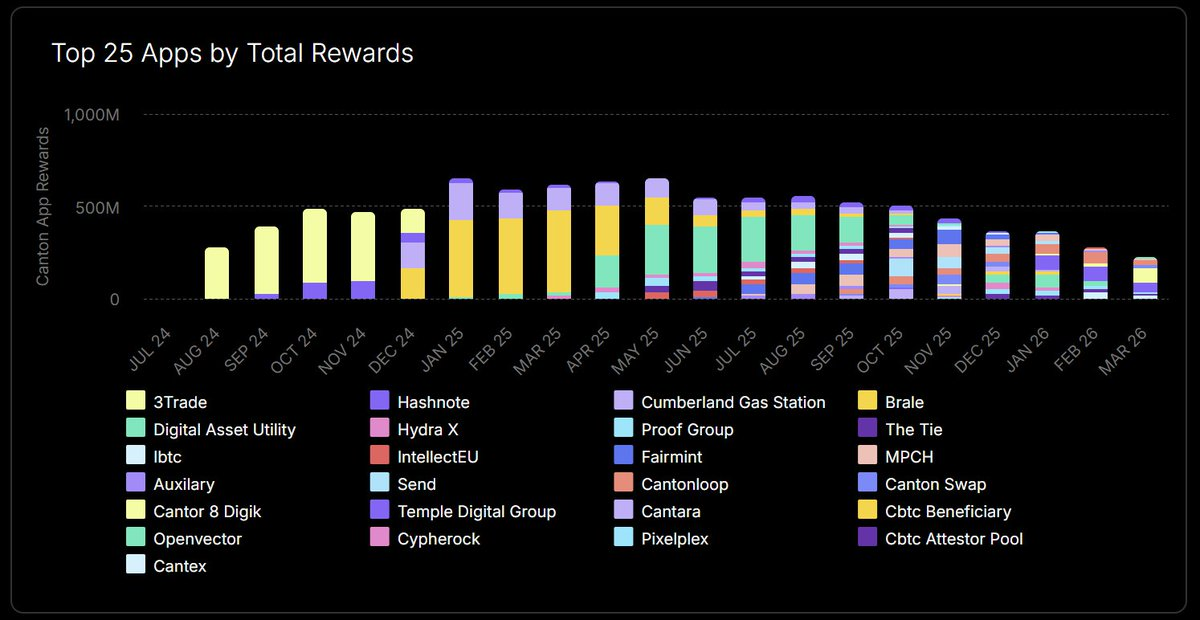
Previously we learned that Canton's daily transaction fees have reached the 1.8 million USD level, meaning that $CC already possesses a powerful destruction engine driven by real financial business. As more rich institutional-level adoptions are landing, increases in $CC fee income and burn amount will further expand the imagination for its token value.
Route dispute undecided,institutions have already signed up
Of course, as Canton rapidly develops, it has also sparked some controversies.
When Visa and Circle announced their entry as super validator nodes, generating extensive market attention and a short-term rise in the price of $CC, the CEO of Helius posted that Canton represents "an interesting variant of a Web2 database with a token."
Additionally, in response to the viewpoint expressed by the Canton founding team that "ZK is not suitable for institutional-level financial systems," the founder of ZKsync pointed out the centralization risks brought on by Canton's heavy reliance on super validator nodes.
However, many community members view this disagreement as "different perspectives on the same issue":
Solana emphasizes high performance, openly composable features, low fees, and developer-friendliness, suitable for the development of DeFi, meme, and consumer-level applications;
ZK represents the extreme of cryptography, pursuing minimal trust and mathematically verifiable security;
While Canton seeks privacy, compliance, and atomic settlement, it accepts certain trust assumptions under the premise of institutional endorsement. This path may not be "crypto fundamentalism," yet it continues to gain recognition in attracting institutions to go on-chain.
Therefore, compared to the path dispute, perhaps the real question worth contemplating is:
When traditional finance of trillion-dollar levels begins to seek on-chain footholds, is it the chain that adapts to capital, or capital that adapts to the chain?
Returning to Grayscale's prediction of 2026 as the "Dawn of the Institutional Era," it is still too early to say whether Canton will be the final winner of this capital migration termed "institutional on-chain."
However, as institutions have become the consensus market-dominant force, the giants have already begun to choose their chains through practical actions.
Standing at the starting point of 1,000 times growth, the real monetary bets made under real business might be more worth contemplating than "what truly is the right chain."
免责声明:本文章仅代表作者个人观点,不代表本平台的立场和观点。本文章仅供信息分享,不构成对任何人的任何投资建议。用户与作者之间的任何争议,与本平台无关。如网页中刊载的文章或图片涉及侵权,请提供相关的权利证明和身份证明发送邮件到support@aicoin.com,本平台相关工作人员将会进行核查。


