Author: Shen Chao TechFlow
Recently, a strange phenomenon has emerged at matchmaking agencies in Seoul.
Some men on blind dates deliberately place their business cards deep inside their suit jacket pockets, only cautiously revealing the card printed with the company name after confirming that the other party's "character is decent," with the card featuring four letters: SK Hynix.

Source: Korean Variety Show
Kang Eun-sun, a senior executive at the South Korean matchmaking company Gayeon, publicly told the media that after the semiconductor super-cycle began, the popularity of employees from Samsung Electronics and SK Hynix has continued to rise. "The market clearly prefers those engineers whose actual income is much higher than some lawyers whose income has diminished." A joke circulating on social media states: "Hynix employees modestly claim they work for Samsung when going on blind dates. Only when they meet someone of good character do they admit they actually work at Hynix."
The numbers that have turned a work uniform into a "blind date battle robe" are ones that make workers worldwide envious.
By 2025, SK Hynix's operating profit is expected to reach 47.2 trillion won. According to a new agreement reached with the union in September last year, 10% of the operating profit will enter the employee bonus pool, averaging approximately 140 million won per employee based on 35,000 employees, which converts to about 650,000 RMB.
In the first quarter of this year, SK Hynix's operating profit increased by over 400% year-over-year to 37.6 trillion won. Different analysts predict that this year's operating profit will fall between 210 trillion and 250 trillion won, estimating that the average bonus per employee will reach between 2.9 million and 3.3 million RMB.
International investment bank Macquarie Securities further predicts that by 2027, operating profit could soar to 447 trillion won, potentially resulting in a per capita bonus as high as 1.29 billion won, about 6.1 million RMB.
However, even more noteworthy than the "6.1 million average bonus" is the story behind it: this company has long been the second in South Korea's semiconductor industry, the little brother standing behind Samsung.
What did it do right that made Samsung, which even has to heed Hynix's opinions on screens and chips, helplessly tumble from its global storage dominance?
2008: Recovering from the Edge of Bankruptcy
Flashback to 2008, and no one would have considered Hynix a "future leader."
The company was previously known as Hyundai Electronics and, during the internet bubble burst in 2001, saw DRAM prices plummet. With $14 billion in massive debt, the company was taken over by creditors, entering a five-year "workout program," a state similar to "reorganization and management" in the Korean dialogue system. For five years, factories, R&D budgets, and personnel allocations were all constricted.
By 2007, Hynix finally crawled out of this "managed" state but was hardly back on its feet, barely surviving.
At this moment, across the Pacific Ocean, a company called AMD came knocking.
AMD was not in a good situation either; it was the second-largest in the GPU market, suffocated by NVIDIA in the gaming card sector. Its researcher Bryan Black was working on something called "High Bandwidth Memory" (HBM), stacking multiple DRAM chips vertically like building blocks and connecting them with a technology called TSV (Through Silicon Via).
Why do this? Because AMD noticed an issue that most people overlooked: the computing speed of CPUs/GPUs was accelerating rapidly, but the memory data transfer speed could not keep up. The calculation units often finished their tasks but then waited for memory to send the next batch of data, a problem dubbed the "memory wall."
To illustrate, imagine a super chef who can cut 10 dishes per second while a waiter can only bring in 2 ingredients per second. Therefore, the chef spends 80% of the time waiting for ingredients. No matter how fast the computing chip is, if the data cannot come in, it is just spinning its wheels.
AMD's idea was straightforward: instead of widening the delivery channels horizontally (the traditional DDR approach), it was better to let the memory "grow taller," stack it vertically on the chip, allowing data to be delivered over a shorter distance and through a wider bus. This vertically stacked "little high-rise" is HBM.
This plan sounded beautiful. The problem was that in 2008, there was no AI demand, no large model training, and no so-called "computing power revolution." The only visible application for HBM at the time was for high-end gaming graphics cards. The market was small, the manufacturing process extremely difficult, and the cost for each chip far exceeded that of ordinary DRAM.
AMD sought out partners, but no one wanted to take it on. Samsung was unwilling because at the time it was fully betting on HMC (Hybrid Memory Cube), an alternate vertical stacking solution developed with Micron. Micron also shied away, following Samsung's lead.
The only one willing to take it on was Hynix, which had just crawled back from the edge of bankruptcy and could not afford to be picky about large orders.
In 2009, Hynix officially launched HBM R&D. It was not until 2013 that the first HBM chip was born in Hynix's factory in Icheon, South Korea.
Who could have imagined that this chip would become something that AI giants lined up to purchase, with production capacity "sold out until 2030" fifteen years later?
No one expected it, not even Hynix itself.
2012: A Chairman's Gamble
In 2012, another key figure in the story emerged.
Chey Tae-won, the chairman of SK Group, led a consortium initiated by SK Telecom, acquiring 21.05% of Hynix from creditors for about 3.4 trillion won (approximately $3 billion). From then on, this semiconductor company was called SK Hynix.
What kind of person is Chey Tae-won? There is a description in the Korean book "Super Momentum": After the acquisition, he met with 100 of Hynix's executives individually in a short period. His first move was not to cut jobs or reduce costs but to merge SK Group's management system with Hynix's technological capabilities, then reopen the halted FAB (wafer fab) investments and process improvement funds.
The timing of this was crucial.
From 2012 to 2014, the entire DRAM industry was still overshadowed by the downturn cycle of 2011-2012. All rational financial models instructed the management, "This is the industry low point; be conservative," but Chey Tae-won made a counterintuitive decision: expand investment.
Even more importantly, HBM.
Between 2011 and 2022, SK Hynix invested a total of about 860 billion won in HBM-related research and about 1.5 trillion won in facilities and equipment. A significant part of these investments took place during years when the market was sluggish, and HBM had no visible commercial prospects.
What happened during this time?
HBM2 did not meet performance expectations, leading to revisions that resulted in a modified version called "HBM2 Gen2." The HBM team at the company temporarily became a "department no one wanted to join," with core members reassigned, causing morale to plummet. AMD's flagship graphics card R9 Fury X used the first generation of HBM in 2015, but received a lukewarm market response because it was too expensive, with few purchases.
More alarming for Hynix was that during 2016-2017, Broadcom approached Samsung, hoping it could supply HBM2 for Google's second-generation TPU. If Samsung could meet 100% of the demand, Broadcom promised exclusive supply rights, which should have marked HBM's first entry into data centers.
Unexpectedly, Samsung dropped the ball.
A report from the Korean newspaper "Chosun Ilbo" details the chaos at the time: The Google TPU project involved Broadcom (design), Samsung (memory), and TSMC (foundry). Samsung's HBM encountered memory issues, and engineers reported upward that TSMC refused to let them enter the factory for checks. The three companies passed the buck to one another, leaving the problem unresolved, leading to delays of up to six months. "Such stalemates were very common between 2016 and 2017," recalled an executive involved.
Eventually, Google leaned toward collaborating with SK Hynix. The first real deployment of HBM in data centers benefited SK Hynix, not Samsung.
But when these events transpired, the world was unaware that HBM would become a critical bottleneck in the AI era.
Chey Tae-won later stated in an interview in "Super Momentum," "We are at a crossroads."
He did not elaborate on why he insisted. But in hindsight, the logic seems to be: Hynix’s fate had already been navigated once at the brink of bankruptcy in 2001. It did not have a diversified business like Samsung to spread the risk—it only had memory as its focus. It had to either become the global leader in memory or forever remain in Samsung's shadow.
Thus, "betting on HBM" was not a choice for Hynix; it had no choice.
2022: Jensen Huang Hands Over a Match
In June 2022, SK Hynix began mass production of HBM3. That year, the first batch of HBM3 chips was installed in a GPU called H100, coming from a company that at the time was valued at around $300 billion and considered "important but not world-changing" in the gaming graphics and data center markets, NVIDIA.
In November, OpenAI released ChatGPT.
The subsequent events are well-known. The demand curve for AI computing power shifted from a gentle incline to a nearly vertical rocket trajectory. Every chip used to train large models required HBM as its closest "data mover."
At that moment, Hynix's 14-year gamble was suddenly revealed.
By the second quarter of 2025, Hynix captured 62% of the global HBM market share. Samsung dropped to 17%, even falling behind the newcomer Micron (21%).
By the end of 2025, Hynix recorded an annual operating profit of 47.2 trillion won, while Samsung Electronics posted an annual operating profit of 43.6 trillion won. This was the first time in Hynix's history that it surpassed Samsung in annual profit.
NVIDIA CEO Jensen Huang visited SK Hynix's booth at Computex in Taipei in August 2025, leaving a handwritten note on the display: "JHH LOVES SK HYNIX!" This photo was subsequently circulated repeatedly by Korean media. In the engineer culture, there could be no more direct official endorsement than this.
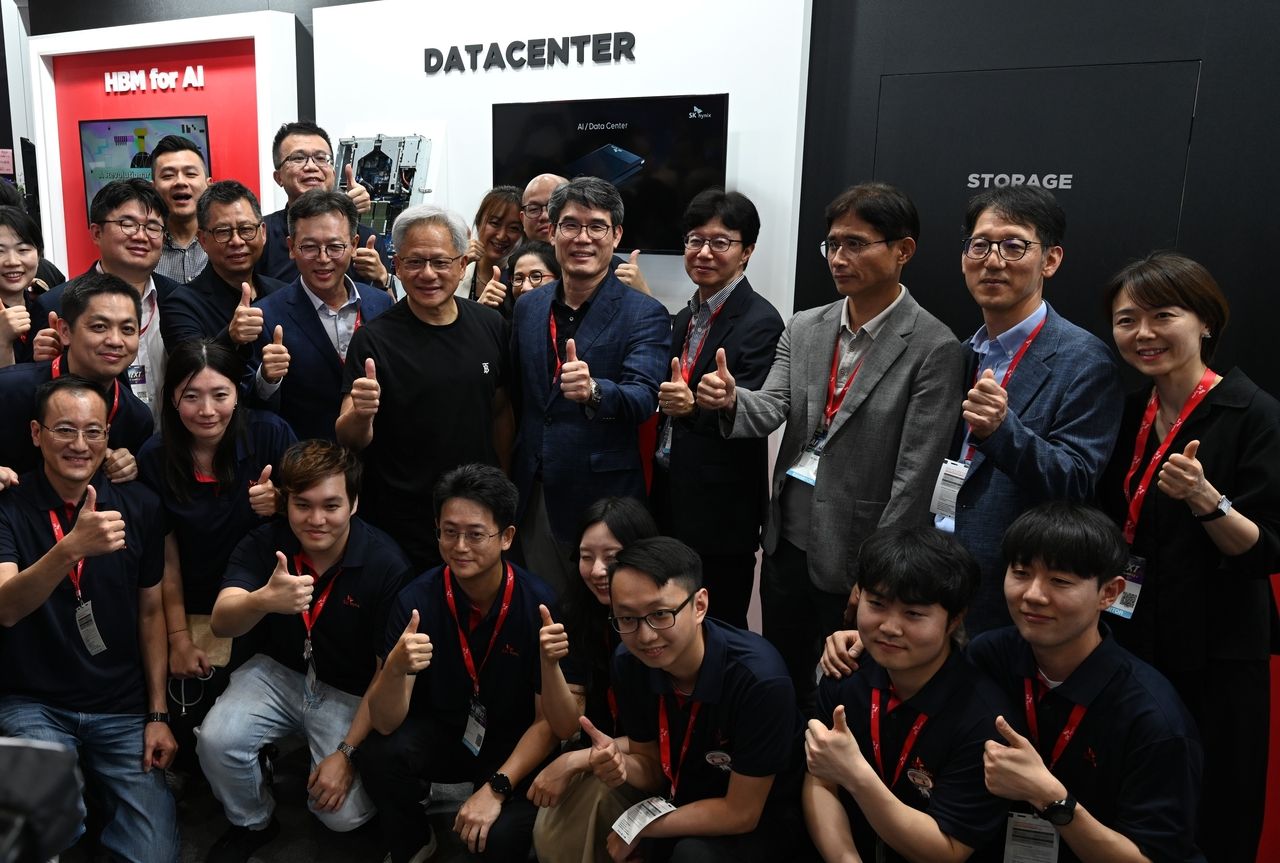
Meanwhile, SK Hynix's engineers privately came up with a new full name for HBM, saying it actually stands for "Hynix Best Memory."
Where Did Samsung Go Wrong?
So the question arises: Where did Samsung, which once ground down all Japanese DRAM factories and cornered Micron, go wrong?
Samsung missed the early positioning of HBM, made incorrect technology route choices (NCF packaging vs. Hynix's MR-MUF packaging), and HBM3E has not passed NVIDIA's certification tests…
These are all facts, but not the fundamental issues. The root cause is something more awkward and ironic: Samsung was too successful, so it could neither afford to lose nor gamble.
Consider the two companies at the point in 2008. Hynix had just climbed out of bankruptcy management, with only memory as its business line and no diversified cash cows to rely on.
It had to gamble on HBM not because of keen insight but because of a lack of options; it had to seize any chance to shake off the label of "that little brother behind Samsung."
And Samsung?
In 2008, Samsung was on the eve of its peak. Its mobile business was about to soar with the Galaxy series, and its semiconductor business was number one in both DRAM and NAND, while its display sector was set to win large orders for OLEDs from Apple for the iPhone. It had extremely rich cash flow, a massive business landscape, and complex stakeholders to balance.
For such a company, what was HBM in 2008? It was a high-risk gamble in a very small market, with a very long return cycle, that would conflict with another technology route it was promoting (HMC). Any rational finance committee would not approve a full bet on this endeavor.
This exemplifies the classic "innovator's dilemma": successful large companies are always constrained by their own success. The markets they have already won are too large, too important, and too in need of protection to allow them to bet everything on a seemingly unreliable new direction like a "challenger cornered."
The deeper irony is that Samsung was not blind to HBM. It started investing in HBM-related research in 2011 and was the first to mass-produce HBM2 in 2016. However, each time, Samsung did not go all in. Its attention was divided among HMC, GDDR, LPDDR, enterprise SSDs, and a dozen other areas. While Hynix's HBM team was "marginalized but still fighting," Samsung’s HBM team also became "marginalized," only they had no one to fight for them.
By 2024-2025, Samsung finally recognized the need to go all in on HBM, but it was too late. The technology gap had already formed, and the moat of customer relationships had been jointly built by NVIDIA and Hynix.
Jun Young-hyun, Vice Chairman of Samsung Electronics Semiconductor Division, stated in a New Year message in 2026: "Customers told us that Samsung is back."
The phrase "is back" is itself a form of self-acknowledgment.
Two Questions
What does the story of SK Hynix signify? At least two questions deserve attention.
First, why do similar stories happen more easily in South Korea than elsewhere?
The success of SK Hynix did not come from thin air. It had a special industrial soil behind it; although the chaebol system in South Korea has been criticized for decades, it objectively allows a company to bet on a 20-year return cycle based on the will of a single decision-maker, continuously infusing capital for ten years without any commercial prospects in between.
When Chey Tae-won acquired Hynix in 2012, no Wall Street analysts were whispering "quarterly earnings, quarterly earnings" in his ear. He did not have to demonstrate HBM's ROI to the board every quarter.
This long decision-making cycle is becoming increasingly rare in today's tech companies driven by U.S. stock markets. It is also a key variable that determines whether Chinese hard-tech companies like Yangtze Memory Technologies and Changxin Storage can break through; technology is not the biggest obstacle—it's whether capital and decision-makers are willing to accompany you for ten years while you sit on the cold bench.
Second, has Hynix's "second-place fate" truly ended?
Not necessarily.
By the fourth quarter of 2025, Samsung had regained the top position in memory revenues worldwide. It is rapidly catching up with the new generation of HBM4, with key certifications for HBM4 nearing completion. Counterpoint's research director MS Hwang believes that Samsung may overcome last year's quality issues in the HBM4 generation and achieve significant turnaround.
Looking longer term, Hynix's current moat also has vulnerable spots. Its customer base is highly concentrated (with NVIDIA orders accounting for a large portion), its MR-MUF packaging route faces warping issues when stacking over 16 layers, and its expansion costs will drag down free cash flow in 2026-2027. Chinese manufacturers are also catching up, with Changxin Storage expected to mass-produce HBM by 2027. Once that line breaks through, the global oligopoly in HBM may change again.
But none of this diminishes one truth: SK Hynix has proved a possibility that a company long considered to be perpetually in the shadow of giants can redefine itself as a leader in the new era over the course of 20 years of ridicule.
A market rule has once again been validated: when everyone is chasing certainty, betting on an uncertain long-term direction is often where the greatest alpha lies.
In 2008, it was HBM; in 2018, it was the new energy vehicle supply chain; and perhaps in 2026, it will be something else that no one is looking at yet.
Don't ask "Who is today's SK Hynix?" Ask instead: Today, who is doing what SK Hynix was doing in 2008, but is considered a joke by everyone?
免责声明:本文章仅代表作者个人观点,不代表本平台的立场和观点。本文章仅供信息分享,不构成对任何人的任何投资建议。用户与作者之间的任何争议,与本平台无关。如网页中刊载的文章或图片涉及侵权,请提供相关的权利证明和身份证明发送邮件到support@aicoin.com,本平台相关工作人员将会进行核查。


