The speed of updates in the prediction market sector is 5-10 times faster than in traditional industries.
Written by: runes_leo
Here are a few status changes from this week: On May 1st, Nasdaq received SEC approval to launch prediction market operations; on May 2-3, Hyperliquid HIP-4 went live on the mainnet, and traders began migrating; on May 5th, Elastics announced it had completed a $2M pre-seed round, with investors including a16z and ElevenLabs; on the same day, functionSPACE launched a two-week vibecoding competition, with a prize of one year of Claude Code Max subscription.
The attention of the Chinese community to this sector is increasing, but it is highly fragmented—people are trading on Polymarket, trying HIP-4 on Hyperliquid, observing attempts on the BNB chain on predict.fun, and subscribing to one or two TG signal bots—very few have a complete overview.
In this article, I want to lay everything out at once. Four Tiers, categorized by "where to bet / what equipment to use / what regulations to watch / what sources to read." Tier 1 is where Chinese traders can currently open positions, Tier 2 is the builder equipment layer, Tier 3 is the U.S. compliant sector as a regulatory reference, and Tier 4 is the academic and historical sources of the sector.
By reading this, you will gain three things: a list of current usable platforms, an understanding of what the equipment layer looks like, and where the thesis of this sector originates from.
Two disclaimers regarding the "overview" and "4 Tiers": ① The 4 Tiers are my perspective, not an industry consensus. Dividing the sector into "practical pools / equipment layer / regulatory sector / academic roots" is a slice I made for convenience while writing—it could be sliced differently by others based on "chains / compliance levels / asset types / regions." This is a subjective view, not an objective classification. ② Each layer lists only representative players, far from exhaustive. The prediction market sector has at least 50+ platforms and tools I can count, and I’ve selected a few that I have used / discussed frequently / represent key turning points; there are many more excluded—including local niche platforms, specific event vertical bots, various segmented SDKs, and research bots with unique styles. So this is a "best-effort slice as a user + builder," not an "exhaustive objective overview." If you find something important missing, feel free to add it in the comments or group, and I will update it in the next version.
Tier 1 · Practical Pool for Chinese Community
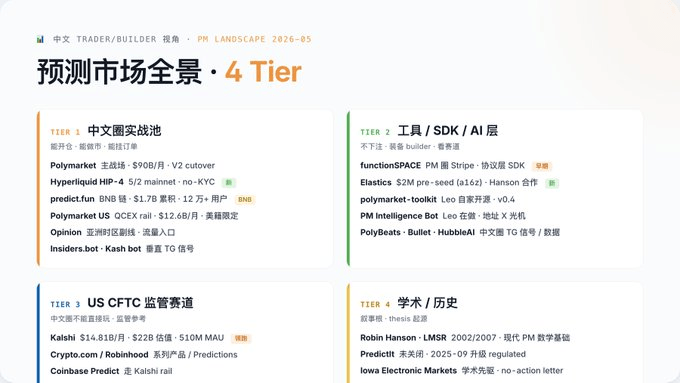
This layer is where Chinese traders can currently open positions, provide market-making, and place orders.
Polymarket remains the main battleground.
In April 2026, the notional volume was around $9B (Data: Dune Analytics). It should be noted that Kalshi’s $14.81B that month has overtaken Polymarket’s main platform—this will be further explored in Tier 3, but there is a common perception in the Chinese community that "Polymarket = the dominant player," which has diverged from the actual trading volume. On April 28, the V2 cutover was completed, and on May 4, deposit wallet phase 1 (direct USDC.e deposits) was launched. The matching engine, order flow, and API are all continuously evolving. Most of the main positions from the Chinese community’s market makers, snipers, reverse copy traders, and those watching Opinion interactions are mostly on Polymarket.
Its advantage is not "doing it best," but "Chinese traders have developed muscle memory for it"—address structure, Gamma API, Chainlink price settlements, order book depth, liquidation rules; everyone has become familiar with this system, and the cost of migration is high.
If you are just starting to explore prediction markets, Polymarket is the lowest threshold entry.
Hyperliquid HIP-4 is the biggest variable this month.
On May 2-3, HIP-4 went live on the mainnet. In the trader community, at least three groups in the runesgang group are discussing: BTC price leading Polymarket, a no-KYC advantage, and order flow depth still increasing.
It is not a replacement for Polymarket—the market breadth of Polymarket (sports, politics, culture, various AI) cannot be matched by HIP-4 in the short term. However, if betting on a single asset in directional betting (especially related to BTC/ETH prices), HIP-4 is now usable and deserves attention as a second option.
predict.fun is a decentralized PM on the BNB chain, gaining significant attention within the Chinese community.
predict.fun has integrated with BN Wallet and is gas sponsored (users do not need to pay BNB transaction fees). The accumulated trading volume has exceeded $1.7B, with over 120,000 users. The early FDV is estimated at $50M+.
This platform is particularly worth noting in the Chinese community for three reasons: ① The BNB chain is the most familiar to Chinese users, with a better wallet experience than Ethereum mainnet; ② Direct integration with BN Wallet lowers the entry barrier for new users; ③ Chinese media, such as BN CN / PANews, have reported multiple times, and community interest remains high. If you prefer to play PM with BNB ecosystem assets instead of USD USDC, predict.fun is the first choice.
Polymarket US (QCEX rail) is territory for users with U.S. identity.
It received its DCM license on July 9, 2025. In April 2026, the notional volume was about $1.26B (vs $256M in March, showing strong growth, but the absolute volume is still far lower than Kalshi and Polymarket’s main platforms). The Chinese community can basically only access it through Robinhood Predictions or VPN, but this route itself is gray.
If you are a compliant U.S. user, this is your main option; if not, treat it merely as a regulatory reference.
Opinion is the "Asian version" of the PM sector.
Opinion operates more flexibly in the Asian time zone compared to Polymarket, with tighter coverage on TG groups, affiliates, and operations. In terms of scale and market coverage, it is not as large as Polymarket.
Its position is better suited for being a "traffic entry point" and "arbitrage counterpart"—when two markets give different probabilities for the same event, there will be an arbitrage window. When observing a target or side position for suitability, whether to place a main position depends on your own preference.
Limitless is a prediction market on the Base chain, running very actively.
Limitless, which was pre-sold through Kaito launchpad in September 2025, completed its LMTS token TGE on October 22. It is currently the largest PM on the Base chain: with a lifetime cumulative trading volume exceeding $4B, the single month notional volume in April 2026 is $1.66B, and the single day ATH is $163M (on May 6-7). It covers markets in sports (UCL, EPL), crypto, esports, politics, and macro.
Who is it suitable for: ① Wallets that are already active on the Base chain, no need to create new wallets / cross-chain; ② Those looking to arbitrage between different platforms; Limitless and Polymarket often have discrepancies in odds for the same event; ③ Those who want to earn follow-up rewards from LMTS, as the platform continues to run point activities.
Insiders.bot / Kash bot / KREO Bot are vertical signals / tool entries.
Insiders.bot: Focuses on TG signals for vertical sports markets like EPL, with subscribers mainly being true sports traders.
Kash bot: The soft testnet (testnet.kash.bot) was launched in May, with Prediction Arc announcing on May 5.
KREO Bot (@KreoPolyBot): TG bot, providing comprehensive data from Polymarket + Kalshi + trading rebates (minimum 5%, divided by trading volume into copper, bronze, silver, gold) + 15% rewards for copy traders + multi-level referral commissions (L1 30% / L2 3% / L3 2%). If you are already trading on Polymarket, connecting this bot can earn you rebates without affecting your order process.
This type of tool is not PM platforms themselves, but surrounding signals/data/rebate layers; it's useful to understand and subscribe as needed.
Tier 2 · Tools / SDK / AI agent Layer
This layer is not for traders to bet, but for builders’ equipment. Traders can find it useful to glance, as they will see what the tool stack looks like.
functionSPACE is like the Stripe of the PM sector.
@functionspaceHQ launched a two-week vibecoding competition on May 4, with a prize of one year of Claude Code Max subscription. The theme of the competition is "belief interoperability across formats"—turning belief expression into a composable protocol layer across platforms.
It is not a market for retail trading but an SDK + ecosystem layer for builders. The fs_trading_sdk provides primitives like belief math, market discovery, and consensus chart, allowing you to create products based on "probability distribution" without building a market from scratch.
It is still in early stages (around 800 followers), but if the "infrastructure layer" of this sector emerges successfully, its significance to PM will be similar to that of Stripe to payments. Builders should pay attention.
Elastics is a sign of AI entry.
@ElasticsAI announced on May 5 that it had completed a $2M pre-seed round, with investors including frst_vc, a16z, ElevenLabs, xbtogroup, redstone_defi. Currently in private beta, it collaborates with Robin Hanson (the inventor of LMSR). The team comprises ex-Kalshi employees.
It represents an attempt for "AI agents to directly participate in prediction markets," with product forms yet to be fully disclosed. Robin Hanson's endorsement is strong, and the VC list is also solid. Keep an eye on this, and we'll see specific forms when the beta is publicly launched.
polymarket-toolkit is a set of PM development scripts I have publicly shared on GitHub.
runesleo/polymarket-toolkit, v0.4 (May 2), currently a collection of a few public scripts—fetch/summarize/label helpers, etc., for easier address analysis and market data grabbing. It's not yet at the level of an SDK toolset, more like "I found these useful and decided to open-source." If you're writing PM scripts/bots/dashboards and can save some boilerplate, feel free to make a PR.
PM Intelligence Bot is another project I'm working on (in development).
It's a TG bot that turns the Polymarket wallet "X-ray" style—input an address and it returns metrics: winning probability, theme tags, hits on watchlist, reversible strategy forms. Currently in internal alpha testing, not publicly accessible yet, and the quality gate and PnL verification system are still being finalized. If a sanitized public version comes out within the functionSPACE vibecoding competition framework, it will be open-sourced to an independent repository.
Signal/data/news layer (commonly used in the Chinese community):
- PolyBeats: TG signal bot, used in Chinese trader groups.
- Bullet TG: fast data bot similar to crex.
- HubbleAI: TG channel signal source, well-known in the tg-digest circle.
- Odaily Star Daily: A TG channel for Chinese crypto media, PM/HL/Kalshi news arrives on the same day (e.g., on May 5, quick news about Hyperliquid testing 15-minute event contracts). Not considered a "signal," but is the news entry for the Chinese community.
The commonality of this layer: fragmented, vertical, non-platform. Each addresses a specific pain point (signals/data/news/reverse engineering/probability modeling), but none "covers the full stack." Builders choose equipment, and traders subscribing to 1-2 signal sources plus 1 news source is sufficient.
Tier 3 · U.S. CFTC Regulatory Sector
The U.S. compliant sector is the clearest version of the regulatory path for prediction markets. The Chinese community cannot directly participate (unless they have U.S. identity), but its scale and compliance progress are important references for judging the entire sector. On May 5, Mick Bransfield organized a panoramic table that compiled 43 U.S. players into one chart, which was a significant amount of work. The player list in this section is based on his compilation, with some updates on status changes after he shared the chart.
Kalshi is the strongest player in this sector.
In April 2026, the nominal monthly trading volume reached $14.81B, a historical high (month-on-month +13.3%).
In March 2026, it completed a funding round, being valued at about $22B (compared to $11B in December 2025, doubling in half a year). The main investor is Coatue Management, with an investment of about $1 billion.
5.1 million MAU (a sharp increase from 600,000 at the beginning of 2025).
The Chinese community's understanding of Kalshi is generally low. Its depth in political markets, sports markets, and macroeconomic markets has already surpassed Polymarket in certain categories. The dominant player may not be who the Chinese community assumes. If you are doing "U.S.-China prediction market arbitrage" or "market depth comparison," Kalshi's data is worth pulling.
Six active operators (according to Mick's table):
- Kalshi (data as mentioned above)
- Polymarket US (QCEX)
- Crypto.com (various products)
- Robinhood Predictions
- Coinbase Predict (operating on Kalshi rail)
- DraftKings Predict (operating on CME rail)
Status updates in Mick's table under the "Coming Soon" section (5/7 verify):
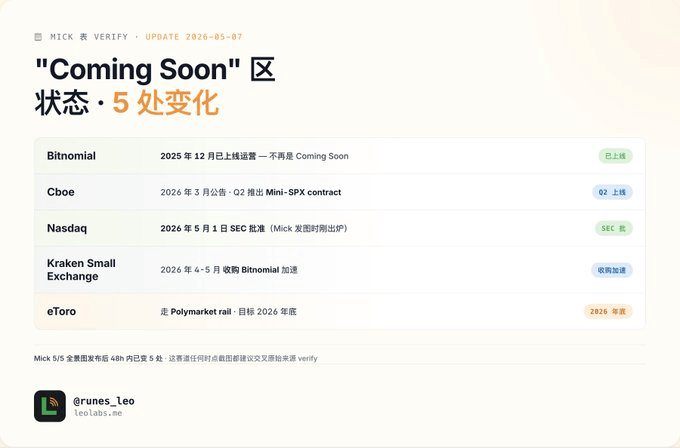
- Bitnomial: Launched and operated since December 2025, no longer "Coming Soon."
- Cboe: Announced in March 2026, launching Mini-SPX contract in Q2.
- Nasdaq: Approved by the SEC on May 1, 2026 (just announced when Mick sent out the chart).
- Kraken Small Exchange: Acquired Bitnomial in April-May 2026 to accelerate.
- eToro (Polymarket rail): Targeting by the end of 2026.
This sector has had several changes within 48 hours. Whenever you read this article, it’s recommended to cross-check the original sources.
Implications for the Chinese audience:
If you do not have U.S. identity, this layer cannot be directly utilized. However, it tells you two things:
The regulatory path is being implemented, and traditional finance is entering quickly (Cboe, Nasdaq). This means that "prediction markets are being accepted by the mainstream" is accelerating, which is a two-way variable for offshore players like Polymarket/Hyperliquid—potentially beneficial (narratives being validated) but also potentially detrimental (compliance versions diverting depth). Kalshi's $22B valuation + 5.1 million MAU has reached a scale surpassing Polymarket. There is a significant gap between the perception and understanding of the Chinese community and the actual trading volume in the U.S.
Tier 4 · Academic / Historical
This layer is the source of "why prediction markets exist." Reading through the sector will give depth, so when placing bets, you won’t be swayed by short-term fluctuations.
Robin Hanson and LMSR (Logarithmic Market Scoring Rule).
In 2002, Hanson wrote a working paper, which was published in 2007 in the Journal of Prediction Markets vol.1 issue 1. This pricing mechanism is the mathematical basis for almost all modern prediction markets (Polymarket, early Kalshi, Augur). It addresses a core problem: how market makers can price in markets without sufficient liquidity to avoid bankruptcy while providing signals.
If you're doing quantitative analysis or market making, this paper is worth reading. It's a concise working paper that can help you understand why most PM platforms use this pricing model.
PredictIt has not shut down.
The Chinese community generally believes PredictIt closed several years ago. In fact, it received an updated no-action letter from the CFTC in July 2025 and upgraded to a regulated derivatives exchange in September 2025. It has been operating all along.
Why is this worth mentioning: because the "regulatory path" of prediction markets is not limited to "DCM license + Kalshi model." PredictIt has taken the no-action letter + academic exemption path, with a single position limit of $850. It has survived for 10 years.
Iowa Electronic Markets is an older academic pioneer.
Operated by the University of Iowa, it has been continuously operating under a no-action letter. Essentially an academic research project, rather than a commercial platform, but it is one of the earliest precedents in the legality of prediction markets in the U.S.
Augur is a legacy from the Layer 1 era.
A decentralized prediction market on Ethereum that launched in 2018. Its significance lies in proving one thing: prediction markets can operate completely on-chain—this thesis was later revalidated by Polymarket using a modified version of Polygon + UMA Optimistic Oracle. The current attempts by predict.fun using the BNB chain and Limitless on the Base chain are essentially continuations of this thesis across different chains.
Conclusion · Next Update
Which Tier you are active in determines what you can gain from this graph:
- Bettors: Focus on Tier 1. Polymarket remains the main battleground, Hyperliquid HIP-4 is a new variable, predict.fun offers a new entry for BNB chain players.
- Tool builders: Focus on Tier 2. functionSPACE is where the infrastructure layer is growing, Elastics signals AI entry.
- Observers of the sector: Focus on Tier 3. Kalshi's $22B valuation + 5.1 million MAU have already brought "the U.S. compliant version of prediction markets" into mainstream scale.
- Those wanting to understand the thesis: Focus on Tier 4. The LMSR paper + PredictIt is still operational, can give you insights to look beyond short-term fluctuations in the sector.
This panoramic view may have 1-2 outdated points tomorrow—HIP-4 order flow may increase again, a dark horse may emerge from the functionSPACE competition, Kalshi's valuation may rise again, and Mick's chart will also see a V2. However, the layered framework will not become outdated. Tier 1 is for betting, Tier 2 is for equipment, Tier 3 is for regulatory references, and Tier 4 is for narrative roots.
免责声明:本文章仅代表作者个人观点,不代表本平台的立场和观点。本文章仅供信息分享,不构成对任何人的任何投资建议。用户与作者之间的任何争议,与本平台无关。如网页中刊载的文章或图片涉及侵权,请提供相关的权利证明和身份证明发送邮件到support@aicoin.com,本平台相关工作人员将会进行核查。


